

The proposal is sitting in your budget deck: test ChatGPT ads this quarter. Your CMO wants an answer by Friday. The pitch sounds compelling, a brand-new ad surface with billions of daily prompts and no minimum spend since May. But you’ve also seen the numbers floating around: click-through rates under 1%, CPMs that started at $60, and a platform that rewrites its own rules every few weeks. Say yes too early and you’re funding OpenAI’s learning curve. Say no and a competitor might lock in cheap early inventory while you wait for case studies.
The answer isn’t yes or no. It’s a framework, and it starts with data you probably haven’t looked at yet.
ChatGPT Ads Are Real Now. The Playbook Isn’t.
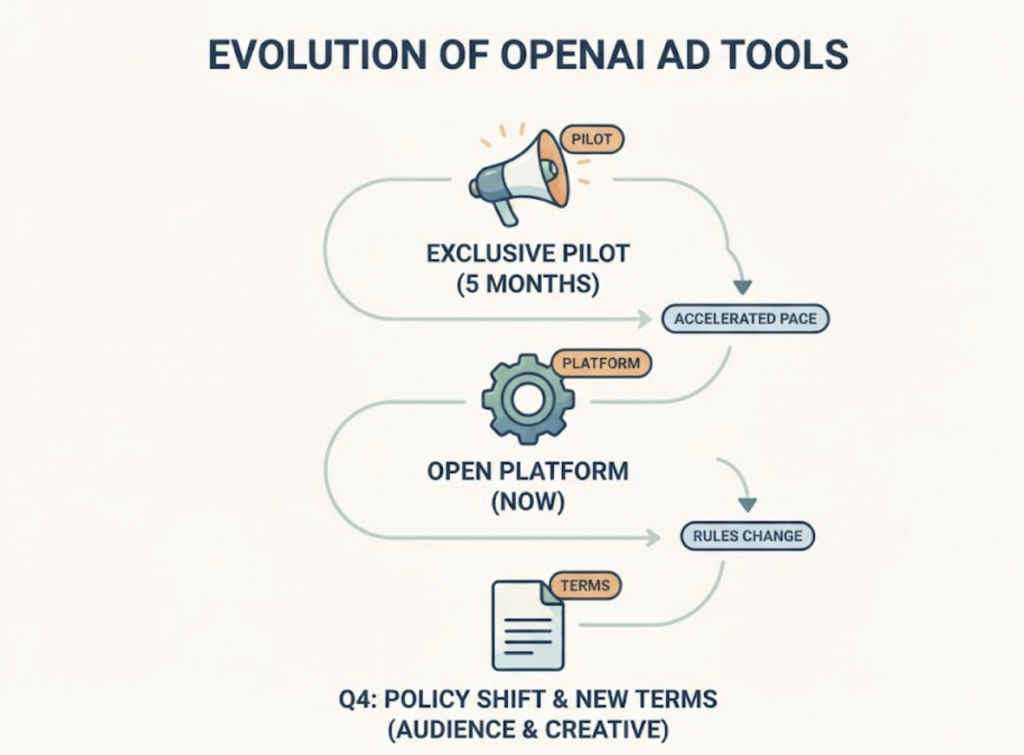
OpenAI moved fast. Ads launched in the US on February 9, 2026, limited to logged-in users on the Free tier and the $8-per-month Go tier. The initial pilot was managed-service only, with a $200,000 minimum commitment at a fixed $60 CPM. That gate kept everyone but enterprise brands out.
Then the gate came down. April brought CPC bidding and a reduced $50,000 minimum. On May 5, 2026, OpenAI opened a beta self-serve Ads Manager, eliminated minimum spend entirely, and shipped conversion tracking through a pixel and Conversions API. By June, auto-generated product feed ads lowered the barrier further, and the pilot had expanded to Canada, Australia, and New Zealand, with the UK, Mexico, Brazil, Japan, and South Korea announced next.
Five months from exclusive pilot to open platform. That pace tells you two things. OpenAI is confident in advertiser demand, and the rules you plan around today will probably change by Q4. In mid-June, OpenAI published new Ad Tools Terms covering first-party audience uploads and AI-generated creative, features announced in policy before they’re live in the product.
One structural fact hasn’t changed, and it matters more than any pricing update: subscribers on Plus, Pro, Business, and Enterprise tiers never see ads. Whoever you reach through ChatGPT ads, it won’t be them.
What ChatGPT Ads Actually Cost in 2026
The pricing has settled into a relevance-weighted second-price auction, and the benchmarks look like this:
| Metric | Mid-2026 Benchmark |
|---|---|
| CPM | $25 to $60 |
| CPC | $3 to $5 typical, $8 to $18 in SaaS and financial services |
| CTR | Roughly 0.91% to 1.5% |
| Minimum spend | None since May 5 |
The gap between the $60 listed CPM and the roughly $25 observed CPM reflects how quickly the auction matured once self-serve buying opened. Vertical density drives the spread on CPC. E-commerce brands often clear near the $3 floor, while SaaS and fintech advertisers compete on higher conversion values and pay accordingly.
The CTR deserves a closer look, because it’s structural rather than fixable. Ads appear in a clearly labeled chat_card below the AI’s response, never inside it. Users get their complete answer first, then see the sponsored placement. A 0.91% click-through rate isn’t a creative problem you can optimize away. It’s the design.
Targeting works differently too. There’s no demographic audience sculpting the way Meta offers. Delivery is intent-first, shaped by the current conversation thread, opted-in personalization history, and prior ad interactions. Advertisers write “context hints” describing the questions and situations users bring to ChatGPT, not exact-match keywords. Chats, names, emails, and precise locations stay inside OpenAI. You never see them.
The Decision Framework: Four Questions Before You Buy ChatGPT Ads
The brands getting this decision wrong tend to skip straight to creative and budget. The brands getting it right answer four questions first.
1. Does Your Audience Actually Live on Free and Go Tiers?
Ads reach Free and Go users only. That skews the reachable audience toward consumers, students, and casual users, not the professionals paying $20 or more per month for Plus and above.
If you sell consumer products, meal kits, travel, or entry-level software, your buyers are probably in the ad-eligible pool. If you sell to CTOs, procurement leads, or enterprise buyers, they’re likely on paid tiers where your ads simply don’t exist. For those brands, paid placement isn’t a weaker option. It’s a nonexistent one, and organic AI visibility becomes the only discovery channel inside ChatGPT.
2. What’s Your Organic Baseline in ChatGPT’s Answers?
This is the question most teams never ask, and it’s the one that should drive the budget decision.
OpenAI mandates that ads don’t influence organic answers. The AI decides which brands to cite independently of ad spend. So before you pay for the box below the answer, you should know whether you already appear inside the answer itself, where every user on every tier can see you.
Measuring that used to mean manually prompting ChatGPT and screenshotting results. Platforms like Topify now do it systematically. Its Visibility Tracking runs your target prompts across ChatGPT, Gemini, Perplexity, and other engines on a schedule, showing how often your brand appears in organic answers, in what position, and with what sentiment. Source Analysis goes a layer deeper, revealing which domains the AI cites when it recommends brands in your category, which tells you exactly where to earn coverage.
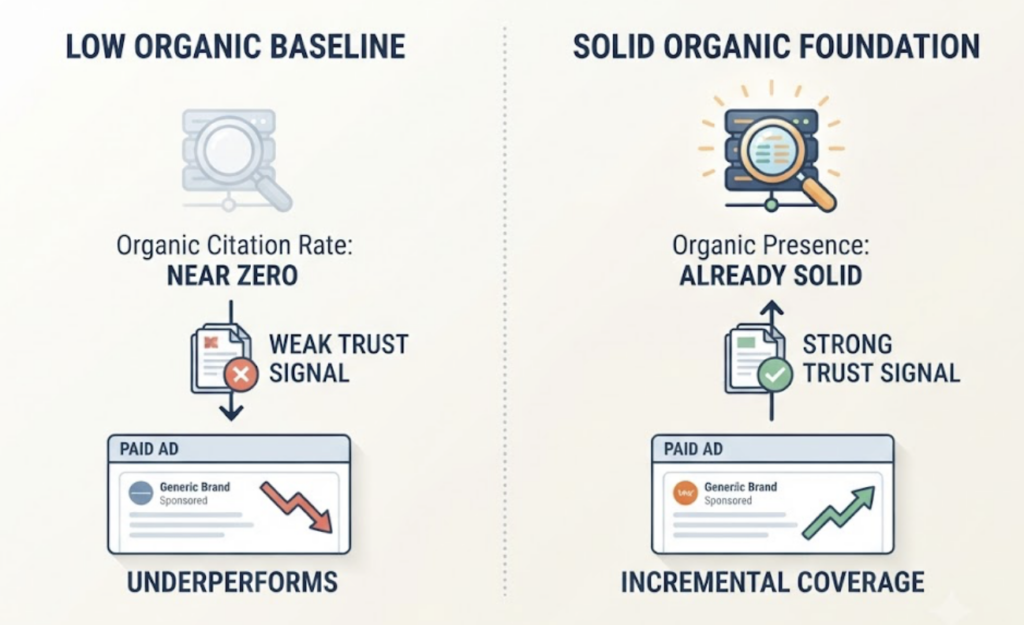
The baseline changes the math. If your organic citation rate is near zero, paid ads tend to underperform, because a sponsored card for a brand the AI never mentions carries a weak trust signal. If your organic presence is already solid, ads become incremental coverage for the Free-tier audience rather than a lifeline.
You can run a first visibility check before your Friday deadline. There are also free GEO tools for a quick initial read before committing to full tracking.
3. Are Competitors Buying Ads, or Winning Organically?
A competitor showing up in ChatGPT’s answers could be running paid placements, earning organic citations, or both. Those are very different threats.
If a rival dominates the organic citation slot, buying an ad doesn’t displace them. Your sponsored card sits below an answer that still recommends them by name. Topify’s Competitor Monitoring makes this visible by tracking which brands AI engines recommend for your target prompts, in what order, and how that shifts over time. In practice, this tells you whether an ad would be a defensive counter-measure or money spent watching a competitor’s organic authority from the cheap seats.
4. Can You Measure Beyond the Click?
With CTRs under 1%, last-click attribution in GA4 will make almost any ChatGPT campaign look like a failure. That doesn’t mean it is one, but it means you need better plumbing before you spend.
At minimum, implement the OpenAI pixel and Conversions API from day one, and confirm your robots.txt allows OAI-SearchBot so organic citation isn’t accidentally blocked while you’re paying for placement. Then watch direct traffic and branded search lift as secondary proxies. Users who see your brand in an AI conversation often don’t click the card. They search for you later.
If you can’t commit to that measurement setup, you’re not ready to evaluate the channel honestly, and an unmeasurable test is worse than no test.
Paid Placement vs. Organic AI Visibility: The Trade-Off
Put side by side, the two paths into ChatGPT look like this:
| Dimension | Organic AI Citation | Paid Sponsored Placement |
|---|---|---|
| Audience reached | All users, Free through Enterprise | Free and Go tiers only |
| Placement | Inside the AI’s answer | Labeled card below the answer |
| Trust signal | High, reads as expert recommendation | Medium, reads as advertisement |
| Cost model | Content and optimization investment | $25 to $60 CPM, $3 to $5 CPC |
| Duration | Compounding earned asset | Stops the moment spend stops |
| Primary metric | Visibility share, citation position | CPM, CPC, CTR |
The duration row is the one budget meetings underweight.
Ad spend rents visibility. Organic citations build it. A brand that spends six months earning citations from the sources ChatGPT trusts keeps that presence whether or not it ever buys an ad. A brand that spends the same budget on sponsored cards goes dark on day one of a paused campaign.
This is where the cost comparison gets concrete. Topify’s tracking plans start at $99 per month for 100 prompts monitored across ChatGPT, Perplexity, and AI Overviews, with roughly 9,000 AI answer analyses included. At a $25 observed CPM, that same $99 buys about 4,000 ad impressions to Free-tier users, with under 1% of them clicking. One is a measurement layer that informs every channel decision you make. The other is a rounding error of rented reach. For most teams, the baseline data comes first, then the ad test, not the other way around.
When ChatGPT Ads Make Sense (and When They Don’t)
The framework resolves into fairly clean scenarios.
A test is justified if your buyers skew consumer or SMB and plausibly sit on Free/Go tiers, your organic visibility baseline is already measurable and nonzero, your vertical’s CPCs sit near the $3 to $5 floor, and your pixel and Conversions API are wired before the first dollar goes out. Product feed advertisers in e-commerce fit this profile best right now.
Hold off and invest in GEO first if your buyers are on ad-free paid tiers, your brand has near-zero organic citations, or your CPCs land in the $8 to $18 range where a sub-1% CTR makes the math brutal. In those cases, the budget does more work earning the citations that reach every user than renting a card that reaches a fraction of them.
Either way, size it honestly. Treat ChatGPT ads as an experimental line item with its own KPIs, not a core channel with revenue targets. The platform is being built in public, formats and geographies are still in motion, and the advertisers winning right now are the ones running cheap, well-instrumented tests while their organic visibility compounds in the background.
Conclusion
The Friday answer for your CMO isn’t “buy” or “pass.” It’s “here’s our organic baseline, here’s who we can actually reach, and here’s the test budget that follows from both.” Brands with strong organic citations and Free-tier audiences should test now while CPMs sit near $25 and inventory competition is thin. Brands invisible to ChatGPT’s organic answers should fix that first, because no ad card compensates for an AI that never mentions you.
Start with the measurement. Run your brand’s visibility baseline across ChatGPT and the other engines, see where you stand against competitors, and let that data decide whether the ad budget is an accelerant or a distraction.
FAQ
Q: How much do ChatGPT ads cost in 2026?
A: Observed CPMs run $25 to $60, with CPC bids typically $3 to $5 and no minimum spend since the self-serve Ads Manager launched on May 5, 2026. SaaS and financial services verticals often see CPCs of $8 to $18 due to competitive density.
Q: Do ChatGPT ads influence the AI’s answers?
A: No. OpenAI mandates that organic answers are generated independently of ad spend. Sponsored placements appear in a labeled card below the response, and buying ads doesn’t earn your brand citations inside the answer itself.
Q: Can ChatGPT Plus or Enterprise users see ads?
A: No. Ads are served only to Free and Go tier users. Subscribers on Plus, Pro, Business, and Enterprise tiers operate in an ad-free environment, which means organic visibility is the only way to reach them inside ChatGPT.
Q: What’s the difference between ChatGPT ads and GEO?
A: ChatGPT ads are paid placements below AI answers, reaching Free/Go users for as long as you spend. Generative engine optimization (GEO) is the practice of earning organic citations inside AI answers across all user tiers, which compounds over time and persists without ongoing ad spend.

