

Your brand shows up when someone asks ChatGPT about your category. The name lands in the answer, and it reads like a win. Then you check the sources the model actually linked, and your domain isn’t one of them. A competitor’s page is doing the citing work. Yours is just along for the ride.
That gap, between getting named and getting cited, is where most GEO measurement quietly breaks. Teams count how often they’re mentioned and call it visibility. The harder question is whether AI engines trust your content enough to hand users your URL as proof. That question has a name: AI citation share.
What AI Citation Share Actually Means
AI citation share is the percentage of citations in a set of AI answers that point to your domain. Not mentions. Citations. The distinction sounds small and turns out to be everything.
A mention is your brand name floating in conversational text, usually unattributed. A citation is a formal act: the model links to your page, references it directly, or uses it as the evidence behind a claim. Similarweb frames the difference cleanly. Being known and being trusted as a source are not the same thing, and treating them as interchangeable is one of the more common strategic errors in GEO right now.
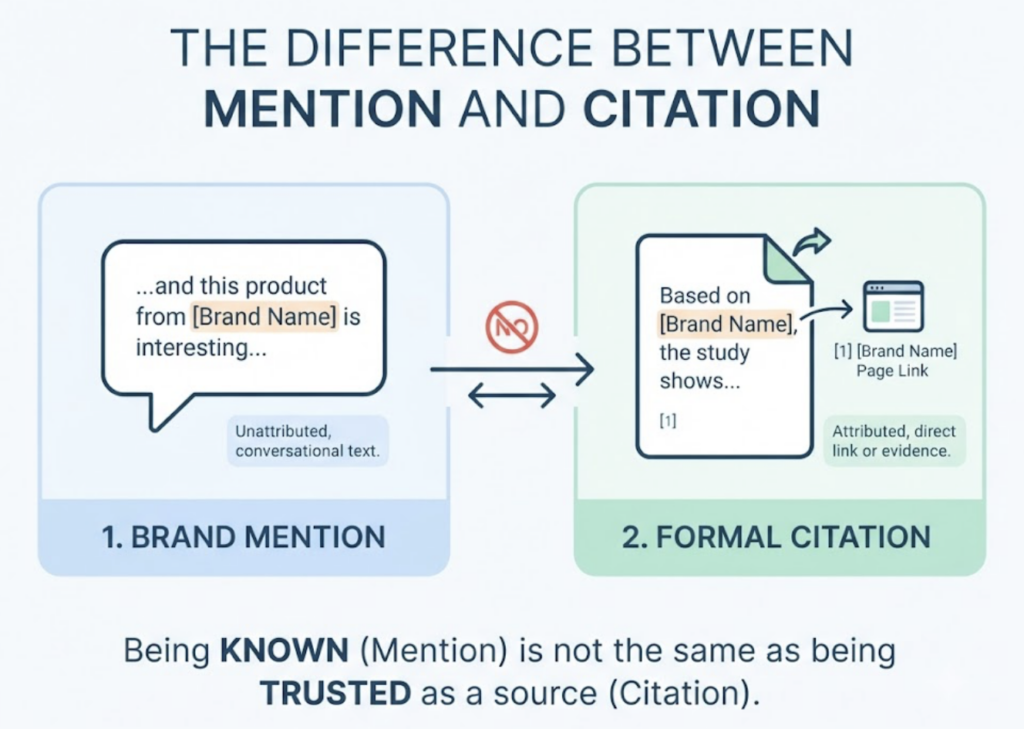
Think of it as a measure of grounding. When an AI model needs evidence to back what it’s telling a user, does it reach for your content or someone else’s? Citation share puts a number on that.
AI Citation Share vs Share of Voice vs Mention Share
Three metrics get used as if they mean the same thing. They don’t. The fastest way to see it is to line up what each one actually counts.
| Metric | Primary unit of analysis | What it tells you |
|---|---|---|
| Share of Voice | Brand mentions in answer text | Awareness and sentiment presence across a prompt set |
| Mention Share | Frequency of brand name appearances | Whether you show up in AI conversations at all |
| AI Citation Share | Domain-level attribution in grounding | Whether AI trusts your content enough to source it |
Share of voice and mention share live at the level of the brand name. They answer “did we come up?” AI citation share lives at the level of the domain and the link. It answers “did we get used as evidence?”
Here’s why the mix-up costs you. Optimize for mentions and you can win a vanity metric while your competitor owns every citation slot underneath the answer. The buyer sees your name once, clicks the sourced link, and lands on the competitor’s page. You measured presence. They captured the referral. If you’re already tracking AI share of voice, citation share is the layer that tells you whether that voice is doing any structural work.
The AI Citation Share Formula, Step by Step
The math is simple, and the simplicity is the point. Citation share is a normalized ratio.
Citation Share = (Total citations to your domain in a prompt set ÷ Total citations across all domains in that set) × 100
The academic version reads the same way. Citation share for a domain is the domain’s citation count divided by the total citation count in the sample. Normalizing by the total is what makes the number portable.
Work an example. You define a set of 20 category prompts. Across all the AI answers those prompts generate, there are 100 citations total. Your domain gets cited 12 times. Your AI citation share is 12 divided by 100, times 100, or 12%.
Why divide by the total instead of just counting your citations? Because a raw citation count scales with how many prompts you ran and how citation-heavy a given platform is. Perplexity cites far more sources per answer than most chat models. Count raw citations and Perplexity will always look like your strongest channel, even when your relative standing is weak. Dividing by the total strips that noise out, so a 12% share on Gemini and a 12% share on Perplexity mean the same thing.
That comparability is the whole reason the metric exists. One number, readable across platforms and across sample sizes.
How to Sample Prompts and Count Citations Correctly
AI search is probabilistic, not deterministic. Ask the same question twice and you can get two different source lists. Run a prompt once and you’ve measured a coin flip, not a trend.
A workable perimeter is 10 to 30 high-intent, category-relevant prompts that mirror the buyer’s journey, some informational, some closer to a purchase decision. Keep them simple. Long, multi-part queries push models to rewrite and improvise instead of retrieving, which pollutes your citation data.
Then repeat. Because models fluctuate, audit weekly or every two weeks rather than once a quarter. Track across several engines, since Google AI Overviews, Perplexity, Gemini, and Claude each have their own sourcing habits. And tag every citation as owned (your domain), earned (independent third parties), or intermediary (review and directory sites like G2 or Capterra). That tagging is what turns a flat percentage into a plan, because it shows you which type of source AI leans on in your category.
Why AI Citation Share Matters More Than Rankings Now
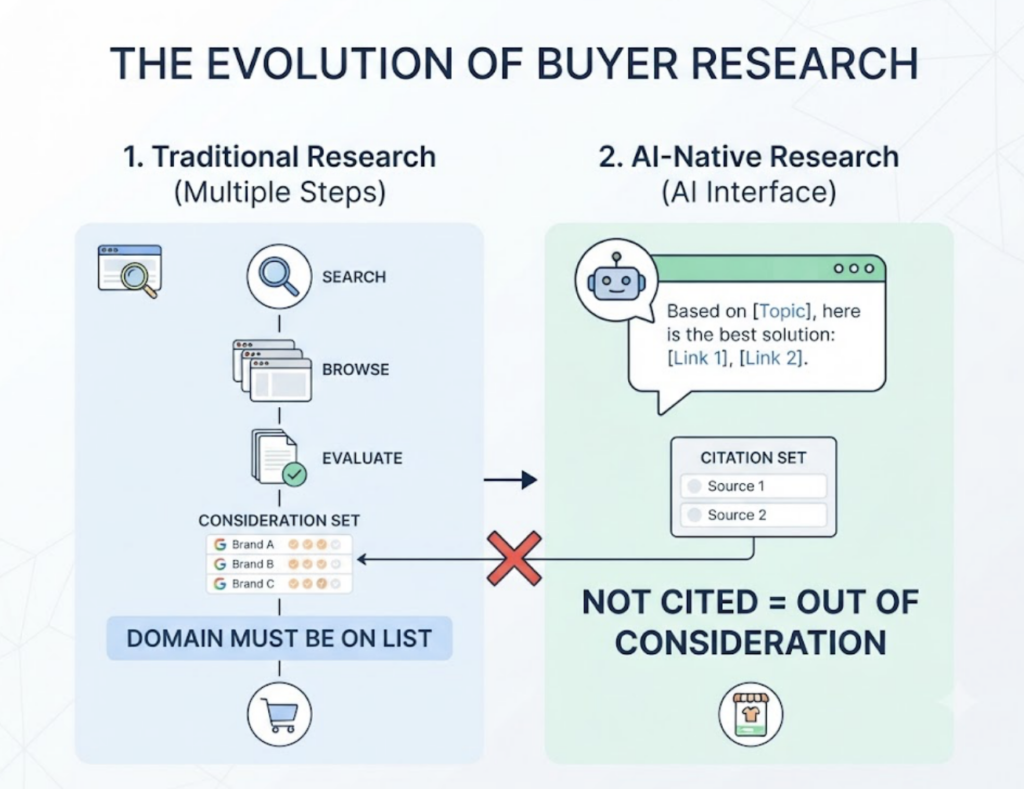
Buyers are finishing their research inside the AI interface. They read the synthesized answer, click a cited source or two, and move on. If your domain isn’t in that citation set, you’re not lower in the consideration set. You’re out of it.
Citations behave like the AI era’s backlinks. A citation carries more weight than a mention because it signals your content cleared the model’s grounding threshold. Some visibility tools already reflect this, weighting citations 1.25 times higher than mentions when scoring overall AI visibility.
The timing is the opportunity. AI search visits grew roughly 42.8% year over year, yet only about 14% of marketers track citation-based visibility at all. Most teams are still optimizing for a search results page that fewer of their buyers ever see.
That’s the gap most brands still can’t see.
It means the brands measuring citation share today are setting a baseline before their category gets crowded. The ones waiting for the metric to feel mainstream will be reverse-engineering someone else’s lead.
How to Track AI Citation Share Without Doing It by Hand
Now the practical wall. The formula is easy. Producing the inputs at any real cadence is not.
Getting a trustworthy citation share means running dozens of prompts across four or five engines, several times a week, then parsing every answer to extract which domains were cited and mapping each one back to a brand. Do that manually and you’ll spend more time assembling the dataset than acting on it. Miss a week and your data goes stale, because AI sourcing shifts faster than most content calendars.
This is where a monitoring platform earns its place. Topify is built around this exact measurement problem. Its Source Analysis feature reverse-engineers AI citations directly, showing the specific domains and URLs that ChatGPT, Gemini, Perplexity, and other engines pull from, so your citation share is computed from real answer data rather than estimated.
From there, the useful part isn’t the raw percentage. It’s the comparison. Topify tracks your citation share against named competitors across the same prompt set, so you can see not just that a rival out-cites you but which of their pages the model keeps reaching for. In practice, that often points to something concrete and fixable, like a competitor’s comparison table that AI finds easier to extract than your prose.
Citation share sits alongside the platform’s other GEO metrics, including visibility, mentions, position, and sentiment, which keeps the number in context instead of stranded in a spreadsheet. If you want to establish a baseline before scaling, you can get started with Topify on your most important head terms first.
Track it. Benchmark it. Then close the gaps the data exposes.
Conclusion
Getting mentioned tells you AI knows your brand exists. AI citation share tells you whether AI trusts you enough to source you. In a search world where buyers decide inside the answer, the second signal is the one that moves pipeline.
Start narrow. Pick your 10 to 20 highest-intent category prompts, measure your citation share as a baseline, and tag where AI is currently reaching for evidence. Once you know your starting number and who’s out-citing you, you have something traditional rankings never gave you: a direct line from what AI trusts to what you need to fix.
FAQ
What is a good AI citation share?
There’s no universal benchmark, because it depends on category density and how many credible sources exist. The useful reading is relative. Measure your share against direct competitors on the same prompt set, then track whether the gap is closing over time. A rising share against named rivals matters more than any absolute percentage.
How is AI citation share different from share of voice?
Share of voice counts brand mentions in answer text and measures awareness. AI citation share counts domain-level citations and measures trust, specifically whether AI uses your content as sourced evidence. You can have high share of voice and low citation share, which usually means AI talks about you but sends users elsewhere for proof.
How often should I measure AI citation share?
Weekly or every two weeks. AI models are probabilistic and their sourcing shifts frequently, so a single measurement captures noise rather than a trend. Regular re-testing across multiple engines is what separates a reliable citation share from a one-off snapshot.
Can you improve your AI citation share?
Yes. Start by identifying which competitor pages AI keeps citing and why, often it’s structural, like extractable tables, clear headings, or direct factual answers. Improving how retrievably your content is formatted, and earning citations on the intermediary sites AI trusts in your category, both tend to move the number.

