

Your brand ranked on page one for every keyword that matters. Then GPT 5.6 Sol shipped on July 9, and a customer asked ChatGPT to recommend a vendor in your category. The answer named three competitors. You weren’t one of them. You checked Claude next. Different list. Then Gemini. Different again.
That’s the part nobody warns you about. Each AI model builds its recommendations from a different citation logic, a different source pool, and a different set of content signals. A brand that dominates one platform can be completely invisible on another. One cross-platform study found citation volume variance of up to 615x for the same brand across different AI engines. And the teams tracking visibility on only one platform have no way of knowing where the gaps are.
GPT 5.6 Sol Just Shipped, and Brand Citations Shifted Again
OpenAI didn’t just release a new model. It restructured how ChatGPT retrieves and cites information entirely.
GPT 5.6 arrived as three distinct tiers: Sol for complex reasoning and research queries, Terra for everyday production work, and Luna for fast, cost-sensitive tasks. OpenAI described the shift as moving from “one model with a dial” to “three models, choose a tier.” For brands, this means different tiers may handle the same product-recommendation query with different citation behaviors.
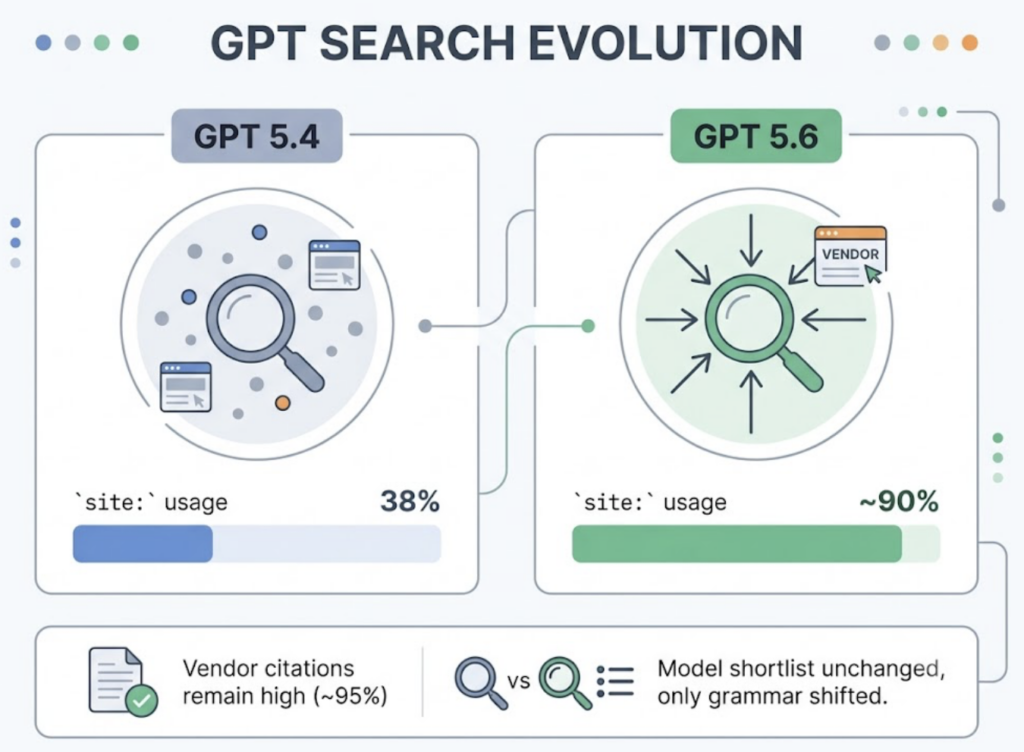
The retrieval changes are measurable. According to DecaGEO’s weekly tracking logs, GPT 5.6 now scopes roughly 90% of its fan-out searches with the site: operator, up from 38% on GPT 5.4. That means nine out of ten searches go directly to a vendor’s domain. Vendor pages still take approximately 95% of citations. The model’s shortlist of products didn’t change, but the grammar of its searching did.
This follows a pattern. A Writesonic study of 1,161 citations found GPT 5.5 cited brand websites 47.2% of the time, down from 56.8% on GPT 5.4. SISTRIX tracked 3.8 million German-language ChatGPT responses and found that day-to-day citation variation normally sits around 1 to 2%, but jumped to 47% during the GPT 5.5 model transition. Every model update reshuffles the citation deck.
The bottom line: if you haven’t checked your brand’s ChatGPT visibility since GPT 5.6 went live, your data is already stale.
Three AI Engines, Three Completely Different Citation Playbooks
The most replicated finding in AI citation research is also the most uncomfortable: only 11% of domains are cited by both ChatGPT and Perplexity. Each engine operates on fundamentally different citation logic. Claude and Gemini add their own divergent patterns on top of that.
Here’s how the three stack up.
ChatGPT (GPT 5.6 Sol) draws heavily on parametric knowledge baked into its training data. It tends to paraphrase rather than name sources, except when its SearchGPT mode is explicitly activated. Ahrefs’ analysis of 75,000 brandsfound that brand web mentions correlate at 0.664 with AI citation rates, roughly three times stronger than backlinks at 0.218. ChatGPT’s retrieval runs on the Bing index, not Google, so a site indexed only on Google is invisible to GPT 5.6’s retrieval layer. With 900 million weekly active users processing roughly a billion queries per day, even small citation shifts move needle for brands.
Claude Opus is the most selective citer of the three. A study of 6,982 AI platform checks found Claude cites brands in just 8.0% of checks, compared to 14.3% for ChatGPT and 19.8% for Gemini. But when Claude does cite, it cites with precision. Attrifast’s 1,200-prompt cross-platform study measured Claude’s median citation density at 3.6 unique domains per answer, higher than ChatGPT’s 3.1. Claude’s Opus 4.8 update emphasized honesty and reliability, making it roughly four times less likely to let flawed claims pass unremarked. In practice, Claude rewards genuine content authority and deprioritizes topical authority content more than other platforms, citing it only 24% of the time compared to 31 to 35% for ChatGPT and Perplexity.
Gemini has two structural advantages no other model matches. First, direct access to Google’s search index and partner data, including Reddit through a $60 million annual licensing deal. Second, JavaScript rendering on crawled content, which lets Gemini see sites that Claude and ChatGPT’s crawlers miss entirely. Gemini cites brands at 19.8% of checks, the highest rate of all four major platforms. But its citation density per answer is the lowest at 2.4 unique domains, meaning it picks fewer sources but picks them more often.
| Metric | ChatGPT (GPT 5.6) | Claude Opus | Gemini |
|---|---|---|---|
| Brand citation rate | 14.3% | 8.0% | 19.8% |
| Median domains per answer | 3.1 | 3.6 | 2.4 |
| Content preference | Third-party mentions, Reddit, Wikipedia | Deep original authority, structured facts | Google-indexed content, schema markup |
| Retrieval index | Bing | Web crawl + training data | Google Search index |
53% of Brands Are Invisible. The Other 47% Often Track Only One Platform.
That 53% figure comes from a cross-platform audit of nearly 7,000 AI checks across ChatGPT, Perplexity, Claude, and Gemini. Half of the brands audited were invisible on all four platforms.
The brands that do show up typically track just one. That’s where the real problem sits.
Slate HQ’s study of 300,000+ AI citations across six B2B SaaS brands tracked the same content across ChatGPT, Perplexity, Gemini, Claude, Google AI Overview, and Google AI Mode for 90 days. The per-platform citation profiles were so different they looked like different brands. Claude gave brands the highest owned citation share at 9.1%. Perplexity gave them 6.8%. ChatGPT was consistently the worst for brand visibility across every company studied.
And 44% of brands ranking in Google’s top 10 get zero ChatGPT citations for the same keyword. The gap is widest in high-competition categories: marketing automation has a 53% citation gap, analytics has a 52% gap. A strong Google ranking does not predict a ChatGPT citation.
That’s the gap most brands still can’t see.
What Each AI Engine Rewards in Your Content
Each model’s citation logic points to a different optimization playbook. Here’s what actually moves the needle on each.
For GPT 5.6: Build entity strength through third-party mentions. ChatGPT’s retrieval layer favors brands that appear consistently across review platforms, industry publications, and community discussions. Submit your sitemap to Bing Webmaster Tools, not just Google Search Console. GPT 5.6’s fan-out queries now scope directly to vendor domains, so your own site’s content structure matters more than it did under GPT 5.4 or 5.5. Focus on structured, fact-dense product pages.
For Claude Opus: Depth over breadth. Claude deprioritizes thin content and rewards pages with original analysis, specific data points, and clear sourcing. If your pages carry no visible date and no author signals, Claude is less likely to cite them. Of 2,225 pages analyzed, 77% carried no visible date, and only 21.2% showed author signals. Fix those basics and you’re already ahead of most competitors in Claude’s citation pool.
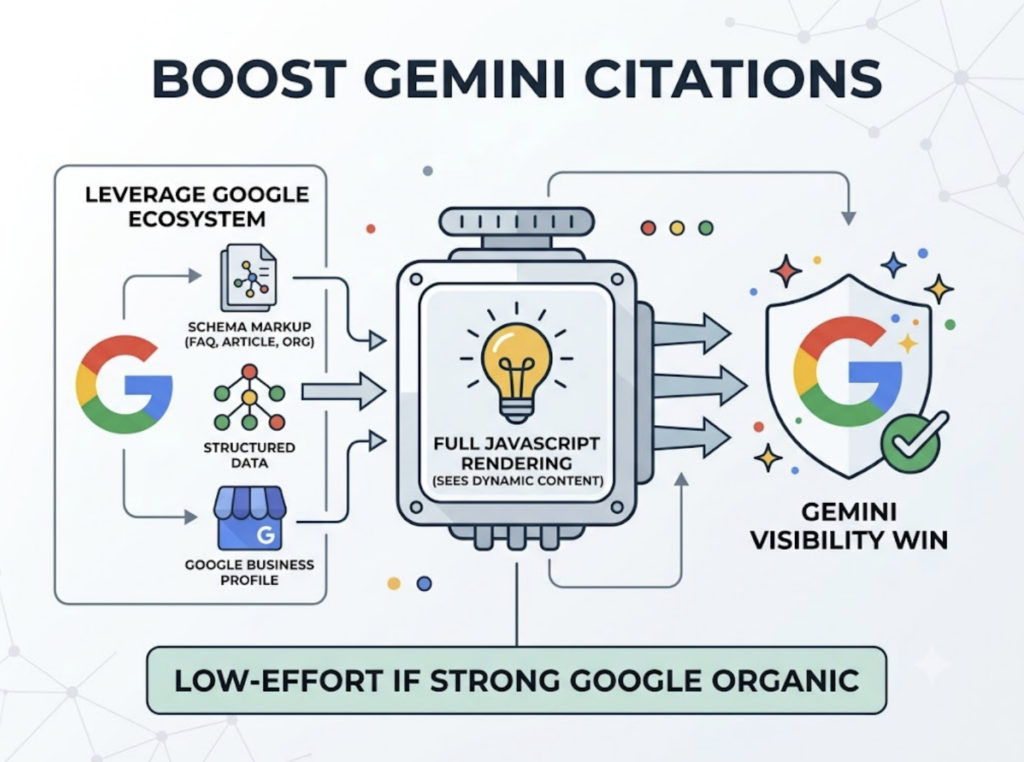
For Gemini: Lean into Google’s ecosystem. Schema markup (Organization, FAQ, Article), structured data, and Google Business Profile optimization all feed Gemini’s citation decisions. Gemini renders JavaScript, so content hidden behind dynamic loading isn’t invisible the way it is to Claude’s and ChatGPT’s crawlers. If you’re already strong in Google organic, Gemini is your lowest-effort AI visibility win.
The critical insight: a strategy that works for one model often fails on another. Brands that treat all AI engines as identical will underperform on the platforms where their approach doesn’t match the citation pattern.
Tracking GPT 5.6, Claude, and Gemini Citations in One Place
Manually testing your brand across three platforms tells you what happened once. It doesn’t tell you when it changes, how it changes, or why.
Topify consolidates AI visibility data across ChatGPT, Gemini, Perplexity, and other major platforms into a single dashboard. For marketing teams dealing with GPT 5.6’s citation behavior shift, the platform’s Comprehensive GEO Analytics pulls Visibility, Sentiment, and Position data into one view. In practice, this means you can spot a drop in ChatGPT mentions after a model update and trace it back to a specific source change, all without running manual prompt tests.
The Source Analysis feature is especially relevant for this moment. GPT 5.6’s shift to scoping 90% of fan-out queries to vendor domains means the sources ChatGPT cites have narrowed. Topify’s source tracking shows exactly which domains AI platforms are citing for your category, so you can see whether your content is in the citation pool or missing from it entirely.
Dynamic Competitor Benchmarking adds the layer most teams lack: seeing who AI engines recommend instead of you. When GPT 5.6 reshuffles the recommendation list in your category, you’ll know within days, not weeks.
Plans start at $99/month, and you can get started with a free trial to see your brand’s current AI visibility baseline before committing.
Conclusion
GPT 5.6’s launch on July 9 wasn’t just an OpenAI product update. It was another citation reshuffle across the platform that handles a billion queries per day. And the data is clear: what ChatGPT recommends, what Claude selects, and what Gemini surfaces are three largely separate brand graphs with minimal overlap.
The brands that win in AI search in 2026 aren’t the ones with the best Google rankings. They’re the ones tracking citation behavior across every platform their buyers actually use, and adjusting their content strategy when the models change. GPT 5.6 is live. Your brand’s citation map probably looks different than it did three weeks ago. The only question is whether you know how.
FAQ
Q: Does GPT 5.6 Sol cite brands differently than GPT 5.5?
A: Yes. DecaGEO’s tracking data shows GPT 5.6 scopes roughly 90% of its fan-out searches with the site: operator, up from lower rates on GPT 5.4 and 5.5. The model’s shortlist of products tends to stay stable across versions, but the way it searches for and validates those brands changes with each release, which shifts citation rates and the mix of first-party versus third-party sources in its answers.
Q: Which AI model is most likely to mention my brand by name?
A: Gemini cites brands at the highest rate (19.8% of checks), followed by ChatGPT (14.3%) and Claude (8.0%). But citation rate alone doesn’t tell the whole story. ChatGPT has 900 million weekly users. Claude converts referred traffic at 5.0%, more than Google organic’s 1.76%. The right platform to prioritize depends on where your buyers actually search.
Q: How often do AI models update their brand citation behavior?
A: Every model update is a potential citation shift. SISTRIX found that citation variation jumped from a baseline of 1 to 2% to 47% during ChatGPT’s GPT 5.5 rollout. OpenAI has released GPT 5.3, 5.4, 5.5, and 5.6 within a six-month window in 2026. Continuous monitoring is the only way to catch these shifts early.
Q: Can I track my brand’s visibility across GPT 5.6, Claude, and Gemini in one place?
A: Yes. Platforms like Topify track AI visibility across ChatGPT, Gemini, Perplexity, and other engines in a single dashboard, with metrics for visibility, sentiment, position, and source analysis. This makes it possible to compare your brand’s citation performance across models and catch shifts when new model versions roll out.

