

You spent months calibrating your brand’s presence in ChatGPT. Structured data, entity signals, citation-worthy content across the pages that mattered. By late June 2026, your mention rate finally looked predictable. Then OpenAI swapped out the model underneath, and for the first time in AI history, the U.S. government decided who got to use it first.
GPT 5.6 didn’t launch like every model before it. A 12-day government-coordinated review kept it locked to a handful of approved partners while the rest of the market waited. For brands tracking AI search visibility, that gap wasn’t just an inconvenience. It was a structural reset that most teams didn’t see coming.
What GPT 5.6 Actually Changes Under the Hood
GPT 5.6 isn’t one model. It’s a three-tier family: Sol (flagship), Terra (balanced), and Luna (fast, affordable). OpenAI positioned the naming as “durable capability tiers that can advance on their own cadence,” meaning future updates can hit one tier without touching the others.
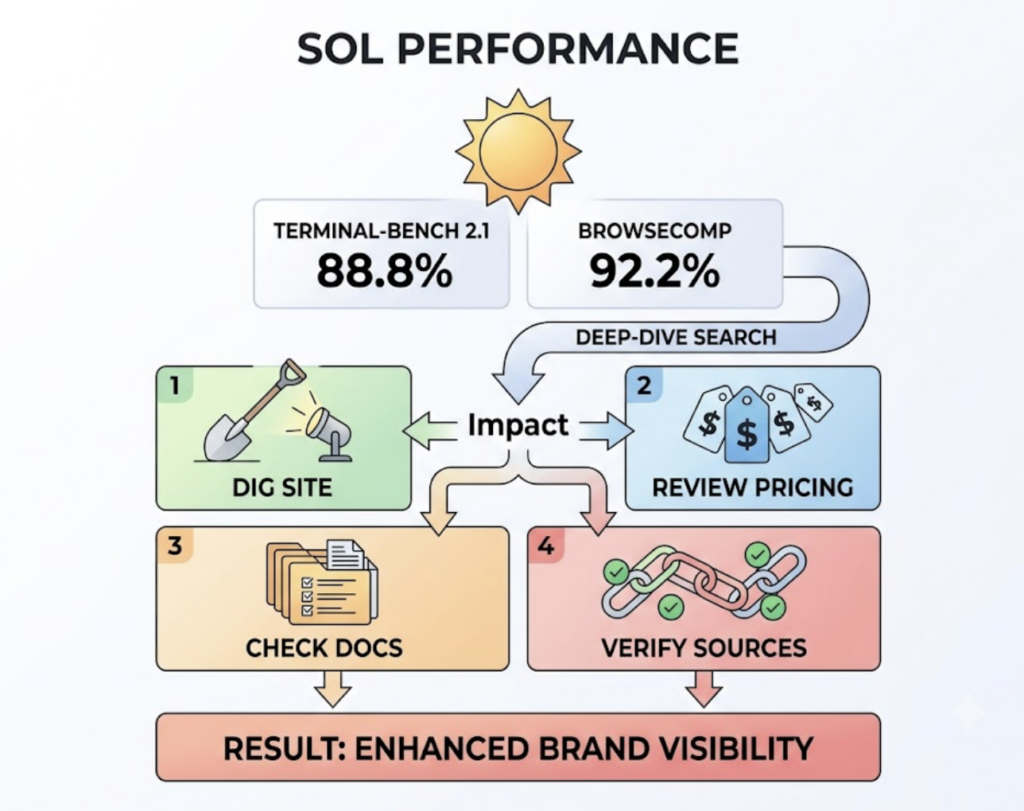
The numbers tell the story. Sol scores 88.8% on Terminal-Bench 2.1 and 92.2% on BrowseComp, the benchmark that measures how persistently an AI searches for hard-to-find information. That BrowseComp score matters for brand visibility: it means GPT 5.6 digs deeper into your site, reads your pricing pages, checks your feature documentation, and cross-references what it finds against third-party sources.
Two workflow additions matter as much as the benchmarks. A new ultra mode spins up parallel sub-agents that divide complex tasks, cross-check each other, and merge conclusions. And ChatGPT Work, released alongside GPT 5.6, operates across desktop apps, connected files, and third-party tools to produce deliverables on its own. Both expand the surface area where AI answers shape how prospects discover brands.
The training cutoff refresh is the quiet change with the loudest brand impact. GPT 5.6 ingests web events through early-to-mid 2026, which means brands that earned significant coverage between April and June 2026 now enter the model’s parametric recall for the first time.
The 12-Day Government Gate: A First for American AI
On June 2, 2026, President Trump signed Executive Order 14409, “Promoting Advanced Artificial Intelligence Innovation and Security.” The order directs federal agencies to design a voluntary framework by August 1, 2026, under which AI developers provide the government with access to “covered frontier models” for up to 30 days before public release.
On paper, the framework is voluntary. In practice, it played out differently. Axios reported that the White House asked OpenAI to limit GPT 5.6’s release to government-approved partners before any wider distribution, marking the first time the U.S. government preemptively restricted an American AI company’s model launch. OpenAI complied, opening a limited preview on June 26 for a “small group of trusted partners whose participation has been shared with the government.”
GPT 5.6 wasn’t the only model caught in this wave. Two weeks earlier, the Commerce Department ordered Anthropic to suspend all access to its Fable 5 and Mythos 5 models for any foreign national, citing cybersecurity concerns over a reported jailbreak. Anthropic shut both models down entirely because it couldn’t filter users by nationality in real time. The suspension lasted until June 30, when the Commerce Department lifted restrictions after Anthropic strengthened its safety guardrails.
That’s two frontier model families, from two different companies, restricted by government action within the same month.
Why Restricted Rollouts Reshape Brand Visibility Worldwide
The instinct is to treat government access gates as a policy story, not a marketing one. That’s a mistake. Here’s the mechanism.
During GPT 5.6’s limited preview, only trusted partners’ usage data shaped early citation patterns and answer caching. GPT 5.6 introduces explicit prompt caching where cache writes cost 1.25x and cache reads get a 90% discount. Once an answer pattern for a high-frequency commercial query gets cached, the platform has a direct compute-cost incentive to reuse it. Brands whose content enters those early cached answers gain a moat backed by economics, not just relevance.
For brands outside the U.S., the impact compounds. As Proton’s analysis noted, European businesses found themselves locked out of the most powerful AI models at the moment those models were forming their initial citation preferences. The EU Commission responded in July 2026 with a cybersecurity action plan that included negotiating early access to U.S. AI models, an acknowledgment that falling behind on model access now carries tangible business consequences.
The cross-model citation data makes this concrete. Research on GPT 5.4 versus GPT 5.3 found a 52% gap in brand website citations: GPT 5.4 sent 56% of its citations to brand websites, while GPT 5.3 sent just 8%. Only 7% of cited sources overlapped between the two models. Every model generation rewrites the citation playbook from scratch.
That’s the real risk. When a new model launches behind a government gate, the brands that are already inside the gate get a head start on shaping the citation patterns that will persist for months.
The 2-to-4-Week Reset Window You Can’t Afford to Miss
Right after a generation launch, the system enters what practitioners call a “re-learning state.” It’s actively seeking stable, well-structured sources to anchor its new output patterns. Brands that act within the first two to four weeks of a model launch get outsized returns.
The technical checklist is straightforward: fix firewall rules that block GPTBot, deploy llms.txt, roll out JSON-LD markup for organization, product, and FAQ content. AirOps research found that pages not updated within the previous quarter were over 3x more likely to lose AI citations compared with recently refreshed content.
Early citations also snowball across ecosystems. Consistent AI recommendations get picked up by aggregators, which lifts traditional search signals, which in turn feeds back into the next round of AI crawling. Miss the window, and you’re not just behind on one platform. You’re behind on the entire feedback loop.
With GPT 5.6, the window was even tighter than usual. The restricted preview ran from June 26 to July 9. General availability followed immediately, meaning brands had roughly two weeks from GA to re-establish baselines before the model’s citation patterns started hardening.
How to Audit Your GPT 5.6 Visibility Before Competitors Lock In Theirs
The first step is knowing where you stand. If you haven’t re-run your brand’s AI visibility baseline since GPT 5.6 went live on July 9, your data is already stale.
For marketing teams tracking visibility across multiple AI platforms, Topify tends to stand out by combining Visibility, Sentiment, and Position data into a single view across ChatGPT, Gemini, Perplexity, and AI Overviews. In practice, this means you can spot a drop in ChatGPT mentions and trace it back to a specific source domain that stopped being cited, all within the same dashboard.
Here’s the audit sequence that matters right now:
Run a fresh GPT 5.6 baseline. Compare your mention rate, citation URLs, and position against what you measured under GPT 5.5. Topify’s Visibility Tracking surfaces exactly this: which prompts still trigger your brand, and which ones you’ve dropped out of.
Check your competitors. Government-gated rollouts create asymmetric windows. If a competitor’s content was indexed during the preview and yours wasn’t, they may have locked in early citation patterns. Topify’s Competitor Monitoring flags emerging rivals in real time, so you’ll see a competitor’s visibility spike before it becomes a structural advantage.
Trace citation sources. GPT 5.6’s deeper browsing (92.2% BrowseComp) means the model is now visiting your actual pages, not just pulling from third-party roundups. Use Source Analysis to see whether GPT 5.6 is citing your domain directly or routing through intermediaries. If intermediaries dominate, your on-site content needs structural work.
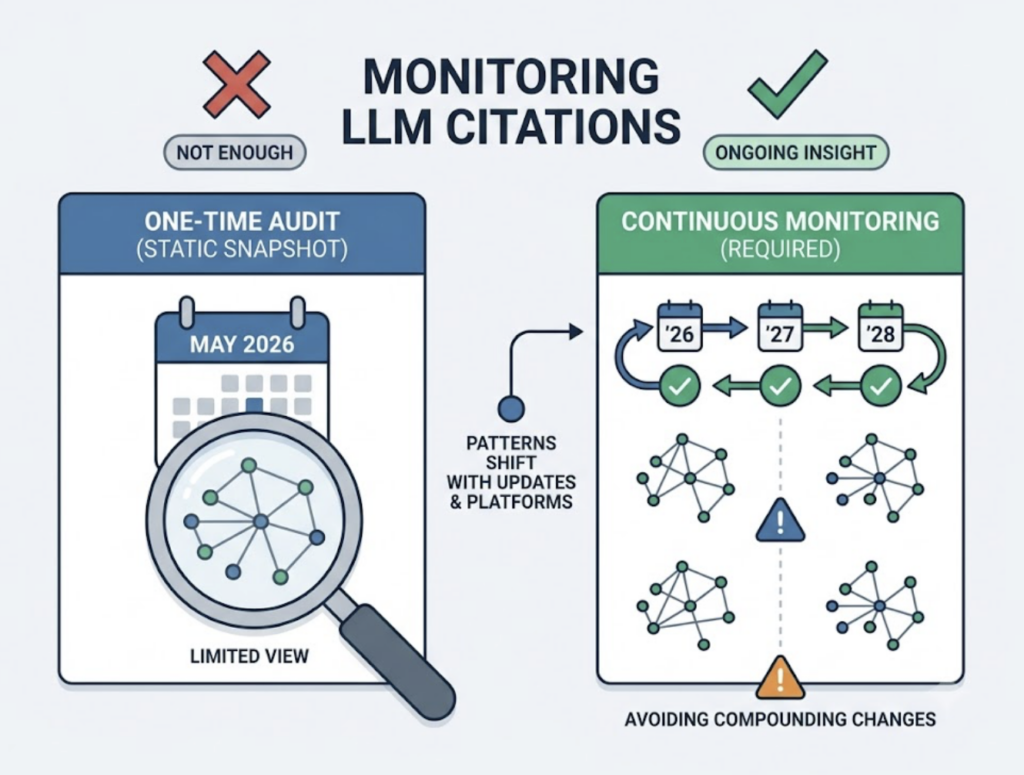
Set up continuous monitoring. Meltwater’s May 2026 analysis of over 8 million citations across eight LLMs confirmed that citation patterns differ significantly by platform and shift with every update. A one-time audit isn’t enough. You need ongoing tracking that catches changes before they compound.
If you’re starting from scratch, Topify’s Basic plan at $99/month covers ChatGPT, Perplexity, and AI Overviews tracking with 100 prompts and 9,000 AI answer analyses. It’s enough to establish a baseline and start catching model-update volatility.
What Comes Next: Every Model Launch Could Look Like This
The August 1, 2026 deadline from EO 14409 is when the voluntary framework is supposed to be finalized. The NSA’s classified benchmarking process will determine which future models qualify as “covered frontier models” subject to government pre-release review. The criteria haven’t been published.
That means every major model release going forward, from OpenAI, from Google, from any U.S.-based AI lab, could come with a government access window attached. Legal analysis from WilmerHale notes that while the EO sets a design deadline for the government, it imposes no compliance deadline on AI companies. But the practical reality of June 2026 tells a different story: both OpenAI and Anthropic complied when asked.
For brand visibility strategy, the implication is direct. Model-update volatility isn’t a one-time disruption. It’s becoming a recurring feature of the AI search environment, and now it carries a policy dimension that can widen or narrow access windows unpredictably.
The brands that treat every model generation as a visibility audit trigger, not just a product news story, will be the ones that stay consistently cited. The ones that wait for general availability to “see what changed” will keep discovering the answer too late.
Get started with Topify and run your GPT 5.6 baseline before the citation patterns harden.
Conclusion
GPT 5.6’s government-gated rollout wasn’t an anomaly. It was the first visible instance of a pattern that’s likely to repeat: frontier models launched under controlled access, with citation preferences forming before most brands even have API access.
The playbook hasn’t changed in principle. Track your brand across every major AI platform, re-baseline after every model update, and act inside the reset window. What’s changed is urgency. When government policy determines who gets early access to the models shaping your prospects’ answers, waiting is itself a competitive disadvantage. Start monitoring now, or start catching up later.
FAQ
Q: Is GPT 5.6 available to everyone now?
A: Yes. GPT 5.6 Sol, Terra, and Luna reached general availability on July 9, 2026, across ChatGPT, Codex, and the API. The restricted government preview that began on June 26 has ended. Plus, Pro, Business, and Enterprise users access Sol through medium and higher reasoning-effort settings. Free users access Terra.
Q: How does a restricted AI rollout affect my brand’s visibility in ChatGPT?
A: During a restricted preview, only approved partners interact with the model, shaping its early answer patterns and prompt cache. GPT 5.6’s caching mechanism creates a compute-cost incentive to reuse cached answers, meaning brands present in early interactions can gain a durable citation advantage over those that enter later.
Q: What is the “reset window” after a major GPT update?
A: In the first two to four weeks after a model generation launches, the system is actively seeking stable sources to anchor new output patterns. Content updates, technical fixes (like unblocking GPTBot), and structured data deployments during this window tend to produce outsized visibility gains compared with the same actions taken months later.
Q: How can I track my brand’s visibility across GPT 5.6 and other AI platforms?
A: Tools like Topify monitor brand mentions, citations, sentiment, and competitive position across ChatGPT, Gemini, Perplexity, and Google AI Overviews at the prompt level. Running a baseline audit immediately after a model update and setting up continuous monitoring are the two highest-leverage actions.

