

OpenAI’s web crawlers are hitting your site three times harder than they were a year ago. A Botify analysis of 7 billion log events confirmed it: after GPT-5 launched in August 2025, OAI-SearchBot activity jumped 3.5x. That’s 2.2 billion additional crawl events in Botify’s dataset alone, and the search-to-training crawl ratio flipped for the first time. OpenAI is now spending more resources on live web search indexing than on model training.
Then GPT 5.6 dropped. With 900 million weekly active users and 250 to 500 million search-intent queries flowing through ChatGPT every week, the question isn’t whether OpenAI’s crawl will keep growing. It’s whether your brand shows up when it does.
OpenAI’s Search Crawl Tripled. GPT 5.6 Makes the Stakes Higher.
Chris Long, co-founder of the SEO consultancy Nectiv, partnered with Botify to analyze how OpenAI’s three crawlers behave across enterprise websites. The dataset covered November 2024 through March 2026, pulling from Botify’s log file infrastructure across retail, media, healthcare, software, travel, and marketplaces.
The numbers tell a clear story. Before GPT-5, OAI-SearchBot and GPTBot ran at roughly even volumes, with a search-to-training ratio of about 0.95. After GPT-5, that ratio rose to 1.14. Translation: ChatGPT is now doing more live web fetching for user queries than it is bulk-crawling for training data.
That shift matters because it changes what “being indexed by OpenAI” actually means.
GPTBot crawling your site means OpenAI might use your content to train future models. OAI-SearchBot crawling your site means your pages can appear in ChatGPT search results right now, cited with a link, in front of hundreds of millions of users. The vertical breakdown makes this even more urgent. Healthcare sites saw approximately 740% more OAI-SearchBot activity post-GPT-5. Media and publishing came in at 702%. Marketplaces, software, and retail clustered between 190% and 216%.
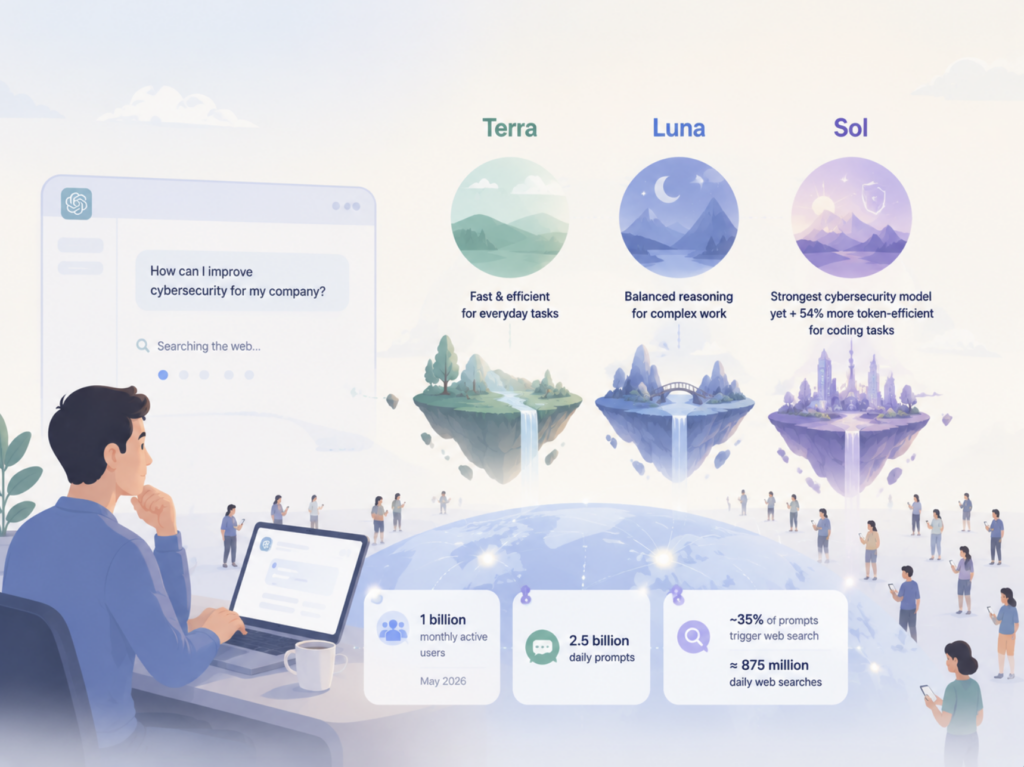
Now factor in GPT 5.6. OpenAI launched the Sol, Terra, and Luna models on July 9, 2026, with Sol described as the “strongest cybersecurity model yet” and 54% more token-efficient for coding tasks. ChatGPT reached 1 billion monthly active users in May 2026. Daily prompt volume sits at 2.5 billion, and roughly 35% of those prompts trigger web search, producing an estimated 875 million daily web searches.
The crawl volume that tripled after GPT-5 has nowhere to go but up.
GPTBot vs OAI-SearchBot vs ChatGPT-User: The Config Most Teams Get Wrong
OpenAI operates three distinct crawlers, and each serves a different purpose. Treating them as one “AI bot” in your robots.txt is the single most common mistake, and one of the most expensive.
Here’s how they break down:
| Crawler | Purpose | What It Controls |
|---|---|---|
| GPTBot | Collects content for model training | Whether your content trains future GPT models |
| OAI-SearchBot | Indexes content for ChatGPT search | Whether your pages appear in ChatGPT search results |
| ChatGPT-User | Fetches pages when a user asks directly | Whether ChatGPT can load your page mid-conversation |
The critical detail: each crawler respects robots.txt independently. Blocking GPTBot does not block OAI-SearchBot. Blocking OAI-SearchBot does not block ChatGPT-User. You can allow one, block another, and fine-tune by directory, all within the same robots.txt file.
OpenAI’s own documentation spells out the consequence: sites that block OAI-SearchBot won’t appear in ChatGPT search answers. Navigational links may still show up, but your content won’t be cited, quoted, or recommended.
That’s where most teams trip up. They see “AI bot” in their server logs, add a blanket Disallow rule, and unknowingly remove their brand from the fastest-growing search surface on the internet.
25% of Top Sites Block AI Crawlers. Most Don’t Realize What It Costs.
The blocking trend is real. 25% of the top 1,000 websites now block GPTBot, up from 5% in early 2023. Among the top news websites in the UK and US, 79% block at least one AI training crawler, and 71% block AI retrieval bots used for live search.
The reasoning makes sense on paper. Publishing content takes resources. Having an AI scrape that work to answer user questions, often without linking back, feels like a bad deal.
But the data complicates that logic.
A BuzzStream study analyzing 4 million citations across 3,600 prompts found that sites blocking OAI-SearchBot still appeared in 82.4% of AI citation cases. Sites blocking ChatGPT-User still showed up 70.6% of the time. The reason: AI models pull from multiple sources, including cached data, training sets, and third-party references. Blocking a crawler doesn’t erase your brand from AI answers. It just removes your ability to control how and when you appear.
On the flip side, a Hostinger analysis of 66.7 billion bot requests found that OAI-SearchBot had achieved 55.67% average coverage across monitored websites. Sites that allow the bot get indexed. Sites that don’t get skipped for live search results while still potentially showing up through indirect references they can’t influence.
The practical trade-off looks like this: blocking AI training crawlers protects your content from being used to train future models. Blocking AI search crawlers removes your brand from the discovery layer where 250 to 500 million search-intent queries happen every week.
61% of enterprise sites have landed on a hybrid approach. They block training bots while allowing search and retrieval bots. That’s the configuration worth studying.
The robots.txt Setup That Gets Your Brand Into ChatGPT Search
The recommended configuration separates training from search. Allow OAI-SearchBot so your pages can appear in ChatGPT search results. Block GPTBot if you don’t want your content used for model training. Leave ChatGPT-User allowed for user-triggered page loads.
Here’s what that looks like:
User-agent: OAI-SearchBot
Allow: /

User-agent: GPTBot
Disallow: /

User-agent: ChatGPT-User
Allow: /
For sites that want more granular control, you can open specific directories while keeping sensitive paths closed:
User-agent: OAI-SearchBot
Allow: /blog/
Allow: /products/
Allow: /resources/
Disallow: /staging/
Disallow: /internal/
Disallow: /admin/
A few things to keep in mind. OpenAI states that changes to search eligibility can take about 24 hours to adjust after a robots.txt update. So don’t expect instant results.
Also, robots.txt isn’t the only layer that matters. CDN configurations, WAF rules, and anti-bot plugins can override your crawler policies at the server level. If your Cloudflare, Akamai, or custom firewall rules rate-limit or block AI user agents, your robots.txt permissions don’t matter. Audit both layers.
A Cloudflare-based analysis of robots.txt rules found that OAI-SearchBot appears in 4.22% of explicit ALLOW rules across the web. That’s still a small fraction of sites deliberately opting in. For brands that do, the competitive advantage is straightforward: you’re visible in a channel where most competitors haven’t shown up yet.
Beyond Crawler Access: The Full Technical Stack for GPT 5.6 Indexing
Letting the crawler in is necessary. It’s not sufficient.
AI models don’t process web pages the way Google does. They don’t follow PageRank. They don’t care about your domain authority score in isolation. They’re looking for content they can extract, summarize, and cite in a structured answer. That means the technical surface area you expose to AI crawlers needs to be built for comprehension, not just crawlability.
The stack that works in 2026 has four layers. Robots.txt controls permissions: who gets in, who doesn’t. Sitemap.xmlhandles discovery: which URLs exist and which ones are canonical. Schema markup (JSON-LD) provides page-level entity data: what this page is about, structured in a format machines parse without guessing. llms.txt offers site-level context: a clean markdown file at your domain root that gives LLMs a summary of your brand, products, and key pages.
Each layer solves a different problem, and skipping one creates a gap.
On schema markup specifically, a cited study found that pages with valid structured data are 2.3x more likely to appear in Google AI Overviews. Princeton’s GEO research found content with clear structural signals saw up to 40% higher visibility in AI-generated responses. The takeaway isn’t that schema guarantees an AI citation. It’s that without it, you’re making the AI work harder to understand your content, and when competing pages make it easier, they win.
For llms.txt, the adoption curve is still early but accelerating. Anthropic, Stripe, Vercel, and Cloudflare all publish one. The file sits at yourdomain.com/llms.txt and contains a structured markdown summary: your brand name, a one-line description, and categorized links to your most important pages. It’s cheap to implement and gives AI systems a clean entry point that bypasses HTML noise, JavaScript rendering issues, and navigation clutter.
One more layer that’s easy to overlook: content quality and third-party coverage. Muck Rack’s May 2026 analysis of more than 25 million AI-cited links found that earned media accounts for 84% of all citations across ChatGPT, Claude, and Gemini. Paid and advertorial content accounts for 0.3%. Journalism alone drives 27% of cited sources. If your brand isn’t covered by credible third-party publications, even perfect technical setup won’t generate consistent AI citations.
You Opened the Door to AI Crawlers. Now Track Who Actually Walked In.
Here’s the gap most teams hit after they’ve configured robots.txt, deployed schema, and published llms.txt: they have no way to measure whether it’s working. Google Search Console doesn’t track ChatGPT citations. Google Analytics doesn’t show Perplexity referrals reliably. Traditional rank trackers weren’t built for a world where “ranking” means appearing inside a generated paragraph, not on a SERP.
That’s the problem Topify was built to solve. The platform tracks how AI systems recommend your brand across ChatGPT, Gemini, Perplexity, and other major AI platforms.
For marketing teams working on GPT 5.6 indexing, Topify’s Visibility Tracking shows whether your brand appears in AI answers, how often, and for which prompts. Source Analysis traces exactly which domains AI platforms cite when they mention your category, so you can see whether your owned content or a competitor’s coverage is driving the narrative. Competitor Monitoring surfaces which brands are showing up alongside yours, and Sentiment Analysis tracks whether AI describes your brand the way your positioning intends.
In practice, this means you can configure your robots.txt on Monday, check Topify on Thursday, and see whether OAI-SearchBot’s increased crawl is actually translating into citations. Without that feedback loop, you’re optimizing blind.
If you want to start with a quick baseline, Topify’s free GEO Score Checker grades how AI-ready your site is across the signals that matter: crawlability, content structure, entity clarity, and citation patterns.
GEO Score Checker
Conclusion
OpenAI’s crawl activity tripled after GPT-5, and GPT 5.6’s launch into a market with 900 million weekly ChatGPT users and hundreds of millions of search-intent queries means the volume will keep climbing. The brands that show up in this channel are the ones that got the technical basics right early: selective crawler access, structured data, site-level AI context, and a measurement system that closes the loop between crawl access and actual citations.
The window to set this up ahead of competitors is still open. But with each model release, the stakes get higher and the competition for AI-generated recommendations gets tighter. Start with your robots.txt. Build the full stack. Then measure what you can’t afford to guess at.
FAQ
Q: Does GPT 5.6 use a different crawler than earlier GPT models?
A: No. GPT 5.6 uses the same three OpenAI crawlers: GPTBot, OAI-SearchBot, and ChatGPT-User. What’s changed is the volume. OAI-SearchBot activity jumped 3.5x after GPT-5, and ChatGPT’s user base has continued growing since then. The crawlers are the same, but they’re hitting your site significantly harder and more frequently.
Q: Should I allow both OAI-SearchBot and GPTBot?
A: It depends on your priorities. If you want your content to appear in ChatGPT search results, allow OAI-SearchBot. If you don’t want your content used for model training, block GPTBot. The two are independent. Most enterprise sites allow OAI-SearchBot while blocking GPTBot, giving them search visibility without training data contribution.
Q: How long does it take for robots.txt changes to affect ChatGPT search?
A: OpenAI’s documentation says search eligibility updates take approximately 24 hours after a robots.txt change. In practice, the full effect may take longer depending on crawl frequency for your domain. Monitor your server logs for OAI-SearchBot activity after making changes.
Q: Can I track whether ChatGPT is citing my brand?
A: Standard analytics tools don’t reliably capture AI citations. ChatGPT doesn’t consistently pass referral headers, so much of the traffic arrives as “Direct” in GA4. Platforms like Topify are designed specifically for this, tracking brand mentions, citation sources, and competitive positioning across ChatGPT, Gemini, Perplexity, and other AI platforms.

