

You’re tracking your brand’s visibility in ChatGPT. But which ChatGPT? Since July 2026, “ChatGPT” has meant three separate models with three different reasoning architectures, three different citation behaviors, and three different sets of winners. A brand that dominates the fast-answer tier can vanish entirely in the deep-reasoning tier, and most tracking setups can’t tell you which one you’re looking at.
That’s not just an OpenAI quirk. It’s the direction every major AI platform is heading. And if your GEO strategy still treats AI search as a single channel, the gap between what you measure and what actually happens to your brand is about to get wider.
GPT 5.6 Isn’t One Model. Neither Is Any Other AI Platform.
When OpenAI released GPT-5.6 in July 2026, it formalized something that had been building for over a year: AI search runs on model families, not single models. GPT-5.6 ships as Sol (the flagship for complex reasoning and agentic work), Terra (a balanced everyday model), and Luna (the fast, low-cost tier for high-volume tasks). Each tier processes the same user question through a fundamentally different reasoning pipeline.
OpenAI isn’t alone here. Anthropic runs Claude as Haiku, Sonnet, and Opus. Google’s Gemini operates across Flash, Flash-Lite, Pro, and Deep Think. Every major AI lab has converged on the same structural pattern: tiered model families where different tiers handle different workloads at different price points.
The logic is straightforward. Not every query needs frontier-level reasoning. A quick product lookup doesn’t require the same computational depth as a multi-step B2B vendor comparison. Tiered models let platforms route simple tasks to lightweight models and reserve deep reasoning for complex questions.
Here’s what that means for GEO: the same user, asking the same question on the same platform, can receive a different answer depending on which tier processes the query. Different tiers retrieve different sources, weigh evidence differently, and can recommend different brands.
Why Different GPT 5.6 Tiers Cite Different Brands
The gap between tiers isn’t theoretical. A Semrush and Kevin Indig study tested 100 prompts across 20 buyer journeys in B2B SaaS, finance, consumer tech, and health. Each prompt ran once in minimal reasoning (Instant mode) and once in high reasoning (Thinking mode).
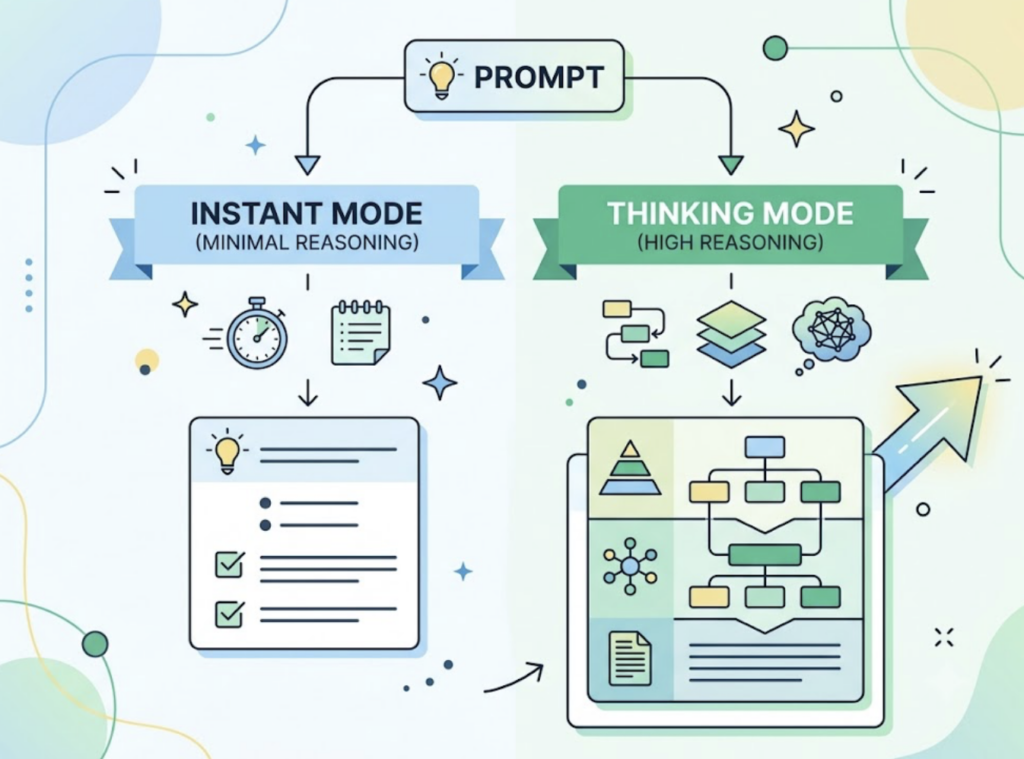
The results were stark: only 25.6% of cited domains overlapped between the two modes. Nearly three in four sources changed when ChatGPT shifted from fast answers to deep reasoning.
The behavioral differences go deeper than just which domains appear. Citation rates jumped from 50% in minimal reasoning to 68% in high reasoning. Sources per response nearly doubled, from 2.6 to 4.5. And high-reasoning mode fired 4.6 times more internal sub-queries before forming its answer.
Source types shifted too. Reddit’s citation share dropped from 15% to 7% when reasoning increased. User-generated content and review sites fell from 14.3% to 6%. Government and academic sources moved in the opposite direction, rising from 1.9% to 8.8%.
That pattern maps directly onto GPT-5.6’s tier structure. Sol, the flagship, runs the kind of deep, multi-step reasoning that cross-references documentation, official sources, and primary data. Luna, built for speed, leans on probabilistic memory and whatever surfaces fastest. A niche brand with rigorous technical documentation but weak traditional SEO can show up in Sol’s carefully constructed answers while staying invisible in Luna’s quick ones. The reverse is equally true.
One visibility number can’t capture that.
The GEO Blind Spot Most Brands Haven’t Found Yet
The tier-level gap within a single platform is just the first layer. Zoom out, and the problem compounds across platforms.
Yext analyzed 17.2 million AI citations across ChatGPT, Gemini, Claude, and Perplexity during Q4 2025. The conclusion was blunt: each model follows predictable but distinct sourcing patterns. Gemini leans heavily on first-party websites and owned content. Claude cites user-generated content, reviews, and social sources at rates 2 to 4 times higher than competing models. Perplexity shows its own preference hierarchy. ChatGPT adjusts its sourcing logic per query context.
A brand can have strong visibility in Gemini and be nearly invisible in Claude. And without model-level tracking, there’s no way to know.
Most brands still report a single “AI visibility” number. That’s like reporting a single “search engine ranking” in 2005 without separating Google from Yahoo from Ask Jeeves. The aggregate hides where you’re winning, where you’re losing, and what’s actually driving each outcome.
Now layer the within-platform tier gap on top of the cross-platform gap. You’re not tracking one visibility surface per AI engine. You’re tracking multiple surfaces per engine, each with its own citation logic. The measurement surface area has multiplied, and most GEO strategies haven’t caught up.
What Tier-Aware GEO Actually Looks Like
Adapting to a tiered AI search environment doesn’t mean throwing out existing GEO work. It means adding structure to it. Three shifts matter most.
Layer your content for different reasoning depths. High-reasoning tiers like Sol break user queries into sub-queries and cross-reference multiple sources before committing to a recommendation. That means detailed technical documentation, structured product comparisons, and primary data earn disproportionate weight. Low-reasoning tiers default to whatever surfaces fastest, so baseline SEO, structured data, and strong domain signals still matter. You need both layers, because optimizing for one tier at the expense of the other creates a blind spot.
Track by tier, not just by platform. A single “ChatGPT visibility” metric now conflates at least three separate surfaces. Topify‘s Comprehensive GEO Analytics tracks brand performance across ChatGPT, Gemini, Perplexity, and other AI platforms through seven key metrics: visibility, sentiment, position, volume, mentions, intent, and CVR. When the model you’re tracking changes its reasoning behavior, that shows up as a shift in your data, not a mystery dip in an aggregate score.
Build a source portfolio, not a single content strategy. Different tiers and different models trust different source types. The Yext data shows that first-party websites generate 4.31 citation occurrences per URL while listings generate 2.46. But Claude draws heavily from reviews and UGC that other models underweight. A source portfolio includes owned content, third-party reviews, structured listings, industry publications, and technical documentation. Topify’s Source Analysis feature tracks exactly which domains AI platforms cite for your category, so you can see where your source coverage is thin and where competitors are earning citations you’re missing.
Pricing Shifts Change the Tier Distribution Overnight
On July 30, 2026, three weeks after launch, OpenAI cut Luna’s price by 80% and Terra’s by 20%. Luna dropped from $1/$6 to $0.20/$1.20 per million tokens. Terra moved from $2.50/$15 to $2/$12. Sol stayed at $5/$30.
That’s not just a pricing story. It’s a distribution story. When a tier gets dramatically cheaper, more applications route more queries to it. The percentage of ChatGPT answers generated by Luna versus Sol versus Terra is shifting in real time. And since each tier cites differently, the population of AI answers your brand competes in is changing with it.
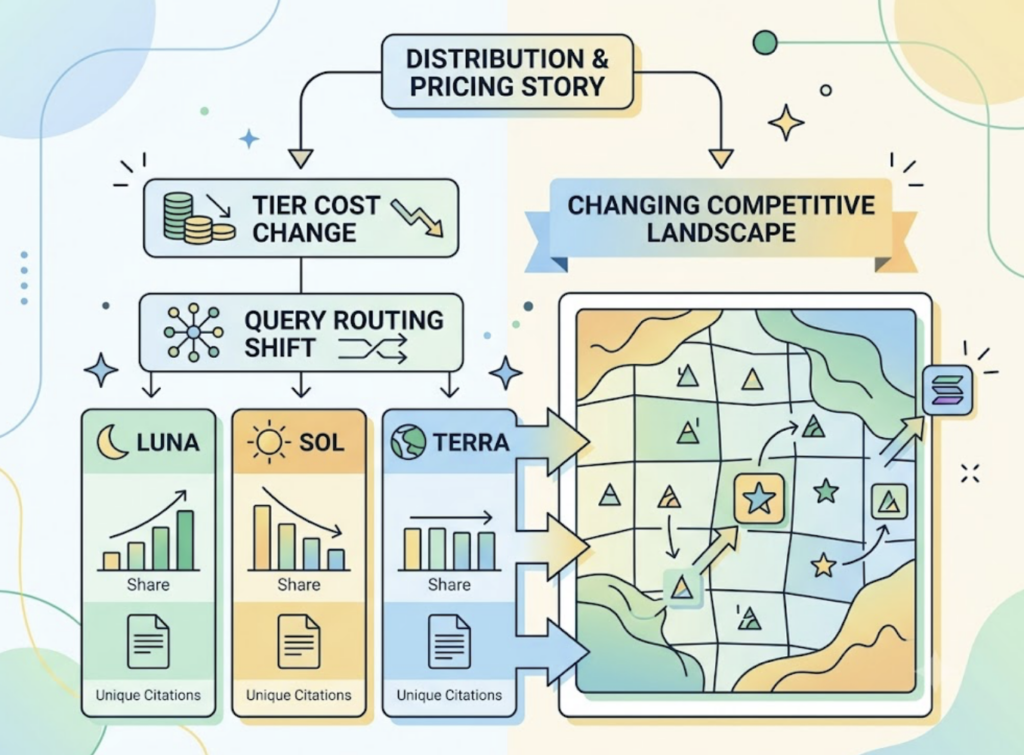
This kind of recalibration happens every time a model updates, a new tier launches, or pricing changes. Google’s Gemini 3.5 Flash launched at $1.50/$9 per million tokens in May 2026, undercutting its own Pro model. Anthropic introduced Claude Sonnet 5 at a promotional rate of $2/$10 that’s scheduled to rise to $3/$15 after August. Every one of those shifts changes which model processes which queries, and therefore which brands get cited.
The brands that treat these shifts as monitoring events, not headlines, are the ones that stay visible through them. Topify’s High-Value Prompt Discovery continuously surfaces the prompts where your brand appears or disappears, so when a tier rebalance shifts citation patterns, you see it within days, not quarters.
Conclusion
GPT-5.6 didn’t create the tiered model pattern. It confirmed it. Every major AI platform now runs a model family where different tiers reason differently, cite differently, and recommend different brands for the same question. The Semrush data shows 75% of cited sources change between reasoning modes on the same platform. The Yext data shows each platform follows its own sourcing logic on top of that.
The GEO strategies that worked when “AI visibility” meant one number on one platform can’t account for this complexity. What works now is tier-aware, cross-platform tracking: knowing which tier your brand wins in, which tier it loses in, and what content investments close the gap. Start by auditing your brand’s visibility across tiers, not just platforms. The answer will probably surprise you.
FAQ
Q: What are the three tiers of GPT 5.6?
A: GPT-5.6 comes in three variants. Sol is the flagship for complex reasoning and agentic work. Terra is the balanced mid-tier model for everyday tasks. Luna is the fastest and cheapest tier, designed for high-volume, speed-sensitive workloads. Each tier uses a different reasoning depth, which affects which sources it cites and which brands it recommends.
Q: Do different GPT 5.6 tiers recommend different brands?
A: Yes. Research from Semrush and Kevin Indig found that only 25.6% of cited domains overlap between ChatGPT’s minimal reasoning mode (aligned with Luna-level processing) and high reasoning mode (aligned with Sol-level processing). Three out of four sources change depending on which tier processes the query.
Q: How does GEO differ from traditional SEO?
A: Traditional SEO optimizes for search engine rankings and click-through rates. GEO (Generative Engine Optimization) optimizes for visibility, citations, and recommendations inside AI-generated answers from platforms like ChatGPT, Gemini, Perplexity, and Claude. In GEO, the goal isn’t to rank on a results page. It’s to be the brand that AI names, cites, and recommends when a user asks a question.
Q: How often should brands monitor their AI search visibility after a model update?
A: Continuously, or at minimum weekly during the first 2 to 4 weeks after a major model release or pricing change. Citation patterns can shift significantly within days of a new tier launch or price adjustment, as query routing changes and model behavior recalibrates.

