

Your brand’s AI search visibility just got split into three lanes. On July 9, 2026, OpenAI launched GPT 5.6 as a three-tier model family: Sol, Terra, and Luna. Each tier runs a different depth of reasoning, pulls from different source pools, and cites different domains. The GEO strategy you calibrated against last month’s ChatGPT model doesn’t map onto any single one of them.
That’s not a minor version bump. It’s a structural change to how ChatGPT decides which brands to mention, which sources to trust, and how many sub-queries to run before answering. And the data from previous model transitions suggests the visibility reset is already underway.
Three Models, One Generation: How GPT 5.6 Restructures ChatGPT
GPT 5.6 isn’t one model with a dial. It’s three distinct models, each tuned for a different point on the cost, speed, and capability curve.
Sol is the flagship. It handles complex reasoning, agentic workflows, deep research, and cybersecurity tasks. It’s the only tier with access to OpenAI’s new ultra mode and max reasoning effort. API pricing sits at $5 input / $30 output per million tokens, the same class as GPT-5.5.
Terra is the balanced mid-tier. OpenAI positions it as GPT-5.5-class quality at half the cost: $2.50 input / $15 output. It handles high-volume business tasks like customer support, document analysis, and internal tooling.
Luna is the fast, affordable option at $1 input / $6 output. It’s built for summarization, classification, drafting, and routine automation.
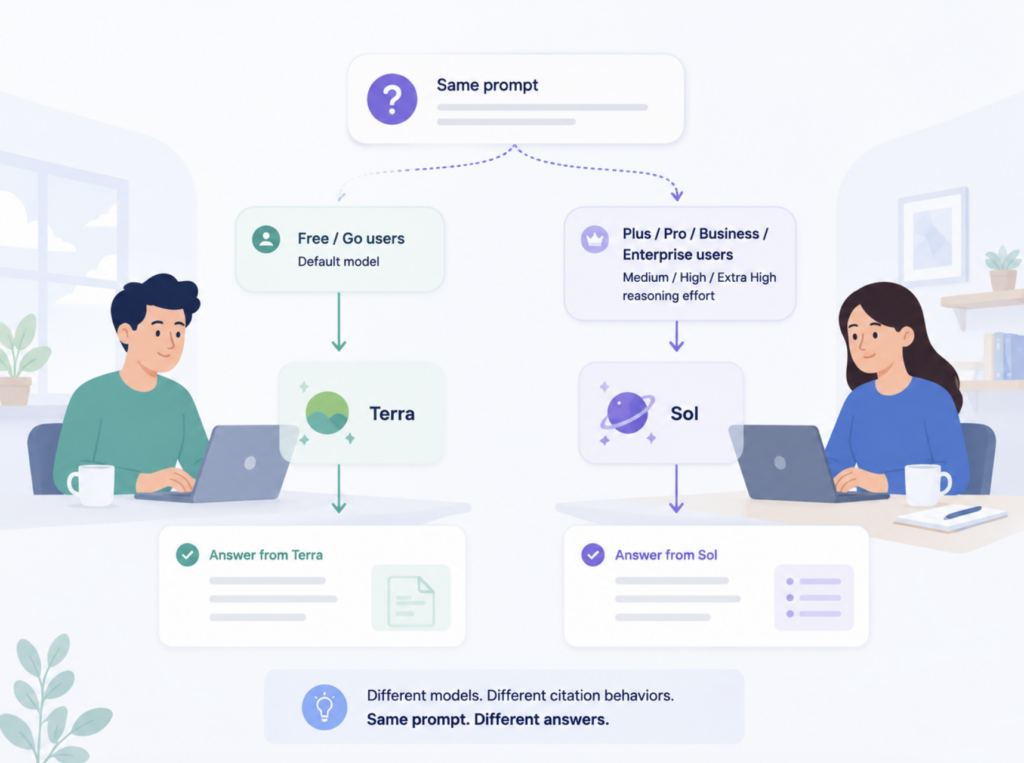
Here’s why this matters for brand visibility: the model a user gets depends on their plan and settings. Free and Go users default to Terra. Paid users on Plus, Pro, Business, and Enterprise get Sol when they select Medium, High, or Extra High reasoning effort. That means two people typing the exact same prompt into ChatGPT can get answers from fundamentally different models, with different citation behaviors.
The naming system itself signals permanence. The number (5.6) marks the generation. Sol, Terra, and Luna are “durable capability tiers” that OpenAI says will advance on their own cadence. This isn’t a one-time split. It’s the new default architecture.
Why Reasoning Depth Changes Which Brands Get Cited
The tier split wouldn’t matter much if all three models cited the same sources. They don’t.
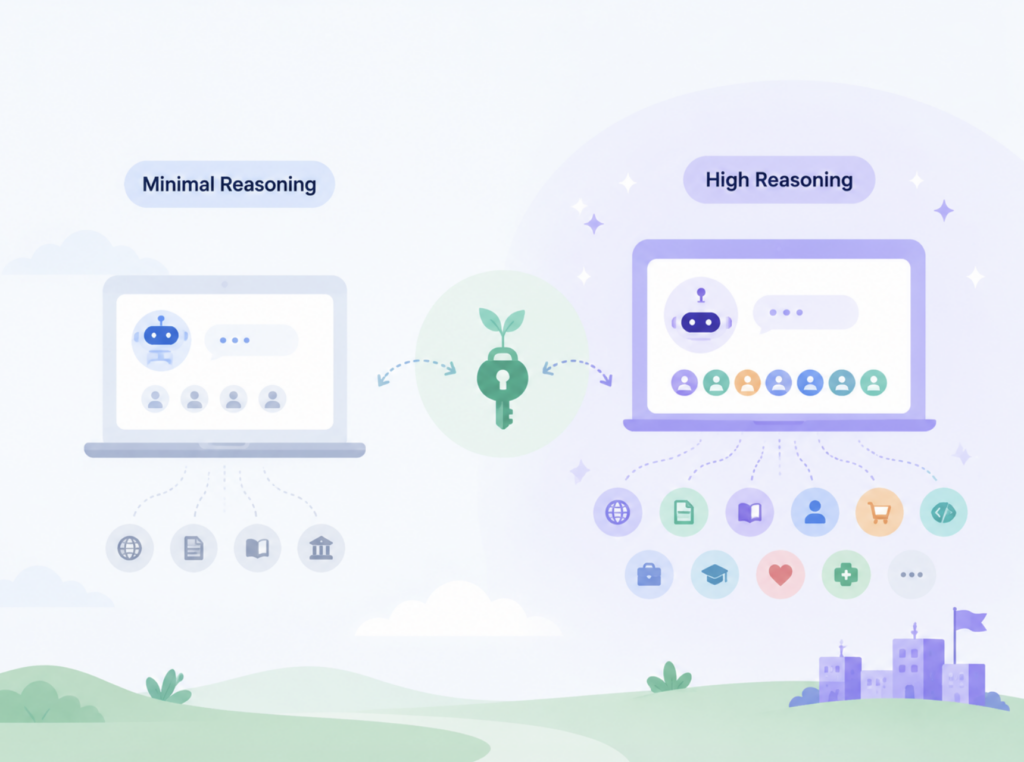
A joint study by Semrush and Kevin Indig tested 100 prompts across 20 buyer journeys, running each prompt twice: once with minimal reasoning (Instant mode) and once with high reasoning (Thinking mode). The gap was significant across every metric. Citation rates jumped from 50% to 68%. Average sources per response nearly doubled, from 2.6 to 4.5. Fan-out queries, the sub-searches ChatGPT runs before answering, increased 4.6x.
The source mix shifted just as sharply. Reddit’s citation share dropped from 15% to 7% when high reasoning was active. User-generated content and review sites fell from 14.3% to 6%. Official documentation and support pages climbed from 12.4% to 17.5%. Government and academic sources jumped from 1.9% to 8.8%.
Only 25.6% of the domains cited under minimal reasoning also appeared under high reasoning.
That single number reframes the entire GPT 5.6 visibility question. A brand that shows up consistently in Terra’s lighter reasoning mode may be completely absent when Sol does its deeper research pass. Two different citation surfaces, same platform, same prompt.
Sol Users vs. Terra Users: Two Audiences Your Brand Needs to Reach
The tier split doesn’t just change citation mechanics. It segments ChatGPT’s user base into distinct audience profiles with different intent signals.
Sol users are overwhelmingly paid subscribers working on complex tasks: purchase evaluations, competitive analysis, technical research, strategic planning. These are the prompts where brand recommendations carry the most commercial weight. When someone asks Sol to compare project management tools for a 200-person engineering team, the answer tends to cite official documentation, third-party editorial coverage, and structured product pages.
Terra and Luna users skew toward everyday queries: quick summaries, content drafts, general how-to questions. The commercial intent is often lower, but the volume is higher. And because Terra runs fewer sub-queries before answering, its citation pool is smaller. Head brands with strong general authority tend to dominate this tier.
Data from previous model transitions supports this pattern. Independent citation research on GPT-5.5 vs. GPT-5.4 found that GPT-5.5 cited brand sites 47% of the time, down from 57% on GPT-5.4. The mechanism was specific: GPT-5.4 used Google’s site: operator on 40.5% of its searches, force-fetching brand domains. GPT-5.5 dropped that to 12.6%, letting the search engine decide which domains to surface.
GPT 5.6 continues this trajectory. The model is becoming more selective, not less, about which brands earn a citation slot. And with three tiers running simultaneously, the selectivity varies by tier.
The Fan-Out Factor: How GPT 5.6 Searches Before It Answers
Before GPT 5.6 produces a visible answer, it runs a series of internal sub-queries. This “fan-out” behavior determines the candidate pool of sources the model considers before composing its response.
The scale difference across reasoning modes is dramatic. Under minimal reasoning, the Semrush study recorded 245 web searches across 100 prompts. Under high reasoning, that number hit 1,130. At the Comparison stage of buyer journeys, high reasoning averaged 24 sub-queries per prompt versus 5.5 for minimal.
More sub-queries means a larger candidate pool. High reasoning pulled from 173 unique domains versus 127 for minimal. Of those, 99 domains that appeared under high reasoning never appeared under minimal reasoning at all. That’s a significant surface area of potential brand exposure that only exists when the model thinks harder.
On the flip side, Terra and Luna’s shallower fan-out compresses the citation pool. Brands at the margin, the ones that appeared in one or two long-tail sub-queries, lose their entry point when the model runs fewer searches. An analysis of GPT-5.5’s fan-out behavior found the model averaged 7.3 fan-out queries per prompt, down from GPT-5.4’s 10.5. Fewer queries means fewer chances to get discovered.
The practical takeaway: your content needs to survive at different search depths. For Sol, that means having authoritative pages that surface across 15 to 20 sub-queries on a complex comparison prompt. For Terra and Luna, it means being authoritative enough to appear in a pool of five to seven queries.
What Breaks When the Model Changes: Citation Volatility Is the Norm
GPT 5.6 isn’t the first model transition to reset brand visibility. It’s the third major one in six months, and each previous shift produced measurable citation swings.
Between GPT-5.3 and GPT-5.4, brand citation behavior changed overnight. GPT-5.3 never cited a brand website in head-to-head comparison prompts. GPT-5.4 cited brands 83% to 100% of the time on the same prompts.
Then in March and April 2026, ChatGPT pulled back hard on external citations across the board. seoClarity trackedcitation volumes across five markets and found drops of 86% to 94% by late April. In May, citations rebounded toward pre-March levels. Their conclusion: “What first looked like a sustained decline now looks like volatility.”
That volatility is the baseline, not the exception. AirOps’ 2026 State of AI Search report found only 30% of brands stay visible from one AI answer to the next, and just 20% remain visible across five consecutive runs.
GPT 5.6 multiplies this volatility by adding a tier dimension. A brand might maintain visibility in Terra’s lighter mode while losing it in Sol’s deeper reasoning, or vice versa. Cross-platform tracking data from competitive software categories shows citation gaps of up to 34% between rivals during a single model transition. With three tiers running simultaneously, brands now need to monitor three citation surfaces instead of one.
How to Audit Your Brand Across All Three GPT 5.6 Tiers
The window after a major model transition is typically two to four weeks. That’s when citation patterns are most fluid and when proactive brands can establish new positions.
Here’s what the data suggests you should do now.
Split your prompt tracking by reasoning mode. Stop averaging your visibility score across all ChatGPT interactions. An aggregate number hides the tier-level reality. Run your core buyer prompts under both Sol-level reasoning (High/Extra High) and Terra-level reasoning (default/lower) and track results separately. The 25.6% domain overlap figure tells you these are functionally different search systems.
Prioritize the content types each tier rewards. Sol’s deeper reasoning elevates official documentation, support pages, and editorial coverage from high-authority publishers. Muck Rack’s May 2026 Generative Pulse study confirmed that earned media accounts for 84% of all AI citations across ChatGPT, Claude, and Gemini, while paid and advertorial content accounts for just 0.3%. If your brand relies on community content and UGC for visibility, expect Sol to discount those signals relative to Terra and Luna.
Don’t assume Google rankings translate. The disconnect between organic search performance and AI visibility is well documented. In large-scale tracking, 88% of URLs cited by AI engines didn’t appear in the top 10 organic results for the same queries. The correlation coefficient between organic rank and AI citation was just 0.034. GPT 5.6’s three tiers make this gap wider because each tier runs its own retrieval logic.
Monitor across platforms, not just ChatGPT. GPT 5.6 is one surface. Perplexity, Gemini, Claude, and Google AI Overviews each have their own citation patterns. BrightEdge data from March 2026 shows ChatGPT, Google AI Overviews, and AI Mode disagree on brand recommendations 61.9% of the time. A brand invisible in Sol might still be cited in Perplexity, or vice versa.
For teams that need to track this at scale, Topify monitors brand visibility across ChatGPT, Gemini, Perplexity, and AI Overviews through seven key metrics: visibility, sentiment, position, volume, mentions, intent, and CVR. The platform’s source analysis identifies exactly which domains AI platforms cite, so you can see whether your brand’s third-party coverage is reaching the sources each GPT 5.6 tier trusts. When citation patterns shift after a model transition, Topify’s competitor benchmarking shows how your visibility moved relative to rivals, not just in absolute terms.
Conclusion
GPT 5.6 turned ChatGPT from a single citation surface into three. Sol, Terra, and Luna each run different reasoning depths, pull from different source pools, and reward different content types. A brand that’s visible in Terra’s quick answers may not exist in Sol’s deep research pass, and the 25.6% domain overlap between reasoning modes confirms these are functionally separate systems.
The brands that come out ahead during this transition won’t be the ones with the strongest Google rankings or the most social proof. They’ll be the ones that track visibility per tier, invest in the earned media and structured content that Sol rewards, and treat every model transition as a monitoring event, not a headline. If you haven’t audited your brand’s visibility across the new GPT 5.6 tiers yet, the recalibration window is closing. Start tracking now.
FAQ
Q: Does GPT 5.6 replace GPT-5.5 in ChatGPT?
A: Not entirely. GPT-5.5 Instant remains the default for fast everyday responses. GPT 5.6 Sol activates when paid users select Medium, High, or Extra High reasoning effort. Free and Go users access Terra through ChatGPT Work and Codex, while Sol is reserved for Plus, Pro, Business, and Enterprise plans.
Q: Do Sol, Terra, and Luna cite different brands for the same prompt?
A: The data strongly suggests yes. Semrush’s study found only 25.6% of cited domains overlap between minimal and high reasoning modes. Sol’s deeper fan-out queries surface different sources and favor different content types (official documentation, editorial coverage) compared to Terra and Luna’s lighter approach.
Q: How often do AI citation patterns change after a model update?
A: Frequently and sharply. seoClarity tracked citation drops of 86% to 94% in March-April 2026, followed by a rebound in May. AirOps found only 30% of brands stay visible from one AI answer to the next. Model transitions amplify this baseline volatility.
Q: How can I check if my brand is visible in GPT 5.6?
A: Run your core buyer prompts at different reasoning effort levels in ChatGPT (Medium for Sol, default for Terra) and compare which brands get cited. For continuous monitoring across multiple AI platforms, tools like Topify track visibility, citations, sentiment, and competitive positioning at the prompt level.

