

Two model upgrades in three months. Each one reshuffled which brands ChatGPT cites, how many sources it references, and how it retrieves them. SISTRIX tracked 3.8 million German-language ChatGPT responses during the GPT 5.5 rollout and found that 47% of all citations redistributed within 48 hours. Now GPT 5.6 is live, and it doesn’t behave the same way either.
If your visibility reports still treat “ChatGPT” as a single, stable engine, the numbers you’re reading describe a version of ChatGPT that may no longer exist.
The 47% Citation Shakeup That Started with GPT 5.5
On April 23, 2026, OpenAI released GPT 5.5. Within two days, the citation picture looked completely different.
SISTRIX’s analysis is the clearest dataset on the shift. The firm sampled 100,000 ChatGPT responses daily across 38 consecutive days, comparing citation behavior before and after the model switch. Normal day-to-day citation variation sits around 1 to 2%. During the GPT 5.5 transition, it hit 47%. The average number of sources cited per response also dropped, from roughly 31 to 28, suggesting the newer model became more selective about what it cites, not just different in what it prefers.
The brand-level data tells a similar story. A controlled comparison of 50 prompts across GPT 5.4 and GPT 5.5 found that brand-owned websites were cited in 47% of GPT 5.5 responses, down from 57% on GPT 5.4. That’s a ten-percentage-point drop in four days. The mechanism behind the drop was specific: ChatGPT’s use of site-scoped search operators collapsed from 40.5% to 12.6% of all queries. When the model stopped force-scoping searches to brand domains, third-party sources filled the gap.
That’s the pattern SISTRIX now calls a “ChatGPT core update.” German publishers and service brands gained citations. International aggregators lost ground. Reddit, despite being predominantly English, kept gaining across languages.
GPT 5.6: Three Models, Three Citation Profiles
GPT 5.6 arrived on July 9, 2026, and it introduced something the citation-tracking world hasn’t dealt with before: a single “ChatGPT” that’s actually three different models.
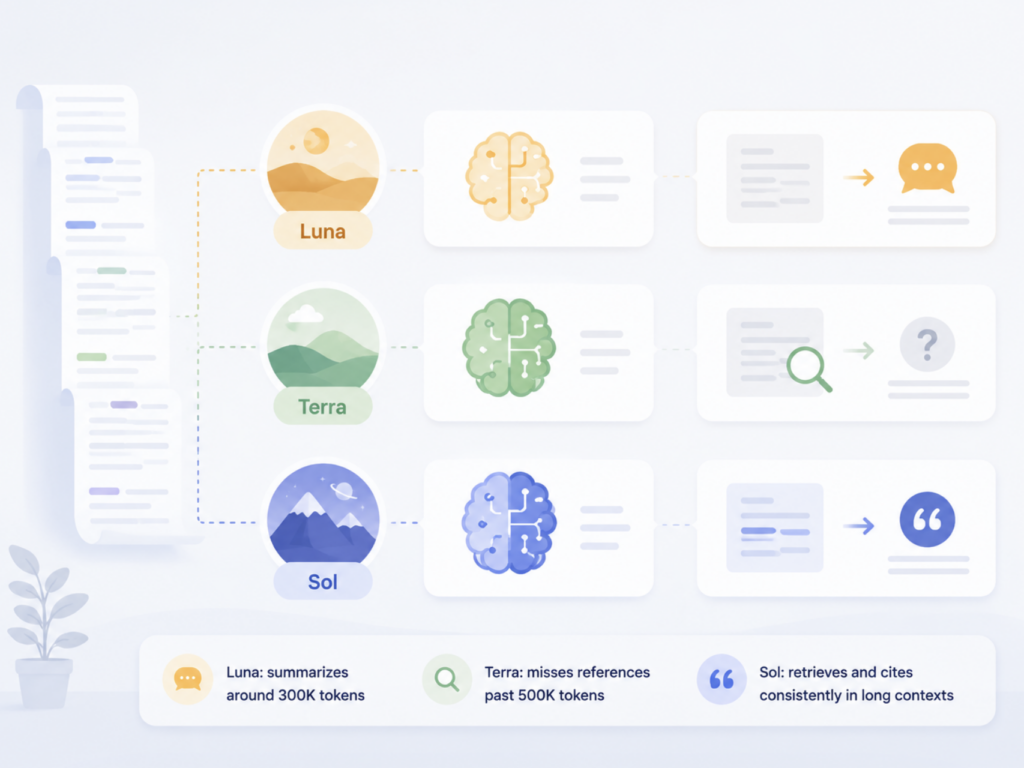
Sol is the flagship, built for complex reasoning and agentic workflows. It carries a 1.05-million-token context window, a new “ultra mode” that splits tasks across parallel subagents, and defaults to shorter answers than GPT 5.5. Terra is the everyday workhorse, positioned as a direct GPT 5.5 replacement at half the cost. Luna is the speed-and-cost tier, optimized for summarization, classification, and high-volume workflows.
Here’s why the three-tier structure matters for citations: each tier reasons differently, and reasoning architecture shapes what gets cited. In testing, Luna started summarizing instead of citing at around 300,000 tokens, while Terra missed references buried past the 500,000-mark. Sol, with its deeper reasoning stack, retrieved and cited more consistently across long contexts.
If your brand shows up when a Pro subscriber triggers Sol but disappears when a Plus user gets Terra, your “ChatGPT visibility” is an average of two different realities.
Topify flagged this problem on launch day. As the platform’s analysis put it: if your visibility reports treat ChatGPT as a single engine, you’re now measuring an average of three.
Why Every GPT Update Reshuffles Brand Visibility
The citation instability isn’t a GPT 5.5 or 5.6 story. It’s a structural pattern that shows up with every model transition.
Look at the cross-version data. When OpenAI replaced GPT 5.2 with GPT 5.4 as the default in March 2026, brand-site citation rates jumped from roughly 8% to 57%. Two months later, GPT 5.5 pulled them back to 47%. That’s not a trend. It’s two data points swinging in opposite directions, which means any strategy built on a single version’s behavior has a short shelf life.
seoClarity’s tracking across five markets (the US, UK, Canada, Germany, and Italy) captured the volatility in real time. Citation volumes dropped between 86% and 94% from February through April 2026, driven by platform-level shifts on March 8 and April 19. Then in May, citations rebounded toward pre-March levels. The takeaway isn’t “citations are disappearing.” It’s that AI search is inherently unstable.
Independent research quantifies this instability further. A study tracking over 3 million citation events across six AI platforms and eight industries found that the average non-network domain has a citation half-life of roughly 4.5 weeks. ChatGPT cycles through sources fastest, at 3.4 weeks. Perplexity is the stickiest at 5.7 weeks.
Single-version optimization is now structurally a worse strategy than building content that holds up across model transitions.
What Survives a Model Switch (and What Doesn’t)
Not everything resets when OpenAI ships a new model. Some content patterns held across the GPT 5.4 to 5.5 transition, and the data is specific enough to act on.
Pages with headlines that directly answer the user’s question were cited 41% of the time across both model versions. Sections between 120 and 180 words produced 70% more citations than shorter sections. Both patterns survived the transition cleanly, which means content architected for direct extraction outperforms content built purely for traditional SEO regardless of which model is running.
The deeper structural signal comes from Ahrefs’ analysis of 75,000 brands. Branded web mentions correlated with AI visibility at 0.664. Backlinks? 0.218. That’s a 3-to-1 gap. YouTube mentions showed an even stronger correlation at 0.737. The top quartile of brands by web mentions earned over 10 times more AI mentions than the next tier. Separately, research from Princeton, Georgia Tech, and IIT Delhi found that adding specific statistics to content improves AI visibility by 41%.
What doesn’t survive? Tactics tied to a specific model version’s retrieval quirks. The site-operator strategy that worked on GPT 5.4 collapsed overnight when GPT 5.5 changed its search pipeline. Any approach that depends on how one model queries the web, rather than on how your brand is perceived across the web, is vulnerable to the next update.
How to Track GPT 5.6’s Impact on Your Brand
The first step is to stop treating ChatGPT as a monolith. GPT 5.6 Sol, Terra, and Luna have different reasoning depths, different context handling, and different citation behaviors. A visibility strategy that doesn’t account for the tier serving the response is reading an average that doesn’t describe any single user’s experience.
Here’s a practical starting point. Run a set of 30 to 50 buyer-intent prompts across ChatGPT on different account tiers. Record which prompts return your brand, which tier produced the response, and which sources got cited. Do the same on Perplexity, Gemini, and Google AI Overviews. AI referral traffic is fragmenting fast: ChatGPT’s share of B2B AI referrals fell from 72.5% to 62.6% between January and April 2026, while Claude grew to 18.5% and Gemini reached 10.6%. Optimizing for one surface covers less ground than it did six months ago.
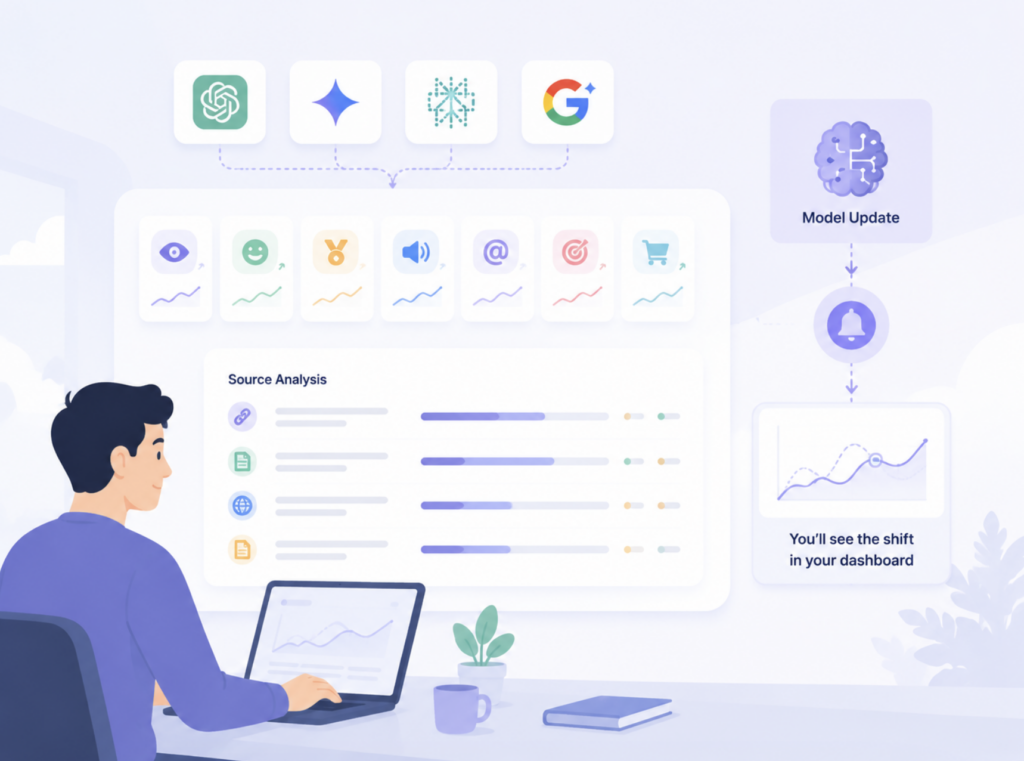
For teams that need this data continuously rather than as a one-time check, Topify’s Comprehensive GEO Analytics tracks brand performance across ChatGPT, Gemini, Perplexity, and Google AI Overviews through seven key metrics: visibility, sentiment, position, volume, mentions, intent, and CVR. Its Source Analysis feature reverse-engineers which domains and URLs AI platforms actually cite for your target prompts. When a model update hits, you’ll see the shift in your dashboard instead of discovering it in a traffic drop three weeks later.
If you want a free baseline before committing to a monitoring platform, Topify’s GEO Score Checker audits any URL against AI readiness criteria and returns a 0-to-100 score with a prioritized fix list. No signup required.
The brands that will hold visibility through GPT 5.6, 5.7, and whatever comes after aren’t the ones optimizing for today’s model. They’re the ones building content architectures and brand signals that are resilient to model-version changes.
Conclusion
The gap between GPT 5.5 and GPT 5.6 was 77 days. The gap between GPT 5.4 and GPT 5.5 was about a month. OpenAI’s iteration cycle is compressing, and each update carries measurable citation consequences: 47% redistribution, 10-point brand-site drops, entire retrieval strategies invalidated overnight.
The pattern is clear enough to plan around. Build content for direct extraction, not for a specific model’s search quirks. Invest in brand consensus signals (mentions, co-occurrence, earned coverage) over single-domain optimization. And track your citation data the way you’d track Google rankings: continuously, across platforms, with alerts when the ground shifts. That’s the baseline for the next update.
FAQ
Q: Does GPT 5.6 cite fewer sources than GPT 5.5?
A: Early observations suggest it can. GPT 5.6 Sol defaults to shorter responses than GPT 5.5, which tends to compress the number of sources referenced per answer. Luna, the budget tier, starts summarizing instead of citing around 300,000 tokens. But the picture varies by tier and prompt type, so it’s too early for a universal number.
Q: How often does ChatGPT change its citation behavior?
A: Every major model update shifts citation patterns. In the first half of 2026 alone, measurable citation changes occurred with the GPT 5.3 rollout (March), GPT 5.5 rollout (April/May), and the GPT 5.6 launch (July). Smaller fluctuations happen between major releases too. SISTRIX documented that normal day-to-day citation variation runs 1 to 2%, but model transitions can move 47% of citations within 48 hours.
Q: Should I optimize differently for Sol vs. Terra vs. Luna?
A: You shouldn’t target a specific tier, because you can’t control which model a given user triggers. Instead, focus on content patterns that hold across tiers: direct-answer headlines, 120-to-180-word modular sections, specific statistics, and broad brand consensus across third-party sources. These structural signals have survived multiple model transitions.
Q: How can I track whether a GPT model update affected my brand’s AI visibility?
A: Start with a baseline. Run buyer-intent prompts on ChatGPT and other AI platforms, and record mention rates, positions, and cited sources. For ongoing monitoring, platforms like Topify track citation changes across engines automatically and flag shifts when they happen. The key is having pre-update data to compare against, so you can distinguish a model-level change from a content-level problem.

