


You launched six months ago. Your product works. Your early users love it. Then you ask ChatGPT to recommend a tool in your category, and it lists five competitors you’ve never even heard of. Your brand doesn’t appear. Not at the bottom. Not as an honorable mention. Nowhere.
This isn’t a ranking problem. It’s a recognition problem. AI systems don’t discover brands the way search engines do. They synthesize answers from patterns of third-party coverage, structured signals, and repeated association between your brand name and a category. New brands start with none of those signals, which means AI has no raw material to work with, even if your product is objectively better than what it’s recommending.
The gap is fixable. But the playbook looks nothing like traditional SEO.
72% of Brands With Active SEO Still Get Zero AI Citations
The scale of the problem is worth quantifying. Research from BrightEdge found that 72% of brands actively investing in SEO receive zero citations from AI search engines. That statistic includes established brands with strong domain authority and years of backlink history.
For new brands, the odds are worse.
AI platforms are now processing serious volume. ChatGPT Search handles 250 to 500 million weekly queries. Perplexity processes roughly 50 million. Google AI Overviews appear on 25 to 30% of informational queries in the U.S. Combined, AI-mediated searches represent 15 to 20% of informational query volume as of Q1 2026.
That’s not a niche channel anymore. And if your brand isn’t being cited in those answers, a growing share of your potential audience will never encounter you.
Here’s the structural challenge: AI citation tends to be self-reinforcing. When a brand gets mentioned across multiple third-party sources, AI treats that as a trust signal and cites it more frequently. Ahrefs’ study of 75,000 brands found that brands in the top 25% for web mentions earn over 10x more AI citations than the next quartile. New brands sit at the bottom of that curve with zero momentum.
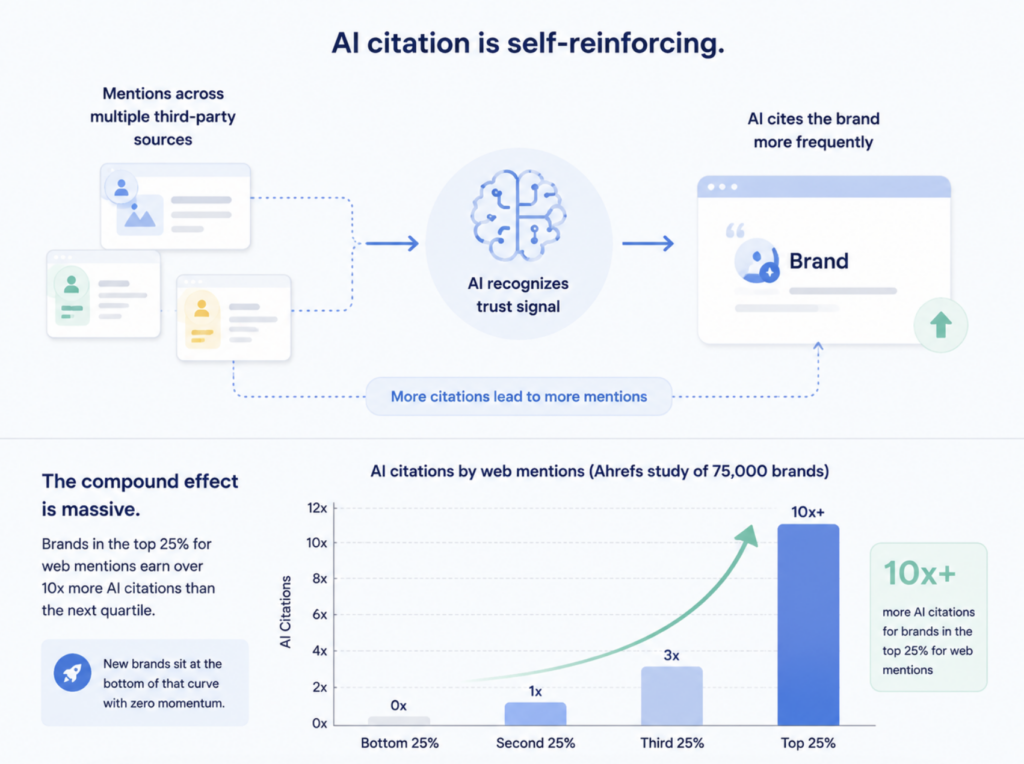
That’s the cold start problem. And solving it requires a different kind of investment.
What AI Brand Citation Actually Means
Before building a strategy, it helps to define the target precisely. AI brand citation isn’t a single event. It shows up in three distinct forms.
Brand mention: The AI names your brand in its response. “Some popular options include [your brand].” This signals recognition but not necessarily trust.
Recommendation position: Your brand appears in a ranked list or as a primary recommendation. “For [use case], [your brand] is a strong option because…” This signals both recognition and positive sentiment.
Source citation: The AI links to your domain or a third-party page about your brand as a reference. This is the deepest form of citation, where AI treats your content as evidence.
The critical insight for new brands: these three forms build on each other. You typically earn mentions before recommendations, and recommendations before source citations. Skipping ahead rarely works because AI systems use the same underlying pattern. They look for consistent, independent validation across multiple sources before trusting a brand enough to recommend it.
One data point makes this concrete. A 2025 analysis by Ahrefs found that branded web mentions correlate with AI visibility at 0.664, while backlinks correlate at just 0.218. The strongest predictor of AI brand citation isn’t link equity. It’s how many independent sources mention your brand by name, in context, across the web.
For a new brand, that reframes the entire growth strategy.
The AI Brand Citation Stack: 5 Layers New Brands Need to Build
Building AI citation authority from scratch isn’t about doing one thing well. It’s about layering five types of signals that compound over time. Skip a layer and the ones above it won’t hold.
Layer 1: Foundational Content That AI Can Actually Extract
AI doesn’t cite pages. It cites passages. The unit of competition is the best paragraph on the internet for a specific question.
That means your content needs to be structured for extraction, not just for reading. 44.2% of all LLM citations come from the first 30% of a page’s content. If your key claims are buried in paragraph eight, AI will pull from a competitor who puts the answer up front.
Three content formats consistently outperform others in AI citation rates. An Omniscient Digital analysis of over 23,000 AI citations found that listicles earn 21.9% of all citations, followed by articles at 16.7% and product pages at 13.7%. These three formats account for more than 52% of all AI citations.
For a new brand, the practical takeaway: start with comparison content and definitive guides in your category. Structure every page with clear headings, answer the target question in the first 40 to 60 words of each section, and use tables where you’re comparing features or options. Research from the Princeton-Georgia Tech GEO study found that adding statisticscan boost AI visibility by up to 40%, making it the single highest-impact content tactic in peer-reviewed GEO research.
Layer 2: Third-Party Source Seeding
This is where most new brands underinvest, and it’s the layer that matters most.
According to the AirOps 2026 State of AI Search report, 85% of brand mentions in AI-generated answers come from third-party pages, not owned domains. A separate Foundation Marketing study tracking 57 million AI citations found that only 10.15% linked to brand-owned domains. The remaining 90% linked to sources the brand doesn’t control: review sites, comparison articles, Reddit threads, YouTube videos, and community forums.
For new brands, this finding is both sobering and encouraging. You can’t rely on your own website to earn AI citations. But you also don’t need a decade of domain authority. A brand with zero traditional search dominance can get recommended to millions of users if it appears in the right third-party content, in the right format, with the right positioning.
Here’s a practical source seeding plan for the first 90 days:
| Channel | Action | Why It Works for AI Citation |
|---|---|---|
| Industry listicles | Get included in “best tools for [category]” roundups | Listicles are the single most-cited content format across AI platforms |
| Reddit and community forums | Contribute genuine value in relevant subreddits | Community platforms drive roughly 48% of citations according to AirOps |
| Review sites | Earn reviews on G2, Capterra, or industry-specific directories | AI systems cross-reference review platforms for brand validation |
| Guest content on authoritative publications | Publish data-driven pieces on niche media | Earned media distribution produces a 239% median citation lift |
The Stacker/GlobeNewswire study measured this precisely: the baseline citation rate for content on a brand’s own site was 8%. When the same content was distributed through third-party news outlets, the citation rate reached 34%.
That’s not a marginal improvement. It’s a 4x multiplier from distribution alone.
Layer 3: Technical Signals That Help AI Find You
Even strong content and third-party coverage won’t generate citations if AI crawlers can’t access or parse your site. This layer is often the easiest to fix and the most frequently neglected.
Three technical priorities for new brands:
Schema markup. Pages with structured data are 2.5x more likely to appear in AI-generated answers. Research from Authoritas found that pages with FAQPage schema were cited 41% of the time, compared to just 9% for equivalent pages without it. Start with Organization, Article, and FAQ schema in JSON-LD format.
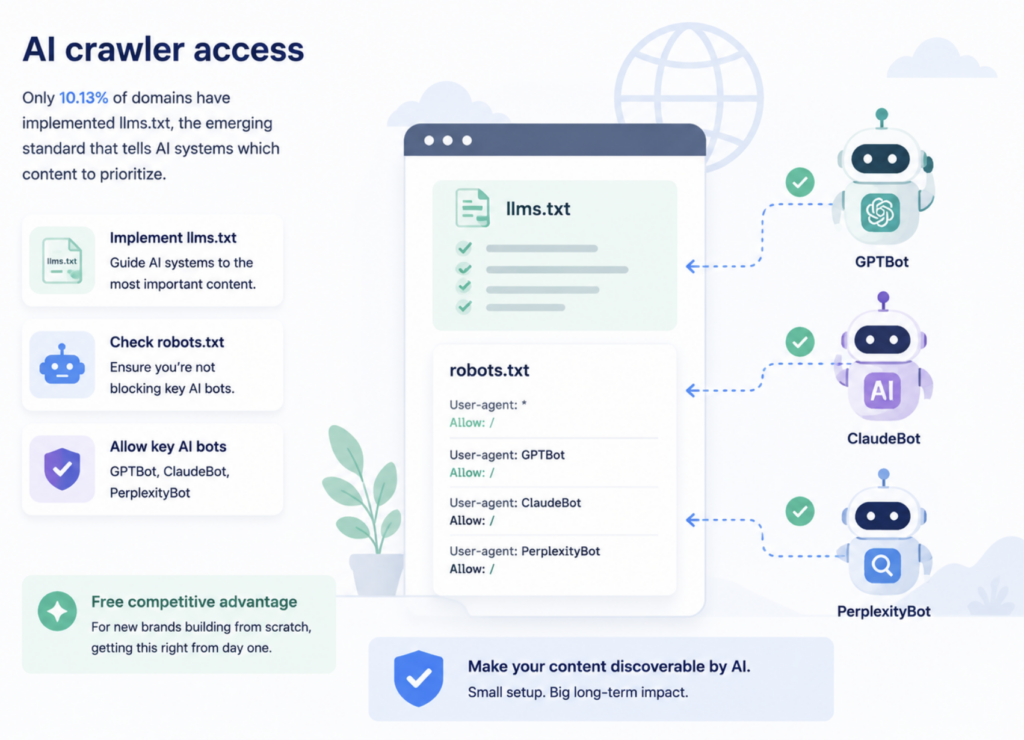
AI crawler access. Only 10.13% of domains have implemented llms.txt, the emerging standard that tells AI systems which content to prioritize. Check your robots.txt to make sure you’re not accidentally blocking GPTBot, ClaudeBot, or PerplexityBot. For new brands building from scratch, getting this right from day one is a free competitive advantage.
Server-side rendering. Content loaded via client-side JavaScript may be completely invisible to AI crawlers. If your site uses a JavaScript framework, make sure critical content renders server-side.
Layer 4: Citation Monitoring
You can’t optimize what you don’t measure. And AI citation is volatile. The AirOps 2026 report found that only 30% of brands that appear in an AI answer show up again in the next response to the same query. Run the same query five times, and just 20% of brands persist across all five.
For new brands, this means two things. First, a single manual check tells you almost nothing. AI answers are non-deterministic, so you need systematic, repeated monitoring to establish a baseline. Second, the volatility is actually an opportunity. If established brands aren’t locking in consistent positions, there’s room for a newcomer that builds the right signals.
Topify turns AI citation tracking into a structured workflow. Its Source Analysis feature shows which domains and URLs AI platforms actually cite for your target prompts. Instead of guessing which content assets are working, you can see whether your latest comparison guide or your G2 listing is the source AI pulls from. The Visibility Tracking dashboard monitors brand mentions across ChatGPT, Gemini, Perplexity, and Google AI Overviews, so you can track progress from zero mentions to your first citation and beyond.
For brands just getting started, Topify’s free GEO Score Checker runs a technical audit in seconds: AI bot access, structured data, content signals, and overall citation visibility. It’s a useful first step before investing in content or outreach, because a low technical score means your other efforts won’t translate into citations.
The High-Value Prompt Discovery feature is especially relevant for new brands. It surfaces the specific prompts where AI search volume is highest in your category, so you can prioritize content creation around the questions that actually drive AI recommendations instead of guessing which topics to target.
Layer 5: Iterative Optimization
AI citation patterns shift with every model update, training data refresh, and retrieval system change. Pages that go more than three months without an update are 3x more likely to lose AI visibility. For a new brand, this means the initial content push is just the starting point.
Build a monthly review cycle: check which prompts your brand appears in, which sources AI is citing, and whether your position is improving or declining. When you spot a citation gap (a prompt where competitors appear but you don’t), trace the source. Often, the fix is specific: get included in one more third-party roundup, update a stat in your comparison guide, or add schema to a product page that AI keeps skipping.
The brands that win AI citation authority aren’t the ones that publish the most content. They’re the ones that close feedback loops fastest.
3 Mistakes That Keep New Brands Invisible to AI
Even with the right framework, certain patterns reliably stall progress.
Treating AI citation like SEO. Traditional SEO optimizes for keywords and backlinks. AI citation rewards brand mentions, third-party consensus, and content extractability. A page can rank #1 on Google and still be absent from every AI answer. 90% of ChatGPT citations come from pages ranked #21 or lower or entirely unranked in traditional search. Optimizing for one doesn’t automatically deliver the other.
Publishing content without tracking AI outcomes. Most new brands measure content performance through organic traffic and keyword rankings. Neither metric tells you whether AI is citing your brand. Without citation tracking, you’ll keep producing content that performs well in traditional search but remains invisible to AI, and you’ll never know the difference.
One-time optimization instead of continuous iteration. AI’s citation patterns change every few weeks. The AirOps data shows 70% of AI Overview citations change within two to three months. A “set and forget” approach guarantees declining visibility over time, even from a strong starting position.
Conclusion
New brands face a real cold start problem in AI search. Zero mentions means zero citations means zero momentum. But the data also shows the path forward is structural, not miraculous. Third-party source seeding matters more than domain authority. Content format and structure matter more than word count. Technical signals like schema markup and AI crawler access are free advantages most competitors still haven’t implemented.
Start with the foundation: run a GEO Score Checker audit to establish your technical baseline. Identify the 10 to 15 prompts that matter most in your category. Then build outward, one third-party placement, one structured content asset, one citation gap closed at a time. AI citation authority compounds. The brands that start building now will be the ones AI recommends six months from now.
FAQ
Q: How long does it take for a new brand to start getting cited by AI?
A: Most new brands can earn their first AI mentions within 60 to 90 days with focused effort on third-party source seeding and structured content. Consistent citations across multiple prompts typically take four to six months. The timeline depends heavily on how quickly you build third-party coverage, since 85% of AI brand mentions come from external sources.
Q: Does domain authority affect AI brand citation?
A: Less than most people assume. Ahrefs’ study of 75,000 brands found that branded web mentions correlate with AI visibility at 0.664, while traditional backlink metrics correlate at just 0.218. High domain authority helps, but a new brand with strong third-party mentions can outperform an established site with a weak off-site presence in AI answers.
Q: Which AI platforms should new brands prioritize for citation?
A: Start with ChatGPT and Perplexity, since they process the highest volume of commercial and informational queries. Google AI Overviews matter for brands targeting search-originated traffic. Each platform has different citation behavior, and only 11% of domains are cited by both ChatGPT and Perplexity, so cross-platform monitoring is important from the start.
Q: Can you build AI citation authority without a big content budget?
A: Yes. The highest-leverage activities for new brands are getting included in existing third-party listicles and comparison content, contributing to relevant community discussions, and ensuring your site’s technical infrastructure is AI-crawler friendly. Schema markup implementation, llms.txt setup, and robots.txt configuration cost nothing and create measurable citation advantages.

