

The mention baseline your team built over the past year of GPT-5.5 monitoring stopped meaning anything on July 9, 2026. That’s when OpenAI publicly released GPT-5.6 after a two-week government review period, replacing a single model with three tiers named Sol, Terra, and Luna. Different retrieval behavior, a refreshed knowledge base, and a new user distribution across tiers mean the question “does ChatGPT mention my brand” now has at least three different answers. This guide walks through how to rebuild your tracking system for the new model family, starting today.
GPT-5.6 Just Reset Your Brand’s AI Visibility Baseline
Model generation changes don’t just improve text quality. They reshuffle training data, retrieval strategies, and recommendation logic, which are the exact mechanisms that decide whether your brand gets named in an AI answer.
The GPT-5.6 rollout came with unusual friction. OpenAI launched a limited preview on June 26 restricted to government-approved partners, then received clearance for a full public release after additional testing by the Department of Commerce. Fourteen days later, the models reached everyone.
Your GPT-5.5 mention data is now a historical record, not a benchmark.
What makes this generation different for brand tracking is the tier structure. GPT-5.6 isn’t one interface. It’s three models with different reasoning depth and different cost profiles, per pricing confirmed by OpenAI:
| Model | Positioning | Input Cost per 1M Tokens | Output Cost per 1M Tokens |
|---|---|---|---|
| GPT-5.6 Sol | Flagship, maximum reasoning, built for long-horizon agentic work and complex analysis | $5.00 | $30.00 |
| GPT-5.6 Terra | Balanced default, performance comparable to GPT-5.5 at roughly half the cost | $2.50 | $15.00 |
| GPT-5.6 Luna | Low-latency, lowest-cost tier for high-volume basic tasks | $1.00 | $6.00 |
Pricing shown is subject to change; refer to OpenAI’s official pricing page for current rates.
An enterprise buyer running deep research through Sol and a free user getting a quick summary from Terra are querying two different neural networks. Your brand’s visibility can diverge sharply between them.
What Changed in ChatGPT 5.6 That Affects Brand Mentions
The naming system itself changes who sees what. The number marks the generation, while Sol, Terra, and Luna mark persistent capability tiers. Free and Go users default to Terra. Plus, Pro, Business, and Enterprise subscribers can select Sol at medium and higher reasoning effort, with a Sol Pro option reserved for Pro and Enterprise plans.
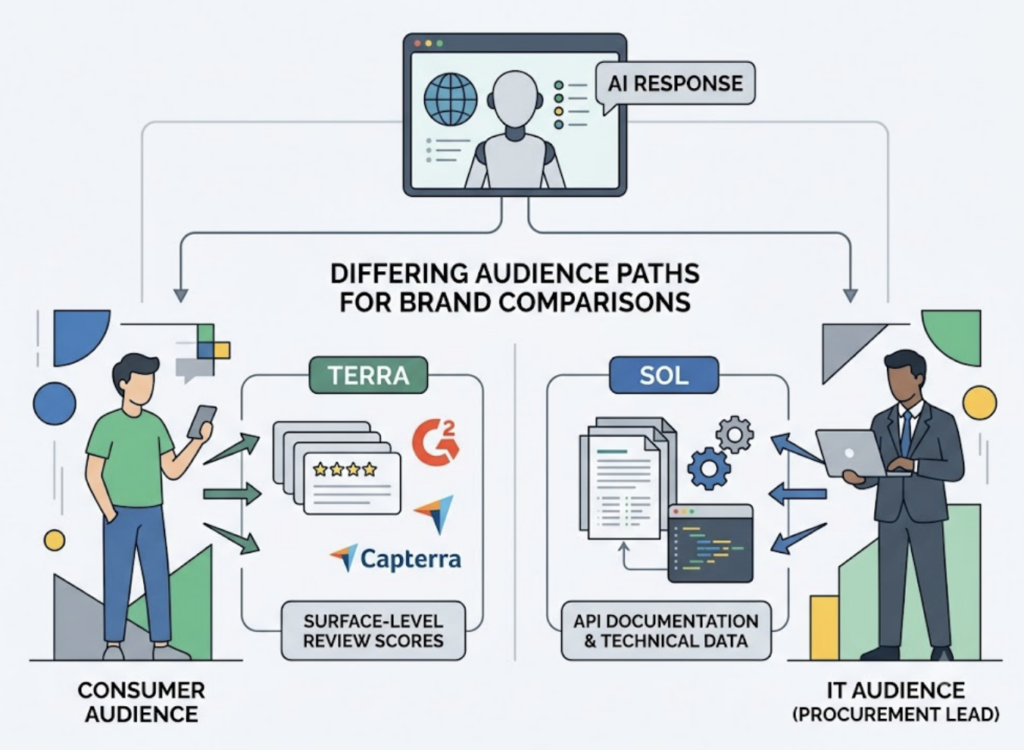
In practice, that splits your audience. When a consumer and an IT procurement lead ask ChatGPT the same brand comparison question, Sol may dig through your API documentation and recent technical discussions, while Terra tends to synthesize surface-level review scores from sites like G2 or Capterra.
Terra’s economics create a second-order effect that matters even more. Because Terra roughly matches GPT-5.5 performance at half the API cost, third-party applications, CRMs, and vertical SaaS platforms have a strong incentive to migrate their language layer to it. Your brand’s exposure surface extends well beyond the ChatGPT interface into every product that embeds the API.
There’s also a shift in what a “mention” even is. GPT-5.6 powers a new agent that works across connected apps and filesto produce documents, spreadsheets, and presentations. Sam Altman told CNBC the model is 54% more token efficient on agentic coding tasks, which gives it room to compare more options, fetch more sources, and verify claims before writing. If an agent drafting a 30-page vendor evaluation skips your brand because your data isn’t extraction-friendly, that lost mention never shows up in any chat log you can spot-check.
Step 1: Establish Your New Mention Baseline Across Sol, Terra, and Luna
Start by defining a prompt universe that reflects how buyers actually ask, not how your brand describes itself. Three categories cover most commercial intent.
Category queries test unprompted recall: “recommend a scalable expense platform for a fast-growing B2B software team.” Comparison queries test head-to-head framing: “compare Competitor A and Competitor B for high-concurrency workloads,” where the useful signal is whether the model introduces your brand as a third option. Pain-point queries map directly to buying triggers: “how do I fix database sync failures caused by cross-region latency, and what enterprise tools handle this.”
A working set runs 100 to 250 prompts. Then comes the part most teams underestimate: every prompt needs to run against all three tiers, because the same question produces materially different answers at different reasoning depths.
Luna, constrained by minimal reasoning budget, tends to output the most conservative, high-frequency brand lists. Terra balances name recognition against feature fit. Sol, especially at higher effort settings, pulls recent technical reviews and community discussions into its answer, consistent with the deep-retrieval behavior OpenAI describes in its Sol preview documentation.
LLM outputs are also non-deterministic, so a single run per prompt proves nothing. At the scale of hundreds of prompts, multiple samples, three tiers, and a weekly cadence, manual checking is arithmetic you lose. Platforms like Topify handle this with automated Visibility Tracking, parsing thousands of AI answers per month (up to 9,000 on the entry plan) so the noise averages out and a statistically usable baseline emerges.
Step 2: Compare Pre- and Post-5.6 Visibility Data
With a fresh baseline in hand, run it against your GPT-5.5 era numbers. The comparison needs four dimensions, not one.
Visibility rate tells you whether the brand entered the model’s consideration set at all. Position tells you whether you’re the lead recommendation or an afterthought at the end of a list, and the commercial gap between those two placements is enormous. Sentiment decodes the framing around your mention: endorsement, neutral description, or a caveat. Citation share reveals which sources produced the mention in the first place.
If your mention rate dropped 20% overnight, the model changed, not your brand.
That distinction matters because the instinct after a data cliff is internal blame: the content team, the last PR cycle, the product page. Generation changes are the more likely cause, and the fix is different.
Here’s how the layered view plays out. Suppose an enterprise finance platform led most GPT-5.5 comparisons as “the most comprehensive option.” After the switch to Sol, Position Tracking shows it slipping to second while Sentiment Analysis flags a decline. Digging into the answer context reveals Sol picked up developer forum threads about API latency and started appending a caveat: strong feature set, but a potential concern for high-frequency API users. That’s a specific, fixable narrative problem. You can update technical documentation and address the community discussion before the caveat hardens into machine consensus. Without tier-level position and sentiment data, you’d never know which thread to pull.
Step 3: Trace Which Sources GPT-5.6 Actually Cites
Mention changes have causes, and the causes live in the citation layer. New model generations typically refresh both the training corpus (GPT-5.6’s knowledge reportedly extends to February 2026) and the weighting of live retrieval sources.
Traditional SEO signals won’t guide you here. Industry analyses of citation behavior suggest the domains LLMs cite overlap very little with Google’s first page, with ChatGPT’s overlap against top-10 organic results reported as low as roughly 2%, and even search-leaning Perplexity around a third. Holding your SERP position is not a strategy for holding AI visibility.
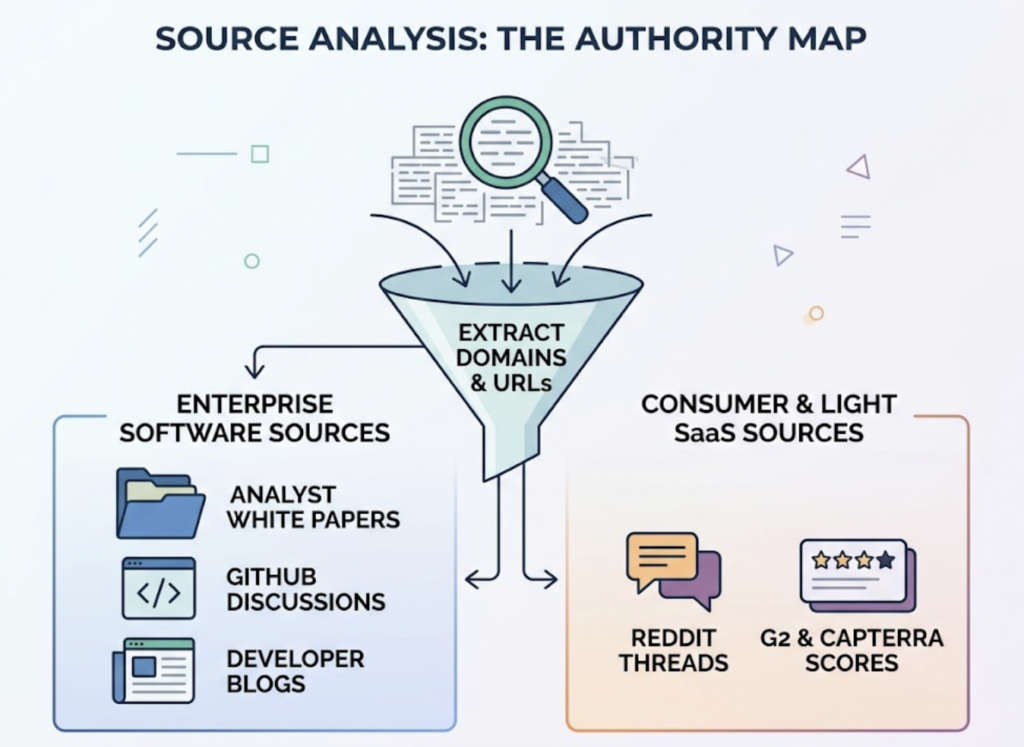
Source Analysis inverts the problem. Instead of guessing what the model reads, you extract the actual domains and URLs behind each brand mention. The pattern that emerges is usually a new authority map: for enterprise software, GPT-5.6 tends to weight GitHub discussions, analyst white papers, and in-depth developer blogs. For consumer and lightweight SaaS categories, Reddit threads and structured review scores on G2 or Capterra often do the heavy lifting.
Once the map is visible, budget allocation gets simple. If Terra’s answers for your core category query lean on five specific review sites and you appear on two, the next quarter’s priority isn’t more blog volume. It’s closing the three missing placements through outreach, partnerships, or fresher data those sites can use. Cover the sources the model trusts, and the next retrieval cycle works in your favor.
Common Mistakes When Tracking Brand Mentions in a New Model
Three failure patterns show up repeatedly when teams respond to a model transition.
The first is testing only the flagship tier. Sol’s benchmark results are impressive (Sol Ultra scores 91.9% on Terminal-Bench 2.1), and it’s tempting to treat it as the definitive judge of your brand. But Terra carries the free-user base and the third-party API ecosystem. A brand that wins Sol’s deep analysis while staying invisible in Terra’s everyday answers has won a small audience of power users and lost the mainstream.
The second is replacing continuous monitoring with a one-time audit. A big launch-week test produces a satisfying report, and then the tracking stops. Model outputs drift constantly as OpenAI fine-tunes, caches reset, and competitors publish. Without a time series, you can’t tell whether next week’s ranking dip is random noise or a real share shift caused by a competitor’s PR push.
The third is misattributing drops to your own content quality. When visibility shrinks on key prompts, the reflex is to question the content team’s output. More often, the new model has reweighted its sources, demoting a press release site you relied on and promoting a developer forum you’ve ignored. Unless you connect the mention drop to a specific citation change, the internal blame cycle burns morale and points optimization at the wrong target.
Why Manual Spot-Checks Break Down at GPT-5.6 Scale
The old habit of opening a few browser tabs and typing your category keywords worked, barely, when there was one model behind one interface. The math no longer allows it.
A minimally useful monitoring program covers 100 prompts. Non-determinism requires around 5 samples per prompt. Three tiers multiply that again, and a weekly cadence adds the time axis. That’s tens of thousands of long-form answers per month to collect, read, and score for position, sentiment, and hidden citations. No team does that by hand.
This is where structured monitoring platforms earn their place. Topify’s Comprehensive GEO Analytics breaks every AI answer into seven metrics: Visibility, Mentions, Position, Sentiment, Volume, Intent, and CVR, which estimates how likely an answer is to drive actual brand engagement. Instead of a raw mention count, you get a profile of how the algorithm perceives your brand and where the leverage points are.
Coverage matters as much as depth. Buyer journeys don’t stay inside one model family, and Topify tracks the GPT-5.6 lineup alongside Gemini, Perplexity, DeepSeek, and Doubao from a single dashboard. That cross-platform view is often where teams find arbitrage: a category where competitors dominate ChatGPT but nobody has claimed Perplexity yet.
The entry cost is modest relative to the stakes. The Basic plan runs $99 per month with 100 tracked prompts, 9,000 monthly AI answer analyses, and a 30-day trial, which is enough to run the full three-step process in this guide before committing budget. You can get started here and have a Sol-Terra-Luna baseline within the trial window.
Conclusion
GPT-5.6 isn’t an incremental update for brand teams. The Sol, Terra, and Luna split means AI visibility is now tier-specific, the third-party migration to Terra extends your exposure surface beyond ChatGPT itself, and agent workflows turn mentions into something that happens inside documents you’ll never see.
The response is a process, not a panic: rebuild your prompt baseline across all three tiers this week, compare the four core metrics against your GPT-5.5 history, and trace mention changes back to specific citation shifts before touching your content budget. Teams that establish the new baseline in the first month of a model generation get a reference point their competitors won’t have.
FAQ
Q: Does GPT-5.6 use different sources than GPT-5.5?
A: Yes, and the difference is significant. Beyond the refreshed knowledge cutoff, GPT-5.6’s upgraded retrieval and tool-calling behavior favors technically substantive, well-structured sources with independent verification signals over thin marketing pages. The citation set that earned your brand mentions under GPT-5.5 may be largely replaced, which is why source-level analysis should come before any content changes.
Q: Which GPT-5.6 model should I track first, Sol, Terra, or Luna?
A: Track Sol and Terra in parallel. Sol drives the recommendations that paid subscribers, executives, and research agents see. Terra serves free users and the growing set of third-party apps built on its cheaper API. Missing either one gives you a distorted picture. Luna is a secondary check for latency-sensitive, high-volume use cases.
Q: How often should I check brand mentions after a model update?
A: Run high-density sampling for roughly the first two weeks after a major release to establish the new baseline, then shift to weekly monitoring. Because model outputs are stochastic, single spot-checks carry no statistical weight; trend lines over time are what separate real ranking shifts from noise.
Q: Can I track brand mentions in ChatGPT for free?
A: You can query ChatGPT manually at no cost, but manual checks can’t control for context, can’t sample at volume, and can’t reach Sol if you’re on a free plan. For decision-grade data across tiers, a platform trial is the practical free option; Topify’s Basic plan includes a 30-day trial covering position, sentiment, and citation tracking.

