

Your next enterprise buyer might never visit your website. Not because they found a competitor first, but because they never searched at all. They handed the entire vendor research project to an AI agent, walked away for an hour, and came back to a finished shortlist.
If your brand isn’t on that shortlist, you didn’t lose the deal. You were never in it.
That’s the scenario the ChatGPT 5.6 launch just made real for B2B marketers. On July 9, 2026, OpenAI shipped ChatGPT Work, an autonomous agent powered by the new GPT-5.6 model family. It doesn’t answer questions. It completes projects. And vendor research is exactly the kind of project it’s built for.
What the ChatGPT 5.6 Launch Actually Ships
ChatGPT Work is an agent with built-in Codex that can complete multi-step tasks across web, mobile, and desktop, pulling context from a user’s connected apps and files. It can run for hours on a single goal, use a built-in browser to research the open web, and produce reports, spreadsheets, and presentations without a human touching the intermediate steps.
The engine underneath is GPT-5.6, released in three tiers: Sol for the most demanding work, Terra for everyday balance, and Luna for speed and cost. OpenAI says the new family is 54% more token efficient on agentic coding, and API pricing starts at $1 per million input tokens for Luna, scaling up to $5 for Sol.
Two details matter more than the benchmarks. First, ChatGPT Work connects directly to Slack, Gmail, Google Drive, Microsoft Teams, and CRM tools, which means agent recommendations land inside the buyer’s actual workflow. Second, an ultra mode coordinates four agents in parallel for demanding tasks, so a single research request can fan out into dozens of retrieval passes.
This isn’t a model upgrade. It’s a change in who does the searching.
Agentic Search Isn’t Search. It’s Delegated Research.
Traditional search puts a human in the loop at every step: type a query, scan results, click, read, repeat. Even standard AI chat keeps a single query-response rhythm. Agentic search breaks both patterns.
An agent performs iterative, multi-step research. It reformulates queries based on what it finds, drills into vendor qualifications, and adapts its strategy mid-task. If you want a visual breakdown of how autonomous agents differ from traditional AI in planning and execution, this comparison of agentic vs. traditional AI covers the core mechanics.
Three differences reshape brand discovery:
| Dimension | Traditional Search | Agentic Search |
|---|---|---|
| Who queries | Human types 1-2 searches | Agent runs dozens of retrieval passes per task |
| What the buyer sees | A results page with 10 links | A synthesized report or shortlist |
| How brands win | Rank high, earn the click | Get cited inside the agent’s reasoning |
The zero-click reality is the sharpest edge. The agent does the reading on the buyer’s behalf, so click-through metrics stop describing anything real. If your brand isn’t in the agent’s final reasoning output, it effectively doesn’t exist for that buyer.
There’s no page two in agentic search. There’s the shortlist, and there’s invisible.
Why B2B Brands Are More Exposed Than B2C in This Shift
B2B buying is research-intensive by nature. Vendor comparisons, RFP analysis, security reviews, pricing breakdowns: these are exactly the long-horizon tasks ChatGPT Work was designed to absorb. Industry research from Deloitte Digital and SaaStr suggests up to 90% of B2B purchases could involve AI agents within three years.
The workflow integration makes the exposure worse. When an agent can weigh your public reputation against a company’s internal procurement history and existing tech stack, the recommendation it produces carries context no landing page can override. The shortlist arrives pre-validated.
And the economics are unforgiving. A B2C brand missing from one AI answer loses a $40 purchase. A B2B brand missing from an agent-generated vendor shortlist loses a six-figure contract and a multi-year relationship, without ever knowing the evaluation happened.
That last part is the trap. The deal doesn’t die in your pipeline. It dies before your pipeline.
What GPT-5.6 Agents Actually Read Before They Recommend You
Agents don’t browse the way humans do, and they don’t rank the way Google does. Traditional SEO signals like keyword density and backlink volume show limited correlation with how likely an agent is to cite a brand in its synthesis. The signals that do move the needle look different:
Reference rates. The probability of being cited as a solution across an agent’s retrieval passes. Agents running in ultra mode coordinate parallel workstreams, so a brand with thin coverage across sources gets averaged out of the final answer.
Machine-readability. Structured product documentation, comparison-ready feature matrices, and clear pricing pages give agents something to extract. Ambiguous marketing copy tends to get skipped, not interpreted.
Third-party authority. Agents pull from diverse, authoritative sources to validate claims. Consistent mentions in niche-expert journals, review platforms, and peer communities raise your reference probability far more than another self-published blog post.
Live integrations. Deep links into platforms like Salesforce or ServiceNow let agents fetch current vendor data directly, which increasingly functions as a trust signal in its own right.
Here’s the thing: your Google rank can be excellent while your agent visibility is zero. The two systems read the web differently, and optimizing for one no longer guarantees the other.
You Can’t Optimize What You Can’t See
Agentic search creates a measurement blackout. Agent retrieval doesn’t generate referral traffic, so your analytics dashboard shows nothing. No impressions, no clicks, no sessions. A buyer’s agent could evaluate and reject your brand fifty times this quarter, and Google Analytics would report business as usual.
Closing that gap starts with visibility tracking. Topify monitors how often your brand appears in AI answers across ChatGPT, Gemini, Perplexity, and other major platforms, measuring visibility, sentiment, position, and mentions in one view. Because agents behave as a black box, tracking which models see you and which don’t is the only reliable way to diagnose where visibility gaps live. In practice, that means you can spot that your brand surfaces in responses on one platform but drops out of procurement-style prompts on another, then trace the gap to specific sources that never cite you.
Source analysis handles the second half of the diagnosis. Topify reverse-engineers the exact domains and URLs AI platforms cite, so you can see whether your content, or your competitor’s, dominates the references agents actually pull from. Pair that with competitor benchmarking, which shows who the AI engines recommend for your category’s buying prompts, and the black box starts producing answers instead of anxiety.
Track it. Diagnose it. Then optimize with evidence instead of guesses.
A 30-Day Playbook for the ChatGPT Work Era
You don’t need a full GEO strategy on day one. You need a baseline and a direction.
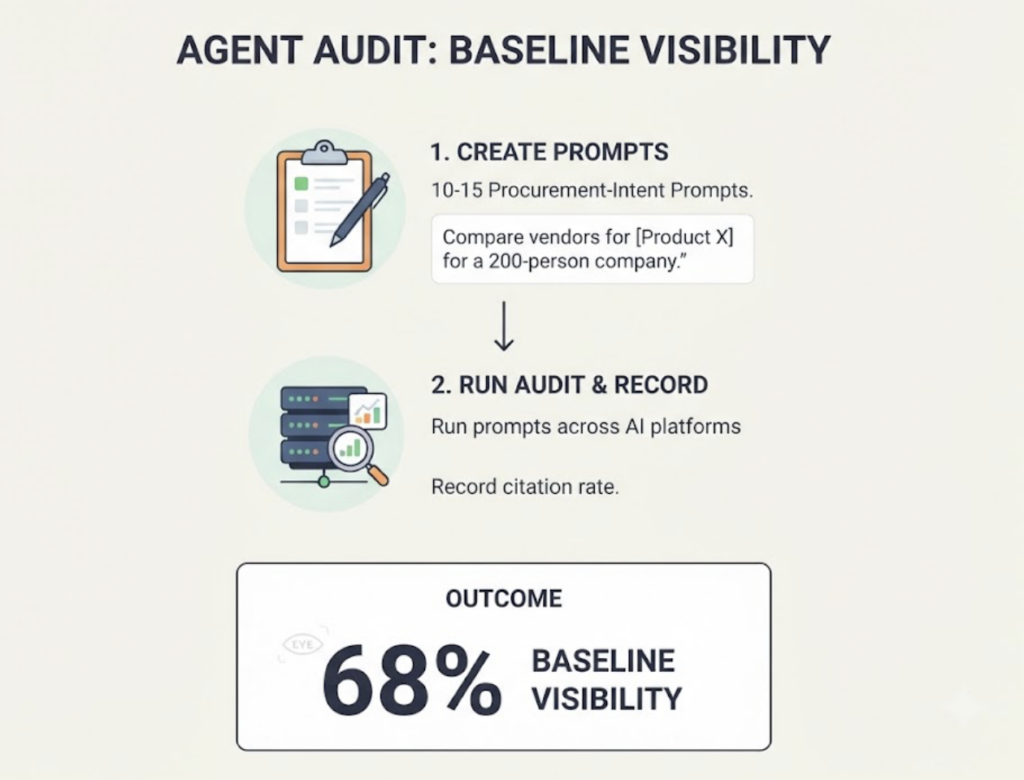
Week 1: Run an agent audit. Write 10-15 procurement-intent prompts your real buyers would delegate. Think “compare top vendors for X and recommend one for a 200-person company,” not “what is X.” Run them across AI platforms and record your citation rate. This is your baseline visibility number.
Week 2: Audit your sources. Identify which domains AI answers cite for your category. Check whether you’re present on those domains, then flag the gaps where competitors appear and you don’t. This becomes your earned-media target list.
Week 3: Fix machine-readability. Add structured data, build comparison-ready feature matrices, and publish documentation agents can parse. Prioritize the pages that answer buying questions directly.
Week 4: Set up continuous monitoring. Agent behavior shifts every time models update, and GPT-5.6 just proved how fast that happens. Get started with ongoing tracking so a visibility drop shows up in your dashboard the week it happens, not the quarter after deals go quiet.
Conclusion
The ChatGPT 5.6 launch didn’t just give buyers a better chatbot. It gave them a researcher who works for free, never gets tired, and never clicks your ads. In that environment, brand visibility stops being a marketing metric and becomes a survival condition for B2B pipelines.
The brands that adapt first will treat agent visibility the way they once treated search rankings: measured weekly, benchmarked against competitors, and tied to revenue. Start with the baseline audit. You can’t win a shortlist you can’t see.
FAQ
Q: What is ChatGPT Work and how is it different from regular ChatGPT?
A: ChatGPT Work is an autonomous agent launched by OpenAI on July 9, 2026. Unlike the chat interface, it executes multi-step projects over hours, connects to apps like Slack, Gmail, and CRMs, and uses a built-in browser to research and produce finished deliverables such as reports and vendor shortlists.
Q: Does GPT-5.6 change how AI recommends B2B brands?
A: Yes. GPT-5.6 powers longer, more autonomous research runs, including an ultra mode that coordinates four parallel agents. That means more retrieval passes per buying question and more weight on consistent, well-sourced brand coverage rather than any single high-ranking page.
Q: How do I know if AI agents mention my brand?
A: Agent activity doesn’t show up in web analytics, so you need direct measurement. Run procurement-intent prompts across AI platforms to establish a baseline citation rate, or use an AI visibility platform like Topify to track mentions, sentiment, and cited sources continuously.
Q: What is agentic search optimization?
A: It’s the practice of improving your brand’s probability of being cited in AI agent research outputs. Core levers include machine-readable content, comparison-ready documentation, third-party authority signals, and continuous visibility tracking across AI models.

