

OpenAI released GPT-6 Astra on September 3, 2026, and the benchmark sheet reads differently than past launches. Astra hit 96 percent on GPQA Diamond, a test built from PhD-level questions across biology, chemistry, and physics. It scored 97.6 percent on FrontierMath Tier 4, a benchmark designed to be nearly unsolvable. It also carries a 1.05 million token context window, big enough to hold an entire technical library in a single pass.
None of that is a party trick. A model that reasons at this level doesn’t just answer questions. It checks them. And that changes something most B2B brands haven’t priced in yet: how their content gets treated when the reader asking is a model that can tell the difference between an expert claim and an expert-sounding one.
A Model That Scores 96% on Expert-Level Questions Doesn’t Cite Casually
Think about what a 96 percent score on GPQA Diamond actually implies. The model isn’t retrieving a memorized answer. It’s working through the logic well enough to catch a wrong premise on its own.
That capability carries over to how Astra treats outside sources. With a context window large enough to hold your site, your competitor’s site, and the relevant research in one place, Astra can cross-check a claim against several sources before it decides which one survives in its answer. Reporting on Astra’s retrieval behavior describes exactly this: a flagship-level reader that can hold a brand’s entire site and its competitors in context, verify claims against each other, and surface the source that holds up under scrutiny.
That’s a meaningfully different bar than a model that summarizes the first plausible-looking page it finds. Vague authority claims don’t survive that kind of scrutiny. Specific, checkable ones do.
Professional Queries Are a Different Game Than Consumer Queries
A question about the best coffee maker and a question about SOC 2 compliance requirements don’t get treated the same way by a reasoning-heavy model, and they shouldn’t.
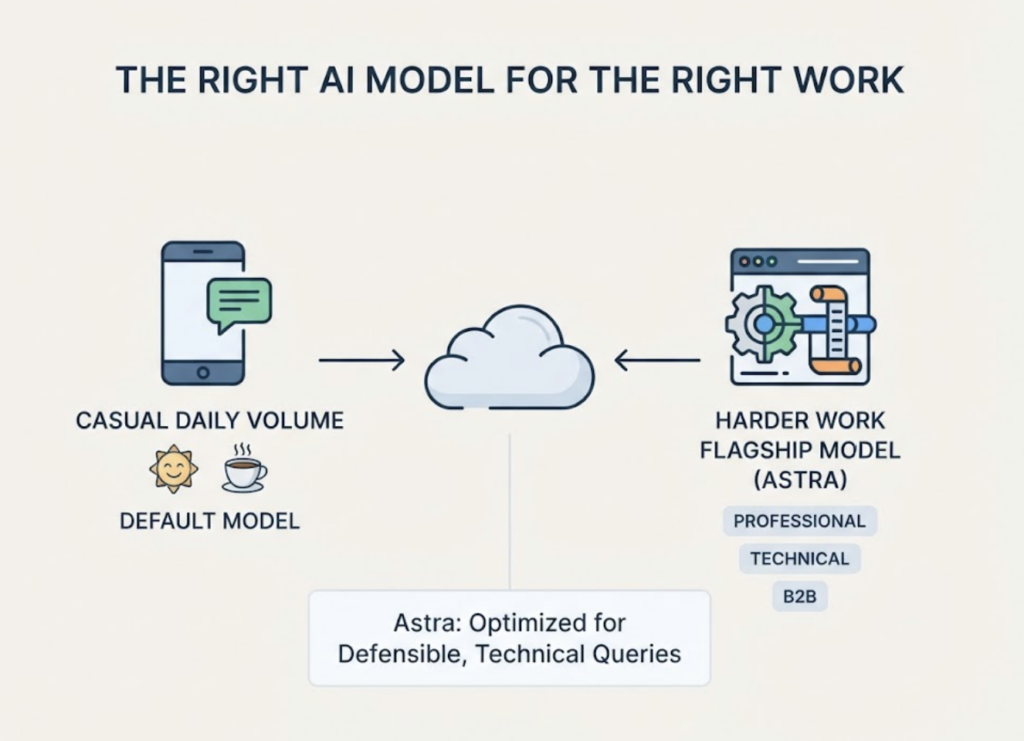
Astra is explicitly positioned by OpenAI as a flagship users select for harder work, not the default model handling casual daily volume. That framing matters because it means Astra shows up disproportionately in exactly the kind of professional, technical, and B2B queries where the answer needs to be defensible, not just popular.
You can already see this pattern play out in high-stakes professional use. Legal teams experimenting with Astra for case research are being warned, repeatedly, that fabricated or outdated citations remain a real risk, and that every reference still needs manual verification before it goes anywhere near a filing or a client memo. That caution exists precisely because the professional-query context has consequences that a casual chatbot answer never had.
The lesson for B2B content isn’t “write more.” It’s that the model is now actively looking for reasons to trust or distrust a source, in a category of query where trust is the entire point.
What Actually Signals Authority to a Reasoning-Heavy Model
Here’s the part that should reshape a content roadmap. Reporting on Astra’s citation behavior draws a clean line: content built on specifics, named authorship, and consistency across the web gains ground, while generic positioning language loses it.
That lines up with what B2B buyers themselves already say drives trust. In G2’s Answer Economy research, nearly half of buyers, 45 percent, name citations from independent software review sites as the single most confidence-inspiring signal inside an AI-generated answer, ahead of a vendor’s own marketing copy. Buyers aren’t rewarding brands that claim expertise. They’re rewarding the ones a third party can back up.
A few concrete signals carry weight with this kind of model:
| Signal | Why it matters to a reasoning model |
|---|---|
| Named authors with real credentials | Gives the model an entity to verify, not just a claim to accept |
| Dated, specific data points | Specifics survive cross-checking; vague claims don’t |
| Consistent facts across your site and third-party mentions | Contradictions get flagged during verification |
| Independent review site and analyst coverage | Matches what buyers themselves already trust as a signal |
None of this is new marketing advice. What’s new is that a model capable of GPQA-level reasoning is now the one grading it.
Why This Raises the Stakes for B2B and Vertical Brands Specifically
Consumer brands mostly compete for attention. B2B and vertical brands, Fintech, enterprise SaaS, legal tech, healthcare, compete for something closer to trust, and trust is exactly what a reasoning-heavy model is built to interrogate.
The buyer-side numbers make the stakes concrete. Forrester’s 2026 Buyers’ Journey survey, covering roughly 18,000 global buyers, found 94 percent of B2B decision-makers used a large language model somewhere in their purchase process, up from 89 percent the year before. G2’s research puts a sharper point on it: 51 percent of B2B software buyers now start their research inside an AI chatbot rather than Google, and 69 percent say they picked a different vendor than they originally planned based on what the chatbot recommended.
That last figure is the one worth sitting with. AI tools aren’t just influencing awareness anymore. They’re actively reordering B2B shortlists, and a model like Astra, tuned specifically for professional reasoning, is a disproportionate part of how those shortlists get assembled for technical and regulated categories.
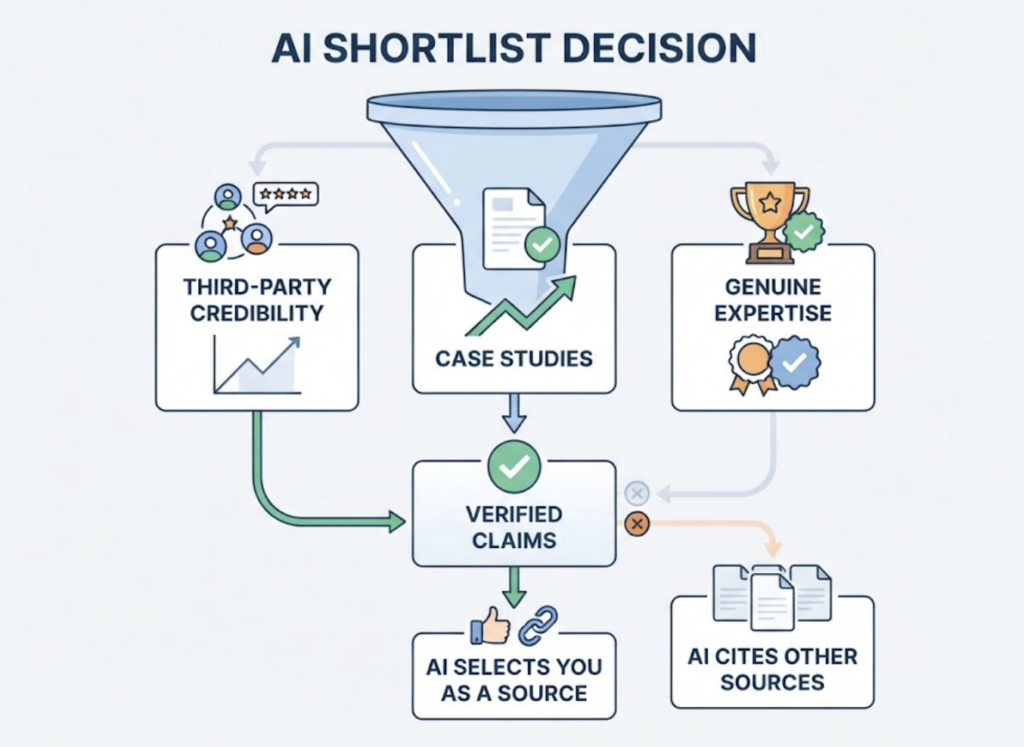
Separate analysis covering 680 million AI citations backs this up from another angle: third-party credibility, case studies, and genuine documented expertise are increasingly what a model draws on to decide who even makes the shortlist in the first place. If Astra can’t verify your claim of expertise, it has plenty of other sources it can cite instead.
There’s also a platform-fragmentation problem sitting underneath all of this. That same citation analysis found the volume of citations a single brand gets can differ by as much as 615 times between AI platforms, and only about 11 percent of domains get cited by both ChatGPT and Perplexity. A brand that’s earned Astra’s trust on a technical question is not automatically earning Gemini’s or Claude’s. Authority, in other words, doesn’t transfer automatically across models the way domain authority once transferred across search engines.
How to Know Where Your Brand Stands in This New Authority Race
The uncomfortable part is that most B2B marketing teams don’t currently know whether Astra treats them as a credible source or not. Traffic dashboards don’t show which domains got cited inside a professional answer, and rankings don’t exist in a category with no result list to rank on.
This is where Source Analysis becomes the more useful lens than a traditional SEO report. It tracks the exact domains and URLs that AI platforms cite in response to a given prompt, so instead of guessing whether your whitepaper or documentation is being treated as an authority, you can see whether it’s actually showing up in the answer.
Paired with Comprehensive GEO Analytics, which monitors sentiment and position alongside raw mention volume, a brand can watch whether its standing in professional, high-reasoning queries is moving in the right direction as newer models roll out. Dynamic Competitor Benchmarking adds the other half of the picture: whether a competitor with thinner but more specific content is quietly winning the citations your brand assumed it owned.
For a marketing team that has spent years building “thought leadership” content on brand instinct, this is the first time that instinct can be checked against what a model like Astra is actually doing with it.
That check matters more the deeper a buyer gets into the funnel. G2’s research found trust in review-site citations actually grows as buyers move from initial discovery toward a renewal decision, climbing from 40 percent of buyers at the top of the journey to 47 percent near the end. A brand that only shows up well in early, broad queries but disappears from the specific, high-reasoning questions asked later in a deal cycle is leaking authority exactly where it counts most.
Conclusion
A model that scores near the ceiling on expert-level reasoning benchmarks doesn’t get more generous with citations. It gets more selective. For B2B and vertical brands, that turns authority from a tone you adopt into a claim you now have to be able to defend, source by source, in front of a model built to check your work.
The brands that treat this as a monitoring problem, not just a content problem, are the ones that will find out early whether Astra sees them as the expert answer or as one more page it decided not to trust.
FAQ
Does GPT-6 Astra change how B2B brands should write content?
Yes, indirectly. Astra’s stronger reasoning and cross-source verification reward specific, dated, attributable claims over generic positioning language, since the model is actively checking sources rather than summarizing the first plausible result.
What makes a source trustworthy to a reasoning-heavy AI model like Astra?
Named authorship, verifiable and dated data, and consistency between your own site and independent third-party mentions. Buyer research shows independent review sites already carry outsized trust, and models built for verification tend to weigh the same kind of proof.
How can a brand track whether it’s being cited in professional AI answers?
Traditional analytics won’t show this, since there’s no ranking to track. Tools like Topify’s Source Analysis and Comprehensive GEO Analytics show which domains actually get cited in AI-generated answers to relevant professional prompts, and how that citation volume and sentiment shift over time.