


Your team built a support bot on GPT-5.6 that cost about $4 per million input tokens. Then OpenAI shipped GPT-6, priced at $10 in and $50 out, and your finance team asked why the AI line item just doubled without anyone approving a budget increase. Most marketing and growth teams assumed model upgrades meant better output, not a line item that quietly reshapes what they can afford to track and produce.
The New Math Behind GPT-6’s API Bill
GPT-6 Astra, OpenAI’s flagship model, launched on September 3, 2026 at $10 per million input tokens and $50 per million output tokens on the standard tier. That’s 2.5 times the promotional rate of GPT-5.6 Sol, which ran $4 in and $20 out. Cached input runs $1 per million, and cache writes cost $12.50.
The bill gets worse past a specific line. Requests over 272,000 input tokens reprice the entire request, not just the overflow, at $20 in and $75 out. A request sitting at 270,000 tokens costs roughly half of one sitting at 275,000 tokens, purely because it crossed a threshold most teams never check.
Reasoning tokens add a second surprise. They bill at output rates even though the user never sees them, which means chatty reasoning models can quietly inflate a bill that looked fine on paper.
Not All AI Spend Feels This Increase the Same Way
Here’s the distinction most budget reviews miss: AI spend splits into two buckets, and GPT-6’s pricing hits them unevenly. Content generation, support automation, and internal copilots consume tokens at volume, so a 2.5x price jump on output tokens lands directly on the invoice. A support workflow processing 2 million input and 500,000 output tokens a month now costs roughly $45, up from about $18 on GPT-5.6 Sol.
AI visibility tracking works differently. It runs a fixed set of prompts across ChatGPT, Perplexity, Gemini, and Google AI Overviews on a schedule, so the token volume barely moves even when the underlying model gets more expensive. That’s the gap most budget conversations still miss.
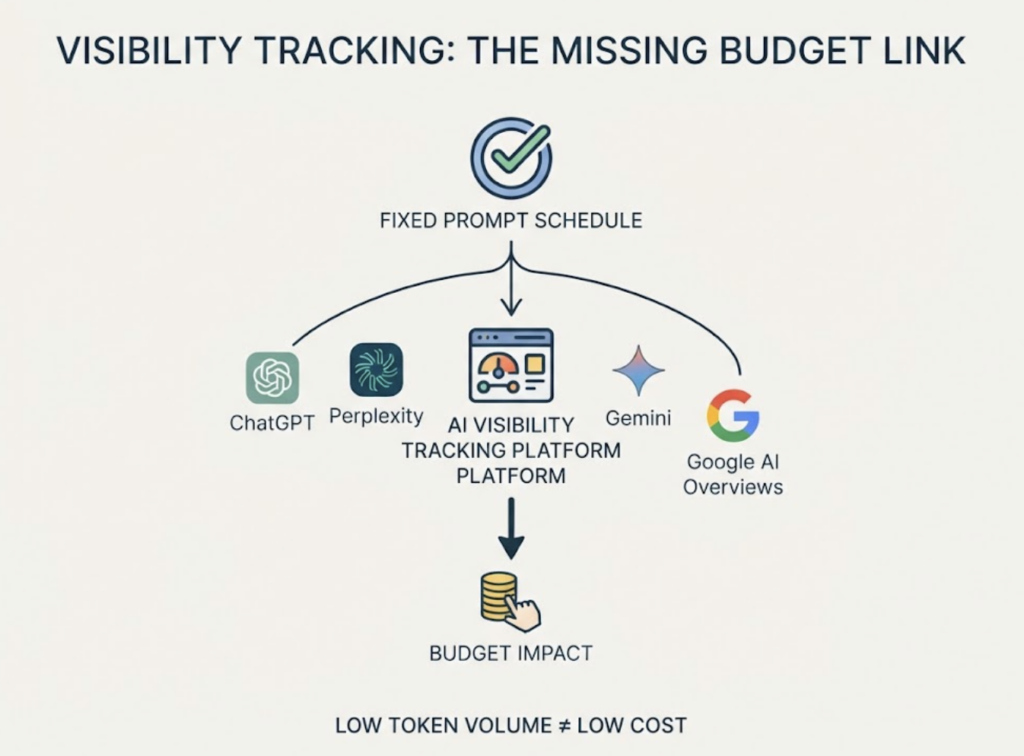
Which means the instinct to cut “AI spend” broadly, across the board, is the wrong instinct. Some of it just got a lot more expensive per unit. Some of it barely changed at all.
Why Cutting AI Visibility Budget Is the Wrong Move Right Now
The pressure to trim AI spend collides with a market fact: AI-driven discovery is growing, not shrinking. Gartner data shows the average marketing budget allocated to AI usage sitting at 15.3% in 2026, with 70% of CMOs naming AI their top priority for the back half of the year. Meanwhile, overall marketing budgets sit at just 7.8% of revenue, which means every dollar spent chasing AI visibility competes directly against everything else on the plan.
That tension gets sharper because 63% of LLM visibility still comes from long-term brand building, while direct marketing spend only accounts for 22% of it. In practice, that means the teams who cut AI visibility tracking to absorb GPT-6’s price hike lose the one signal that tells them whether their brand-building work is actually landing inside ChatGPT and Perplexity answers.
Late movers pay for that gap later. Companies missing from AI responses lose deals before prospects visit their site, and teams that wait typically face higher acquisition costs once competitors have already claimed the AI-recommended slot in their category. Cutting the tracking budget doesn’t reduce that risk. It just makes the team blind to it while it happens.
How to Prove AI Visibility Spend Is Worth Keeping
The real fix isn’t defending AI visibility spend on faith. It’s making the ROI visible enough that nobody questions it during the next budget cut. That’s the gap Topify is built to close.
Topify’s core metric for this is CVR, or Conversion Visibility Rate, one of seven metrics inside its Comprehensive GEO Analytics suite alongside visibility, sentiment, position, volume, mentions, and intent. Instead of reporting a raw mention count, CVR estimates how likely an AI answer is to actually push a user toward your brand, turning “we got mentioned” into a number finance can weigh against the bill.
The other lever is prompt discovery. Most visibility budgets get wasted tracking prompts nobody searches and platforms your buyers don’t use. Topify’s high-value prompt discovery surfaces the queries that actually drive volume in your category, so the tracking spend concentrates on the handful of prompts and platforms that matter instead of spreading thin across all of them.
That focus matters more given what tracking itself costs. Single-brand tools in the category run $19 to $99 a month, while Topify’s Basic plan starts at $99 and includes tracking across ChatGPT, Perplexity, and AI Overviews, 9,000 AI answer analyses, and 50 content generations a month. Against a GPT-6 bill that can hit hundreds of dollars for a mid-size content workflow, the tracking layer that proves whether any of that content spend is working costs a fraction of the line item it’s meant to justify.
Reallocating: What to Cut, What to Keep
A practical reallocation framework starts with separating token-hungry use cases from visibility tracking, then applying different rules to each.
For token-heavy workflows: audit which tasks actually need GPT-6’s reasoning quality versus which ones can run on a cheaper model or a trimmed prompt. Support ticket triage, internal summarization, and first-draft content rarely need the flagship model. Reserve GPT-6 for the outputs where quality differences show up in conversion, not for every automated task by default.
For visibility tracking: don’t touch it. It’s a fixed-cost, low-token workflow that isn’t exposed to GPT-6’s price increase the way content generation is, and it’s the layer that proves whether the rest of the budget is producing results worth defending.
Conclusion
GPT-6’s price jump forces a question every AI budget review should have asked already: which spend produces content, and which spend proves that content works. The first bucket just got more expensive per token. The second bucket is what tells finance whether the first bucket is worth keeping. Protect the tracking layer, trim the token-heavy workflows that don’t need flagship reasoning, and let the data make the case for what stays.
FAQ
Q: Why did GPT-6 cost more than GPT-5.6?
A: GPT-6 Astra launched at $10 per million input tokens and $50 per million output tokens, about 2.5 times GPT-5.6 Sol’s promotional pricing, reflecting the jump to a larger flagship reasoning model with a 1.05 million token context window.
Q: Does GPT-6’s price increase affect AI visibility tracking tools?
A: Not directly. Visibility tracking runs a fixed set of prompts on a schedule, so token volume stays roughly constant even as per-token pricing rises. Content generation and automation workflows, which scale with usage, absorb most of the impact.
Q: How can marketing teams justify AI visibility spend to leadership?
A: Tie visibility tracking to a conversion metric rather than a mention count. Metrics like Topify’s CVR translate AI mentions into an estimate of actual buying influence, giving finance a number to weigh against the cost.
Q: What should teams cut first if the AI budget needs to shrink?
A: Start with token-heavy, low-stakes workflows, internal summarization, draft generation, ticket triage, that don’t need flagship-level reasoning. Keep visibility tracking, since it’s both cheap relative to content spend and the only layer that shows whether the rest of the budget is working.

