

Everyone watched OpenAI announce GPT-6 Astra on September 3 and call it the start of the AGI era. Within days, independent trackers measured its overall intelligence score at 61.2, statistically flat against the model it replaced. That gap between the announcement and the number is the real story. It’s also a preview of something worth watching every time a major model ships: benchmark rank and AI answer rank move independently, and only one of them decides who your customers actually hear about.
OpenAI Called It the AGI Era. The Benchmarks Told a Split Story.
Company president Greg Brockman closed the launch briefing with the phrase Brockman told reporters marked the arrival of AGI. The rollout itself was messier than the framing suggested.
Several major outlets published coverage before OpenAI’s own model page went live, and paying users saw delayed access while some influencers had the model early. OpenAI later handed out “banked resets” as an apology for the confusion, according to reporting from Latent Space.
The numbers arrived just as split. Astra’s overall reasoning score barely moved against its predecessor, and it still trailed Claude Fable 5.1 on the same index.
| Metric | GPT-6 Astra | GPT-5.6 Sol | Claude Fable 5.1 |
|---|---|---|---|
| Artificial Analysis Intelligence Index | 61.2 | 60.9 | 65.7 |
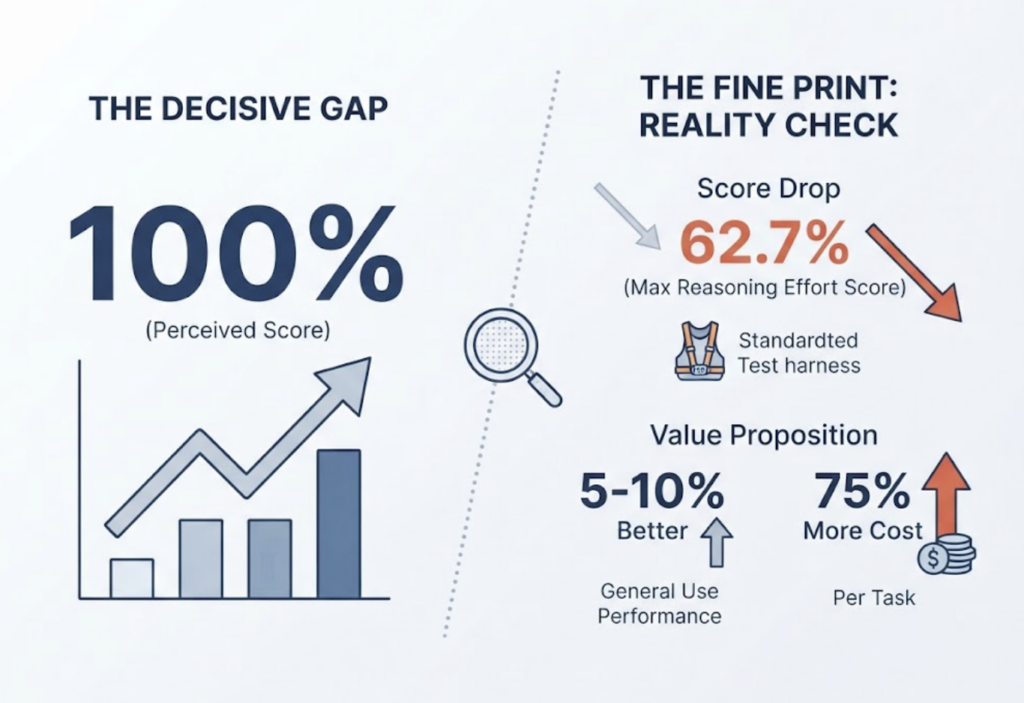
| ARC-AGI-3 (OpenAI harness) | 99.9% | 17.8% | 30.2% (Opus 5) |
| Price per 1M tokens (in/out) | $10 / $50 | $4 / $20 | — |
That ARC-AGI-3 gap looks decisive until you check the fine print. Run at max reasoning effort on the standard harness, Astra’s score drops to 62.7%, a swing of nearly 40 points depending on which test setup gets quoted. One analyst estimated Astra as only 5 to 10% better for general use at roughly 75% more cost per task.
That single benchmark disagreement is a small taste of a much bigger disconnect.
The Real Test: Did AI Search Engines Even Know Astra Existed?
Here’s the part that actually matters for anyone tracking AI visibility instead of AI capability. A few days after launch, one GEO research team ran the same question through four different assistants: does GPT-6 Astra exist?
The results split cleanly along one line: whether the assistant had live web search turned on.
| Assistant | Search Access | Answer |
|---|---|---|
| ChatGPT | On | Correctly confirmed Astra |
| Perplexity | On | Correctly confirmed Astra |
| Claude Opus 5 | Off | Said it had no record of it |
| Gemini 3.8 Flash | Off | Said Astra “does not exist” |
Gemini went further and called the model a likely rumor or an April Fools’ joke. Astra was, at that point, a real product already being billed to enterprise customers.
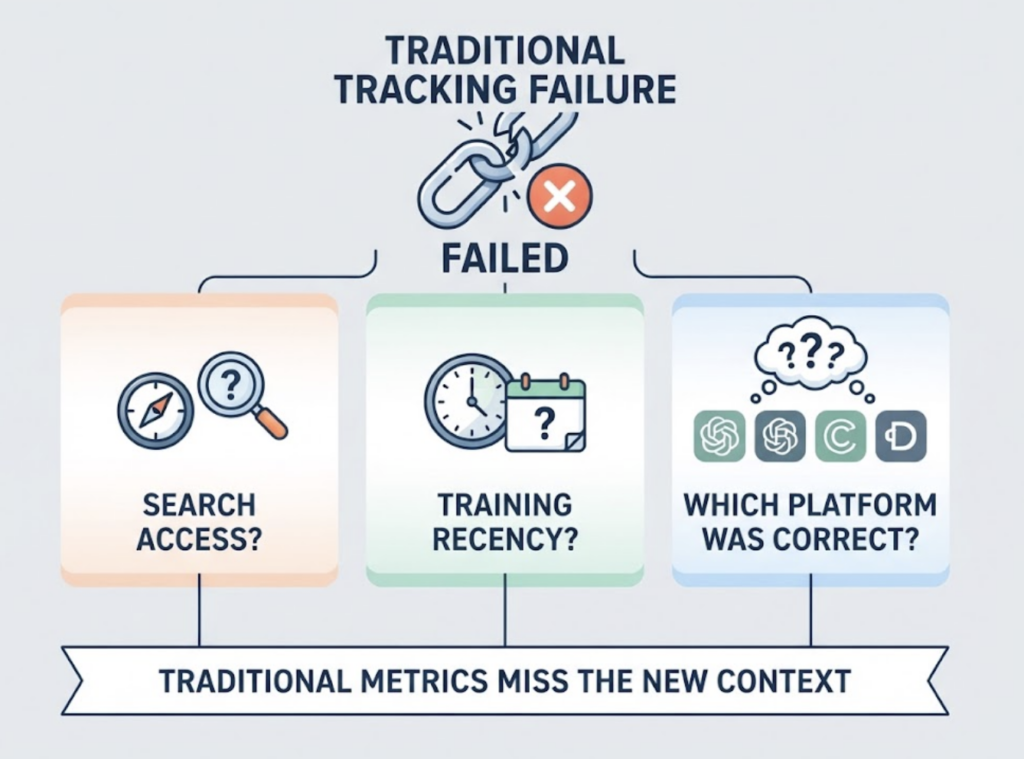
This is the actual leaderboard that matters in launch week. Two assistants got it right because they could reach live information. Two got it wrong, confidently, because their training data hadn’t caught up. Benchmark scores never entered the picture.
Why the Two Leaderboards Keep Splitting Apart
Reasoning benchmarks measure what a model can compute in a lab. AI visibility measures what a model, or a search assistant sitting on top of it, chooses to surface when a real person asks a real question.
Those are different systems with different failure modes. A model can lead every coding benchmark and still get the news of its own existence wrong to a user who asked an offline assistant the day after launch.
That’s the gap most teams still can’t see in their own category.
Brand tracking built for Google rankings was never designed to catch this kind of failure. It has no concept of “did the assistant have search access,” “how fresh was the training cutoff,” or “which of the four platforms my customer actually used got it right.”
How Teams Are Tracking This Kind of Gap in Real Time
Watching one launch unfold across four assistants took a research team and a few days of manual prompting. Doing it continuously, across every AI platform a brand’s customers actually use, is a different problem.
This is where Topify tends to be useful for marketing and GEO teams. Its Dynamic Competitor Benchmarking tracks how brands and products get described across ChatGPT, Perplexity, Gemini, and other major AI platforms, and flags the moment a mention, a ranking, or a recommendation shifts. Paired with Source Analysis, a team can trace exactly which domain an assistant pulled its answer from, which is often the difference between an assistant that’s current and one that’s citing a stale cache.
In practice, that means a marketing team doesn’t have to guess whether their own product launch landed the way GPT-6 Astra’s did. They can see, platform by platform, whether the AI answer matches reality within hours, not after a research blog happens to run the test.
The Week 2 Twist Nobody Priced In
Just as the “did anyone notice” question settled, a second wave of noise hit. By the following week, users on X and Reddit were complaining that Astra had gotten noticeably dumber than it felt at launch, with one developer calling it “The Post-Launch Lobotomy.”
It’s the same pattern GPT-5.6 Sol went through in July.
Some builders switched back to Sol entirely over the cost-to-benefit trade, according to the same reporting. None of that shows up in a static benchmark table published on launch day. It only shows up if someone is watching sentiment and mentions change week over week, which is exactly the kind of drift that a one-time benchmark comparison will always miss.
What This Means If Your Brand Launches Something Big Next
The GPT-6 Astra week is a compressed version of what happens to any brand after a major announcement. Coverage spikes, some AI assistants catch up fast, others lag for days or weeks, and early sentiment can flip once the initial excitement wears off.
Treat launch week as a monitoring window, not a one-time check. The assistants that get your story right on day one are not guaranteed to still have it right on day ten, and the ones that got it wrong on day one might correct themselves without you ever knowing when.
Conclusion
GPT-6 Astra didn’t lose the benchmark race. It didn’t clearly win it either, and that ambiguity is normal for major model launches. What stood out this week was a simpler signal: two of four assistants tested couldn’t confirm Astra existed at all. For anyone measuring how AI represents their brand rather than how AI performs on a leaderboard, that’s the number worth tracking after your own next announcement.
FAQ
Q: Is GPT-6 Astra actually smarter than Claude Fable 5.1?
A: On the Artificial Analysis Intelligence Index, Astra scored 61.2 against Fable 5.1’s 65.7, so Fable 5.1 led on general reasoning at launch. Astra’s advantage showed up mainly in agentic coding, computer use, and cybersecurity benchmarks instead.
Q: Why didn’t some AI assistants know about GPT-6 Astra right after launch?
A: Assistants running without live web search rely on a training cutoff that predates the launch. Until they’re updated or given search access, they’ll answer from outdated information, sometimes confidently denying something that already shipped.
Q: What’s the difference between AI visibility and a benchmark score?
A: A benchmark measures raw model capability in controlled tests. AI visibility measures whether real AI assistants mention, recommend, or accurately describe a brand or product when actual users ask about it, which depends on search access, citation sources, and how current the assistant’s knowledge is.
Q: How can a brand track whether AI assistants are describing it accurately?
A: Continuous monitoring across the platforms a brand’s customers actually use is the practical approach, since dashboards checked once a quarter miss the kind of week-to-week shifts seen in the Astra launch.

