

Your team just shipped a 900-word explainer that ranked on page one for six months. Then GPT-6 launched with a 1,050,000-token context window, and that same page now gets read alongside a dozen competitor documents in a single request instead of on its own. Length was never the real problem. What’s changing is how much surrounding evidence a model can hold before it decides which source actually answers the question.
What GPT-6’s Context Window Actually Changed
OpenAI’s GPT-6 Astra shipped on September 3, 2026 with a 1.05 million token context window and standard pricing of $10 per million input tokens and $50 per million output tokens. The model’s official page also lists a 128,000-token output cap and a knowledge cutoff of April 30, 2026, which matters more than it sounds. A model can hold a million tokens of input and still return a fairly short answer, so the window is about how much it reads, not how much it writes.
This isn’t an isolated jump. Earlier in 2026, GPT-5.6 Sol, Terra, and Luna already reached 1 million token context windows on Amazon Bedrock, built for tasks like reading full codebases and multi-turn agent histories in one pass. GPT-6 pushed the same ceiling into the flagship tier and made it standard.
| GPT-5.6 Sol | GPT-6 Astra | |
|---|---|---|
| Context window | 1,050,000 tokens | 1,050,000 tokens |
| Max output | 128,000 tokens | 128,000 tokens |
| Standard pricing | $4 / $20 per 1M tokens | $10 / $50 per 1M tokens |
| Availability | Bedrock, Codex | Flagship API tier |
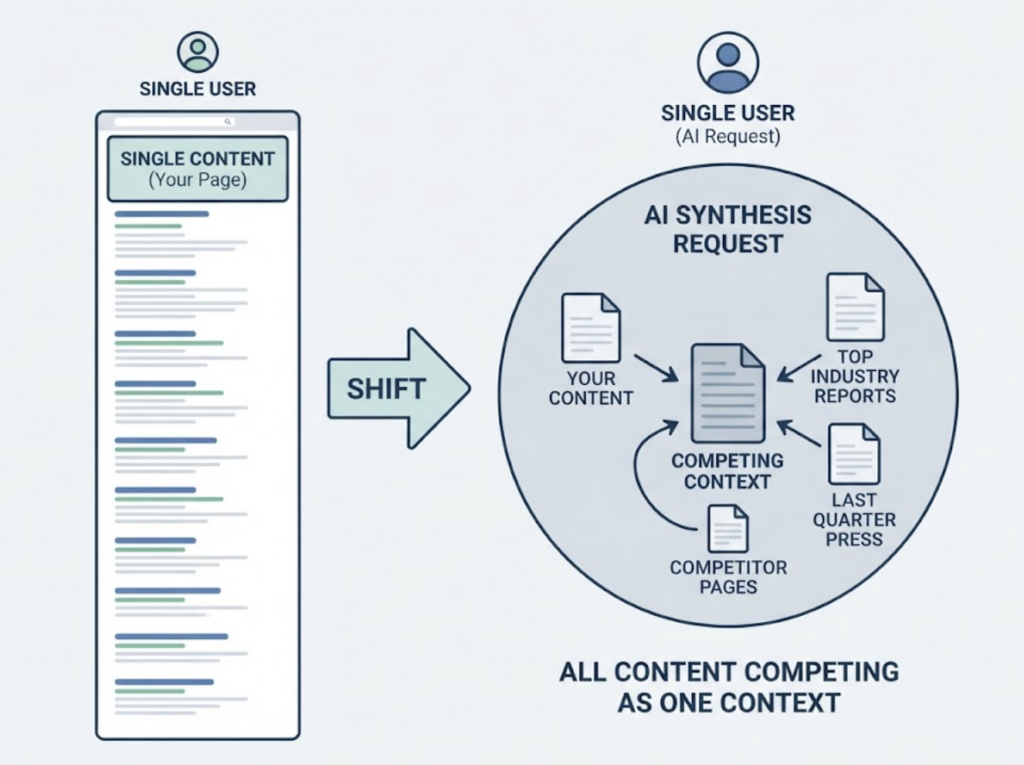
The trend line is clear even if the exact number keeps shifting between model families. Content built for a single skim no longer competes on its own terms. It competes inside a request that can also hold your competitors’ pages, your industry’s top three reports, and last quarter’s press coverage, all at once.
Why a Bigger Window Means AI Reads More of You at Once
A larger context window changes what “getting cited” requires. The model isn’t choosing between your page and a blank slate anymore. It’s choosing between your page and everything else it was handed in that same request.
Research backs this up directly. BrightEdge’s analysis of AI Overview citations found that 82.5% went to deep pages, not homepages, with roughly 0.5% citing homepages at all. Depth already mattered before GPT-6. A bigger window just raises how much depth counts as competitive.
Content that answers a query in isolation used to be enough. Content that answers a query while sitting next to ten other sources making the same claim is a different bar entirely.
The shift shows up in how differently the major AI engines behave once they’re holding more context. ChatGPT tends to cite fewer sources per answer but lean on them more heavily, while Perplexity often cites ten or more sources per prompt but absorbs each one more shallowly. Gemini sits in between. That means the same page can carry a lot of weight in one engine’s answer and barely register in another’s, depending on how each model allocates attention across a crowded context.
What doesn’t vary across engines is the preference for content that does its own synthesis. AI citation studies consistently show that content aggregators and encyclopedic sites get pulled in as raw material but rarely credited by name, while original analysis with clear attribution tends to get named directly. A bigger window means a model can hold more raw material at once. It still has to decide which source did the actual thinking, and that decision hasn’t gotten any easier to win by accident.
The Content Depth Gap Most Brands Don’t Know They Have
Most content libraries were built for keyword coverage, not for standing up inside a crowded context window. That gap doesn’t show up in traditional SEO metrics, because rankings and backlinks never measured whether a page could out-argue nine competitors an AI just read in the same breath.
AI engines cite long-form content in the 2,500 to 4,000-plus word range roughly three times more often than short posts, and models tend to prefer one comprehensive source over several shallow ones covering the same ground. A 500-word overview and a 2,500-word deep dive on the same topic aren’t really competing. The model just picks the one that already did the synthesis work.
A bigger window doesn’t reward more content. It rewards more complete content.
That distinction matters because brands often respond to “AI needs more depth” by publishing more pages, not deeper ones. Fragmented content spread across five shallow posts is still fragmented, no matter how many of them exist.
A Bigger Window Doesn’t Fix Lost in the Middle
Here’s the part most coverage of GPT-6 skips. A million-token window doesn’t mean the model reads every token with equal attention.
Researchers first documented a “lost in the middle” effect where LLM accuracy drops for information positioned in the center of a long context, while facts near the start or end get recalled far more reliably. A separate study found performance can degrade by more than 30% when relevant information shifts from the start or end of a document toward the middle. The effect has held up across model families and context sizes since it was first identified.
That means a 4,000-word article buried in the middle of your site, with the actual answer three paragraphs down, is competing at a structural disadvantage even if the content itself is excellent. Depth without structure is not the same as depth AI can use.
The practical takeaway: lead with the direct answer, keep it self-contained, and don’t rely on the model to dig through the middle of a long page to find your best point.
This is where a lot of “just write longer” advice quietly falls apart. Adding a million tokens of window capacity doesn’t cancel out an architectural bias that’s been reproduced across six different model families, from GPT-3.5 and GPT-4 to Claude and open-weight models like MPT-30B. Depth still matters. It just has to be depth that’s organized so a model scanning quickly can find the answer without depending on it reading your fifth paragraph as carefully as your first.
How Topify Helps You Close That Gap
None of this is something a content team can eyeball. Knowing whether your pages are getting read, skipped, or absorbed alongside competitor sources inside a model’s expanding context window requires actually seeing what’s being cited and what isn’t.
Topify built Source Analysis for exactly that gap. It tracks the exact domains and URLs that AI platforms cite, so you can see whether your content is showing up in the same conversations as your competitors’ or getting quietly passed over. In practice, that means you can pull up a query in your category, see which five sources ChatGPT or Perplexity actually pulled from, and find out in minutes whether your deep-dive page made the cut or your competitor’s did instead.
Comprehensive GEO Analytics sits alongside it, tracking visibility, sentiment, position, and citation volume across platforms, so you can tell whether restructuring a page for depth and answer-first framing actually moved the needle, rather than guessing.
How to Start Auditing Your Content Depth
- Pull your five highest-traffic pages and check whether the core answer appears in the first two sentences, or whether it’s buried mid-page where lost-in-the-middle effects hit hardest.
- Compare your longest, most-cited competitor page against your equivalent page and look for what it covers that yours doesn’t, not just how long it is.
- Run your category’s top queries through Topify’s Source Analysis to see which domains are actually getting pulled into AI answers right now.
Conclusion
GPT-6’s 1.05 million token window didn’t change what good content looks like. It changed how much company your content keeps every time an AI answers a question, and how little tolerance there is for pages that only half-answer it. Brands that treat this as a prompt to write more will keep publishing into the noise. Brands that treat it as a prompt to write more completely, with the answer up front and the evidence to back it, are the ones that show up when the model is choosing between a dozen open tabs at once.
FAQ
Does GPT-6’s bigger context window mean shorter content gets ignored?
Not automatically, but short content that only partially answers a query is easier for the model to pass over once it has several fuller sources in the same context. Length isn’t the signal. Completeness is.
Is content depth the same as word count?
No. A long page that buries its answer in the middle can perform worse than a shorter page that states the answer clearly up front, especially given how the lost-in-the-middle effect degrades recall for mid-document information.
Do I need to rewrite everything now that GPT-6 has a 1M-token window?
Start with your highest-traffic and highest-intent pages first. Check whether they lead with a direct answer and whether they cover the topic as thoroughly as the sources currently getting cited in your category.
How do I know if my content is actually being cited by AI models?
You need visibility into which domains and URLs AI platforms are pulling from for your category’s queries. Tools like Topify’s Source Analysis surface this directly instead of leaving you to guess from traffic data alone.

