


Your team spent the last two quarters climbing Google rankings for your category’s top keywords. Then someone on the sales side mentioned that a prospect had asked ChatGPT which vendor to use, and your brand wasn’t in the answer. No warning, no ranking drop to explain it. Just absence.
That gap is about to get wider. GPT‑6 Astra, OpenAI’s newest flagship model, launched on September 3, 2026, and it’s built to hand people finished answers instead of a page of options to sort through. Every jump in model capability is also a jump in how confidently AI systems now decide who gets recommended, and who gets left out.
When a Model Gets This Good, Nobody Reads a List of Ten Links
Astra ships with roughly a 1 million token context window and a jump in computer-use performance, scoring 72.6% on OSWorld 2.0 versus 65.7% for its predecessor. It’s also the first OpenAI model to cross the “Critical” threshold for cybersecurity capability under the company’s own Preparedness Framework.
None of those numbers are about search directly. But they describe a model that can hold more context, weigh more sources, and act more autonomously on a user’s behalf. That’s exactly the kind of system that makes “browse and compare” behavior disappear.
The user-facing effect is already visible. Google’s AI Overviews cut click-through rates for top-ranking results by 58%, and in AI Mode, 93% of searches now end without a single click. People aren’t scanning links anymore. They’re reading an answer and moving on.
Ranking Was Never the Real Goal. It Was a Proxy for Being Chosen
Search rankings measured something useful once: the probability that a page would get seen. But a rank was never the destination. It was a stand-in for “will someone pick this.”
AI systems removed the stand-in. There’s no list to climb because there’s no list. The model synthesizes one answer and names a handful of options, sometimes just one. As one industry breakdown puts it, the shift is from ranking to inclusion: there’s nothing to climb, only being in the answer or being left out of it.
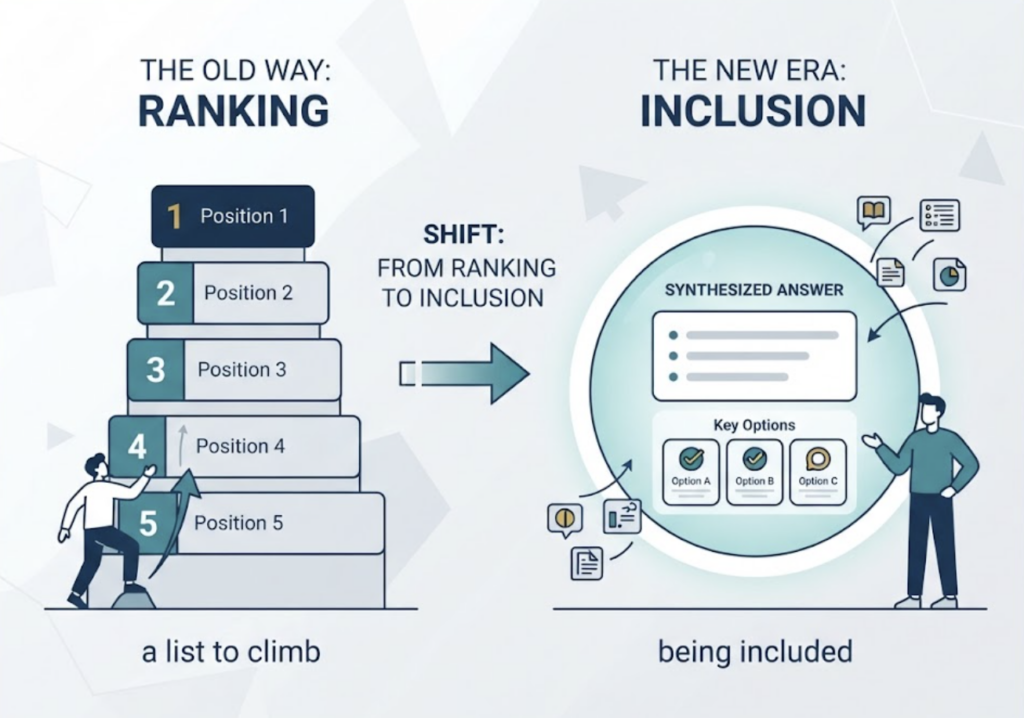
That changes what “optimization” even means. Traditional SEO tools track keyword position, organic traffic, and click volume. None of those metrics exist inside a generated answer. What exists instead is whether the model mentioned you, how it described you, and whether it trusted your source enough to cite it.
| Traditional Search | AI Recommendation | |
|---|---|---|
| Output | Ranked list of links | One synthesized answer |
| Core metric | Keyword rank, clicks | Mentions, citations, sentiment |
| Source selection | Ranks pages individually | Cites a handful of trusted sources |
| Win condition | Top of page one | Named in the answer at all |
What GPT-6 Astra Changes About Who Gets Named
A more capable model doesn’t just answer questions faster. It gets pickier about what it cites, because it can afford to be. Roughly 85% of brand mentions in AI search now come from third-party pages, not brand-owned websites, and brands are about 6.5 times more likely to get cited through someone else’s content than their own. Your marketing site was never the deciding factor. Your reputation across the web is.
This matters more, not less, as models like Astra move toward acting on a user’s behalf rather than just answering their questions. In a retail simulation run by Andon Labs, Astra ran an autonomous store and out-earned rival models while sticking to fair pricing. That’s a preview of agentic commerce: a system that doesn’t just recommend a product, it might also be the one placing the order. If a model is choosing suppliers and vendors on a user’s behalf, the cost of not being in its consideration set stops being theoretical.
The practical takeaway for marketing teams: the brands that show up in Astra’s answers next quarter probably aren’t the ones with the best-optimized landing page. They’re the ones with a citation footprint spread across review sites, comparison content, forums, and trade coverage that the model already trusts.
The Metrics That Actually Matter Now
Rank tracking has nothing left to track. What replaced it is a small set of signals that behave more like reputation metrics than SEO metrics.
Citation frequency alone accounts for about 35% of whether a brand gets included in an AI answer at all. But that number moves constantly. Citation patterns can drift 40 to 60% month over month across AI platforms, so a brand that appeared in answers in August can quietly vanish by October with no alert to explain why.
The upside for brands that do get named is real. Similarweb found that visitors were 2.5 times more likely to visit a company’s site within seven days after an AI recommendation, and 56% of those visits still arrived through a search engine. Being recommended by AI doesn’t replace search traffic. It feeds it.
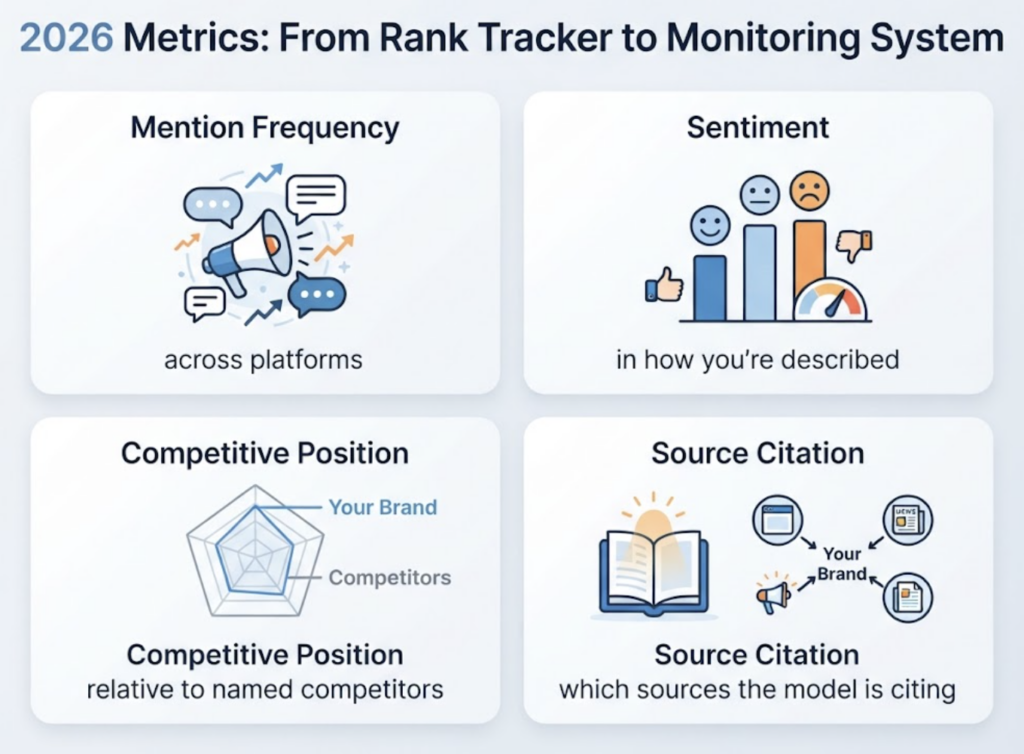
So the working metric set for 2026 looks less like a rank tracker and more like a monitoring system: mention frequency across platforms, sentiment in how you’re described, position relative to named competitors, and which sources the model is actually citing when it talks about you.
Where a Tracking Layer Fits Into This Shift
Once ranking stops being the scoreboard, teams need something that shows what replaced it. That’s a monitoring problem, not a content problem: you need visibility into which prompts surface your brand, how sentiment is trending, and which third-party sources the models are pulling from.
This is the gap Topify was built to close. Its Comprehensive GEO Analytics tracks seven metrics across ChatGPT, Gemini, and Perplexity at once: visibility, sentiment, position, volume, mentions, intent, and a conversion visibility score that estimates how likely an AI answer is to drive real engagement. In practice, that means a brand manager can spot a mention drop on one platform and trace it back to the exact source that stopped citing them, all in the same dashboard.
Two other pieces matter for the Astra-era landscape specifically. Dynamic Competitor Benchmarking shows who a model recommends instead of you, which is the closest thing to a new leaderboard. Reverse-Engineer AI Citations shows the exact domains and pages models are pulling from, so a content team can go fix the actual gap rather than guessing at it. Plans start at $99 a month, with wider platform coverage and prompt volume as teams scale.
Conclusion
GPT-6 Astra isn’t the reason ranking stopped mattering. It’s the clearest signal yet of how far that shift has already gone. As models get better at holding context and acting autonomously, the gap between brands that get named and brands that get skipped will keep widening, not narrowing. The teams that start tracking mentions, sentiment, and citation sources now will have a real head start over the ones still waiting for their next Google Search Console report to explain a traffic drop it was never built to explain.
FAQ
Q: Does GPT-6 Astra directly change SEO rankings?
A: No. Astra doesn’t touch Google’s ranking algorithm. What it changes is how confidently AI systems synthesize a single answer instead of surfacing a list, which reduces the practical relevance of page rank as a visibility metric.
Q: What replaces keyword rank as a metric in AI search?
A: Brand mention frequency, sentiment in how a model describes you, your position relative to named competitors, and which third-party sources the model actually cites.
Q: Why do third-party sources matter more than my own website for AI visibility?
A: Roughly 85% of brand mentions in AI answers trace back to third-party pages rather than brand-owned sites, since models tend to trust independent coverage, reviews, and comparisons more than a company’s own marketing copy.
Q: How often does AI citation data change?
A: Citation patterns can shift 40 to 60% month over month, which is why point-in-time checks are far less useful than ongoing tracking.

