

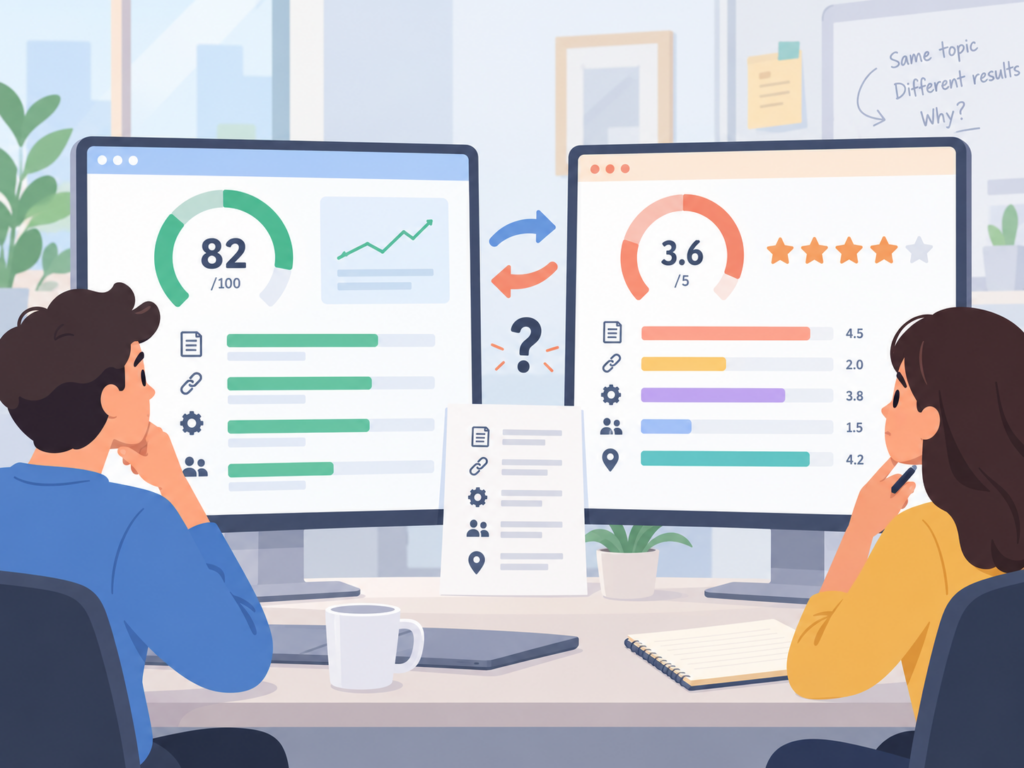
Your marketing lead runs your domain through an AI visibility checker on Monday. Your SEO contractor runs a different one on Wednesday. The two reports don’t agree on almost anything: one says you show up in 40% of ChatGPT answers, the other says 22%. Nobody touched your website in between.
That gap isn’t a bug in either tool. It’s the default outcome when five different vendors each define “visibility” their own way, then hand you a single number and call it a score.
Why the Same Domain Gets Five Different Scores
Most people assume an AI visibility checker measures one fixed thing: how often your brand shows up when someone asks ChatGPT, Gemini, or Perplexity about your category. In practice, that’s where the agreement ends.
A recent methodology audit examined how major platforms define their core visibility metric, and the results were not reassuring. The audit found that several leading vendors define the same metric in contradictory ways within their own documentation, sometimes describing visibility as brand mentions divided by all tracked responses, and elsewhere as mentions divided only by responses that already contain a brand name. Those are two different denominators. They produce two different scores from the exact same raw data.
Some vendors get this right. The audit noted that a handful of platforms keep a single, consistent definition across their public materials. But consistency within one tool doesn’t help you when you’re comparing across tools, which is exactly what happens the moment two people on your team run two different checkers.
We Ran the Same Domain Through Five AI Visibility Checkers
Here’s the pattern that shows up almost every time someone lines up multiple checkers side by side. The tools don’t just report different numbers, they report on different things entirely.
Topify runs a free version of this check called the AI Visibility Report, which generates probe questions and queries ChatGPT, Gemini, and Perplexity directly. It’s a useful first move if you want to see where your own domain stands before comparing it against anything else, since you’ll have a real baseline rather than someone else’s screenshot.
Run that same domain through four other well-known checkers and the differences show up fast. Coverage alone varies widely. Some tools track 15 or more platforms including ChatGPT, Claude, Gemini, and Perplexity, while others stop at three. A domain that looks strong on a three-platform tool can look thin on a fifteen-platform one, simply because the second tool is sampling a wider, noisier set of AI surfaces.
Pricing and access shape the picture too. Free options range from a limited one-time snapshot to a genuinely free tier, while several enterprise tools sit behind a demo request with no self-serve number at all. That means the “five tools” in any real test rarely have equal depth to begin with.
Where the Numbers Actually Diverge
Three specific design choices explain almost all the disagreement between checkers, and none of them are about data quality.
The competitor set is rarely open. Share of voice is a ratio, and the denominator matters as much as the numerator. If a tool asks you to name your competitors before it runs the check, your score reflects visibility inside a pool you built, not the pool AI actually produced. Independent research on this metric points out that the denominator must stay openfor the number to mean anything comparable across tools or time.
Mentions and citations get lumped together. An AI answer can name your brand in prose without linking to your site, or cite your URL without saying your name out loud. Treating those as the same event inflates or deflates a score depending on which one a given tool prioritizes.
A single run is not a measurement. Language models sample from a probability distribution, so running an identical prompt twice on the same day can return a different brand order both times. Research on this variance found that the chance of two independent runs producing an identical ranked list is very low, and that response variance is highest on exactly the competitive ranking questions marketers care about most.
| Design choice | Effect on your score |
|---|---|
| Closed competitor set defined upfront | Score reflects a pool you chose, not what AI actually surfaces |
| Mentions and citations counted as one metric | Hides whether AI is naming you or actually linking to you |
| Single prompt run, single day | Score can shift meaningfully on a re-run with zero real-world change |
| Platform coverage limited to 2 to 3 engines | Misses gaps on engines the tool doesn’t track at all |
What a Single Score Can’t Tell You
One number hides more than it reveals.
A domain can dominate ChatGPT, get cited occasionally by Perplexity, and be functionally invisible on Gemini, all at the same time. Averaging those three outcomes into a single visibility percentage erases the exact detail a marketing team needs to act on.
Free checkers tend to compound this problem, not because they’re inaccurate, but because they’re built for a one-time snapshot. Comparison data across use cases consistently shows the same gap: free tools offer a single check with no historical trend, while paid platforms add continuous daily or weekly monitoring, per-platform breakdown, and competitor benchmarking over time. A snapshot answers “where do I stand today.” It can’t tell you whether that position is improving, decaying, or about to flip after your competitor ships new content.
That’s the real risk in treating any single checker’s output as a verdict. It’s a data point, not a diagnosis.
How Topify Makes Sense of the Same Data
The fix isn’t finding the one checker with the “right” number. It’s using a measurement approach that keeps its definitions consistent across every platform it touches, so a change in your score reflects a change in AI behavior rather than a change in methodology.
Topify’s Comprehensive GEO Analytics tracks brand performance across major AI platforms through seven metrics at once, including visibility, sentiment, position, and mentions, all measured the same way regardless of which engine produced the answer. That consistency is what lets you trust a week-over-week trend line instead of squinting at two incompatible snapshots.
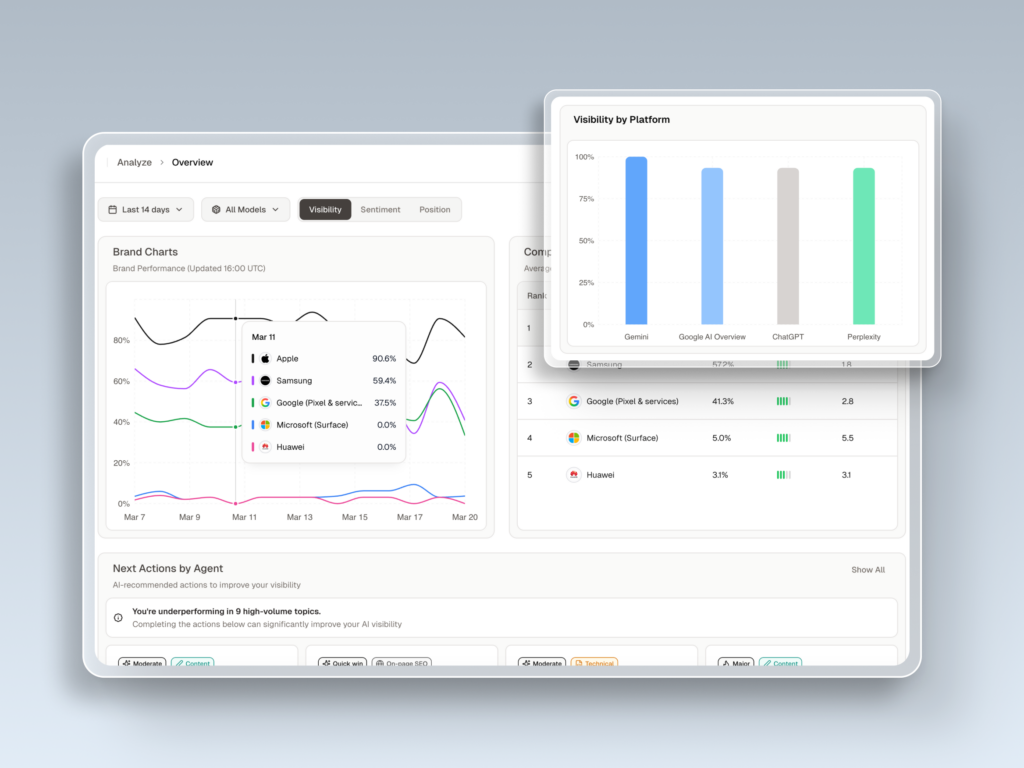
The competitor problem gets solved the same way. Dynamic Competitor Benchmarking doesn’t ask you to lock in a competitor list upfront. It tracks who AI engines actually recommend alongside you, and flags emerging rivals as they show up in real answers rather than in a list you typed into a form six months ago.
For teams that want to see the citation layer specifically, Reverse-Engineer AI Citations analyzes the exact domains and URLs AI platforms pull from when they mention a brand, which separates the mention question from the citation question instead of blending them into one score. Getting started with the full platform starts with the same domain check you’d run for free, just extended into something you can track over time.
How to Read Any AI Visibility Report Without Getting Misled
Before you trust a number from any checker, three quick checks tell you how much weight it deserves.
First, look for a published definition of the core metric. If a tool can’t tell you whether its denominator is all responses or only brand-containing responses, treat the score as directional, not exact.
Second, check platform coverage against where your buyers actually are. A tool that skips Gemini isn’t wrong, it’s incomplete, and incomplete is fine as long as you know it going in.
Third, ask whether the number came from one prompt run or many, on one day or averaged over time. A score built from a single run on a single day tells you about that run, not about your brand.
Conclusion
Five checkers on the same domain rarely disagree because one of them is broken. They disagree because visibility, share of voice, mentions, and citations are five related but distinct things, and most tools blend them into one headline number. Start with a free baseline check to see where you stand today, then decide whether the gaps you find are worth tracking continuously rather than guessing at from a single snapshot next quarter.
FAQ
Q: Why do AI visibility checkers give different scores for the same brand?
A: They typically use different denominators, different platform coverage, and different rules for what counts as a mention versus a citation, so the same underlying AI answers get scored differently by each tool.
Q: Which AI visibility checker is the most accurate?
A: Accuracy depends less on the vendor and more on whether the tool publishes a clear, consistent definition of its metrics and covers the platforms your buyers actually use. A tool with a transparent methodology and narrower coverage often beats one with broad claims and no documentation.
Q: How often should I check my AI visibility?
A: A single check gives you a baseline. Weekly tracking tends to match how often AI-generated answers shift in practice, since daily checks can be noisy and monthly checks lose too much signal between runs.
Q: Is a free AI visibility checker enough, or do I need a paid platform?
A: A free checker is a solid starting point for a one-time snapshot. If you need historical trends, competitor benchmarking, or alerts when your visibility drops, that requires continuous monitoring, which free tools generally don’t provide.

