

Your engineering team just spent a week debating GPT-6 vs Claude for the next coding assistant rollout. Someone forwarded OpenAI’s launch table, where GPT-6 Astra beats Fable 5.1 on almost every row. Someone else forwarded an independent benchmark showing Fable 5.1 in first place. Both charts cite real numbers. Neither one tells you which model to actually pick.
GPT-6 Astra vs Claude Fable 5.1: The Coding Numbers Don’t Agree
OpenAI launched GPT-6 Astra on September 3, 2026, two days after Anthropic shipped Claude Fable 5.1. OpenAI’s own comparison table put Astra ahead on Terminal-Bench 4.0, 57.9% against 55.8%, and further ahead on DeepSWE v1.1, 74.1% against 67.4%, according to benchmark figures compiled by CometAPI.
Artificial Analysis, a third-party evaluator with no stake in either lab, tells a different story. Its Coding Agent Indexscores Fable 5.1 at 70, three points ahead of Astra’s 67, running each model through its own dedicated harness, Claude Code for Fable and Codex for Astra. On the broader Intelligence Index, the gap widens: Fable 5.1 scores 66, Astra sits at 61.
That’s the part most coverage skips. OpenAI tested Fable 5.1 on Astra’s launch evaluations. Anthropic never ran the reverse comparison in public. When a vendor grades its own competitor, the scoreboard tends to tilt toward the vendor doing the grading.
| Benchmark | GPT-6 Astra | Claude Fable 5.1 | Tested by |
|---|---|---|---|
| AA Coding Agent Index | 67 | 70 | Artificial Analysis |
| AA Intelligence Index | 61 | 66 | Artificial Analysis |
| Terminal-Bench 4.0 | 57.9% | 55.8% | OpenAI |
| DeepSWE v1.1 | 74.1% | 67.4% | OpenAI |
| CursorBench 3.2.0 | not published | 73.4% | Anthropic |
The split is consistent: whoever runs the test tends to win it, or at least come closer to winning it. That alone should make any single-source coding claim worth a second look before it shapes a purchasing decision.
What Fable 5.1 Actually Wins at Coding
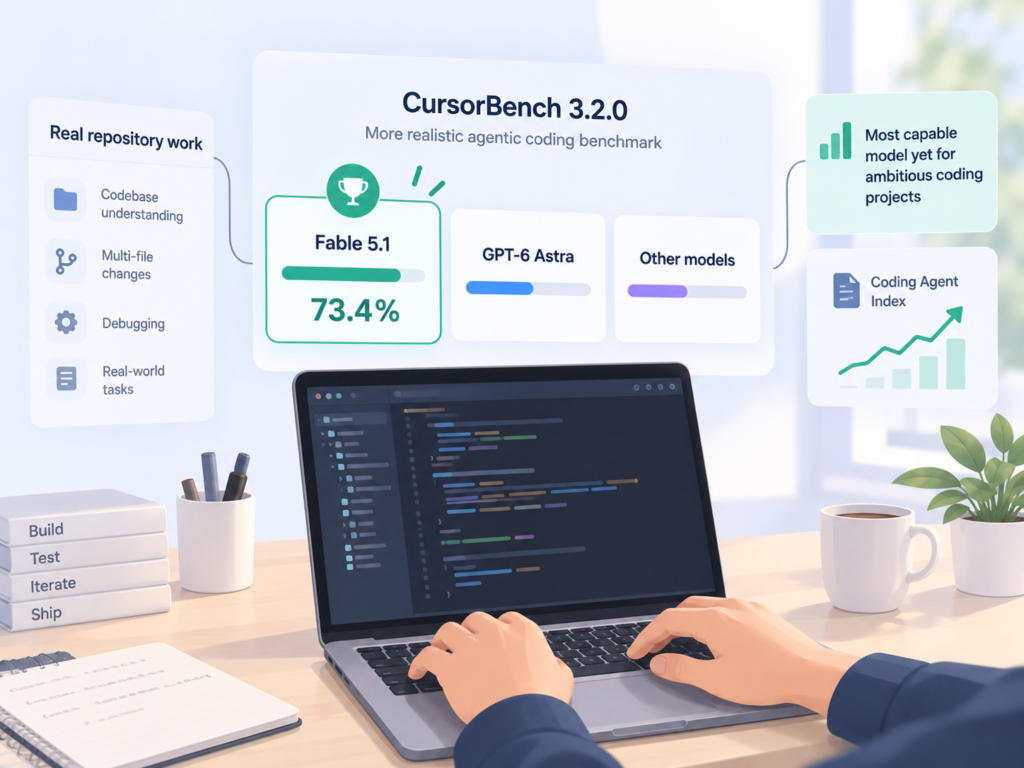
Independent testing keeps landing in Fable 5.1’s favor on the metrics built to simulate real agentic coding work, not isolated code snippets. On CursorBench 3.2.0, a benchmark meant to reflect day-to-day repository work, Fable 5.1 posts 73.4%. Anthropic describes it as its most capable model yet for ambitious coding projects, a claim the Coding Agent Index backs up at the aggregate level.
The pattern holds on reasoning tasks with tools attached, too. On Humanity’s Last Exam with tool access, Fable 5.1 reaches 65.0% against Astra’s 57.2%, a reversal from most of the raw knowledge benchmarks where Astra leads.
Here’s the thing: a three-point lead on one index and a five-point lead on another sound decisive until you notice both indices come from the same evaluator, running on the same day, using methodology neither lab controls.
Cost per task tells a similar story once you factor in what a coding agent actually spends its budget on. Fable 5.1’s cache reads price out at $0.25 per million tokens, a rate Astra doesn’t match on any tier. For teams running agentic coding loops that reread the same repository context dozens of times per session, that pricing gap shows up directly in the monthly bill, not just in the benchmark table.
Where GPT-6 Astra Pulls Ahead Instead
Astra isn’t a weaker model. It’s a differently optimized one. On raw execution benchmarks published by OpenAI, Astra leads FrontierMath Tier 4 at 97.6% against Fable 5.1’s 87.8%, and it holds a similar edge on GPQA Diamond and AutomationBench.
Token efficiency is where Astra genuinely separates itself. Per task, Astra costs less than half of Fable 5 for the same Coding Agent Index score, largely because it burns roughly a third of the tokens GPT-5.6 Sol needed for comparable output. That efficiency doesn’t survive contact with pricing, though: list rates for Astra rose 2.5x to $10 per million input tokens and $50 per million output tokens, identical to Fable 5.1’s rate card.
The one place the pricing story flips is cache reads. Astra charges $1.00 per million cached tokens, four times Fable 5.1’s $0.25 rate. In a long agent loop that rereads the same system prompt and tool schema hundreds of times, that difference compounds fast. The same workload that favors Astra on a single-shot task can favor Fable 5.1 across a forty-step agent run.
Astra also carries a surcharge most comparison charts leave out. Above 272,000 input tokens, its rate doubles on both input and cache reads, and output pricing rises 1.5x. Fable 5.1 applies no such surcharge at any context length. For teams working with large codebases or long documents, that difference changes which model is actually cheaper well before the benchmark scores come into play.
The Real Lesson: Benchmarks Depend on Who’s Holding the Ruler
Both claims are true. Astra wins more rows on OpenAI’s table. Fable 5.1 wins both flagship indices on the one evaluator with no vendor stake in the outcome. They’re measuring different workloads, different harnesses, and in some cases, different task sets entirely.
This isn’t unique to these two models. It’s the structural reality of AI benchmarking in 2026. Every lab optimizes for the evaluations it controls, and every comparison table quietly encodes whose test you’re trusting.
What This Means If You Only Optimize for One Engine
The same distortion shows up outside coding benchmarks, and it’s more expensive when it happens to your brand. If your team only tracks how your product shows up in ChatGPT, you’re making the same mistake as trusting a single vendor’s benchmark table: you’re seeing one engine’s version of reality and calling it the whole picture.
AI answer engines don’t cite, rank, or recommend brands the same way. A product that gets consistently surfaced in Perplexity’s answers might be nearly invisible in Gemini’s, and neither Google Search Console nor a single-platform tracker will tell you why. Topify was built around that gap, tracking visibility, sentiment, and position across ChatGPT, Gemini, Perplexity, DeepSeek, Doubao, Qwen, and other major AI platforms, so a blind spot in one engine doesn’t become a blind spot in your entire strategy.
Tracking Visibility Across Engines, Not Just One
In practice, this means a marketing team can see that a product is losing citations in one AI engine while gaining them in another, and trace the shift back to a specific source domain that stopped or started getting cited. Topify’s Dynamic Competitor Benchmarking applies the same logic used to sort out the Astra-versus-Fable debate: don’t trust one scoreboard, compare across all of them, and let the pattern across engines tell you what a single dashboard can’t.
For teams managing content across multiple client brands or product lines, that cross-engine view often matters more than any single benchmark win. A brand that ranks first in ChatGPT recommendations but never gets mentioned in Claude’s answers is optimizing for half the market, often without knowing it.
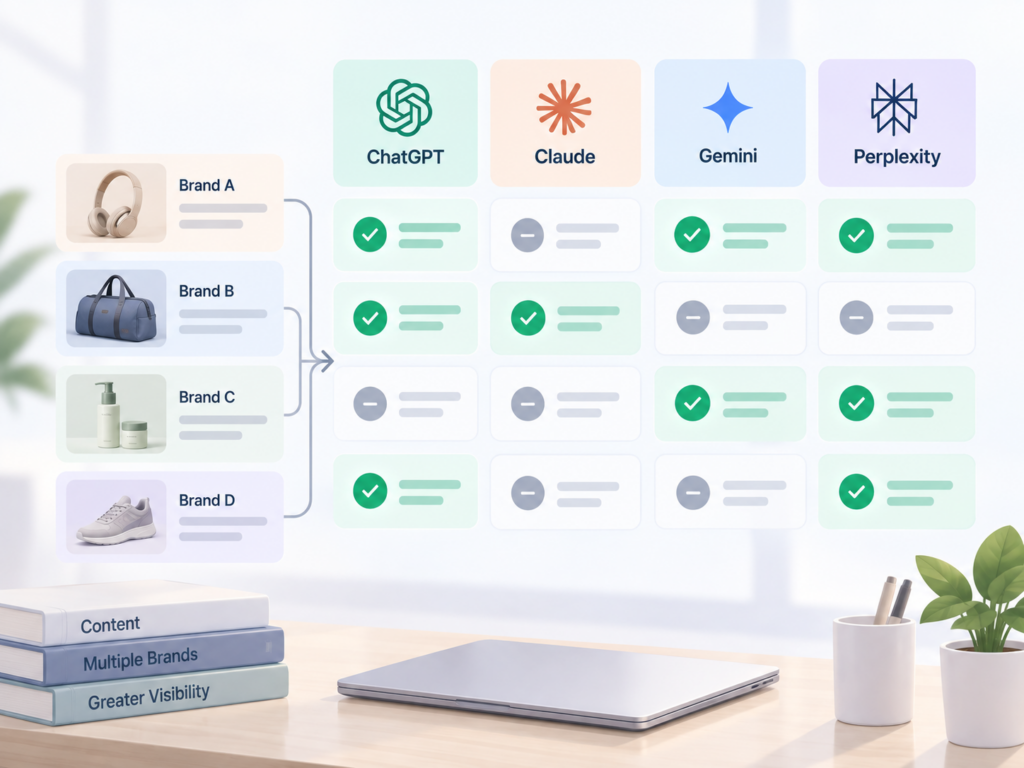
The parallel to the Astra-versus-Fable debate holds up under scrutiny. Just as OpenAI’s table and Artificial Analysis’s index disagree because they measure different workloads, a brand’s ChatGPT visibility score and its Perplexity visibility score can disagree because the two engines pull from different source domains and weigh citations differently. Treating either one as the full picture leads to the same error: optimizing for the ruler instead of the thing it’s supposed to measure.
Conclusion
There’s no clean winner between GPT-6 Astra and Claude Fable 5.1 on coding, and there won’t be one between any two frontier models going forward. The scoreboards will keep disagreeing because the labs keep building the tests. The practical move isn’t picking a side. It’s tracking your own workload against multiple independent measures, whether that’s coding benchmarks or your brand’s visibility across AI engines, so one vendor’s table never becomes your only source of truth.
FAQ
Q: Is GPT-6 Astra better than Claude Fable 5.1 for coding?
A: It depends on which benchmark you trust. OpenAI’s own launch table shows Astra ahead on Terminal-Bench and DeepSWE. Artificial Analysis, an independent evaluator, has Fable 5.1 ahead on its Coding Agent Index, 70 to 67.
Q: Why do OpenAI and Artificial Analysis disagree on benchmark results?
A: Each organization runs its own harness, task set, and effort settings. OpenAI tested Fable 5.1 on evaluations built for Astra’s launch, while Anthropic reports its own separately measured results, so the two tables aren’t directly comparable.
Q: Is GPT-6 Astra cheaper than Claude Fable 5.1?
A: List prices are identical at $10 per million input tokens and $50 per million output tokens. Astra is more token-efficient per task, but its cache read pricing is four times higher than Fable 5.1’s, which can offset the savings in long agent workflows.
Q: Should brands optimize content for one AI engine or several?
A: Optimizing for a single engine creates the same blind spot as trusting one vendor’s benchmark table. Tracking visibility across multiple AI platforms gives a more accurate picture of where a brand actually stands.

