

On September 8, 2026, Salesforce fell about 4% and ServiceNow lost roughly 5% in a single trading session. Intuit dropped close to 4% too, and the broader software and services index slid 1.4%.
Nobody missed an earnings call. Nobody cut guidance.
The trigger was a model launch. OpenAI had shipped GPT-6 Astra five days earlier, built specifically to operate inside software: filling forms, updating CRM records, running tests, navigating browser interfaces on its own. Investors did the math on what that means for per-seat licensing, and they sold first, asked questions later.
That’s the part worth sitting with. A model demo moved billions in market cap before a single customer canceled a contract.
When a Launch Announcement Outruns the Actual Product
Astra’s pitch is computer use: an agent that reads a screen, decides what to click, and completes multi-step tasks across applications instead of waiting for a human to drive each one. OpenAI’s own benchmarks put it at the top of several agentic leaderboards.
Procurement teams heard that and started running a different calculation. Instead of comparing Salesforce’s license price to a competitor’s license price, they’re now comparing it to the cost of an agent doing the same task. That’s a structural shift in how software gets evaluated, not a one-quarter blip.
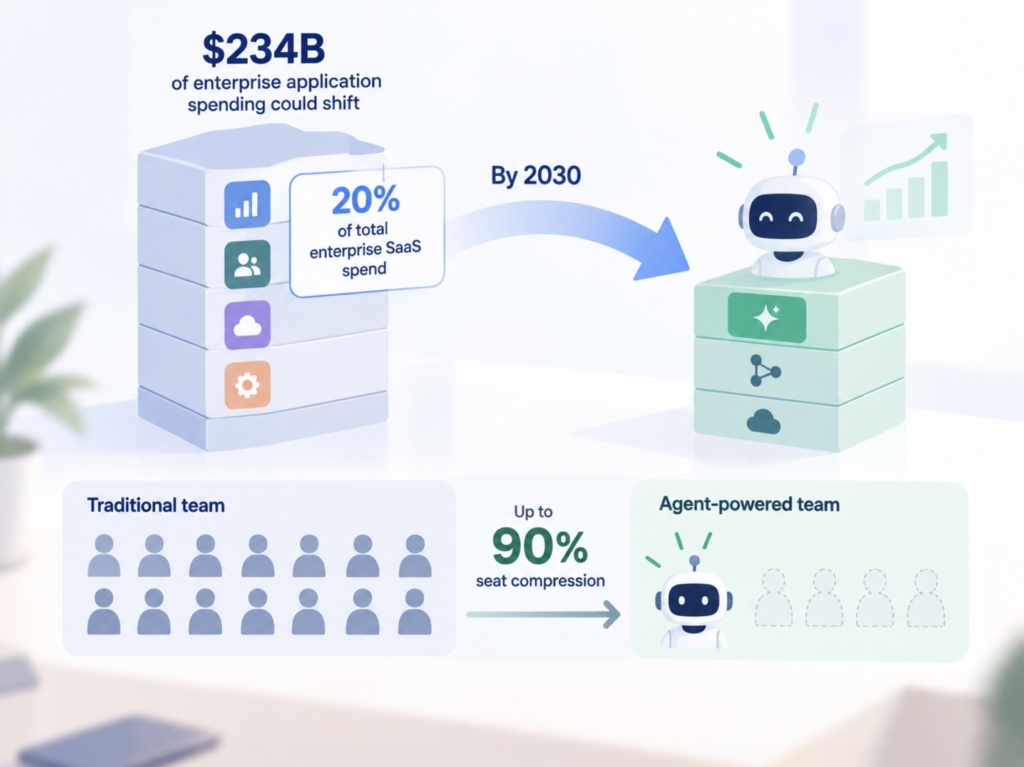
Gartner has already put a number on the exposure: roughly $234 billion of enterprise application spending, about 20% of total enterprise SaaS spend, could shift toward agent-based delivery by 2030. Separate research on early adopters found some teams reporting seat compression as high as 90% once agents absorbed the repetitive parts of a role.
Salesforce isn’t standing still on this. Its Agentforce and Data 360 products already approach $3.9 billion in ARR, and the company mixes per-user licensing with consumption pricing to hedge against exactly this scenario. Contracted obligations also cover roughly 72% of near-term guidance, which is why the stock steadied the next day even as the disruption narrative kept running.
None of that shows up in a one-day stock chart.
Stock Price Tells You What Investors Fear. It Doesn’t Tell You What’s Happening
Here’s the problem with treating the September 8 selloff as your risk dashboard. A stock price reacts to sentiment, positioning, and short interest as much as to fundamentals. It’s a lagging, noisy proxy for a question that’s actually being answered somewhere else every single day.
That somewhere else is AI search. When a buyer types “best CRM for a 40-person sales team” or “do I still need Salesforce if I have an AI agent,” the answer they get back is the real-time referendum on displacement risk. Not the stock ticker.
And buyers are asking those questions constantly now. G2’s 2026 buyer survey of over a thousand B2B software decision-makers found that 51% now start their research inside an AI chatbot rather than a search engine, and 69% ended up switching away from their original vendor preference based on what the chatbot recommended. A third bought from a company they’d never heard of before that conversation.
Forrester goes further, ranking generative AI as the top research channel for business buyers, ahead of both Google and peer referrals. As one industry analysis put it, by the time your sales team hears about an opportunity, the AI has often already filtered the shortlist. If your brand isn’t in that answer, you were never in the deal.
That’s the gap most software brands still can’t see.
What Displacement Actually Looks Like Inside an AI Answer
Stock price moves in one direction on one day. AI displacement, if it’s real, shows up as a pattern across three separate signals over weeks and months.
The first is whether AI systems start offering “do it yourself with an agent” as a legitimate answer to a question that used to have only one kind of response: buy the specialized software. The second is position. Even when your brand still gets mentioned, is it sliding from the first recommendation to the third, or the fifth? The third is tone. AI models can shift from describing a product as essential infrastructure to describing it as one option among several, and that language change usually arrives before the churn numbers do.
None of these three signals are visible from a quarterly earnings call. They live inside millions of AI conversations that happen every day, most of which no one at the company ever reads.
Turning the Signal Into Something You Can Actually Track
This is where Topify fits in. It’s built around the idea that AI visibility, not search ranking, is the metric that now sits upstream of both revenue and stock sentiment.
Topify runs continuous checks across ChatGPT, Gemini, Perplexity, and Google AI Overview using seven core metrics: visibility, sentiment, position, share of voice, volume, competitors, and sources. For a brand worried about agent displacement specifically, two of those matter most in practice.
Dynamic competitor benchmarking tracks who AI engines are naming alongside you, so a brand can catch the moment a general-purpose agent or a new point solution starts appearing in answers where it never used to show up. Position tracking then quantifies whether that new entrant is climbing past you in the recommendation order, which is a much earlier warning than a subscription cancellation.
Sentiment analysis adds the tone dimension. It scores how AI describes a brand on a 0-100 scale, so a slow drift from “the standard tool for this” to “one option, though some teams now handle this with an agent” gets caught as a trend line instead of a surprise.
What This Looks Like for a Real Software Brand
Picture a mid-market workflow automation company that has owned the top answer for its category in AI search for over a year. Nothing about its product, pricing, or reviews has changed.
But over eight weeks, its monitoring shows something else. A general-purpose agent starts appearing as an alternative answer in roughly a third of the prompts it tracks, its own position slips from first to third on the most common buyer questions, and the sentiment score dips as AI answers add a qualifier about needing “more setup for non-technical teams.”
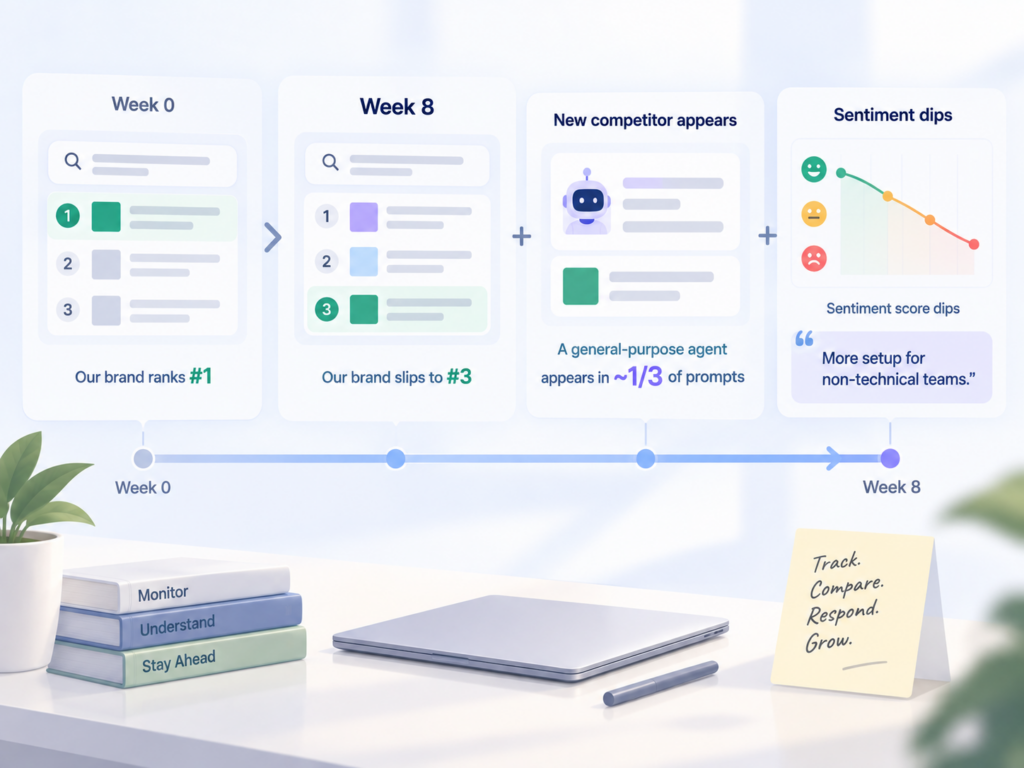
Stock price wouldn’t register any of that. A dashboard built around AI answers would.
A Starting Checklist Before the Next Model Launch
You don’t need to wait for the next Astra-level release to start building this baseline. A few steps get most teams a usable signal within weeks.
Build a canonical prompt list of the 20 to 50 questions your actual buyers ask when they’re deciding whether to keep using specialized software or try an agent instead. Track your position and sentiment against named competitors and against generic “AI agent” framing, not just your traditional rivals. Review the trend monthly rather than reacting to any single answer, since individual AI responses vary run to run. Then route what you find to product and pricing, not just marketing, because a sentiment shift toward “optional” is a positioning problem the whole company needs to see.
Conclusion
The September 8 selloff told investors something real: general-purpose AI agents are now capable enough to make procurement teams ask a question they didn’t used to ask. But a stock chart can’t tell a software brand whether that risk is landing on them specifically, or when.
AI answers can. They’re the place where the substitution decision actually gets made, buyer by buyer, months before it ever reaches an earnings call. The brands that build a way to watch that signal now won’t need to guess what the next model launch means for them.
FAQ
Does a stock drop after an AI model launch mean a software product will actually get replaced?
Not on its own. A one-day move like the September 8 selloff reflects investor sentiment and repricing of future risk, not confirmed customer behavior. The more reliable early signal is whether AI systems start recommending agent-based alternatives over your product in real buyer conversations.
How is AI displacement risk different from ordinary competitor risk?
Traditional competitor risk shows up in win-loss reports and renewal data, often after a deal is already lost. AI displacement risk can show up earlier, inside AI-generated answers, before a single customer has switched, since it reflects how AI systems are already framing the buying decision.
How often should a software brand check its visibility in AI answers?
Monthly tracking is usually enough to catch a real trend, since individual AI responses vary from run to run. What matters is watching position and sentiment move in one direction consistently across weeks, not reacting to any single answer.

