


On September 3, 2026, OpenAI announced GPT-6 Astra to considerable fanfare. Almost nobody who paid for ChatGPT could actually use it.
Pro and Enterprise accounts got access first. Plus subscribers, who make up the bulk of ChatGPT’s paying base, waited days. Sam Altman later called the rollout “messy” and apologized publicly for the gap between what OpenAI announced and what customers could actually reach.
If you track brand visibility in ChatGPT for a living, this isn’t just an inconvenience story. It’s a data integrity problem.
When “ChatGPT” Stopped Meaning One Model
Here’s the thing most GEO reports don’t account for: “ChatGPT” is not one product. It’s a moving target that depends on your plan, your region, and the day you happen to query it.
The Astra rollout made that painfully literal. Coverage from the week of the launch shows just how fragmented access got across tiers.
| Plan | Astra Access | Message Allowance |
|---|---|---|
| ChatGPT Pro ($100) | Rolling out in tiers | 50 messages per week |
| ChatGPT Pro ($200) | Rolling out in tiers | 200 messages per week |
| Business Standard | In tiers | 15 messages per month |
| Business Premium | In tiers | 50 messages per week |
| ChatGPT Plus | Delayed, then restored | Included in existing limits |
Two Plus accounts, queried on the same day, could return answers from two different model generations. One might already be on GPT-6 Astra. The other could still be running GPT-5.6 Sol.
That’s not a rounding error. That’s a different reasoning engine producing your data.
Why Staged Rollouts Quietly Corrupt Your Rate Limit Tracking
Most teams treat “ChatGPT” as a fixed data source, the same way they’d treat a Google API endpoint. That assumption breaks the moment a staged rollout hits.
Think about what actually happens when you sample a prompt to check brand visibility. You send a query, log the response, and compare it against last week’s baseline. If last week’s query ran on GPT-5.6 and this week’s ran on Astra, you’re not tracking a visibility trend. You’re comparing two different models’ opinions and calling the delta “movement.”

Early benchmark estimates put Astra’s per-task cost around $167 on aggregate coding benchmarks, notably higher than GPT-5.6 on comparable tasks. Higher inference cost often comes with different reasoning depth, different citation behavior, and different phrasing habits. All three directly affect whether your brand gets mentioned, how it’s framed, and where it lands in the response.
Rate limits make the noise worse. When a model change also throttles message volume, teams often cut their sampling frequency to conserve quota. Fewer samples during exactly the window when the underlying model is shifting is the worst possible combination for a clean baseline.
The Banked Reset Was a Patch, Not a Fix
OpenAI tried to soften the blow. Starting September 3, paid subscribers began earning one banked usage reset for every day they went without Astra access, a mechanic the company had already used before to smooth over quota complaints on Codex.
It’s a reasonable goodwill gesture. It also doesn’t touch the actual problem.
A banked reset gives you more messages. It says nothing about which model generated those messages, or whether your historical data points came from the same one. For a support team frustrated by throttling, that’s a fair trade. For a marketing team trying to prove a GEO campaign moved the needle, it’s irrelevant.
By September 4, Astra had reached all Pro, Enterprise, and Business Premium accounts. Plus users kept trickling in over the following days, meaning the exact rollout window varied by account, not just by tier.
What This Means for Anyone Measuring AI Search Visibility
Scale is what makes this matter. ChatGPT crossed 900 million weekly active users by February 2026, with more than 50 million people paying for a subscription. That’s the single largest AI answer engine most brands are trying to get recommended by.
When a platform that size ships a model change unevenly, the ripple hits every team using ChatGPT rate limits and API responses as ground truth for brand visibility. A single-platform, single-snapshot approach to GEO was already fragile. Staged rollouts expose exactly how fragile.
There’s a broader pattern here, too. This wasn’t an isolated OpenAI event. In that same week, Anthropic reset Claude Code’s session limits in response to its own capacity pressure. Model providers are increasingly managing access as a lever, not a constant. Treating any single model version as a stable measurement instrument is a bet that keeps getting worse.
The practical takeaway: if your GEO methodology depends on one model, one plan tier, and one sampling window, you’re building a baseline on sand.
How Topify Keeps Your Baseline Stable Through Model Churn
This is exactly the failure mode Topify was built to avoid. Instead of anchoring visibility data to a single model snapshot, its Comprehensive GEO Analytics runs repeated sampling across ChatGPT, Gemini, Perplexity, Google AI Overviews, and other major engines, then normalizes the results into seven metrics: visibility, sentiment, position, volume, mentions, intent, and CVR.
That cross-platform, repeat-sample structure matters most exactly when one provider is mid-rollout. If Astra’s staged release introduces noise into ChatGPT-only data, Topify’s Position Tracking still shows whether your brand’s relative standing against competitors held steady or shifted, because it’s not betting everything on one model’s output.
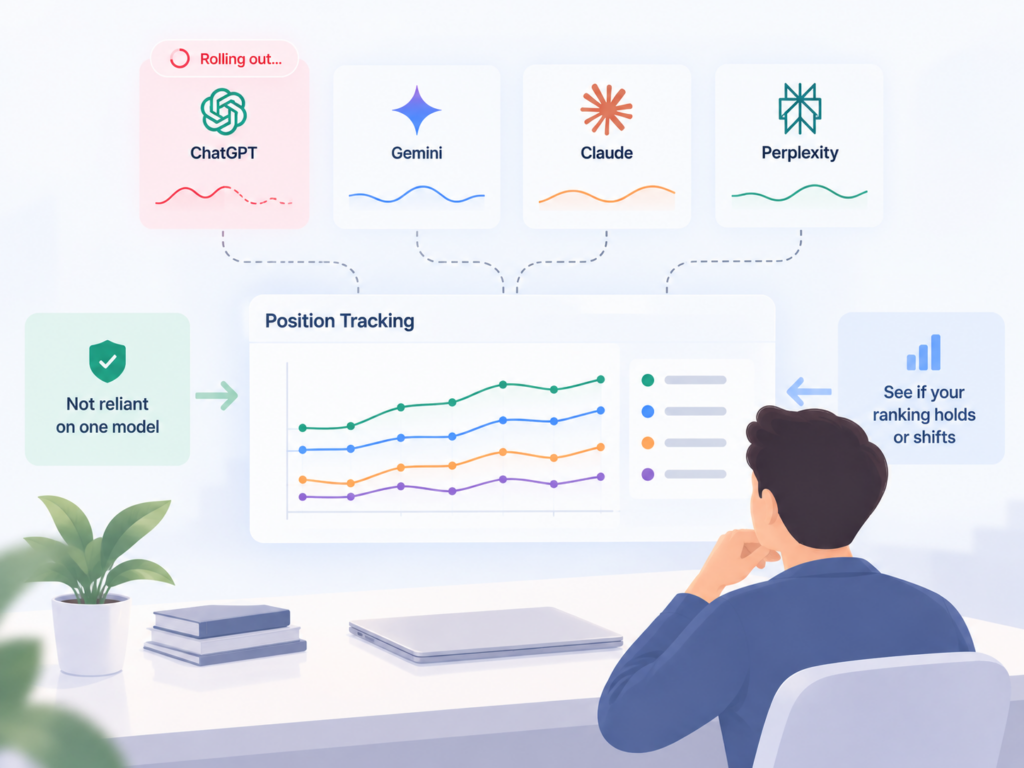
The platform also separates the trend line from the daily line, tracking a rolling average against day-to-day fluctuation so a single volatile week from a model update doesn’t get mistaken for a real visibility drop or gain.
How to Audit Your Own Data for Model-Version Noise
If you’re not ready to change tooling, you can still catch this problem in your existing reports.
- Check whether your sampling dates cross a known model release window, like September 3 to 8, 2026, for Astra.
- Compare visibility scores immediately before and after that window against the weeks flanking it. A sharp, isolated spike usually signals model noise, not real movement.
- Note your account’s plan tier at each sampling date. Tier changes mid-quarter often mean model access changed too.
- Flag any week where message volume dropped sharply. That often means quota pressure forced fewer samples, which lowers statistical confidence in that week’s number.
Conclusion
ChatGPT rate limits aren’t just a subscriber annoyance this time. The Astra rollout showed that “ChatGPT” can mean different models to different accounts on the same day, and that alone is enough to distort any team’s AI visibility baseline.
The fix isn’t to stop tracking ChatGPT. It’s to stop trusting a single model, a single platform, and a single snapshot to tell you the whole story. Cross-platform, repeat-sampled monitoring is the only way to tell a real visibility shift from a model version doing the talking.
FAQ
Did the GPT-6 Astra rollout affect all ChatGPT plans the same way?
No. Pro, Enterprise, and Business Premium accounts got access within a day of the September 3 announcement, while Plus and Business Standard users waited longer, per staggered messaging tiers that OpenAI published during the rollout.
How do chatgpt plus rate limit changes affect brand tracking tools?
Any change to message allowances or model access on Plus accounts can shift which model generation answers a given prompt, which changes phrasing, citation behavior, and mention rates in ways unrelated to actual brand performance.
What is the real impact of a staged model rollout on GEO data?
A staged rollout means identical prompts can return answers from different underlying models depending on account tier and timing, making week-over-week visibility comparisons unreliable unless the tracking method accounts for the version difference.
How can I track brand mentions across AI models consistently?
Use repeat sampling across multiple engines rather than one-off queries to a single model, track a rolling trend line instead of daily snapshots, and log which model version served each response when the data is available.

