

Your team just watched a coffee maker recommendation in Google’s AI Mode slip a sponsored listing between two organic picks, with nothing but a small “Sponsored” tag to give it away. Now Google is testing something even harder to catch: plain text link ads formatted exactly like the AI’s own answers. This isn’t the first AI Mode ads experiment, but it’s the hardest one to spot. That distinction used to be easy to make. Not anymore.
AI Mode Just Got a New Kind of Ad
Google is testing a text-based ad format inside AI Mode that looks almost identical to a normal AI-generated response. The links carry regular anchor text, sit inline with the rest of the answer, and are marked “Sponsored” above the AI-generated content rather than set apart in a separate box.
That’s a shift from earlier this year. Back in April, Google had already started showing text anchor links inside AI Mode answers, but those were organic citations, not paid placements. The format hasn’t changed much. What’s changed is who’s paying to sit inside it.
How This AI Mode Ads Test Differs From Past Formats
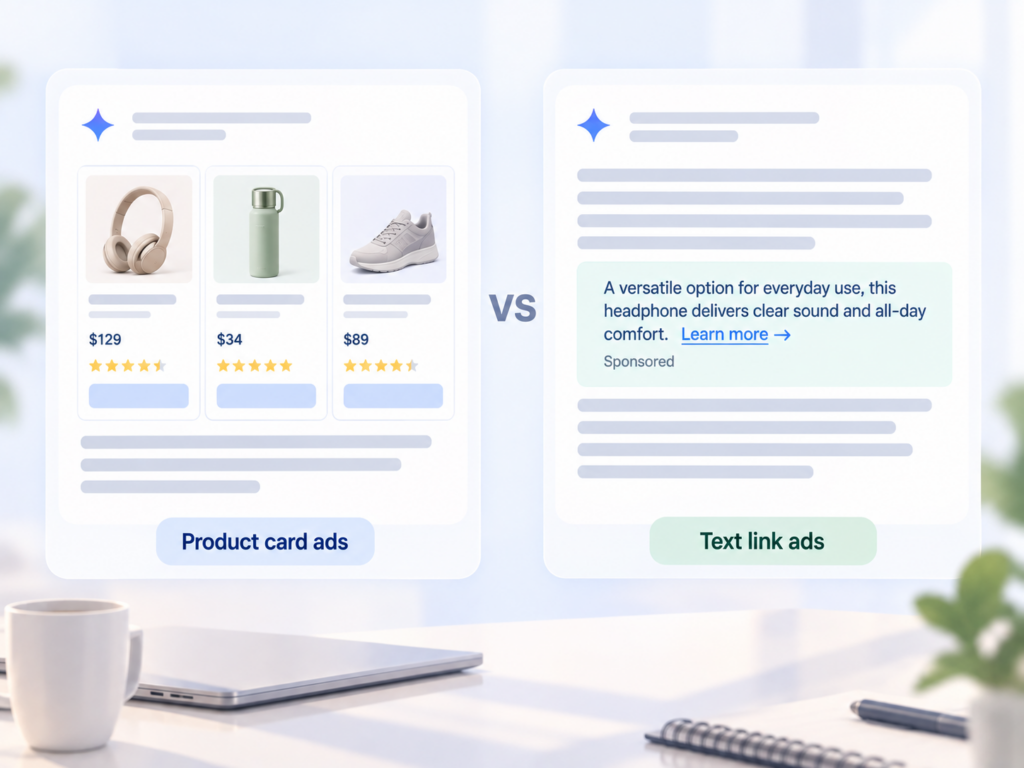
The ad format Google has run since late 2025 looked more like a product card: an image, a price, a star rating, a merchant name, all wrapped around a small “Sponsored” label. Google calls this format Highlighted Answers, and it’s climbed in frequency since AI Mode passed a billion monthly active users earlier this year.
Text link ads strip that visual scaffolding away. No product image, no price tag, no star rating. Just a sentence that reads like the rest of the AI’s response, with a link inside it. That’s a deliberate design choice, and it raises the same question critics raised about the product-card format: if an ad is styled to be indistinguishable from an answer, does the sponsorship label do its job?
Google has also been testing AI-generated descriptions for the ads themselves, adding a line clarifying that the AI’s commentary was generated independently from the ad. That disclaimer only exists because the two are getting harder to tell apart.
The Bigger Pattern Behind This AI Mode Ads Test
This test doesn’t sit in isolation. Google’s Ads Liaison, Ginny Marvin, confirmed in early September 2026 that Google is also testing whether standard Search campaigns using exact and phrase match keywords can serve ads in AI Mode, something that previously required AI Max, Performance Max, or broad match with Smart Bidding.
That eligibility rule mattered because it let advertisers keep tight budgets out of AI Mode by sticking with restrictive match types. Marvin capped the new test to queries with “explicit and direct user intent,” but the direction is clear: the boundary between traditional Search campaigns and AI Mode inventory is dissolving, one experiment at a time.
Put the two tests together and a pattern emerges. Google is widening both who can buy into AI Mode and what the ads look like once they’re there. Given that AI Mode has surpassed a billion monthly active users with query volume more than doubling every quarter, the incentive to keep expanding ad inventory here isn’t going away.
What Blurred Ad Boundaries Mean for Visibility
Here’s the part that should worry marketing teams more than the ad format itself. Organic visibility inside AI Mode is already under pressure. Ahrefs found that the first organic result loses an average of 34.5% of its clicks once AI Overviews appear on a query, based on 300,000 searches compared against the same period before AI Overviews launched.
Now add ads that are visually inseparable from organic recommendations into that same answer. A brand showing up in an AI Mode response next to a competitor can no longer assume that placement reflects genuine algorithmic preference. It might. Or the competitor might have simply bought the spot next to yours.
You can’t tell the difference by eye anymore, and that’s the point.
This matters because most teams still evaluate AI visibility the way they evaluate SEO: check the SERP, screenshot the result, move on. That approach assumes what you’re looking at is earned. Once paid placements are styled to match earned ones, a screenshot tells you almost nothing about why your brand appeared, or whether it will still be there next week.
Tracking Visibility When Ads Look Like Answers
If the interface itself won’t reliably distinguish paid from organic, the tracking has to happen underneath it. That’s a structural argument for treating AI visibility as a measured, ongoing signal rather than something you check by eye when a query comes up.
Topify approaches this through Visibility Tracking and Position Tracking, monitoring how often a brand actually appears across ChatGPT, Gemini, Perplexity, and other AI platforms, and where it lands relative to competitors on the same prompts over time. In practice, that means a marketing team can watch a specific set of prompts week over week and see whether a drop in mentions traces back to a content or citation issue, or to a competitor’s ad buy crowding the same answer.
That distinction changes what a team does next. A citation problem gets fixed with content and source strategy. A paid placement doesn’t respond to either, and knowing which one you’re facing keeps a team from chasing the wrong fix. Comprehensive GEO Analytics rounds this out by tracking sentiment, position, volume, and mentions together, so a visibility change shows up with context instead of as an isolated number.
How to Read This Test as a Marketing Team
A few things are worth doing now, regardless of whether this specific test rolls out broadly.
Separate your tracking from your screenshots. A single query result tells you what happened once, not what’s happening consistently. Track the same prompts on a schedule so a change in an answer’s makeup, ad or otherwise, actually registers as a change rather than noise.
Watch position, not just presence. Being mentioned matters less than where you land relative to competitors on the prompts your buyers actually use. If a paid link starts appearing above your organic mention on the same query, that’s worth flagging even if your visibility number hasn’t moved.
Don’t treat this as a one-time story. Text link ads, Highlighted Answers, and the exact and phrase match test are three data points on the same trend line. Expect more formats, not fewer, as AI Mode’s ad inventory keeps expanding.
Conclusion
Text link ads in AI Mode aren’t a one-off experiment. They’re the latest step in Google widening both the ad formats and the advertiser eligibility inside its conversational search surface, at a moment when organic clicks in AI-generated answers are already under measurable pressure. For brands, the practical shift is this: you can no longer tell, by looking, whether your placement in an AI answer was earned or bought by someone next to you. That’s a reason to measure AI visibility on a schedule instead of by spot-checking screenshots.
FAQ
Q: Are the new AI Mode text link ads labeled as sponsored?
A: Yes. Google places a “Sponsored” label above the AI-generated response, but the link itself is styled like a normal in-answer citation.
Q: How is this different from the Highlighted Answers ad format?
A: Highlighted Answers include a product image, price, and rating alongside a sponsored tag. The text link format drops that visual scaffolding entirely, so it reads like a standard AI Mode citation.
Q: Does this mean more advertisers can now appear in AI Mode?
A: A related test lets standard Search campaigns using exact and phrase match keywords serve ads in AI Mode, a path that previously required AI Max or Performance Max. Combined with the text link format, both the format and the eligibility rules are expanding.
Q: How can a brand tell if it’s losing visibility to ads or to a content issue?
A: Ongoing tracking across AI platforms, rather than one-off checks, is the only reliable way to separate a drop caused by a citation change from one caused by a competitor’s paid placement in the same answer.

