

You assumed Google only took from your content when AI Overviews summarized it and the click never happened. Now Google is testing something stranger. It’s paying some publishers back for that same summary, but only when it decides your content deserves the credit.
That’s the core of the AI Contribution Pilot, a quiet Search Console feature Google confirmed to Digiday is an early-stage learning experiment. It sits at the center of a bigger question every content team is now asking: what does AI content licensing from Google actually look like in practice, and is it worth opting in.
The AI Contribution Pilot Isn’t a Licensing Deal. It’s a Black Box
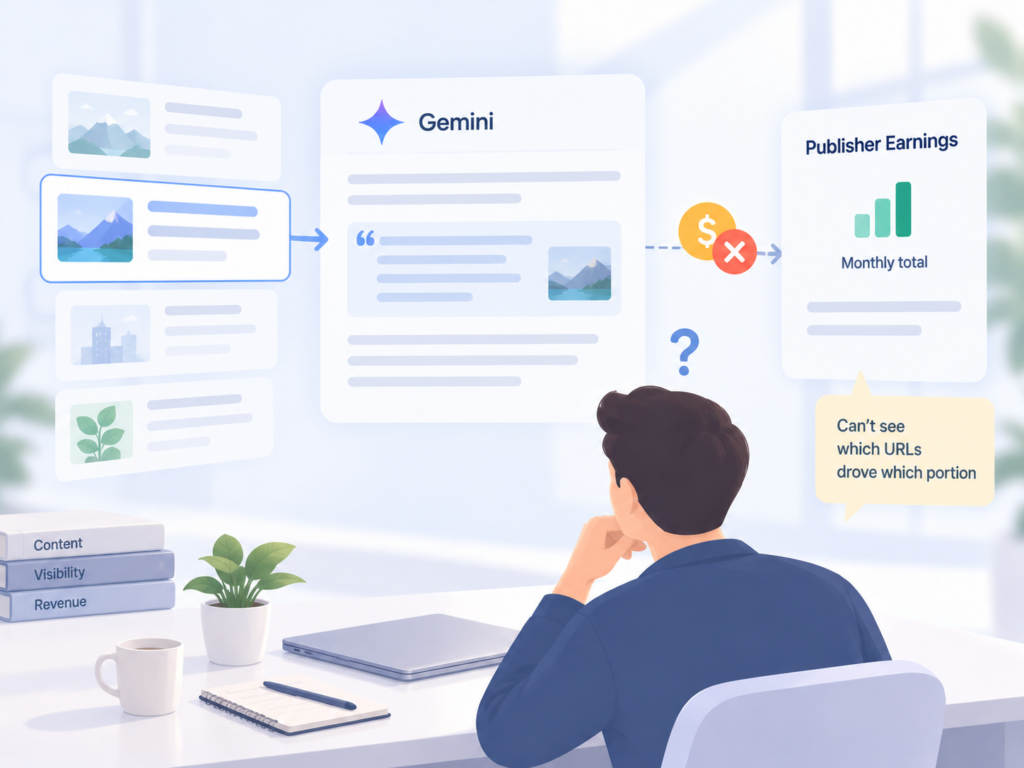
The pilot lives inside Search Console, not in a separate licensing dashboard. Eligible publishers see a notification, review the terms, and opt in. Once accepted, an “AI contribution” panel appears showing a monthly earnings figure and some historical data.
Coverage spans Gemini, AI Overviews, and AI Mode. Access is invite-only, and Google has reportedly approached dozens of publishers so far, with more interest coming from small and mid-sized sites than from large media groups.
Here’s the part that trips people up. This isn’t a negotiated contract with a fixed rate card. It’s Google unilaterally deciding what your content is worth, then showing you a number with no breakdown behind it.
How Google Decides Your Content “Contributed Significantly”
Payment triggers when Google’s internal model judges that a piece of content played a meaningful role in an AI-generated answer. That’s a value-based standard, not a usage-based one.
In practice, this means your article can be cited in a Gemini response and still generate zero payout, because Google’s model decided the contribution wasn’t significant enough. Publishers can’t see which specific URLs drove which portion of their monthly total. They just see the aggregate.
Opting out is always available, and some accounts describe weekly calls with Google as part of the pilot relationship. That’s more hand-holding than a typical Search Console feature gets, which tells you Google knows this is sensitive.
How the Pilot Stacks Up Against Other AI Content Licensing Models
Google isn’t the first company paying for content used in AI systems. The difference is in structure, not intent. Most prior deals set a price before content gets used. Google’s pilot sets the price after, based on its own judgment.
| Licensing Model | Example | How Payment Works | Transparency |
|---|---|---|---|
| Lump-sum / minimum guarantee | Axel Springer’s multi-year deal with OpenAI, reportedly worth tens of millions of euros | Fixed fee agreed upfront, often with a floor regardless of usage | Terms negotiated directly, though financial details are usually undisclosed |
| Upfront plus recurring | Informa’s Taylor & Francis deal with Microsoft, described as $10M+ upfront with recurring payments through 2027 | Initial data access fee, then scheduled payments | Publisher knows the total commitment in advance |
| Variable / usage-based | Axel Springer’s separate $25M OpenAI arrangement, combining a training fee with variable back-end payments | Payment scales with how much content gets used or how it performs | Publisher typically sees usage metrics tied to payment |
| Pay-per-value pilot | Google’s AI Contribution Pilot | Google’s model scores “significant contribution” and pays against that score | Publisher sees a monthly total, not the underlying calculation |
The pattern is clear. Every model to the left of Google’s pilot gives the publisher some visibility into what’s being paid for and why. Google’s model asks publishers to trust an internal scoring system they can’t audit.
Why Some Publishers Call It a Legal Fig Leaf
Not everyone in the pilot is thrilled. One executive told Digiday that accepting recurring payments could weaken a publisher’s leverage for a larger licensing agreement later, since Google can point to the pilot as proof it already compensates publishers.
That’s the trade-off in one sentence. Take the small, steady payment now, and you may lose your strongest argument for demanding a bigger deal down the line.
Some critics go further. One analysis frames the pilot as a way for Google to normalize the idea that your content is “inference data” rather than reader-facing work, while providing Google legal cover before stricter copyright rules arrive.
Publishers who are already in the program see it differently. “I’m hopeful that the fact that they’re setting a precedent for exploring paying publishers directly for content through this is meaningful,” one participant told Digiday, even while admitting the transparency is thin.
A Payout Isn’t the Same as Getting Your Traffic Back
This is the point most coverage glosses over. A monthly check for AI contributions doesn’t restore a lost referral visit, and Google hasn’t claimed the pilot is designed to replace that traffic.
The pilot also isn’t happening in a vacuum. Google says it already runs commercial partnerships covering more than 3,000 publications across over 50 countries, on top of the long-running News Showcase program, which covers over 2,800 publications in 33 countries. The AI Contribution Pilot is one more layer on top of that stack, not a replacement for any of it.
For most sites, that means treating any AI licensing income as a supplement to your existing revenue, not a strategy on its own.
Getting Cited Is the Metric That Actually Matters Now
Here’s the uncomfortable truth underneath all of this. Whether or not you’re invited into Google’s pilot, the more important question is whether AI systems are citing you at all.
Most brands and publishers simply don’t know. They can see search rankings and referral traffic, but they have no visibility into whether ChatGPT, Perplexity, Gemini, or AI Overviews are pulling from their pages, a competitor’s pages, or a completely different domain. In practice, tools built for generative engine optimization, like Topify, close that gap by tracking exactly which domains AI platforms cite for a given topic or prompt.
Topify’s Source Analysis feature exists precisely for this scenario. It surfaces the specific URLs AI engines reference, so you can see if your content is already contributing to answers, at scale, before you ever hear from Google about a pilot invite. That distinction matters. Being cited is the underlying event. Getting paid for it is a separate, much narrower question that only a handful of publishers can currently answer.
What to Do While the Program Stays Invite-Only
Since the AI Contribution Pilot remains limited and opaque, the more productive move is building your own visibility baseline first.
Start by checking whether your content already appears in AI answers for your core topics, across more than one platform. A single ChatGPT check tells you little; patterns across Gemini, Perplexity, and AI Overviews tell you a lot more.
From there, watch which competitors get cited instead of you, and for which specific queries. That’s the kind of gap you can act on immediately, regardless of whether Google ever extends an invitation.
If you do get invited into the pilot, treat the payout as a data point, not a verdict. A low or zero monthly figure doesn’t mean your content isn’t being used. It means Google’s internal model didn’t score it as significant, which is a very different thing.
Conclusion
The AI Contribution Pilot is a real signal that Google is willing to pay for content in AI answers, but it’s still a narrow, invite-only, opaque program. Waiting for an invitation isn’t a strategy. Knowing whether your content is already shaping AI answers, and where the gaps are relative to competitors, is something you can act on today. Get started with Topify to see exactly where your brand stands before the licensing conversation ever reaches your inbox.
FAQ
Q: Is the Google AI Contribution Pilot available to all publishers?
A: No. It’s currently invite-only. Google has approached a limited number of sites, with reporting suggesting more interest from small and mid-sized publishers than large media groups.
Q: How does Google calculate AI Contribution Pilot payments?
A: Google uses an internal model to judge whether content “significantly” shaped an AI-generated response, then pays based on that assessed value. The exact formula hasn’t been made public.
Q: Does the AI Contribution Pilot replace lost referral traffic?
A: No. Google hasn’t presented it as a traffic replacement. It’s a separate, additional revenue stream tied to content use inside Gemini, AI Overviews, and AI Mode.
Q: How can I tell if my content is already being cited by AI platforms?
A: Search Console won’t show this on its own unless you’re in the pilot. Dedicated AI visibility platforms, including Topify, track which domains get cited across multiple AI engines for a given set of topics or prompts.

