

You’ve spent months getting your content cited in ChatGPT and Perplexity answers. The tactics worked: clean headings, a few stats, a page that ranked. Then Claude Fable 5 launched, and the same content stopped surfacing. Fable 5 doesn’t skim and summarize. It reads across dozens of sources, cross-checks them against each other, and drops anything it can’t verify. The bar for getting cited just moved, and most of the old playbook doesn’t clear it.
Why Claude Fable 5 Rewrites the Rules for Getting Cited
Claude Fable 5 isn’t a bigger version of the chat model you already optimized for. It’s a long-horizon reasoning model that behaves less like a search box and more like a junior analyst. Before it answers, it explores multiple approaches, checks its own reasoning, and hunts for edge cases.
That changes what “getting cited” means. Older models often paraphrased whatever ranked well. Fable 5 treats each source as raw material to be verified, not a fact to be trusted on sight.
Here’s the gap most brands miss. Ranking in search gets you into the model’s reading pool. It doesn’t get you into the answer.
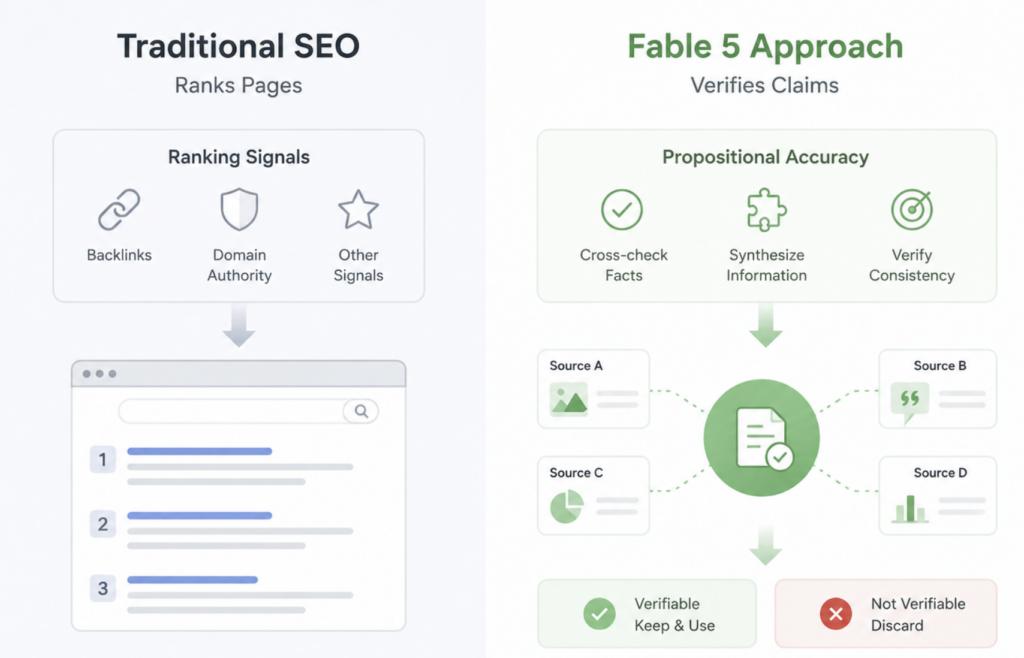
Traditional SEO leans on ranking signals like backlinks and domain authority. Fable 5 leans on propositional accuracy: whether a specific claim holds up when checked against everything else it just read. Content that appears in results but carries no verifiable data tends to get read and then quietly discarded.
How Claude Fable 5 Decides Which Sources to Cite
To optimize for Fable 5, you have to understand what its reasoning loop is actually filtering for. Three patterns show up consistently in how frontier models handle citations.
The first is consensus. When a claim shows up across multiple independent, high-authority domains, the model treats it as closer to ground truth. Research on citation behavior found that when multiple independent models cite the same work, perceived accuracy runs 95.6% higher. A single “rank #1” page rarely carries that weight on its own.
The second is how the model resolves conflict. When Fable 5 hits contradictory data, it doesn’t just pick the top result. It applies a weighted consensus that favors positions repeated across trusted, independent sources. Being loud in one place loses to being consistent across many.
The third is structure. Models cite passages, not pages. They pull the specific chunk of text that satisfies a logical need in their response, and they strongly prefer chunks that are easy to parse.
That’s the real unit of GEO now: the passage, not the URL.
Step 1: Structure Content So Claude Fable 5 Can Extract and Trust It
Your first job is to make content agent-readable. That means shifting from keyword-dense copy to data-dense architecture, where every section answers a concrete question and backs it with something checkable.
Start with your headings. Write them as the questions a user would actually ask. “What are the core benefits of X?” gives the model a clean retrieval target. “The Benefits” gives it nothing to match against.
Then serialize your data. Comparative prose is hard for a model to extract cleanly, and it tends to lose the pieces. Structured formats hold together far better: analysis of citation patterns suggests tables, numbered steps, and lists get pulled with markedly higher reliability than the same information buried in paragraphs.
There’s a sequencing trick here too, sometimes called baseline-expand. Confirm the facts the model already believes, then extend them with something new. A passage that first aligns with established knowledge, then adds proprietary data or original research, gives Fable 5 a reason to cite you specifically instead of a generic source.
Practical version: lead each section with the accepted answer, then add the number, benchmark, or finding only you can provide.
Step 2: Build Cross-Source Corroboration Around Your Claims
One authoritative page on your own domain isn’t enough anymore. Because Fable 5 validates by cross-referencing, a claim that lives in exactly one place looks unverified, no matter how strong that page is.
The fix is what you might call echo-and-expand. Your key brand claims and proprietary data should show up across several independent channels, not just your homepage. Think third-party technical blogs, industry directories, expert forums, and analyst mentions. Each independent echo raises the odds your claim survives the model’s cross-check.
Anchor those echoes to domains the model weights heavily. Established industry journals, .edu and .gov sources, and recognized reference sites act as truth anchors in a reasoning loop.
The trade-off is that this takes longer than publishing one great page. But it’s what separates a claim Fable 5 repeats from one it ignores.
Bottom line: if your most important stat exists in only one location on the web, you’ve built a single point of failure into your AI visibility.
Step 3: Track Whether Claude Fable 5 Is Actually Citing Your Brand
Here’s the problem with everything above. You can’t see it working. Fable 5’s answers are generated on the fly, vary between sessions, and shift as its safety classifiers and rerouting logic evolve. Spot-checking by asking the model a few questions yourself isn’t a strategy. It’s a guess.
This is where measurement stops being optional. To manage citation authority, you need continuous telemetry on what the model pulls into its context and what it says about you.
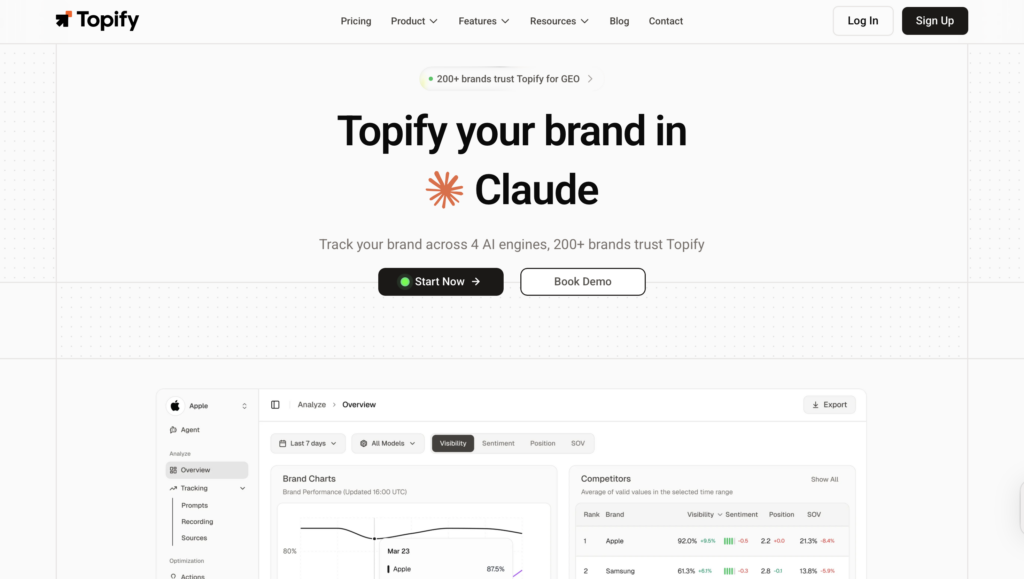
For teams tracking this at scale, Topify is built around reverse-engineering AI citations rather than guessing at them. In practice, that means three connected views. Visibility tracking monitors how often your brand gets mentioned across Claude, Perplexity, and ChatGPT, so you can tell whether a content change moved the needle. Source analysis reverse-engineers the exact domains and URLs the model pulls into its context, which shows you whether Fable 5 is citing your page or a third party echoing your claim. Competitor benchmarking flags when a rival captures a citation slot in a reasoning thread you used to own, so you can react while it still matters.
The shift is from rank-tracking to share of citation. Google rankings tell you where a page sits. Citation analytics tell you whether the model is actually building its answer on you. If you want the full picture of how these tools compare, this breakdown of AI citation tracking platforms in 2026 is a useful starting point.
You can get started with Topify on a single brand before scaling the workflow across clients.
The Mistakes That Keep Brands Out of Fable 5’s Answers
Most brands that stay invisible to Fable 5 make the same handful of errors.
They optimize only for ChatGPT and assume it transfers. It doesn’t. A deep-research model applies a stricter verification bar, so surface-level content that passed before now fails.
They publish claims with no corroboration. A bold stat on one page, echoed nowhere else, reads as unverified and gets skipped during cross-check.
They treat GEO as a one-time project. Fable 5’s citation patterns move week to week, so a single optimization pass ages fast.
And they measure the wrong thing. Watching your keyword rank tells you nothing about whether the model mentions you. Rank and mention are separate signals, and only one of them shows up in the answer.
Fix those four, and you’ve cleared most of the field.
Conclusion
Getting cited by Claude Fable 5 isn’t about ranking higher. It’s about becoming a verifiable, structured, corroborated source the model can trust inside a multi-step reasoning loop. Structure your content for extraction. Echo your key claims across independent, high-authority domains. Then measure share of citation continuously, because a model this dynamic can’t be tracked by hand. Start with one high-value topic, confirm whether Fable 5 is pulling you into its answers, and expand from there. The brands that treat citation authority as a measurable channel, not a lucky break, are the ones that show up.
FAQ
Does Claude Fable 5 actually cite sources in its answers?
Yes. Fable 5 reads and cross-checks multiple sources during its reasoning process, and it favors claims corroborated across independent, high-authority domains. Its citations reflect what survived verification, not just what ranked.
How is getting cited by Fable 5 different from ranking on Google?
Google rewards ranking signals like backlinks and domain authority. Fable 5 rewards propositional accuracy: whether a specific claim holds up when checked against everything else it read. You can rank well and still never be cited.
How long until content changes show up in Fable 5’s citations?
There’s no fixed window, and it varies by topic and how quickly independent sources pick up your claims. Because citation patterns shift week to week, continuous tracking beats a single before-and-after check.
Can I track my brand’s citations across Fable 5 and other AI models?
Yes. Platforms like Topify monitor mentions and source citations across Claude, Perplexity, and ChatGPT in one place, so you can compare share of citation across models instead of spot-checking each one manually.

