

A prospect used to open Google, type your category, and scan a page of links until they found you. Now they open Claude, ask for the best option in your space, and read a short answer that names three brands. If yours isn’t one of them, the conversation is over before you knew it started. Your keyword rankings won’t flag this, because they were never built to measure what a model chooses to say out loud.
Why Claude Fable 5 Changes Who Gets Recommended
Claude Fable 5 is Anthropic’s most capable widely released model, built for long-horizon, autonomous research work. It doesn’t hand back ten blue links and let the user sort it out. It reasons across sources, cross-checks them, and returns a shortlist of named brands.
That matters more every month. Claude’s share of AI answers grew 64x over the tracked period, overtaking Perplexity in March 2026. The audience asking Claude “who should I use” is no longer a rounding error.
Here’s the part most teams miss. The shift isn’t from ranking lower to ranking higher. It’s from being listed to being named.
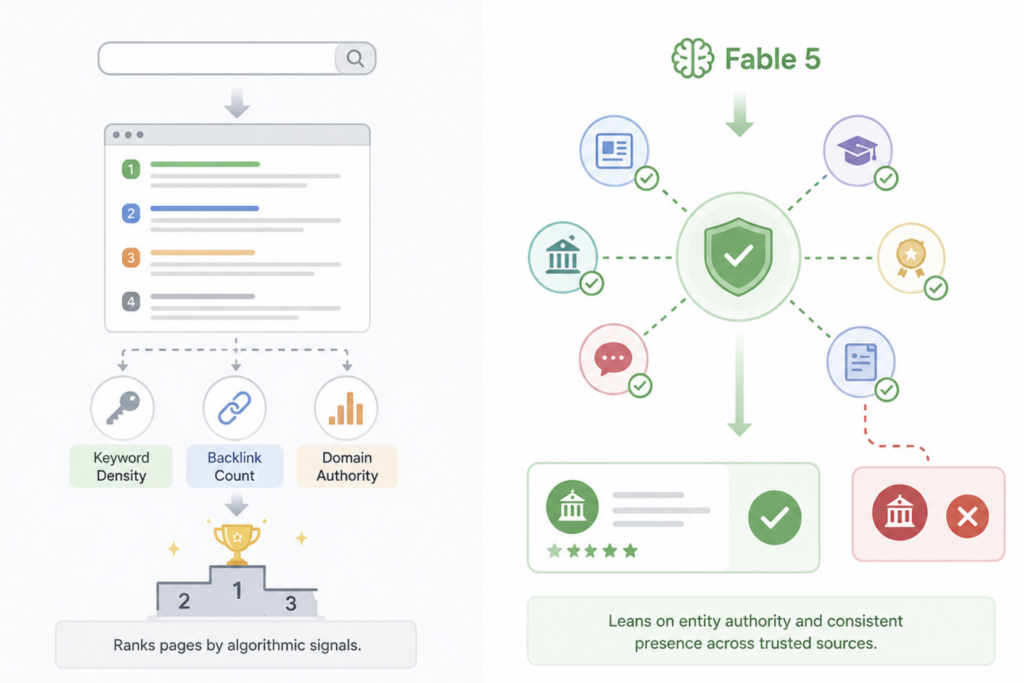
Fable 5 also decides differently than a search engine. It leans on entity authority and how consistently your brand shows up across trusted third-party sources, not on keyword density or raw backlink counts. If the model can’t corroborate your brand across several reliable domains, its verification loop tends to drop you as unconfirmed. A high Google ranking doesn’t buy you a seat at that table.
The Blind Spot: Your SEO Metrics Can’t See AI Brand Visibility
Most marketing teams are measuring the wrong surface. Rank trackers tell you where a page sits in a list of links. They say nothing about whether your brand appears inside an AI-generated answer.
The gap is wider than it looks. A 2026 local visibility study found AI platforms recommend a tiny slice of the businesses that win in traditional search: 1.2% through ChatGPT and 11% through Gemini, against 35.9% appearing in Google’s local 3-pack. By that measure, AI visibility runs three to 30 times harder to earn than a strong local ranking.
The click is disappearing too. Up to 83% of AI-generated answer queries get resolved on the results page without a visit to any website. So even a page that ranks well can go completely unseen if the model summarizes the answer and never cites you.
And the two disciplines have quietly decoupled. Strong search rankings no longer predict AI visibility; the correlation between the two has fallen sharply in a single year. Good SEO is not automatically good GEO.
You can’t optimize what you can’t see.
What “Does Claude Recommend Your Brand” Actually Means
Treat “recommended” as a scale, not a yes-or-no. A model can name you often but describe you as the budget option. It can mention you once and bury you at the bottom of a five-brand list. AI brand visibility is really a bundle of signals, and each one moves independently.
| Dimension | What it measures |
|---|---|
| Mention frequency | How often your brand surfaces in model answers |
| Sentiment and context | Whether you’re framed as a leader or an also-ran |
| Comparative position | Where you land in a ranked list of options |
| Citation density | How many high-authority sources tie you to your category |
| Source authority | The quality of the domains the model relies on to cite you |
| Entity consistency | How cleanly your brand data reads across the web |
| Answer relevance | How directly you match the specific question asked |
This is also why a single flattering answer can mislead you. Fable 5 builds its picture of your brand from repeated corroboration. Industry estimates put the bar around 250 unique mentions for a model to form a stable understanding of who you are. One mention today doesn’t make you a trusted entity tomorrow.
How to Check for Free in Under Three Minutes
You don’t need a contract or a sales call to find out where you stand. Topify runs a free GEO score check that takes about three minutes and no signup.
The flow is simple. You enter your domain, and the tool returns a GEO score with a baseline read on how visible your brand is across AI answers. It’s the fastest way to turn a vague worry (“are we even showing up?”) into a number you can act on.
Run it. Read the score. Then decide what’s worth doing next.
Think of the score as a diagnostic, not a verdict. A low number doesn’t mean your brand is broken; it usually means the corroborating signals AI models look for aren’t in place yet. That’s fixable, but only once you know it’s the problem.
From a One-Time Score to Ongoing AI Brand Visibility Tracking
A single score is a snapshot, and AI search doesn’t hold still. Across major platforms, 40% to 60% of cited sources change from one month to the next. A source that anchored your visibility in June can quietly drop out in July, and your score falls without any change on your end.
That volatility is the argument for continuous monitoring over one-off audits. This is where Topify’s Comprehensive GEO Analytics picks up after the free check. It tracks your brand across ChatGPT, Perplexity, Gemini, and Claude, and it separates the signals that a rank tracker collapses into one: mention frequency, sentiment, and comparative position, each monitored over time rather than sampled once.
The Source Analysis layer is what makes a score drop diagnosable. Instead of telling you your visibility fell, it reverse-engineers the exact domains and URLs the models cite in your category. In practice, that means you can catch a dip in Claude mentions, trace it to a specific third-party source that stopped referencing your brand, and know precisely which relationship or piece of content to rebuild. Competitor benchmarking sits alongside it, so you can see which rival the model started naming in your place and why.
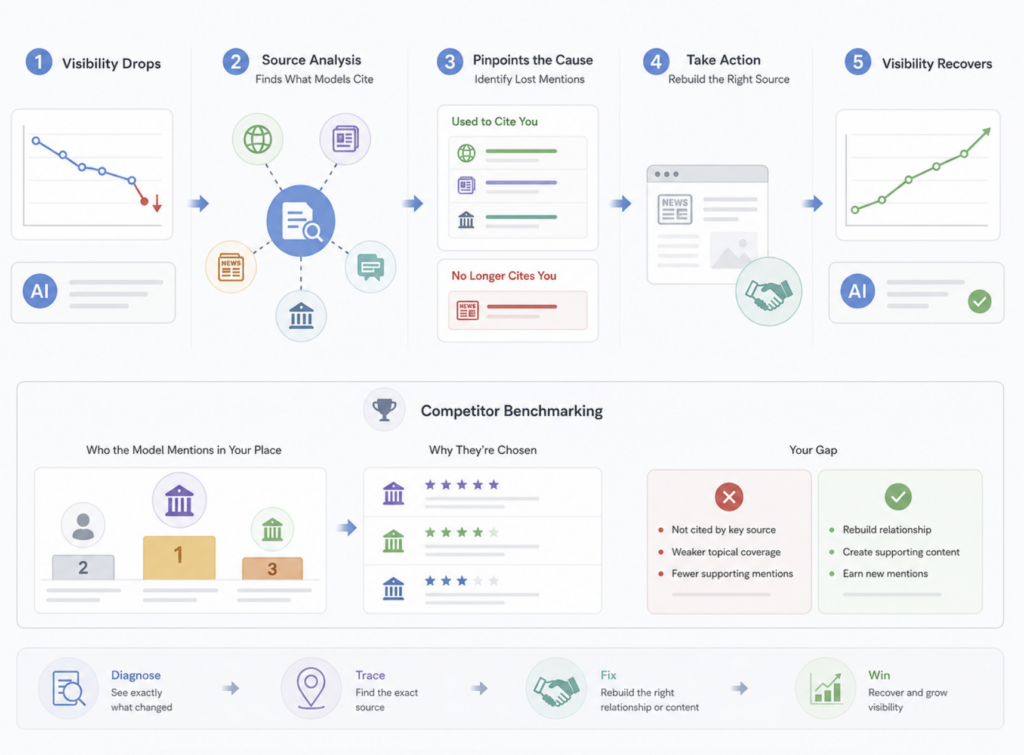
That’s the difference between knowing you slipped and knowing what to fix. A dashboard full of numbers is easy to build. Connecting a number to a cause is the harder problem, and it’s the one that actually changes what your team does on Monday.
What to Do With the Results
A GEO score is only useful if it points somewhere. Once you have yours, a few moves tend to matter most.
Start with your source footprint. If the models aren’t citing you, the fix is usually more corroboration across trusted third-party domains, not another page on your own site. Trade media, niche communities, and professional directories carry weight that a company blog can’t.
Then structure content for extraction. AI models pull cleanly from tables, lists, and direct fact statements, and far less easily from long narrative prose. Rewriting a dense explainer into scannable, fact-first blocks often lifts citability on its own.
Finally, watch position, not just presence. Being named fifth in a list of five is barely better than being absent, so track where you land relative to competitors and treat slippage as an early warning. If you want to start tracking rather than guessing, get started with Topify and set a baseline you can measure against.
Conclusion
Your prospects are already asking Claude Fable 5 which brand to choose. The only open question is whether the model names you, how it describes you, and where you sit against your competitors, none of which your ranking reports can answer. Run the free GEO score check first to see where you actually stand. If the number gives you a reason to worry, that’s the moment to move from a one-time snapshot to ongoing AI brand visibility tracking, while the answer box in your category is still up for grabs.
FAQ
Does Claude Fable 5 actually recommend specific brands?
Yes. When a user asks for the best option in a category, Fable 5 reasons across sources and returns a shortlist of named brands rather than a page of links. Whether your brand appears depends on how consistently AI models can corroborate it across trusted third-party sources.
How is checking AI brand visibility different from checking my Google ranking?
A Google ranking tells you where a page sits in a list. AI brand visibility tells you whether your brand is mentioned inside an AI answer, how it’s described, and where it ranks against competitors. Since up to 83% of AI answers end without a click, ranking well and being cited are now two separate things.
Can I check if Claude recommends my brand for free?
Yes. Topify’s free GEO score check returns a baseline read on your AI visibility in about three minutes with no signup, so you can see where you stand before committing to anything.
How often should I track my brand’s visibility in Claude and other AI tools?
Often enough to catch change, because 40% to 60% of the sources AI models cite shift month to month. A one-time score gets stale fast, so continuous monitoring is the only way to spot a drop early and trace it to a cause.

