

A new frontier model drops, and most marketing teams file it under “developer news.” Claude Fable 5 doesn’t fit that box. When a model gets better at reasoning through a question on its own, it changes which brands it names in an answer and which ones it quietly leaves out. That shift happens whether or not your team is watching. The metrics that told you how you rank on Google were never built to tell you what a model like this decides to say about you.
What Claude Fable 5 Actually Is
Claude Fable 5 launched on June 9, 2026 as the first Mythos-class model Anthropic has made generally available. The Mythos tier sits above the older Opus class in Anthropic’s hierarchy, and it’s positioned for the hardest, longest-running work rather than quick back-and-forth chat.
Under the hood, Fable 5 shares the same architecture as Claude Mythos 5. The difference isn’t the model. It’s the safety configuration layered on top, which we’ll get to below.
Here’s the part that matters for anyone tracking AI search. Fable 5 is built to operate with minimal human oversight, handling multi-day, multi-stage projects instead of single prompts.
That’s the real story: this is a model designed to work on its own, not just answer faster.
The Features That Set Claude Fable 5 Apart
Fable 5 moves the center of gravity from “smart chatbot” to autonomous operator. A few capabilities define that shift.
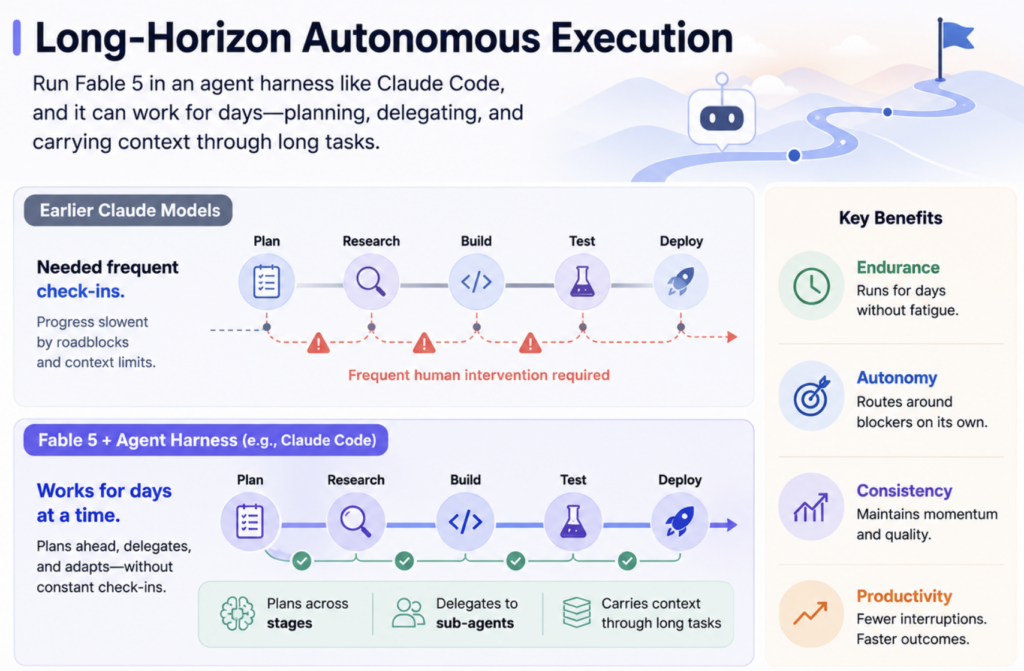
Long-horizon autonomous execution. Run Fable 5 inside an agent harness like Claude Code, and it can work for days at a time, planning across stages, delegating to sub-agents, and carrying context through a long task. Earlier models needed frequent check-ins. This one routes around blockers on its own.
Self-verification. The model writes its own test suites and uses vision to check its output against the original design or goal. So a team reviews finished work rather than supervising every step.
Visual reasoning. Fable 5 reads diagrams, charts, and tables buried inside PDFs and technical documents. In one demonstration, it completed Pokémon FireRed using only raw game screenshots, with no maps or navigation aids. That vision strength carries into finance, legal, and analytics work where the data lives inside dense figures.
Scale. A 1M token context window and up to 128K tokens of output per request. That’s enough to hold a large codebase or an extensive legal archive in a single session.
Independent testers describe it as slow and expensive, but capable of churning through almost anything thrown at it. The trade-off is clear: Fable 5 earns its keep on long, ambiguous tasks, not on quick lookups.
Claude Fable 5 Pricing and How to Access It
Fable 5 is priced at $10 per million input tokens and $50 per million output tokens, with the existing 90% discount on cached input tokens. For workloads that need to run inside the United States, US-only inference is available at 1.1x that rate.
For context, that’s double Opus 4.8’s standard rate of $5 / $25. The premium buys frontier capability on long-running work, not a better deal on short prompts.
On the access side, Fable 5 is available to Pro, Max, Team, and Enterprise users on Claude.ai, through the Claude API as claude-fable-5, and across AWS, Google Cloud, and Microsoft Foundry. Using it requires 30-day data retention for safety monitoring, and it isn’t offered under zero data retention.
One note on availability. Access was briefly suspended in June 2026 to comply with a US export control directive, then restored shortly after. If you’re evaluating it for a specific region, confirm current terms before you build on it.
Fable 5 vs Mythos 5 vs Opus 4.8
The cleanest way to place Fable 5 is against its two closest neighbors. Mythos 5 is the same model with safeguards lifted in specific areas, and Opus 4.8 is the tier below it.
| Feature | Claude Fable 5 | Claude Mythos 5 | Claude Opus 4.8 |
|---|---|---|---|
| Class | Mythos-class | Mythos-class | Opus-class |
| Safeguards | Active (standard) | Lifted in some areas | Standard |
| Availability | Generally available | Limited (Project Glasswing) | Generally available |
| Input price | $10 / MTok | $10 / MTok | $5 / MTok |
| Output price | $50 / MTok | $50 / MTok | $25 / MTok |
The safeguards are more than a footnote. Fable 5 ships with safety classifiers covering cybersecurity, biology, chemistry, and distillation. When a query trips one, the request falls back to Opus 4.8 instead of Fable 5, and you aren’t charged Fable’s premium rate for that rerouted request.
Anthropic tuned those classifiers conservatively, so they trigger in less than 5% of sessions on average, with some harmless requests caught along the way. Mythos 5, by contrast, runs without those classifiers and stays gated to a small set of vetted partners through Project Glasswing.
So for nearly all general use, “Fable 5” and “the most capable model I can actually get” mean the same thing.
Why Claude Fable 5 Matters for AI Search Visibility
Here’s where the developer story becomes a brand story. As models like Claude Fable 5 get more autonomous, they lean less on static search rankings and more on their own multi-step synthesis of information. They pull toward sources that are information-dense, authoritative, and structurally consistent.
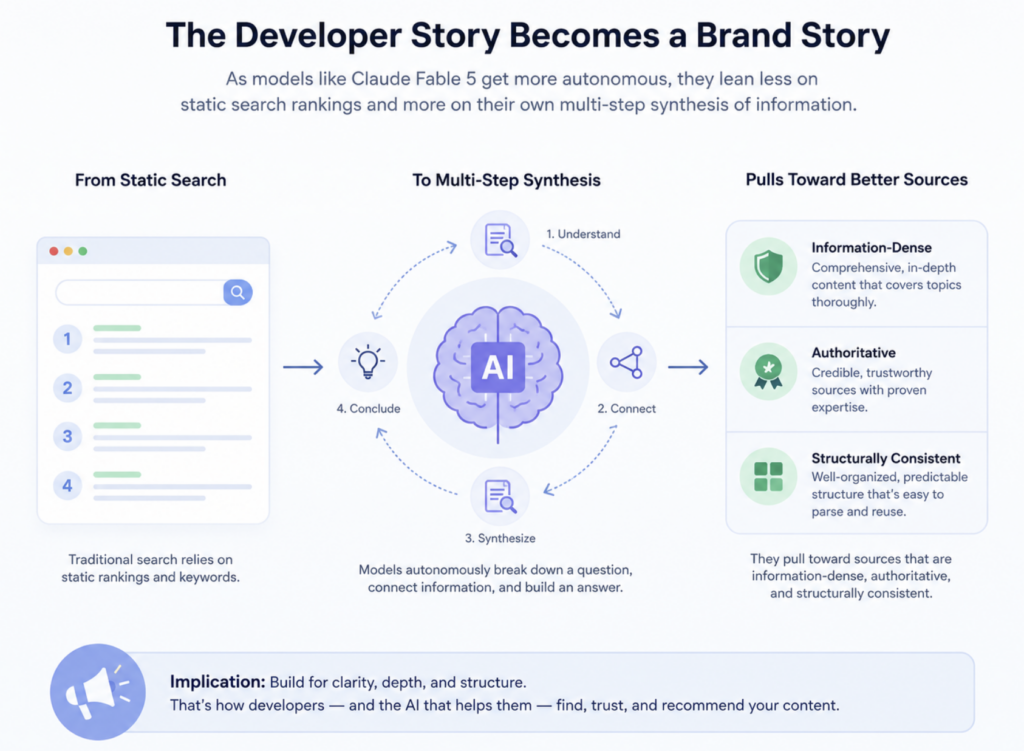
That changes the game for anyone who depends on being recommended by AI. A model that reasons through a category and picks what to cite is making an editorial choice about your brand, on every answer, without telling you.
Traditional SEO can’t measure that choice. It was built for a ranked list of blue links, not for a synthesized paragraph that names three competitors and skips you.
This is the gap that Generative Engine Optimization is meant to close, and it’s where a monitoring platform like Topifyfits in. Instead of guessing whether Fable 5 or any other model mentions you, teams track it directly.
In practice, that means watching a few things at once. You can monitor source citation frequency to see whether a model references your brand in the contexts that matter, run competitor benchmarking to catch how rival positioning shifts after a model update, and keep cross-model telemetry across ChatGPT, Perplexity, and Claude so your visibility score stays consistent no matter which architecture is answering. Topify’s Comprehensive GEO Analytics rolls those signals into a single view built around visibility, sentiment, position, and source data.
The point isn’t to chase every model release. It’s to know, with data, what the current generation of models says about you before a customer asks one for a recommendation.
Conclusion
Claude Fable 5 isn’t a routine upgrade. It’s a step toward AI that plans, executes, and checks its own work over days, which is why it reads as a developer milestone. But the same autonomy that makes it useful for coding also reshapes how AI decides which brands to surface. If your visibility now depends on a model’s synthesis rather than a search ranking, the practical move is to establish a baseline visibility score today and start tracking how your brand gets cited across models as they update.
FAQ
What is Claude Fable 5?
It’s Anthropic’s first generally available Mythos-class model, released June 9, 2026. It’s built for long-horizon, autonomous coding and knowledge work, and it sits above the Opus tier in capability.
How is Claude Fable 5 different from Mythos 5?
They share the same underlying model. Mythos 5 runs with safeguards lifted in specific areas and stays limited to vetted partners through Project Glasswing, while Fable 5 is generally available with standard safety classifiers active.
What happens if a Claude Fable 5 prompt gets blocked?
If a query trips a safety classifier, it’s rerouted to Opus 4.8 rather than answered by Fable 5, and you aren’t charged Fable’s premium rate for that rerouted request.
Can I use Claude Fable 5 right now?
Yes. It’s available through Claude.ai for Pro, Max, Team, and Enterprise users, through the Claude API, and on AWS, Google Cloud, and Microsoft Foundry, subject to a 30-day data retention requirement and current regional terms.

