

You ran the check. The number came back somewhere in the 30s or 40s. Now you’re staring at it, trying to figure out if this is a five-minute fix or a five-month rebuild.
That’s the trap of a single GEO score. A number by itself doesn’t tell you what’s broken. It just tells you that something is. The useful information lives one layer down, in the four dimensions that number is built from.
Check your GEO score and you’ll see that breakdown instead of just the total. It’s free, takes about 60 seconds, and doesn’t require signup.
GEO Score Checker
A Low Number Doesn’t Tell You What’s Broken
Here’s the mistake most teams make: they treat a low GEO score like a single grade on a single test. It isn’t. It’s an average of four separate signals, and those signals don’t move together.
A brand can have excellent content and still score low, because the problem sits at the crawler level, not the writing level. Or a brand can have flawless technical setup and still score low, because AI models don’t see enough evidence to trust what’s on the page. Same number, completely different fix.
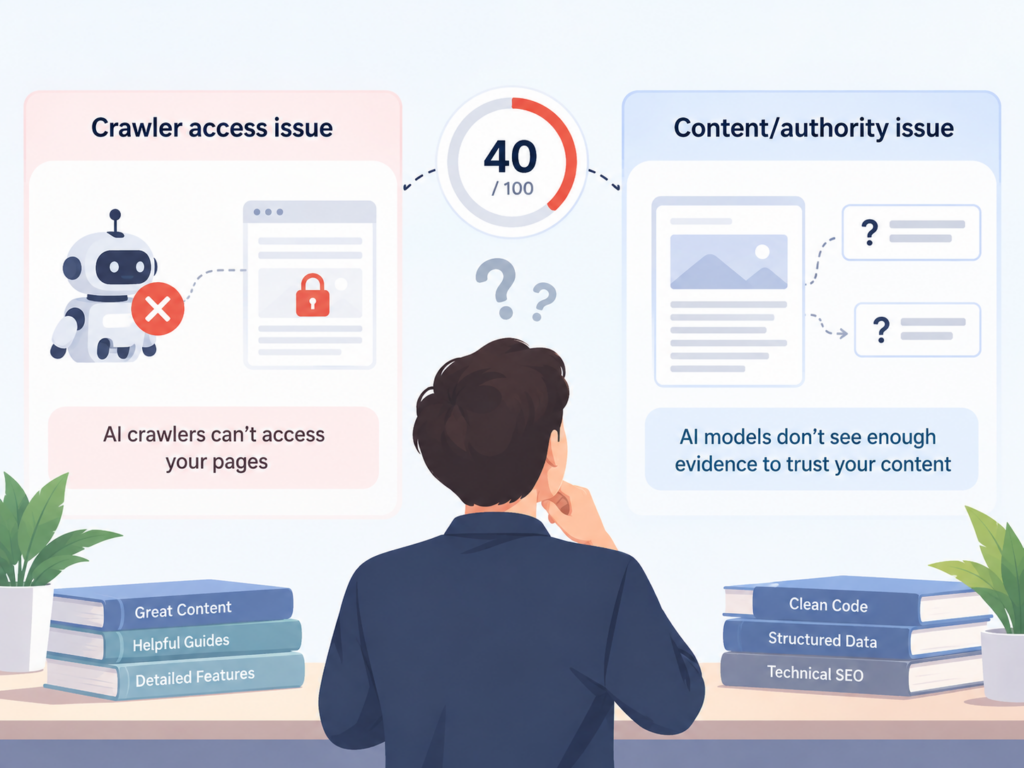
That’s not something you can diagnose ahead of time based on complaints or hunches. The GEO Score Checker gives you the four numbers underneath the total, which is the part that actually points you somewhere.
The Four Numbers Hiding Inside Your One Score
Every GEO score is really four scores compressed into one. Each answers a different question about how AI systems interact with your site.
| Score Dimension | What It Measures | What a Low Number Usually Means |
|---|---|---|
| Bot Access | Whether AI crawlers can reach and read your pages | Robots.txt, firewall rules, or JavaScript rendering are blocking access |
| Structured Data | Whether your content is machine-readable | Schema markup, JSON-LD, or clear entity structure is missing or broken |
| Content Signals | Whether your content reads as authoritative | Thin content, weak sourcing, or no clear expertise signals |
| Visibility Score | How often your brand actually shows up in AI answers | Low presence across ChatGPT, Perplexity, Gemini, and AI Overviews |
Once you see the split, the low total stops being a mystery. Here’s how to check it against your own site:
- Run your domain through the GEO Score Checker
- Get your score across all four dimensions in under a minute
- Line up each dimension against the table above
- Fix the lowest one first, not the one that feels most obvious
That last step matters more than it sounds. Teams tend to jump straight to content, because that’s the dimension they have the most control over. But if Bot Access is the weak point, no amount of rewriting fixes anything. The crawler never sees the new content either.
Reading the Gap Between Dimensions
The most useful signal isn’t the low score itself. It’s the gap between dimensions.
A brand scoring 80 on Bot Access and 25 on Content Signals has a different problem than a brand scoring 25 on Bot Access and 80 on Content Signals. The first team needs to fix what they’re saying. The second team needs to fix whether anyone can read it at all.
That gap is measurable, and it’s the piece most low-score conversations skip past.
Why Brands With Good Content Still Score Low
Bot Access is the dimension that surprises people most, because it has nothing to do with content quality. It’s a technical access question, and a lot of sites fail it without knowing they’re failing it.
A Q3 2026 crawl of nearly 1,750 sites found that 9.9% block GPTBot outright in robots.txt, and 13.7% block at least one AI crawler entirely. More telling: 84.2% of sites have no AI crawler policy set up at all, which means most low Bot Access scores aren’t a deliberate choice. They’re a default nobody reviewed.
Structured Data tends to fail for a quieter reason. Plenty of sites have solid content but no schema markup, no clear entity definitions, and no JSON-LD to tell an AI model what it’s looking at. The information is there. It’s just not labeled in a way a model can parse quickly.

Content Signals scores low most often when a page answers a question technically correct but without the specificity that makes AI models trust it, named sources, concrete numbers, clear authorship. Generic explainer content tends to underperform here even when it’s accurate.
What a Low Visibility Score Actually Costs You
Visibility Score is the dimension that turns a diagnostic exercise into a business conversation, because it’s the one your buyers actually experience.
Forrester’s 2026 Buyers’ Journey Survey, covering close to 18,000 global buyers, found that 94% of B2B decision-makers used a large language model somewhere in their purchase process in 2025, up from 89% the year before. G2’s Answer Economy report puts it more specifically: 51% of B2B software buyers now start their research with an AI chatbot more often than Google, and 71% rely on one somewhere in the process.
If your Visibility Score sits low, that’s not a hypothetical gap. It’s a real share of buyers asking a question in ChatGPT or Perplexity and getting a competitor’s name back instead of yours.
That’s the part a one-time score can flag but can’t fix on its own. It tells you where you stand today. It doesn’t tell you whether tomorrow’s answer changes.
From a One-Time Score to Knowing Why It Changes
A GEO score is a snapshot. The four dimensions behind it move independently and keep moving, crawler access rules get updated, competitors publish new content, AI platforms shift how they weight sources. A single check tells you where you are right now. It doesn’t tell you which direction things are heading.
That’s the gap Comprehensive GEO Analytics is built to close. Instead of a one-time read, it tracks all four dimensions on an ongoing basis and layers in competitor visibility so you can see whether a low score is improving or quietly getting worse.
| Capability | Free GEO Score Checker | Topify Platform |
|---|---|---|
| Check frequency | One-time snapshot | Continuous monitoring |
| Dimensions tracked | 4 GEO scores | Full GEO analytics plus sentiment and citations |
| Historical trends | None | Full trend history with alerts |
| Competitor benchmarking | Not included | Real-time competitor tracking |
| Platform breakdown | Aggregated | Per-platform, ChatGPT, Perplexity, Gemini, AI Overviews |
| Optimization actions | Directional guidance | Specific, prioritized execution steps |
The checker gives you a snapshot. The platform tracks the trajectory. If your score comes back low and you want to know whether your fixes are actually moving the needle, that’s the part a single check can’t answer on its own. You can start a free trial or look at pricing if you’re ready to move past the one-time read.
Conclusion
A low GEO score isn’t a verdict. It’s a starting point that only means something once you see which of the four dimensions is actually pulling the total down. Bot Access, Structured Data, Content Signals, and Visibility Score each point to a different fix, and mixing them up wastes time on the wrong one.
Run your domain through the GEO Score Checker again once you’ve made a change, and compare the new breakdown against the old one. If Bot Access keeps coming back as the weak spot, the AI Robots Checker will help you trace the exact rule that’s blocking access. If Content Signals is the gap, the Brand Authority Checker digs further into what’s missing.
Frequently Asked Questions
What counts as a good GEO score?
Scores above 80 generally mean AI platforms can access, understand, and cite your content with confidence. 61 to 80 is workable but leaves room to improve. Anything under 60 usually means at least one dimension has a real gap worth fixing.
How fast can a low GEO score improve?
It depends on which dimension is dragging the score down. Bot Access fixes, like updating robots.txt, can show up within days. Content Signals and Visibility Score tend to move slower, often over several weeks, since AI platforms need to recrawl and reassess your pages.
Is GEO score the same thing as an SEO score?
No. SEO scores measure ranking factors for traditional search results. GEO score measures whether AI platforms can access, understand, and choose to cite your content in generated answers, which is a different set of signals entirely.
What’s the difference between the free checker and the full platform?
The GEO Score Checker gives you a one-time snapshot across four dimensions. Comprehensive GEO Analytics tracks those same dimensions continuously, adds competitor benchmarking, and flags when something changes.

