

You ran your site through three different free GEO checkers last week. One gave you a 41. Another said 78. The third didn’t score you at all, it just flagged twelve robots.txt lines and called it a day. None of them agreed on what “good” looks like, and the report you now have to explain to your team doesn’t tell a coherent story. That’s not because one tool is wrong. It’s because none of them are measuring the same thing.
What a Free GEO Checker Actually Claims to Measure
Most tools in this category test some mix of four signals: whether AI crawlers can reach your pages, whether your structured data is readable, whether your content carries authority signals, and whether you already show up in AI answers. The catch is that no two checkers weight these four the same way, and some only test one of them.
Bot access alone is messier than it looks. A crawl across 1,744 sites found that 9.9% block GPTBot outright, and 13.7% block at least one AI crawler through robots.txt. A separate live-fetch test found the gap runs deeper than policy files suggest: on real page loads, GPTBot’s pass rate sits at 44.4%, a 33-point drop from a normal browser request. A checker that only reads your robots.txt file and one that actually fetches the page like a crawler would will often hand you two different verdicts on the same site.
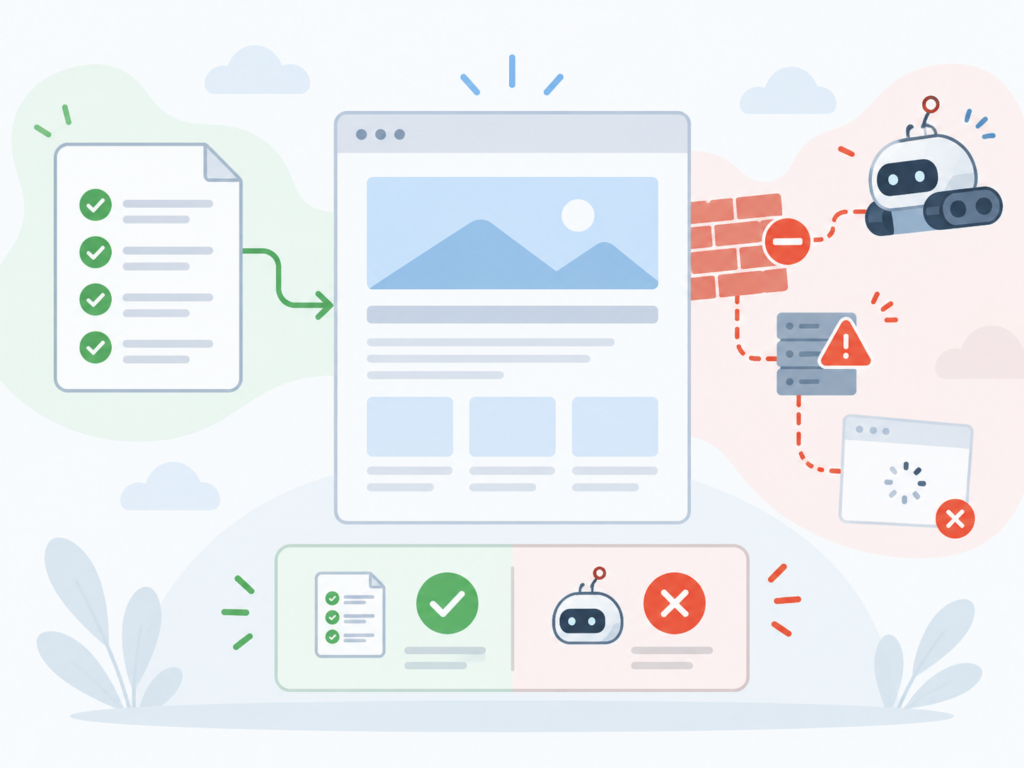
That’s the first place free tools disagree, and you haven’t even opened a dashboard yet.
If you want to see where your own site lands on that layer without guessing which checker to trust, Topify‘s GEO Score Checker runs all four signals in one pass and returns a single snapshot in under a minute, no signup required.
Quick Comparison: What Each Type of Free Checker Actually Scores
Free GEO checkers generally fall into a handful of categories, and each one is built to answer a narrower question than “how visible am I to AI.”
| Checker Type | What It Actually Scores | What It Tends to Miss |
|---|---|---|
| Bot-access scanners | Which AI crawlers are disallowed in robots.txt | Whether the blocked bot is a training crawler or a live-answer bot, which changes the risk entirely |
| Multi-platform site crawlers | Citability across several AI platforms from a full site crawl, sometimes checking a dozen or more crawler types at once | Doesn’t separate live-fetch access from bulk training-crawl access, so the two get blended into one number |
| Dashboard-style visibility checkers | A per-model score alongside schema completeness and entity recognition | One aggregated headline number can hide which specific platform you’re actually losing |
| Workflow-embedded graders | Structural extraction and content-side signals, since these tools live inside content platforms built for writers | Weak on the technical crawler-access layer, since that’s not what the tool was designed to catch |
| Four-dimension composite checkers | Bot access, structured data, content authority signals, and platform visibility together, in one score | Nothing structurally, this is the category built to close the gap the others leave open |
None of these tools is measuring the same thing, so lining up two scores side by side is closer to comparing apples to crawler logs than comparing the same test twice.
Where the Disagreements Actually Come From
The first mismatch is crawler scope. A checker that reports on GPTBot and ClaudeBot, the bots used mainly for training, will show a different number than one that reports on ChatGPT-User and Claude-User, the bots used to answer a live question. In the same census of top sites, live-fetch bots were blocked at roughly a third the rate of bulk training crawlers. Two checkers that each measure “bot access” honestly can land on opposite conclusions about the exact same site, depending on which bot list they check.
The second mismatch is schema depth. Some checkers grade structured data as a single completeness percentage. Others break it into FAQ schema, Organization schema, and product schema separately, then average unevenly across the three. A site with strong Organization markup and no FAQ schema can score high on one tool and mediocre on another, for the exact same page.
That gap isn’t a bug in either tool. It’s two different definitions of “complete.”
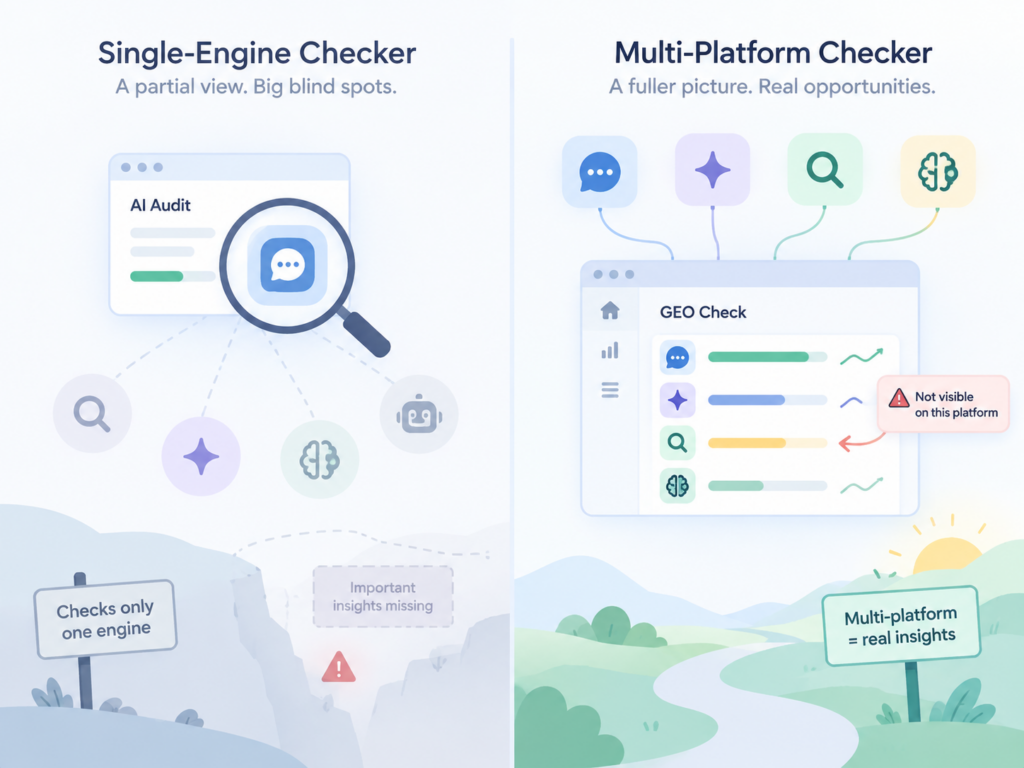
The third mismatch is platform weighting. A checker built around a single AI engine treats a gap on a different platform as a footnote. A checker built to test several platforms at once treats that same gap as a core finding. Since AI referral traffic and citation behavior vary sharply by platform, a tool that only samples one engine is, by design, blind to the others.
From a One-Time Score to Continuous Monitoring
A free checker answers one question: where do you stand today. It doesn’t tell you whether last month’s schema fix actually moved your visibility on a specific platform, or whether a competitor’s content update just pushed you out of an answer you used to own.
| Capability | Free GEO Checker | Topify Platform |
|---|---|---|
| Check frequency | One-time snapshot | Continuous monitoring |
| Dimensions tracked | Bot access, schema, or visibility, rarely all four together | Full GEO analytics plus sentiment and citation tracking |
| Historical trend | None | Full trend history with alerts |
| Competitor benchmarking | Not included | Real-time competitor tracking |
| Platform breakdown | Aggregated or partial | Per-platform, across ChatGPT, Perplexity, Gemini, and AI Overviews |
| Optimization actions | Directional guidance | Specific, prioritized execution steps |
The checker tells you where you stand. Comprehensive GEO Analytics tells you which direction you’re moving, and why.
Most teams run the free score first to confirm there’s a real gap worth closing, then start a free trial or check Topify’s pricing once they decide the gap needs ongoing attention rather than a one-time fix.
Conclusion
The scores disagree because the tools disagree on what to measure, not because one of them got your site wrong. A bot-access checker and a schema checker can both be accurate and still tell you completely different things. Use a free checker to establish your baseline, then decide whether the gap it found is a one-time fix or an ongoing drift. Run the free GEO checker once to see where you stand today, and treat that number as the reason to keep watching, not the end of the conversation.
Frequently Asked Questions
Why do free GEO checkers give different scores for the same website?
Each checker tests a different combination of signals, such as bot access, schema, or platform visibility, and weights them differently. A tool that only reads robots.txt will disagree with one that scores several AI platforms individually. Neither score is wrong, they’re measuring different layers of the same problem.
Which free GEO checker should I trust?
No single one, on its own. A checker that covers bot access, structured data, content signals, and platform visibility together, like Topify’s GEO Score Checker, gives you one consistent baseline instead of stitching together three partial reports that don’t agree.
How is a GEO score different from a traditional SEO score?
An SEO score typically measures keyword rankings and backlink authority in classic search results. A GEO score measures whether AI crawlers can access your content, whether your structured data is machine-readable, and whether AI platforms actually cite or recommend your brand in generated answers.
What’s the real difference between a free checker and a paid GEO platform?
A free checker gives you a one-time snapshot. A platform like Topify tracks the same dimensions continuously, benchmarks you against competitors, and flags when your visibility shifts on a specific platform, instead of asking you to rerun a manual check every few weeks to catch drift.

