

Ask ChatGPT a question about your own industry and see what comes back. If you run a project management tool, ask it what small teams should use. If you sell skincare, ask it what to try for sensitive skin. There’s a decent chance you’ll get three or four brand names, and yours might not be one of them.
That’s not a ranking problem. It’s a visibility problem, and it’s one most sites have never actually tested for. You’ve probably run an SEO audit at some point. You’ve likely never run a GEO check, which is a different question entirely: can AI systems even access, parse, and trust your site well enough to mention it at all.
Run a free GEO check and you’ll have an answer in under a minute. No signup, no credit card, just a score.
GEO Score Checker
✅ Free ⚡ Results in 60 seconds 🔒 No signup required
Most Sites Have Never Actually Been Checked for AI Visibility
SEO audits check things like keyword targeting, backlinks, and page speed. A GEO check asks a narrower set of questions: can AI crawlers reach this page, is the content structured in a way machines can parse, and does the site show up when someone actually asks an AI platform about this topic.
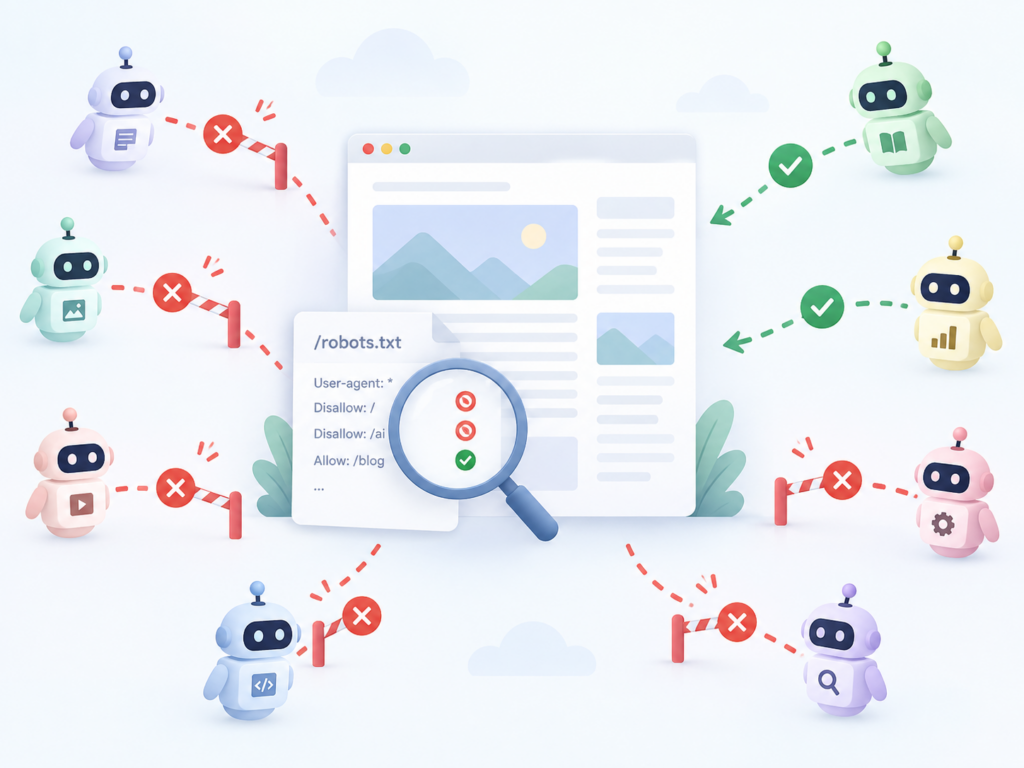
Those questions matter more than most site owners realize. Publishers now block AI crawlers at roughly five times the rate of the open web, and ClaudeBot alone is disallowed by about 35% of top sites according to a June 2026 robots.txt audit. Some of that blocking is intentional. A lot of it isn’t.
That’s the gap a GEO check is built to close. You can’t fix what you haven’t measured, and most teams have never measured this at all.
What a GEO Check Actually Measures
A proper GEO check isn’t a single number pulled out of thin air. It breaks your site down into four dimensions, each one answering a specific question about how AI systems experience your pages.
| Score Dimension | What It Measures | Why It Matters |
|---|---|---|
| Bot Access | Whether AI crawlers like GPTBot, ClaudeBot, and PerplexityBot can actually reach your pages | If the bots can’t get in, nothing else on this list matters |
| Structured Data | Whether your content has schema markup AI systems can parse | Machines extract meaning from labeled data far more reliably than plain text |
| Content Signals | Whether your content reads as authoritative, specific, and well-sourced | This is what AI weighs when deciding which brand to name |
| Visibility Score | How often your brand actually shows up across ChatGPT, Perplexity, Gemini, and AI Overviews | The outcome metric that ties the other three together |
Scores run 0 to 100. Under 40 usually means AI systems can barely see the site. 41 to 60 is a foothold, but competitors likely have an edge. 61 to 80 is solid, with room to close specific gaps. 81 and up means AI has a real reason to recommend the brand on its own.
Step-by-Step: Running Your Own Check
- Open the GEO Score Checker and enter your domain
- Wait about 60 seconds while it pulls the four scores
- Compare the dimensions against each other, not just the total. A 75 total can hide a Bot Access score of 20
- Note which single dimension is dragging the average down. That’s where you start
What People Are Actually Asking AI About Your Category
Here’s the part that makes the score feel less abstract. AI chatbots are already the front door for a lot of purchase research. Nearly half of all ChatGPT usage is people asking for recommendations and advice, not writing help or code. And more than 59% of AI users say they’ve discovered a new brand through a chatbot recommendation.
That means the prompts below are already happening, right now, in your category:
| AI Prompt Example | Platform | Search Intent | What It Reveals |
|---|---|---|---|
| “Best project management tool for a 5-person startup” | ChatGPT | Comparison, no brand named | Whether AI names your brand unprompted |
| “Is [competitor] worth it for small teams” | Perplexity | Validation of a known option | Whether your brand shows up as an alternative |
| “What’s a good CRM for solo founders” | ChatGPT | Early-stage discovery | Whether your content is specific enough to get cited |
| “Compare pricing for [category] tools” | Gemini | Bottom-funnel decision | Whether your pricing page is structured enough to parse |
| “What should I use instead of [older tool]” | Perplexity | Switching intent | Whether your migration or comparison content exists at all |
A low score on any single dimension usually explains why a brand is absent from prompts like these. Bot Access problems mean AI never even reads the page. Content Signals problems mean it reads the page and still doesn’t trust it enough to name it.
Where Sites Lose Points, and Why It’s Not Always Obvious
The Bot Access and Structured Data gaps are the two that catch people off guard, mostly because they’re invisible unless you go looking.
On structured data specifically, adoption looks healthy at first glance. A 2026 audit of 5,000 production sites found that 71% deploy at least one schema type, but only 22% pass a clean validation check across every type they emit. That 49-point gap between “deployed” and “valid” is exactly the kind of thing a GEO check surfaces that a standard SEO audit misses.
It matters because AI platforms lean on that markup to decide what to cite. Separate research on AI-cited pages found that 65% of pages cited by Google’s AI Mode and 71% cited by ChatGPT include structured data, well above the average site.
On the crawler side, the story is similar. Plenty of teams assume their site is fully open to AI bots because nobody touched robots.txt on purpose. But default settings from a CDN, an old security rule, or a plugin can quietly disallow GPTBot or ClaudeBot without anyone noticing. That’s a Bot Access score problem hiding behind a site that otherwise looks fine.

One Check Tells You Where You Stand. It Doesn’t Tell You Where You’re Heading
A GEO check is a snapshot. It’s accurate the moment you run it, and then AI platforms keep updating what they know, who they cite, and what they recommend. Your score today doesn’t stay fixed.
That’s the honest limit of a free, one-time tool, and it’s worth being upfront about.
| Capability | Free GEO Score Checker | Topify Platform |
|---|---|---|
| Check frequency | One-time snapshot | Continuous monitoring |
| Dimensions tracked | 4 GEO scores | Full GEO analytics, sentiment, and citation tracking |
| Historical trends | None | Full trend history with alerts |
| Competitor benchmarking | Not included | Real-time competitor tracking |
| Platform breakdown | Aggregated | Per-platform view across ChatGPT, Perplexity, Gemini, and AI Overviews |
| Optimization actions | Directional guidance | Specific, prioritized execution steps |
The checker tells you where you stand today. Comprehensive GEO Analytics tracks the trajectory, so a dip in Bot Access or a competitor gaining ground in Perplexity shows up before it costs you visibility. If the one-time score already found something worth fixing, it’s worth starting a free trial to see how it trends over the next few weeks. Pricing starts well below what most teams expect for this kind of tracking.
Conclusion
A GEO check takes five minutes and answers a question most sites have never asked: can AI systems actually see us. Run your own GEO check and read the four scores side by side rather than just the total.
If Bot Access comes back low, the AI Robots Checker will help you find exactly which crawler is being blocked and where. If Content Signals looks weak, the Brand Authority Checker digs into that dimension specifically. Either way, the five minutes it takes to run the first check is the cheapest audit you’ll do this quarter.
Frequently Asked Questions
How often should I run a GEO check?
Once as a baseline, then again after any major site change, like a CMS migration or a new CDN setup. AI platforms update frequently, so a quarterly recheck is a reasonable cadence for most teams.
Is a GEO check the same as an SEO audit?
No. An SEO audit focuses on rankings, backlinks, and keyword targeting. A GEO check focuses on whether AI crawlers can access your site, whether your markup is machine-readable, and whether AI platforms actually mention your brand.
What’s the difference between the free checker and the full platform?
The free GEO Score Checker gives you a one-time snapshot across four dimensions. Comprehensive GEO Analytics tracks those same dimensions continuously, adds competitor benchmarking, and flags changes as they happen.
My score came back low. What should I fix first?
Start with whichever dimension scored lowest, not the total. A low Bot Access score means nothing else can improve until crawlers can reach the page, so that’s almost always the first fix.

