

A lifter opens ChatGPT and types “best pre-workout for endurance athletes on a budget.” Back come three brand names, each with a short reason. None of them is yours, even though your formula is cleaner and your reviews are stronger.
That gap isn’t a product problem. It’s a technical one, and it’s measurable.
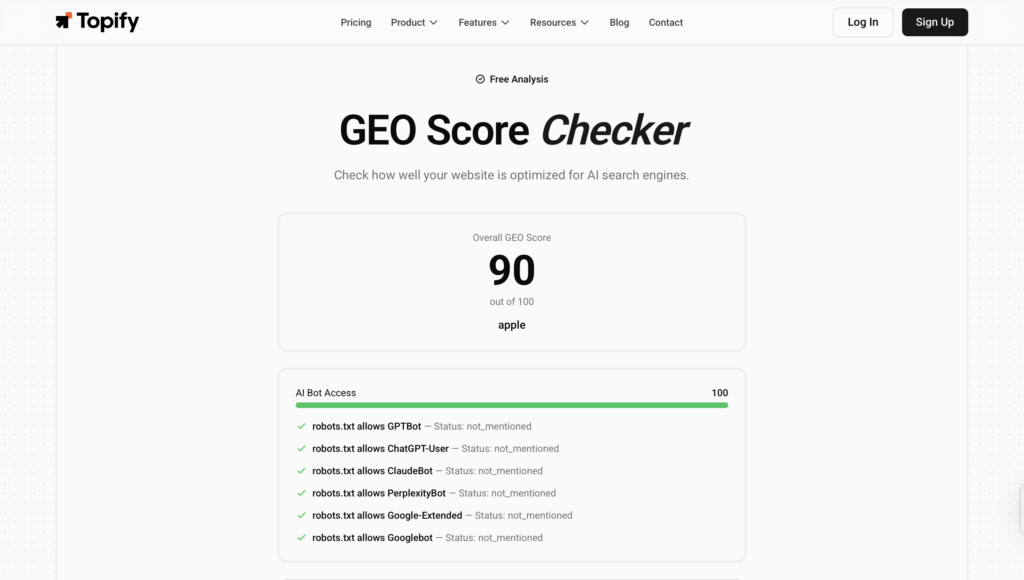
In sports and fitness, AI assistants now compress an entire category into a shortlist of three to five brands. Getting onto that shortlist depends less on how good your product is and more on whether AI can crawl, parse, and trust your brand. The fastest way to see where you stand is to run a free GEO Score Checker scan from Topify and read the four numbers it returns.
✅ Free ⚡ Results in 60 seconds 🔒 No signup required
GEO Score Checker
The Four Numbers That Tell You Why AI Skips Your Fitness Brand
The GEO Score Checker grades your domain 0-100 across four dimensions. Each one maps to a specific reason AI either surfaces or skips a sports and fitness brand.
| Score Dimension | What It Measures | Sports & Fitness Impact |
|---|---|---|
| Bot Access | Whether AI crawlers like GPTBot, ClaudeBot, and PerplexityBot can reach your site | Many fitness sites block crawlers at the CDN or app layer, so workout libraries and product pages never enter the model’s index |
| Structured Data | Whether your content carries schema and JSON-LD AI can read | Product specs, ingredient panels, class schedules, and review markup go unread without it |
| Content Signals | Whether AI judges your content authoritative enough to cite | Health-adjacent claims need proof, citations, and depth, not marketing copy |
| Visibility Score | How often your brand actually appears across ChatGPT, Perplexity, Gemini, and AI Overviews | Tells you if the first three signals are translating into real recommendations |
A score under 40 means AI can barely identify you. Between 41 and 60, you’re visible but losing the shortlist to competitors. Here’s how that plays out in practice.
A supplement brand with clinical data and no recommendations
You have third-party lab results and a peer-reviewed study behind your creatine. Yet AI keeps naming other brands. Run the scan and the Content Signals score often sits low because that evidence lives in a PDF or an image, not in crawlable, structured text. AI weighs clinical proof and certifications like NSF or USP heavily for anything ingestible. It can only weigh what it can read.
A gear brand that praises itself and no one else does
Your equipment pages call the product the strongest, lightest, and most durable. The problem is that AI wants corroboration before it puts your name forward. When the proof lives only on your own domain, your Content Signals and Visibility scores both stay flat.
A studio that shows up in one platform and vanishes in another
You appear when someone asks Perplexity for a yoga studio nearby, but ChatGPT never mentions you. That’s a Visibility Score split, usually traced to inconsistent local data and thin structured markup that one platform tolerates and another ignores.
Running the check takes about a minute:
- Open the GEO Score Checker and enter your brand name or domain.
- Wait roughly 60 seconds for the four-dimension breakdown.
- Find your lowest score. That’s your starting point.
- Compare it against the 0-100 bands to gauge how far you are from the recommendation threshold.
What Fitness Buyers Actually Type Into AI Before They Buy
Sports and fitness buyers ask AI long, specific, high-intent questions. These aren’t keywords. They’re decisions in progress.
| AI Prompt Example | Platform | Search Intent | What It Reveals |
|---|---|---|---|
| “best whey isolate under $40 for lactose sensitivity” | ChatGPT | Ready to buy, narrow constraints | Brand absence here is a lost sale, not a lost click |
| “compare two adjustable dumbbell sets for a small apartment” | Perplexity | Late-stage comparison | AI is building the shortlist you need to be on |
| “is this running shoe good for flat feet and marathon training” | Gemini | Validation before checkout | Requires structured product detail AI can parse |
| “affordable yoga studio with prenatal classes near downtown” | ChatGPT | Local, immediate | Decided by local data and review signals |
| “creatine brand with third-party testing and no fillers” | Perplexity | Trust-driven, proof-seeking | Citations and certifications decide inclusion |
| “best budget fitness app for strength training at home” | ChatGPT | Category discovery | Positioning clarity determines if you appear at all |
The scale is real. Roughly 68% of supplement shoppers now use AI tools before deciding what to buy, and AI Overviews have climbed to appear in close to half of all Google searches.
Here’s the part that stings. When AI answers one of these prompts without you, the buyer rarely notices you were ever an option.
Where Sports & Fitness Brands Consistently Lose GEO Points
Three patterns show up again and again when fitness brands score below the recommendation threshold.
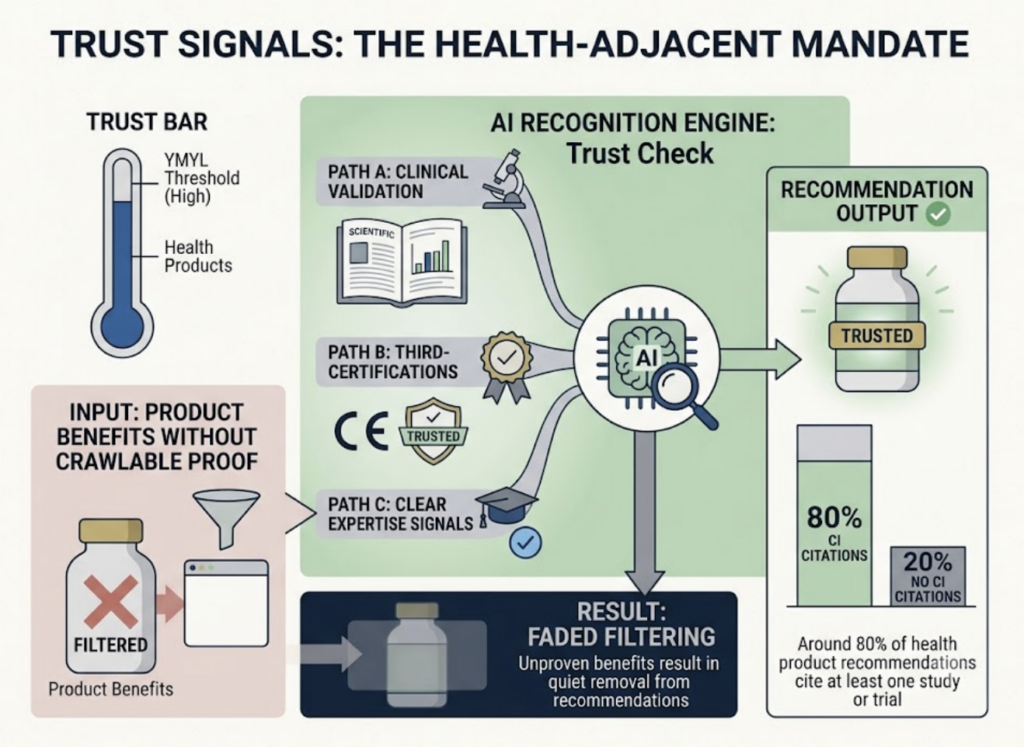
The health-adjacent trust bar is higher than you think. Anything ingestible or tied to physical outcomes gets treated as Your Money or Your Life content. AI leans on clinical validation, third-party certifications, and clear expertise signals before recommending. Around 80% of AI-generated health product recommendations cite at least one study or trial. A brand that asserts benefits without crawlable proof tends to get filtered out quietly, no matter how good the product is.
AI trusts other people more than it trusts you. This is the gap most fitness brands underestimate. AI pulls recommendations from third-party lifestyle publishers, retailer pages, and community consensus far more than from brand sites. One athleisure visibility study of more than 1,100 AI responses found consumer publishers like Men’s Health carried more weight than industry trades, and that mentions rarely linked back to the brand’s own site. Reviews matter too. One analysis found ChatGPT references reviews in 58% of responses and Perplexity in nearly all of them. If your external proof is thin, your Content Signals score reflects it.
Being mentioned is not the same as being recommended. A 2026 sports nutrition benchmark made this distinction sharp: brands appeared in AI answers as factual references far more often than they earned an actual recommendation, and citation architecture decided which side of that line they landed on. You can show up in the text and still never make the shortlist.
| Symptom | GEO Score Signal | Likely Cause | Where to Look |
|---|---|---|---|
| Clinical claims ignored by AI | Content Signals under 40 | Proof locked in PDFs or images | Structured Data + Content depth |
| Named as a fact, never recommended | Visibility Score under 40 | No third-party corroboration | External citation building |
| Present in one platform only | Visibility Score split | Inconsistent local or schema data | Bot Access + Structured Data |
From a One-Time Score to Continuous GEO Monitoring
A single scan tells you where you stand today. It doesn’t tell you which way you’re moving.
That matters in fitness because AI visibility shifts constantly. Models update, competitors publish, reviews accumulate, and a brand that was on the shortlist in March can drop off by June. The checker gives you a snapshot. Tracking the trajectory is a different job.
| Capability | Free GEO Score Checker | Topify Platform |
|---|---|---|
| Check frequency | One-time snapshot | Continuous monitoring |
| Dimensions tracked | 4 GEO scores | Full GEO analytics plus sentiment and citations |
| Historical trends | None | Full trend history with alerts |
| Competitor benchmarking | Not included | Real-time competitor tracking |
| Platform breakdown | Aggregated | Per-platform (ChatGPT, Perplexity, Gemini, AI Overviews) |
| Optimization actions | Directional guidance | Specific, prioritized steps |
That’s the bridge from the free tool to Comprehensive GEO Analytics, which tracks all four signals over time across platforms. You can start a free trial without a credit card, and the pricing scales from a single brand to multi-brand agencies.
Conclusion
In sports and fitness, AI doesn’t reward the best product. It rewards the brand it can crawl, parse, trust, and corroborate. Those are the four numbers the checker hands you.
Start by running your domain through the GEO Score Checker and finding your weakest dimension. If Bot Access comes back low, the AI Robots Checker shows exactly which crawlers your robots.txt is turning away. If the issue is whether AI sees you as a credible source, the Brand Authority Checker digs into that, and the AI Visibility Report gives you a cross-platform snapshot of where you currently appear.
Frequently Asked Questions
Why does AI recommend competitors when my supplement has better clinical data?
Usually because the data isn’t readable. AI weighs clinical proof and certifications heavily for ingestible products, but only when that evidence sits in crawlable, structured text rather than a PDF or image. If your Content Signals score is low, start there before adding more studies.
My gym ranks well on Google but never shows up in ChatGPT. Why?
Traditional rankings and AI visibility are separate systems. AI assistants pull local recommendations from business profile data, reviews, and local citations, then weigh consistency across them. A strong Google rank doesn’t guarantee the structured, corroborated signals AI needs to recommend you.
What’s the difference between being mentioned by AI and being recommended?
A mention is AI referencing your brand as a fact. A recommendation is AI actively putting you on the shortlist when someone asks what to buy. Citation quality and third-party corroboration decide which one you get, which is why two brands with similar products can land on opposite sides.
How is the free checker different from continuous monitoring?
The GEO Score Checker gives you a one-time score across four dimensions. Comprehensive GEO Analytics tracks those signals over time, breaks them down per platform, and benchmarks you against competitors, since fitness AI visibility shifts week to week.
Read more:

