

A collector with serious budget opens ChatGPT and asks for the best heritage watchmakers for a first investment-grade piece. The answer names four houses, describes their movements, and links to a few editorial sources. Your maison, with a century of craft behind it, isn’t in the reply. Not ranked low. Absent.
This usually isn’t a brand problem. It’s a technical visibility gap. AI systems couldn’t read, verify, or trust your site clearly enough to include you. You can see exactly where that breaks down with the GEO Score Checker from Topify.
✅ Free ⚡ Results in 60 seconds 🔒 No signup required
GEO Score Checker
The Four Numbers Behind Why AI Overlooks Your Luxury Brand
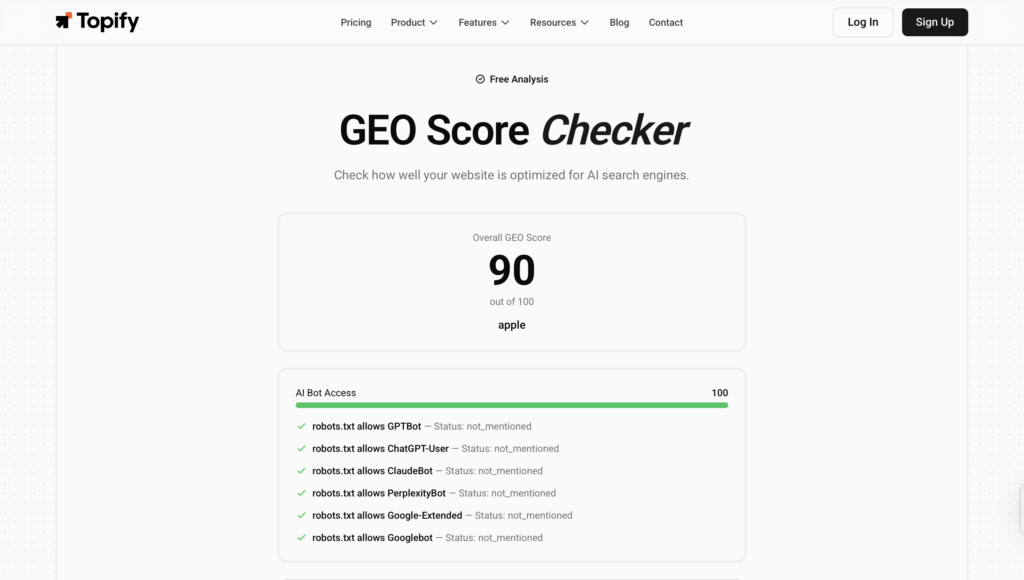
The GEO Score Checker gives your domain a single 0-100 score, then breaks it into four dimensions. For luxury brands, each one maps to a specific way the category tends to lose ground in AI answers.
| Score Dimension | What It Measures | Luxury Goods Impact |
|---|---|---|
| Bot Access | Whether AI crawlers like GPTBot, ClaudeBot, and PerplexityBot can reach your pages | Image-heavy, JavaScript-rendered sites often block or starve crawlers, so AI never sees the collection |
| Structured Data | Whether Product, Organization, and FAQ schema describe your content in machine-readable form | Craft, provenance, and pricing live in lookbooks and PDFs, not in markup AI can parse |
| Content Signals | Depth, semantic relevance, and authority signals AI reads as expertise | Minimal copy and visual-first storytelling leave little text for AI to extract |
| Visibility Score | How often your brand actually surfaces across ChatGPT, Perplexity, Gemini, and AI Overviews | A house can be present on one platform and effectively invisible on another |
Here’s the thing about luxury sites. They’re often built as art objects: full-bleed imagery, sparse copy, heavy front-end frameworks. Beautiful for a human. Close to unreadable for a crawler.
Scenario 1: The Site That Reads Like a Gallery, Not a Page
A jewelry maison runs a stunning single-page experience. Large video loops, a few poetic lines, products loaded through JavaScript. The GEO Score Checker returns Bot Access in the low 30s and Content Signals under 40. AI tools can render the homepage as a name, but they can’t tell what you sell, in what materials, at what tier. So when a buyer asks for high jewelry houses known for emerald settings, the model has nothing concrete to cite.
Scenario 2: Heritage Buried in a PDF
A fashion house keeps its archive, atelier story, and craftsmanship details inside downloadable lookbooks. That narrative is your strongest authority signal. AI can’t index a 40MB PDF the way it indexes a structured page. Content Signals stays flat even though the underlying expertise is real.
Scenario 3: Strong on One Platform, Gone on Another
A leather goods brand shows up in ChatGPT for “best Italian bag makers” but never appears in Perplexity for the same query. The aggregate Visibility Score looks mediocre, which hides the fact that one platform sees you clearly and another doesn’t see you at all.
Running the check takes a minute. Open the GEO Score Checker, enter your domain, and you’ll get all four dimension scores in about 60 seconds. Compare them, and your weakest number tells you where to start.
What Luxury Buyers Actually Type Into AI Before They Ever Walk In
In luxury, AI is rarely the place where the purchase closes. Jewelry and high-value goods are among the least common categories for direct AI checkout, with roughly 28% of shoppers using AI for jewelry purchases. But that statistic misses the real shift. Affluent buyers use AI earlier, to research provenance, compare houses, and build a shortlist before they ever contact a boutique.
That shortlist stage is where your visibility is decided. These are the kinds of prompts driving it.
| AI Prompt Example | Platform | Search Intent | What It Reveals |
|---|---|---|---|
| “Best heritage watchmakers for a first investment piece” | ChatGPT | Shortlist building | Which houses AI treats as category authorities |
| “Quietly luxury handbag brands that hold resale value” | Perplexity | Comparison with proof | Whether third-party resale and review data names you |
| “Sustainable high jewelry brands using recycled gold” | Gemini | Values-based filtering | If your sustainability claims are structured and verifiable |
| “Compare [Maison A] and [Maison B] for craftsmanship” | ChatGPT | Direct head-to-head | How AI characterizes you against a named rival |
| “Where do collectors buy rare vintage timepieces” | Perplexity | Channel and trust research | Whether trusted editorial sources cite your name |
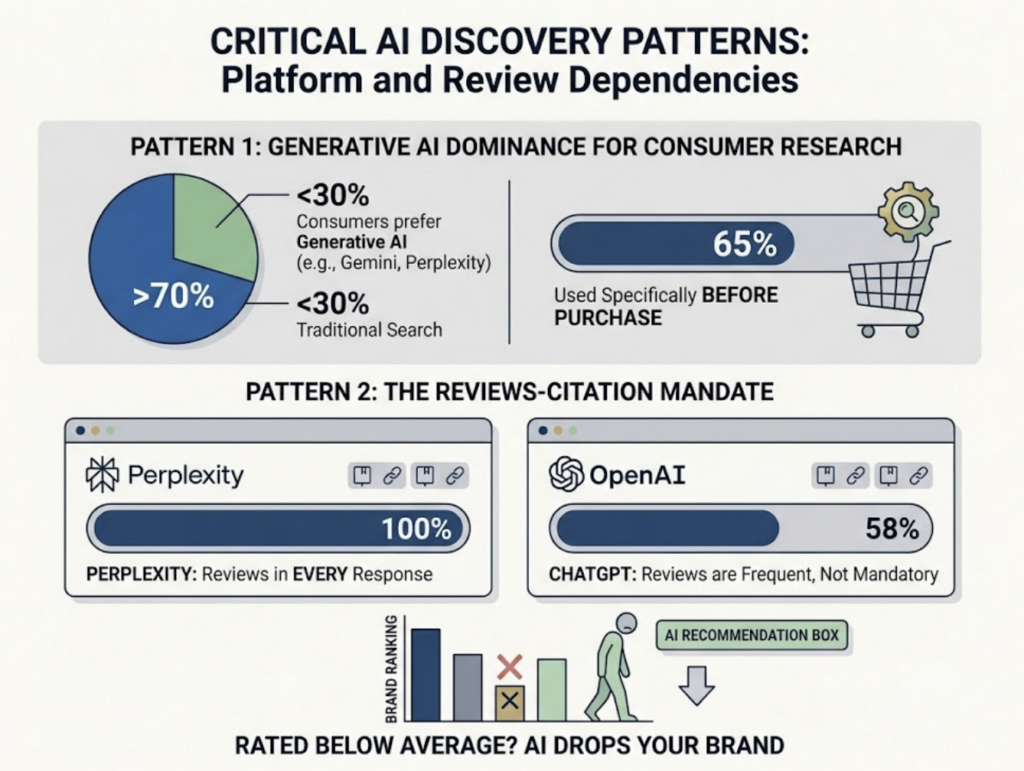
Two patterns matter here. First, more than 70% of consumers now reach for generative AI over traditional search for product research, and around 65% use it specifically before buying. Second, AI leans hard on third-party proof. Studies found Perplexity references reviews in 100% of responses and ChatGPT in 58%, and brands rated below the category average were often dropped from recommendations entirely.
If your maison isn’t in that early answer, you’re cut from the consideration set before a single human conversation happens. And you won’t see it in any analytics dashboard.
Where Heritage Brands Quietly Bleed GEO Points
Luxury brands tend to lose AI visibility in three predictable places. Each one shows up in a different part of the GEO score.
The website is built for the eye, not the crawler. This is the most common and most fixable problem. When a site renders products through client-side JavaScript and carries almost no descriptive text, AI sees a shell. Bot Access and Content Signals both suffer. The craft is there. The machine-readable evidence of it isn’t.
Your authority lives outside your control, and it’s inconsistent. AI doesn’t take your word for your standing. It cross-references Wikipedia, editorial coverage, retailer listings, and specialist directories to decide whether you’re safe to recommend. Luxury houses often have fragmented third-party footprints: a different brand name on a marketplace, an outdated founding date in one directory, missing entity links in another. That inconsistency makes AI less confident citing you, even when the press coverage exists.
Platform fragmentation hides the gap. A brand can look fine if you only check ChatGPT. The danger is the platform you’re not watching. Perplexity crawls the live web and weights fresh, well-cited pages differently than ChatGPT does. A house with strong editorial history might dominate one and vanish from the other. Looking at a single platform gives you false comfort.
| Luxury Scenario | GEO Score Signal | Likely Cause | Direction to Fix |
|---|---|---|---|
| Products invisible in AI answers | Bot Access below 30 | JS-rendered catalog, blocked crawlers | Open crawler access, server-render key pages |
| Craft story not cited | Content Signals below 40 | Narrative trapped in PDFs and imagery | Move provenance into structured page copy |
| Inconsistent brand description | Structured Data below 40 | Missing or conflicting schema and entity data | Add Organization and Product schema, align directories |
| Present in one platform only | Visibility Score uneven | Platform-specific data and freshness gaps | Track each platform separately, not as one number |
That last point is the one most teams underestimate. A single blended score can look acceptable while one platform shows you at zero.
From a One-Time Score to Tracking Every Mention Over Time
The GEO Score Checker tells you where you stand today. That’s the right first move. But AI visibility isn’t static. Models retrain, competitors publish, editorial coverage shifts, and your scores move with them.
A single score tells you where you stand. Continuous monitoring tells you which direction you’re moving.
That’s the gap Comprehensive GEO Analytics is built to close.
| Capability | Free GEO Score Checker | Topify Platform |
|---|---|---|
| Check frequency | One-time snapshot | Continuous monitoring |
| Dimensions tracked | 4 GEO scores | Full GEO analytics plus sentiment and citations |
| Historical trends | None | Full trend history with alerts |
| Competitor benchmarking | Not included | Real-time competitor tracking |
| Platform breakdown | Aggregated | Per-platform (ChatGPT, Perplexity, Gemini, AI Overviews) |
| Optimization actions | Directional guidance | Specific, prioritized execution steps |
For luxury brands fighting platform fragmentation, the per-platform view is the part that earns its keep. You can start a free trial with no credit card, and the pricing scales from a single house to multi-brand groups.
Conclusion
For luxury goods, AI visibility is less about how refined your brand looks and more about whether machines can read, verify, and trust what you’ve built. The craft is rarely the problem. The technical signals around it usually are.
Start with the number. Run your domain through the GEO Score Checker and see which of the four dimensions is dragging you down. If Bot Access is low, the AI Robots Checker helps you dig into what your robots.txt is actually telling crawlers. If you suspect your third-party authority is thin, the Brand Authority Checker shows how AI weighs your standing, and the AI Visibility Report gives you a cross-platform snapshot of where you appear.
Frequently Asked Questions
Why would a famous luxury brand score low on the GEO Score Checker?
Recognition among humans doesn’t translate to machine readability. A maison can be world-famous yet score low because its site blocks crawlers, hides product details in JavaScript, or lacks structured data. AI grades the signals it can parse, not your reputation. The GEO Score Checker shows which signals are missing.
Does it matter if buyers don’t actually purchase luxury goods through AI?
Yes. Affluent buyers use AI for research and shortlisting long before they buy, and roughly 65% use it before a purchase. If your brand isn’t in that early shortlist, you’re filtered out at the start of the journey, well before any boutique conversation happens.
Why does my brand appear in one AI platform but not another?
Each platform uses different data sources and freshness rules. Perplexity crawls the live web and weights recent, well-cited pages, while ChatGPT relies more on training data and retrieval. A brand strong in one can be absent in the other, which is why per-platform tracking in Comprehensive GEO Analytics matters more than a single blended figure.
How is GEO different from the SEO my agency already does?
Traditional SEO optimizes for ranking position in a list of links. GEO optimizes for being mentioned and accurately described inside a single AI-generated answer where there’s no second page. The skills overlap, but GEO puts more weight on structured data, third-party authority, and machine-readable content.
Read More

