

Your team spent six months building content, earning backlinks, and climbing Google. Then a prospect opened ChatGPT and asked for the best tool in your category. The answer named five brands. Yours wasn’t one of them. Nothing in your SEO dashboard explains why, because none of those metrics measure what an AI model decides to say. ChatGPT ranking runs on a different logic than Google ranking, and the brands winning it aren’t always the ones sitting at #1 in search results.
What Is ChatGPT Ranking, Really
ChatGPT ranking isn’t a list of blue links. It’s whether an AI model includes your brand in its answer, and where that mention lands.
In practice, it breaks into two measurable things. The first is visibility, or mention rate: how often your brand shows up when someone asks ChatGPT a category or comparison question. The second is position, or salience: whether you’re named as the recommended leader, buried mid-list, or cited only as a footnote source.
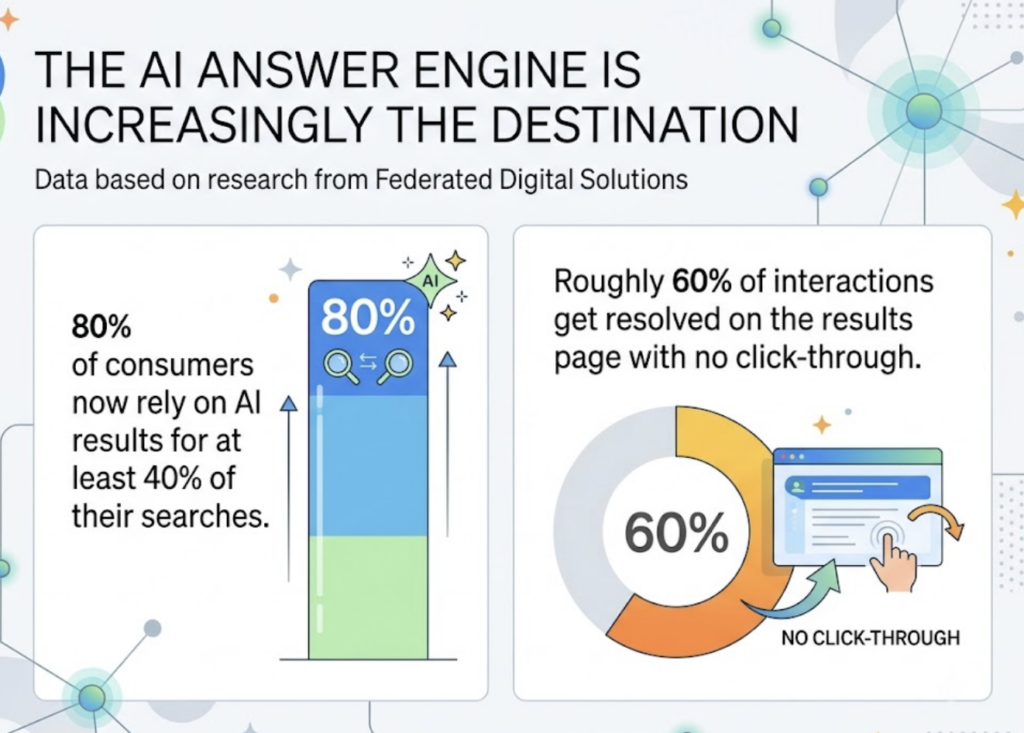
This matters because the answer engine increasingly is the destination. Research on AI search behavior from Federated Digital Solutions found that 80% of consumers now rely on AI-generated results for at least 40% of their searches, and roughly 60% of those interactions get resolved on the results page with no click through to any website.
That’s the gap most brands still can’t see.
How Does ChatGPT Ranking Work
ChatGPT doesn’t rank pages in a vacuum the way a search index does. It uses Retrieval-Augmented Generation, pulling from trusted sources across the web and synthesizing them into one confident answer. If your brand isn’t part of that synthesized consensus, you effectively don’t exist for the person asking.
A few signals drive whether you make it into that consensus.
Multi-source corroboration is the big one. Models favor content patterns that repeat across diverse, authoritative domains like G2, industry publications, and Reddit. When the same claim about your brand appears in several reputable places, it creates a trust cascade that tells the model you’re a real entity in your category.
Structural clarity is the second. AI models prefer content they can extract cleanly. According to the 7 Pillars of LLM Visibility from Limy.ai, pages with clear H1 to H3 headers, bulleted lists, and answer-first summaries can see up to a 40% increase in citation rates over unstructured prose.
The third is something traditional SEO undervalues: unlinked mentions. Google leans heavily on backlink equity. LLMs treat an unlinked mention on a reputable third-party platform as a strong signal of relevance on its own.
Why Google Rankings Don’t Translate
Here’s the part SEO teams keep missing.
A high domain authority and solid keyword positions don’t guarantee anything in AI search. Marketing.org.nz makes the case plainly in its work on why traditional SEO isn’t enough: the answer engine optimizes for synthesis and entity association, not link hierarchy. The numbers back it up. Only 12% of AI Overviews link to the #1 organic ranking result, which means your Google position is no longer a reliable proxy for whether AI knows you exist.
How to Measure ChatGPT Ranking
The instinct is to open ChatGPT, ask the question, and see if you show up. That single check tells you almost nothing.
AI results are non-deterministic. The same prompt can return different answers in back-to-back sessions, because models use a temperature setting to introduce conversational variety. Visiblie’s research on whether ChatGPT gives everyone the same answer points to a second variable: personalization. Chat history, saved memory, and custom instructions all shape the response, so what you see isn’t what your customer sees.
So a single good mention is a proof of concept, not a metric. Reliable measurement means aggregating results across many fresh sessions, then watching the trend instead of reacting to one lucky or unlucky output.
That’s the core reason manual checking falls apart at scale, and where a dedicated tool earns its place.
Using an LLM Ranking Checker
An LLM ranking checker runs your category prompts across AI platforms repeatedly, then turns the noisy output into a stable visibility and position score you can track over time.
For teams measuring this across more than one engine, Topify tends to stand out by combining Visibility and Position tracking into a single view spanning ChatGPT, Perplexity, and Google AI Overviews. In practice, that means you can watch your mention rate for a key prompt, see whether you’re climbing or slipping against a competitor, and catch a drop the week it happens rather than a quarter later. It’s the difference between guessing and knowing where you actually stand.
How to Improve Your ChatGPT Ranking
Improving your ChatGPT ranking is less about keywords and more about entity authority. Three moves do most of the work.
Build source authority. LLMs index high-trust platforms heavily, so placements on sites like G2 and respected industry journals feed directly into the consensus they synthesize. Reverse-engineering which domains the AI already cites for your category tells you exactly where to earn presence. Topify’s Source Analysis surfaces the exact domains and URLs AI platforms pull from, so you can see whether you or a competitor owns those references.
Format answer-first. Put the direct answer to a likely prompt inside the first 40 to 60 words of a page, then support it with structure the model can lift cleanly. This single habit lifts extractability more than almost any other on-page change.
Benchmark against competitors continuously. If a rival gets cited for a feature you also offer, the problem usually isn’t the feature. It’s that your content structure is stopping the model from making the connection. Topify’s competitor benchmarking shows who AI engines recommend and where the gaps sit, which turns a vague strategy into a specific content to-do list.
The throughline of any real strategy for ChatGPT ranking: measure first, then fix what the data points to.
Common Mistakes That Tank Your ChatGPT Ranking
Most brands lose visibility for predictable reasons.
The first is treating Google rankings as the scoreboard. With only 12% of AI Overviews pointing to the top organic result, that assumption quietly misleads the whole strategy.
The second is checking one platform and calling it done. Your audience moves across ChatGPT, Perplexity, and AI Overviews, and your position can differ on each.
The third is the one-off check. A single fresh session can’t separate signal from the model’s built-in randomness, so teams celebrate a mention that won’t repeat, or panic over an absence that wasn’t real.
The last is ignoring sentiment. Federated Digital Solutions notes that 78% of users visit a retail site after an AI recommendation, which means a negative or off-brand AI summary can cost you the customer before they ever reach your page. How AI describes you matters as much as whether it mentions you.
Conclusion
ChatGPT ranking comes down to two questions: does AI mention your brand, and does it put you where it counts. The brands winning aren’t the ones with the highest domain authority. They’re the ones being measured, monitored, and corrected as AI answers shift week to week. With 58% of product research now running through AI tools, per Federated Digital Solutions, that visibility is no longer a side metric.
Start by getting an honest baseline of where you stand across the major AI engines, then work the gaps the data exposes. You can get started with Topify to track your AI search position in one place.
FAQ
Q: What are the best tools for ChatGPT ranking?
A: The right tool tracks more than one AI platform, runs prompts across many fresh sessions to control for randomness, and reports both mention rate and position. Platforms built for this, like Topify, also tie in source and sentiment data so you can act on what you find rather than just watch a number.
Q: Is there a checklist for ChatGPT ranking?
A: A simple checklist for ChatGPT ranking: earn mentions on high-authority third-party sites, format pages answer-first within the first 40 to 60 words, use clear H1 to H3 structure, monitor multiple AI platforms, and track sentiment alongside visibility. Review the data on a recurring schedule, not once.
Q: Can you give an example of ChatGPT ranking in action?
A: A common example of ChatGPT ranking: you ask ChatGPT “best [your category] tool” and it returns five brands in a ranked list. Whether you appear, and at which position, is your ChatGPT ranking for that prompt. Run the same prompt across 20 sessions and the aggregate placement is your real score.
Q: How much does ChatGPT ranking tracking cost?
A: Pricing for ChatGPT ranking tools varies by prompt volume and platform coverage. Topify’s plans start at $99 per month for tracking across ChatGPT, Perplexity, and AI Overviews, with higher tiers adding more prompts, projects, and seats. You can review current Topify pricing for the full breakdown.

