

A potential client is going through a contract dispute. They open ChatGPT at 10 p.m. and type: “What’s the best business litigation firm in Chicago?” They get three names. Yours isn’t one of them.
Your firm has the track record. You’ve won the cases. You have the testimonials. But AI didn’t mention you.
That’s not a reputation problem. It’s a GEO problem — and it’s measurable.
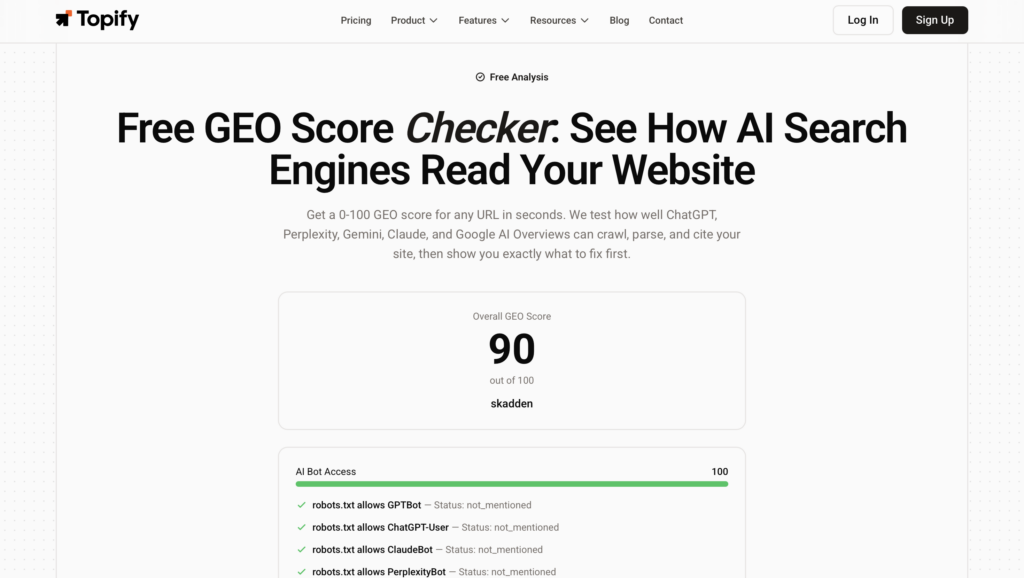
Run your firm’s GEO Score Checker right now. You’ll have your score in under 60 seconds, no signup needed.
✅ Free ⚡ Results in 60 seconds 🔒 No signup required
GEO Score Checker
Your Firm Has the Credentials. AI Has No Idea.
Law firms lose AI recommendations not because their expertise is lacking, but because AI crawlers can’t access or interpret the credentials sitting behind the website. That’s the structural reality most practices haven’t confronted yet.
Legal clients asking AI for attorney recommendations get answers shaped by structured data and third-party citations, not by the firm’s actual track record or case history. A firm with 40 years of M&A experience can score lower than a newer competitor simply because its website blocks GPTBot, uses no attorney schema markup, and has published content that reads fluently to humans but carries almost no semantic signal for AI models.
Compliance-heavy legal content compounds the issue. Ethics disclaimers, jurisdiction caveats, and “this is not legal advice” footers are professionally necessary. But when poorly implemented, they can inadvertently suppress Bot Access scores by triggering crawler restrictions or signaling to AI systems that the content is non-authoritative.
The gap between what your firm actually is and what AI can verify about you is exactly what the GEO Score Checkermeasures.
Scenario 1: Strong Practice Area Page, Zero AI Citations
A mid-size IP firm has well-written patent litigation pages ranking on page one of Google. But its robots.txt blocks all AI crawlers by default — a legacy setting from a 2021 site rebuild. ChatGPT can’t read the page. Perplexity returns competitors instead. The Bot Access score: 22.
Scenario 2: Attorney Bio Blocked to AI Crawlers
A partner’s bio page includes peer awards, bar admissions across four states, and 15 years of published case summaries. The page loads behind a JavaScript-heavy accordion layout that AI crawlers can’t parse. The Structured Data score reads 18. From the AI’s perspective, that partner barely exists.
Scenario 3: Perplexity Visible, ChatGPT Absent
A boutique employment law firm appears in Perplexity results for “wrongful termination lawyer NYC” because it’s been cited in a few HR publications. But it has no presence in ChatGPT or Google AI Overviews for the same query. Content Signals score: 34. The content is there — it just hasn’t been structured for cross-platform AI indexing.
The Four GEO Scores That Expose Your Firm’s AI Blind Spots
The GEO Score Checker evaluates your firm across four dimensions. Each one maps directly to a structural decision your web team made, often years ago, that’s now costing you client discovery.
| Score Dimension | What It Measures | Legal Services Impact |
|---|---|---|
| Bot Access | Whether AI crawlers (GPTBot, ClaudeBot, PerplexityBot) can access your site | Firms blocking bots through robots.txt or JS-heavy layouts are invisible to AI regardless of content quality |
| Structured Data | Quality of schema markup and JSON-LD | Attorney schema, practice area markup, and bar admissions data tell AI systems what your firm actually specializes in |
| Content Signals | Depth, semantic relevance, and E-E-A-T signals | Case studies, named attorney content, and jurisdiction-specific articles drive AI authority recognition |
| Visibility Score | How often your firm appears in ChatGPT, Perplexity, Gemini, and AI Overviews | Measures actual AI recommendation frequency — the number that matters most to client acquisition |
Score guide: 0-40 means AI can barely recognize your firm. 41-60 is partial visibility with notable competitor advantages. 61-80 is solid but improvable. 81-100 puts you in regular AI recommendation rotation.
How to run it:
- Go to GEO Score Checker
- Enter your firm’s name or domain
- Get your four-dimensional score in 60 seconds
- Identify which dimension is weakest — that’s your first fix
What Legal Clients Actually Ask AI Before They Call a Lawyer
The discovery moment has moved. Clients aren’t typing keywords anymore. They’re asking AI assistants full questions, often late at night, often in emotionally charged moments. The firm that appears in that answer gets the call.
| AI Prompt Example | Platform | Search Intent | What It Reveals |
|---|---|---|---|
| “Best employment lawyers for wrongful termination in Texas” | ChatGPT | High-intent attorney search | Whether your firm’s practice area pages have sufficient content depth and named-attorney authority |
| “What should I look for in a corporate M&A attorney?” | Perplexity | Evaluation criteria research | Whether your thought leadership content is structured for AI extraction |
| “Top immigration law firms for EB-2 NIW applications” | Gemini | Specialty service lookup | Whether your niche practice areas have schema markup and third-party citations |
| “How do I choose between mediation and litigation for a contract dispute?” | ChatGPT | Decision-stage research | Whether your educational content positions your firm as the logical next step |
| “Which law firms handle data privacy compliance for startups?” | Perplexity | B2B specialty search | Whether your firm appears in the tech and startup publication ecosystem AI pulls from |
According to BrightEdge’s 2025 analysis, around 68% of legal-related queries in the US now trigger AI-generated overviews. A firm absent from those overviews is absent from the first touchpoint most clients have.
That gap doesn’t close on its own.
Why Legal Firms Consistently Bleed GEO Points
Legal websites have specific structural patterns that consistently underperform in AI scoring. Understanding where the points go is half the fix.
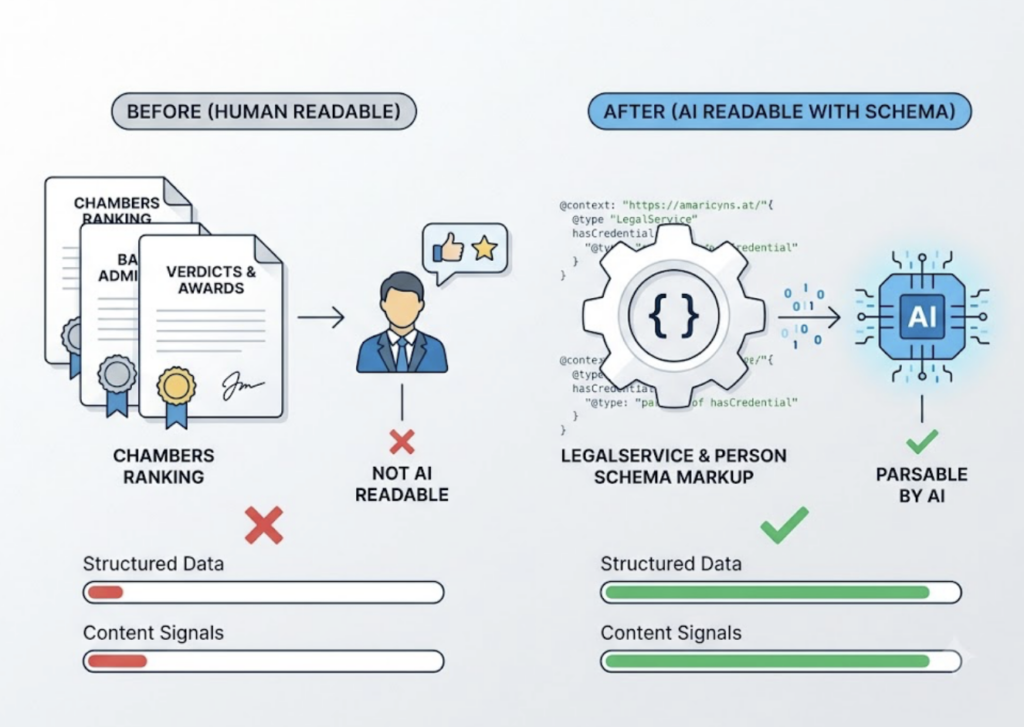
Attorney credentials don’t translate without schema. A partner’s Chambers ranking, bar admissions, and published verdicts are powerful trust signals — for human readers. For AI systems, that information needs to be encoded in LegalService and Person schema markup to be parseable. Most law firm websites don’t have it. That’s a direct hit to both Structured Data and Content Signals scores.
Compliance language suppresses authority signals. Legal ethics rules require firms to include disclaimers, jurisdiction notices, and “results may vary” language. When that language dominates a page’s text — especially when it appears before substantive content — AI models score the page lower on E-E-A-T (Experience, Expertise, Authoritativeness, Trustworthiness) signals. The fix isn’t removing the disclaimers. It’s structuring the page so substantive expertise content leads and disclaimers follow.
Cross-platform inconsistency is the rule, not the exception. A firm may appear in Perplexity results because it’s been cited in a few HR or legal tech publications. But that same firm is absent from ChatGPT and Google AI Overviews because it hasn’t built the broader citation ecosystem those platforms draw from. The Visibility Score dimension captures this asymmetry precisely.
The diagnostic table below shows common patterns:
| Legal Scenario | GEO Signal | Likely Cause | Direction |
|---|---|---|---|
| Strong Google rankings, no AI citations | Bot Access: below 35 | Crawlers blocked or JS-heavy layout | Audit robots.txt, render-test key pages |
| Named attorneys not appearing in AI answers | Structured Data: below 40 | No Person/LegalService schema | Add JSON-LD attorney markup sitewide |
| Educational content present but not cited | Content Signals: below 45 | Content depth insufficient, no author credentials marked up | Add named authorship, expand semantic depth |
| Appearing in one AI platform only | Visibility Score: below 50 | Narrow citation footprint | Expand to legal directories, trade publications, bar association content |
From a One-Time Score to Continuous GEO Monitoring
The GEO Score Checker gives you a snapshot of where your firm stands today. That’s the right place to start.
The challenge is that GEO signals don’t stay static. A competitor earns a Chambers citation. A new practice area page goes live with proper schema. A legal tech publication runs a roundup that includes three firms in your space — and none of them is yours. Each of these events shifts the AI recommendation landscape, and a one-time score won’t catch them.
That’s the gap Topify’s Comprehensive GEO Analytics fills.
| Capability | Free GEO Score Checker | Topify Platform |
|---|---|---|
| Check frequency | One-time snapshot | Continuous monitoring |
| Dimensions tracked | 4 GEO scores | Full GEO analytics + sentiment + citations |
| Historical trends | None | Full trend history with alerts |
| Competitor benchmarking | Not included | Real-time competitor tracking |
| Platform breakdown | Aggregated | Per-platform (ChatGPT, Perplexity, Gemini, AI Overviews) |
| Optimization actions | Directional guidance | Specific, prioritized execution steps |
The checker tells you where you stand. Topify’s platform tracks which direction you’re moving.
For firms actively building AI visibility, the Standard plan at $199/month covers 100 daily prompts, 30 blog posts, and full cross-platform tracking. All plans start with a 7-day free trial — no credit card required. Full pricing details here.
Conclusion
Most law firms aren’t invisible to AI because their work isn’t good enough. They’re invisible because the technical and structural signals AI needs to recognize them were never put in place.
The first step is knowing your number. Run your GEO Score Checker now — it takes 60 seconds and costs nothing.
Once you have your four scores, you’ll know exactly which dimension to address first: whether that’s fixing crawler access, adding attorney schema, deepening your content authority signals, or building a broader citation footprint.
For deeper diagnostics, pair the GEO Score Checker with the AI Robots Checker to audit exactly which bots your site is blocking, the Brand Authority Checker to assess third-party citation depth, and the Knowledge Freshness Checker to see how current AI models’ understanding of your firm actually is.
Frequently Asked Questions
What is a GEO Score for a law firm?
A GEO Score is a 0-100 rating that measures how visible your firm is to AI search engines like ChatGPT, Perplexity, and Google AI Overviews. It evaluates four dimensions: whether AI crawlers can access your site, how well your structured data communicates your practice areas, how authoritative your content appears to AI models, and how often your firm actually surfaces in AI-generated recommendations.
Why would a well-known law firm score low on GEO?
Brand reputation and GEO score don’t always align. A firm can have decades of experience and strong Google rankings while still scoring poorly on GEO because of technical barriers — a robots.txt that blocks AI crawlers, missing attorney schema markup, or JavaScript-heavy page layouts that AI bots can’t parse. The GEO Score Checker measures technical accessibility and AI readability, not prestige.
Does adding legal disclaimers hurt AI visibility?
It can, if not implemented carefully. Ethics disclaimers and jurisdiction caveats are professionally required, but when they appear before substantive content or are embedded in ways that dominate the page’s semantic signal, AI models may deprioritize the page’s authority. The fix is structural: lead with expertise content, position disclaimers below the fold or in footers, and ensure your practice area pages carry meaningful E-E-A-T signals.
Why does my firm appear in Perplexity but not in ChatGPT?
Each AI platform draws from different data sources and citation ecosystems. Perplexity may surface your firm because you’ve been cited in a few industry publications it indexes. ChatGPT and Google AI Overviews require a broader citation footprint — legal directories, bar association content, trade press, and consistent entity data across the web. A low Visibility Score in the GEO Score Checker often reflects this cross-platform inconsistency.
Read More

