

A prospect opens ChatGPT and types: “What’s the best project management tool for remote engineering teams?” ChatGPT returns three names. Yours isn’t one of them.
It’s not because your product is weaker. It’s because AI engines can’t find you, can’t read you, or don’t trust you enough to cite you. That’s a GEO problem, not a product problem.
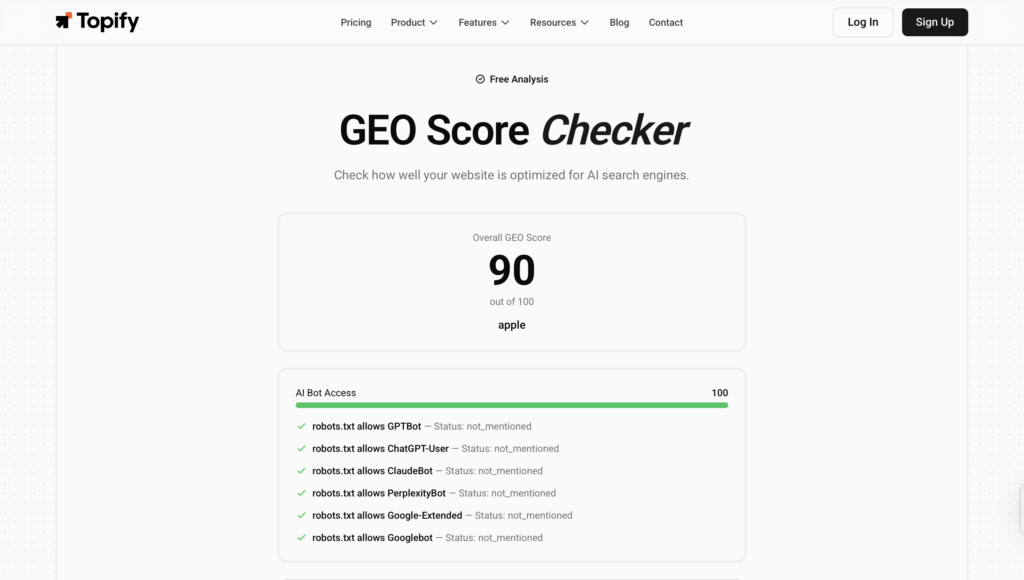
Run your GEO Score Checker now to see exactly where your SaaS website stands. No signup needed. Results in 60 seconds.
✅ Free ⚡ Results in 60 seconds 🔒 No signup required
GEO Score Checker
The AI Recommendation Your Competitor Just Got (And You Didn’t)
The B2B SaaS buying journey has shifted. 73% of B2B buyers now use AI tools like ChatGPT and Perplexity in their research process. They’re not browsing G2 listings or clicking Google ads first. They’re asking AI to build their shortlist.
AI-referred traffic converts at 14.2%, compared to Google organic’s 2.8%. That’s a 5x+ advantage on traffic that’s already ready to evaluate.
Here’s the part most SaaS teams haven’t processed yet: only 18% of brands have an active AI visibility strategy. The other 82% are invisible by default, and their standard dashboards don’t measure it, so they don’t know it’s happening.
That gap is measurable. And it starts with four numbers.
The Four GEO Scores That Decide If AI Recommends Your SaaS Product
The GEO Score Checker evaluates your website across four dimensions, each one mapped to a specific reason AI engines skip your brand. Here’s what each score means in SaaS terms:
| Score Dimension | What It Measures | SaaS Impact |
|---|---|---|
| Bot Access | Whether AI crawlers (GPTBot, ClaudeBot, PerplexityBot) can access your site | If your trial page or pricing page blocks bots, AI engines never see your most conversion-relevant content |
| Structured Data | Whether AI can interpret your product category and feature set | Without SoftwareApplication schema, AI treats your SaaS product like a generic webpage, not a tool to recommend |
| Content Signals | Whether your content is authoritative enough for AI to cite | Thin feature pages and marketing copy score low; comparison guides, use-case articles, and original data score high |
| Visibility Score | How often your brand appears in AI-generated answers across ChatGPT, Perplexity, Gemini, and AI Overviews | The aggregate output: is AI recommending you or your competitors when buyers ask category questions? |
Score benchmarks to know:
- 0-40: AI largely can’t identify or recommend you
- 41-60: Baseline visibility, but competitors with stronger signals have a clear edge
- 61-80: Good standing with room to improve on specific dimensions
- 81-100: AI is likely recommending you unprompted in relevant queries
Bot Access: Are GPTBot and PerplexityBot Actually Crawling Your Trial Pages?
Most SaaS teams configure robots.txt for Google. They don’t think about GPTBot, ClaudeBot, or PerplexityBot as separate entities with separate access rules.
If your trial page, pricing page, or feature comparison page blocks AI crawlers, those pages don’t exist to AI. A bot access score below 30 often means your highest-converting pages are invisible to the engines your buyers are using most.
Structured Data: Does AI Know Your Tool Is a CRM (and Not a Blog)?
This is the most overlooked GEO problem in SaaS. Most SaaS websites have no SoftwareApplication schema, or only generic Organization markup that tells AI nothing about product category, use case, or pricing tier.
AI engines that crawl live content (Perplexity, Google AI Mode) rely on structured data to categorize and cite tools accurately. Without it, even a well-ranked SaaS brand gets misclassified or omitted entirely from category queries.
Content Signals: Your Feature Page vs. a Competitor’s Comparison Article
A feature page that says “Streamline your workflow with powerful automation” does not give AI anything citable. A competitor article that says “Here’s how [Tool] reduced onboarding time by 40% for mid-market SaaS teams” does.
Content Signals measures semantic depth, E-E-A-T indicators, and whether your content contains the kind of specific, verifiable claims AI engines actually quote. Marketing copy fails this test almost every time.
Visibility Score: Where You Rank When Buyers Ask AI to Recommend a Tool
This is the output dimension, the one that reflects whether all the other signals are working. A low Visibility Score doesn’t just mean lost brand awareness. It means buyers are completing their shortlisting process without ever seeing your name.
How to Run Your GEO Score in 60 Seconds
- Go to GEO Score Checker
- Enter your brand name or domain
- Receive your four-dimension score within 60 seconds
- Identify your weakest dimension and start there
What SaaS Buyers Actually Type Into ChatGPT Before They Start a Trial
The prompts below represent real buying-intent queries your prospects are running across AI platforms right now. Each one is a potential recommendation slot for your brand, or your competitor’s.
| AI Prompt Example | Platform | Search Intent | What It Reveals |
|---|---|---|---|
| “What’s the best project management tool for a remote engineering team of 20?” | ChatGPT | Vendor shortlisting | Buyers want named recommendations, not search results |
| “Compare Notion vs. [Tool] for product teams” | Perplexity | Competitive evaluation | Perplexity cites sources; if your comparison content is thin, you lose the citation |
| “Which CRM integrates best with HubSpot for early-stage SaaS?” | Gemini | Integration-specific selection | Structured data about integrations directly affects whether AI can answer this accurately |
| “Is there a free project tracking tool that works for solo founders?” | ChatGPT | Use-case discovery | Content Signals score determines if your free plan page gets cited here |
| “What do people think of [Your Brand] vs [Competitor]?” | Perplexity | Social proof validation | Third-party citations and review site presence feed this response |
| “Best SaaS tools for customer success teams in 2026” | Gemini | Category research | Brands with strong Visibility Scores dominate these category list queries |
Notice the pattern: none of these queries ask for a website to visit. They ask AI to decide.
If your GEO scores are low, AI doesn’t have enough reliable signal to include you. The buyer makes their shortlist without you ever appearing.
Three GEO Blind Spots That Are Specific to SaaS Websites
SaaS sites share a set of structural patterns that consistently produce low GEO scores. These aren’t content quality problems. They’re technical and architectural gaps that are easy to miss because they don’t show up in traditional SEO audits.
Blind Spot 1: Trial and pricing pages are built for conversion, not for AI consumption.
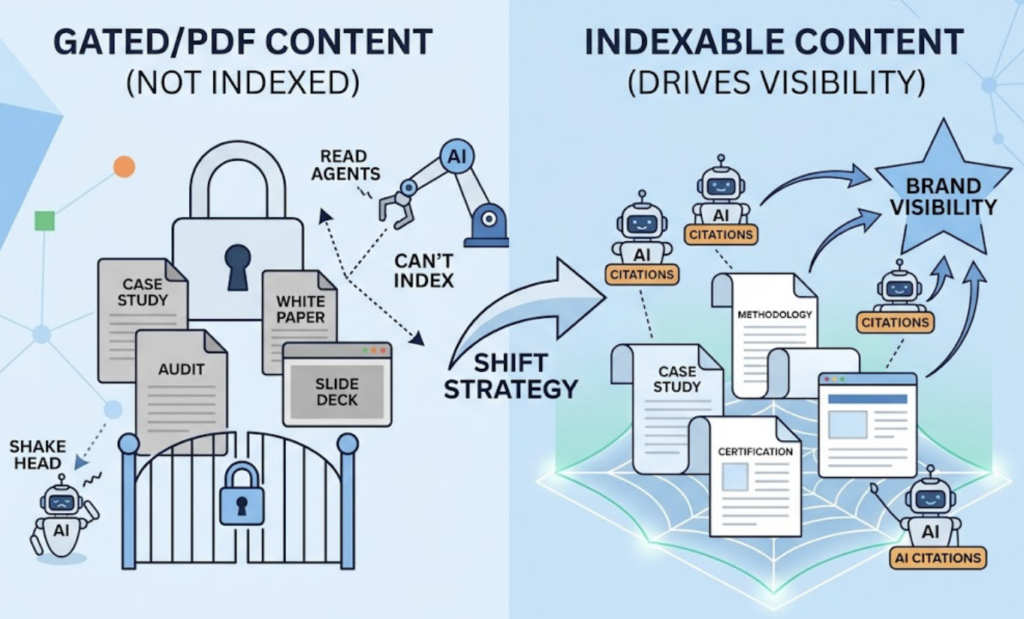
Your trial page is probably your highest-intent page. It’s also likely your lowest GEO-scoring page. Why? It’s optimized for human psychology: short copy, a prominent CTA, minimal text. AI engines see a page with no structured data, no semantic context, and nothing citable. Bot Access and Structured Data scores for these pages tend to be the lowest on a SaaS domain.
Blind Spot 2: The measurement gap means you’re flying blind.
Most SaaS marketing teams track keyword rankings, organic traffic, and conversion rates. None of those metrics tell you whether ChatGPT mentioned your product 200 times this week or zero. The 2026 B2B AI visibility data shows that teams without active AI monitoring are making roadmap decisions without knowing a channel that converts 5x better than Google is either working for them or against them.
That’s not a reporting problem. That’s a strategic blind spot.
Blind Spot 3: Cross-platform fragmentation.
AI search has fractured. ChatGPT held 89% of B2B AI referrals in mid-2025. By early 2026, that share dropped to 63%, with Claude, Gemini, and Perplexity absorbing the rest. A SaaS brand can score well in Perplexity through strong third-party citations while being nearly invisible in ChatGPT due to bot access blocks. Optimizing for one engine isn’t a strategy anymore.
The Visibility Score dimension in the GEO Score Checker surfaces this fragmentation. A low aggregate score often masks a specific platform gap that’s entirely fixable once you know it exists.
| SaaS Scenario | GEO Score Signal | Likely Cause | Direction |
|---|---|---|---|
| Pricing page not cited in ChatGPT | Bot Access: below 35 | GPTBot blocked in robots.txt | Update crawler access rules |
| AI recommends competitors for your category | Structured Data: below 40 | No SoftwareApplication schema | Add JSON-LD product schema |
| Strong Google rankings, weak AI presence | Content Signals: below 45 | Content optimized for keywords, not authority | Add case studies, original data, cited comparisons |
| Visible in Perplexity, absent in ChatGPT | Visibility Score: below 50 | Platform-specific crawl or citation gap | Audit per-platform visibility separately |
One Score Is a Snapshot. Continuous Monitoring Is Strategy.
The GEO Score Checker gives you a clear picture of where you stand today. That’s a useful starting point.
GEO signals change. A competitor updates their schema. A new AI model shifts citation patterns. Your trial page gets reconfigured and accidentally re-blocks GPTBot. The snapshot you took last month may no longer reflect your actual AI visibility.
That’s the gap Comprehensive GEO Analytics fills.
| Capability | Free GEO Score Checker | Topify Platform |
|---|---|---|
| Check frequency | One-time snapshot | Continuous monitoring |
| Dimensions tracked | 4 GEO scores | Full GEO analytics + sentiment + citation tracking |
| Historical trends | None | Full trend history with alerts |
| Competitor benchmarking | Not included | Real-time competitor tracking |
| Platform breakdown | Aggregated | Per-platform (ChatGPT, Perplexity, Gemini, AI Overviews) |
| Optimization actions | Directional guidance | Specific, prioritized execution steps |
The checker tells you where you stand. The platform tells you which direction you’re moving, and when something changes.
Topify offers a 7-day free trial, no credit card required. Plans start at $99/month. See the full pricing breakdown, or start your free trial directly.
Conclusion
SaaS brands with strong products are losing AI recommendations to competitors with better-structured websites. It’s not a feature gap. It’s a GEO gap, and it’s measurable.
Start with your four scores. Run the GEO Score Checker now and find out which dimension is costing you the most.
What is a GEO Score for SaaS?
A GEO Score is a 0-100 rating that measures how visible your SaaS brand is to AI engines like ChatGPT, Perplexity, and Gemini. It evaluates four dimensions: whether AI crawlers can access your site (Bot Access), whether AI can understand your product category (Structured Data), whether your content is authoritative enough to cite (Content Signals), and how often your brand actually appears in AI-generated answers (Visibility Score). For SaaS companies, a low GEO Score typically means competitors are capturing the AI recommendations your buyers see first.
Why is my SaaS website invisible to AI even though it ranks well on Google?
Google SEO and AI visibility measure different things. Google ranks pages based on keyword relevance and backlinks. AI engines decide what to cite based on structured data, content authority, and crawler access. A SaaS site can hold a top-3 Google ranking while scoring below 40 on Bot Access because GPTBot is blocked in robots.txt, or score poorly on Structured Data because there’s no SoftwareApplication schema telling AI what category the product belongs to. Strong Google rankings don’t transfer to AI visibility automatically.
Which pages on a SaaS site hurt GEO scores the most?
Trial pages and pricing pages are typically the lowest-scoring pages on SaaS domains. They’re built for conversion: short copy, prominent CTAs, minimal explanatory text. That same design makes them nearly unreadable to AI crawlers. They often lack structured data, provide no citable content, and in some cases actively block AI bots through JavaScript rendering or robots.txt rules. These are also the pages that matter most for buyer decisions, which makes the gap particularly costly.
Does fixing structured data alone improve AI visibility?
Structured data (Structured Data score) is one of four dimensions, and improving it alone won’t guarantee better AI visibility. A 2026 experiment tracking 319 prompts over five months found that schema implementation had a measurable effect on Google AI Overviews but limited isolated impact on ChatGPT citation rates. The most consistent GEO improvements come from addressing all four dimensions together: crawler access, schema quality, content authority signals, and cross-platform visibility monitoring.
Read More:
- Best AI Search Visibility Tools for SaaS in 2026
- AI Search Visibility vs. Google Rankings: What’s the Difference?
- The Complete Guide to Generative Engine Optimization (GEO)
For deeper diagnostics beyond your GEO score, the AI Robots Checker walks through your robots.txt line by line to identify which crawlers you’re blocking. The Brand Authority Checker surfaces how AI platforms assess your domain credibility. And the Knowledge Freshness Checker shows whether AI models are working from current or outdated information about your product.
Your GEO score is waiting. The buyers running those AI queries aren’t.

