

A parent types “best online math tutor for 5th graders” into ChatGPT. Three brand names appear. Yours isn’t one of them.
It’s not because your curriculum is weaker. It’s not because your pricing is off. It’s because the technical signals AI needs to verify your credibility simply aren’t there. No bot access. No structured data. No content authority signals that a language model can parse and trust.
That’s a GEO problem, not a product problem.
Check your EdTech platform’s GEO score in under 60 seconds, no signup required.
✅ Free ⚡ Results in 60 seconds 🔒 No signup required
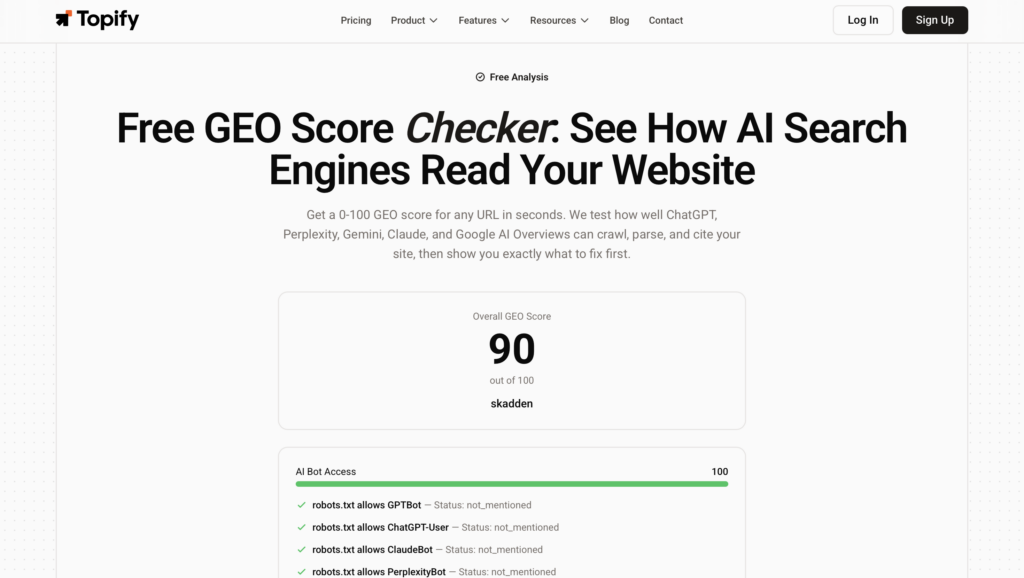
GEO Score Checker
EdTech Buyers Ask AI First. Your Platform Isn’t in the Answer.
The EdTech decision journey has shifted. Parents research tutoring apps on Perplexity. Students ask ChatGPT which coding bootcamp is worth it. HR managers query Gemini for the best upskilling platforms before they ever open a vendor’s website.
The parent looking for a math tutor
A parent of a struggling 7th grader asks ChatGPT: “What’s the best adaptive math platform for middle school students?” The model responds with three platforms, each supported by structured content, schema-tagged instructor credentials, and verified curriculum alignment data. Your platform, which has comparable features, doesn’t appear. Not because it’s worse. Because its course pages are built for human readers, not AI retrieval systems.
The HR manager sourcing upskilling tools
An L&D director at a 500-person company asks Perplexity: “Which online learning platforms have the best ROI data for employee upskilling?” Perplexity pulls from review platforms, third-party reports, and sites with structured outcome statistics. If your platform buries completion rates in a PDF or gates case studies behind a form, that evidence doesn’t exist for AI.
The student picking a coding bootcamp
A college sophomore asks Gemini: “Is [Your Platform] a good coding bootcamp or should I use something else?” Gemini checks your domain for schema markup, looks for instructor bio pages with structured credentials, and evaluates whether your content signals expertise. A low Structured Data score means Gemini can’t verify the basics, so it defaults to brands that made the answer easy.
That gap is measurable. And fixable.
The Four GEO Scores Every EdTech Brand Needs to Understand
Topify’s GEO Score Checker evaluates your platform across four dimensions, each mapped to how AI engines decide whether to recommend you. Here’s what they mean in EdTech terms:
| Score Dimension | What It Measures | EdTech Impact |
|---|---|---|
| Bot Access | Whether AI crawlers (GPTBot, ClaudeBot, PerplexityBot) can access your site | Course pages, curriculum PDFs, and gated content that block AI crawlers won’t be indexed or cited |
| Structured Data | Quality of schema markup and JSON-LD on your pages | Instructor credentials, course duration, learning outcomes, and accreditation data need structured markup to be AI-readable |
| Content Signals | Depth, semantic authority, and E-E-A-T signals in your content | AI evaluates whether your platform demonstrates pedagogical expertise — thin landing pages score poorly even with strong product features |
| Visibility Score | How often your brand appears across ChatGPT, Perplexity, Gemini, and AI Overviews | A score below 40 means AI platforms rarely cite your brand, regardless of your actual market presence |
Score benchmarks to know:
- 0–40: Severely undervisible. AI can’t reliably identify or recommend your platform.
- 41–60: Baseline presence, but competitors with better GEO signals have a clear advantage.
- 61–80: Solid visibility with room to improve.
- 81–100: High probability of consistent AI recommendation.
When your courseware blocks the crawlers that would recommend you
Many EdTech platforms serve their best content behind authentication walls: course modules, lesson previews, instructor bios. That’s reasonable for paying users. But when GPTBot hits a login redirect or a robots.txt that blocks indexing, your Bot Access score drops sharply. AI platforms can’t recommend content they’ve never seen.
Credential pages with no structured data — invisible to AI
An instructor with 15 years of experience and a Harvard PhD means a lot to a human reader. To an AI engine without JSON-LD markup, that credential is unstructured text it can’t reliably extract or trust. Your Content Signals score reflects this directly. EdTech brands that treat instructor bios as marketing copy rather than structured authority signals lose ground to competitors who’ve marked up the same information properly.
Strong blog presence, zero Visibility Score
It’s possible to have solid Bot Access, decent Structured Data, and good Content Signals, and still score low on Visibility. This happens when your content earns zero citations across AI platforms. In practice, it means your articles haven’t been picked up by the sources that AI platforms trust as references. Third-party reviews, accreditation body mentions, and industry press coverage all feed the Visibility Score.
How to run the check (4 steps):
- Go to GEO Score Checker
- Enter your brand name or domain
- Get your four-dimensional score in 60 seconds
- Identify your weakest dimension and prioritize there first
What Learners and Buyers Are Actually Asking AI
The prompts that matter aren’t generic. EdTech buyers ask specific, intent-driven questions that AI platforms answer with citations. Here’s what that looks like in practice:
| AI Prompt Example | Platform | Search Intent | What It Reveals |
|---|---|---|---|
| “Best adaptive learning platform for K-12 students in 2026” | ChatGPT | Product discovery | Platforms with structured course data and curriculum alignment markup dominate citations |
| “Which online MBA programs have the best career outcomes?” | Perplexity | Comparison research | Perplexity pulls from review sites and outcome reports — brands without third-party data citations get skipped |
| “Is [Platform Name] accredited and recognized by employers?” | Gemini | Credential verification | Gemini checks for schema-tagged accreditation data; missing markup = unverifiable |
| “Affordable coding bootcamps with job placement guarantee” | ChatGPT | High-intent purchase | Outcome statistics need to be in structured, crawlable format to appear in AI responses |
| “What upskilling platform should my company use for data skills?” | Perplexity | B2B procurement | Perplexity favors community sources and industry reports; EdTech brands absent from G2 or TrustRadius lose here |
| “Compare Coursera vs [Your Platform] for professional certificates” | Gemini | Direct comparison | Without structured content signals, your platform loses every head-to-head comparison AI is asked to make |
According to 5W’s EdTech AI Visibility Index Q1 2026, the top 5 EdTech brands capture a disproportionate share of AI citations across 60+ tracked prompts. Every consumer, parent, teacher, and HR buyer decision in this category now routes through an AI answer engine before any brand gets a click.
Only 22% of EdTech marketing teams currently track AI visibility, according to Yext’s 2025 companion report. That’s the gap your competitors haven’t closed yet.
Where EdTech GEO Scores Actually Break Down
Most EdTech brands don’t have a content problem. They have a content structure problem.
Course content formats that AI can’t parse
Video-heavy platforms face a specific challenge. A 90-minute course video contains hours of expertise — but if the transcript isn’t indexed, the learning objectives aren’t marked up in schema, and the instructor credentials aren’t in JSON-LD, that expertise is invisible to AI. The same applies to PDF lesson plans, gated curriculum guides, and interactive exercises that render in JavaScript without server-side fallbacks for crawlers.
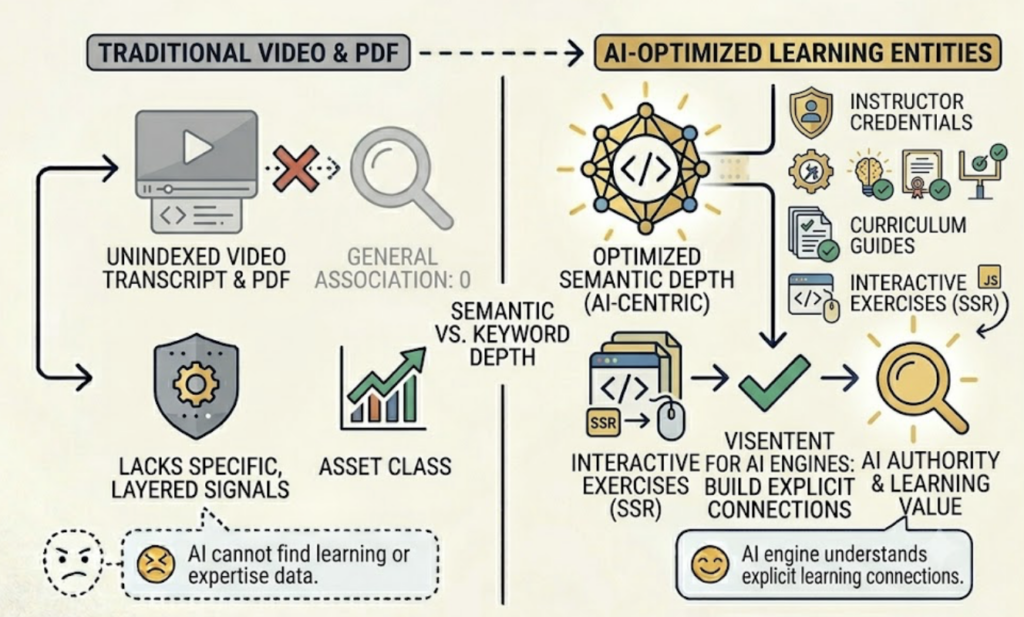
Bot Access scores below 40 in EdTech almost always trace back to one of three causes: robots.txt rules that block AI crawlers by default, authentication walls on content that should be partially public, or JavaScript-rendered pages that GPTBot can’t fully parse.
Accreditation and authority signals that aren’t structured
EdTech credibility rests on proof: accreditation bodies, instructor qualifications, employer partnerships, completion and placement rates. These signals matter enormously to human readers. But AI platforms rely on structured markup to extract and verify this information.
A platform with a Structured Data score below 40 typically lacks Course schema, Person schema on instructor pages, or Review schema on testimonials — the exact signals an AI needs to answer questions like “is this platform legitimate?” with confidence.
Inconsistent visibility across platforms
Here’s a pattern that GEO scores reveal clearly: an EdTech brand appears consistently in Perplexity responses but rarely in ChatGPT or Gemini. This happens because different AI platforms source information differently. Perplexity weights recent web content and community discussions. ChatGPT relies more on broad corpus authority and multi-source corroboration. Gemini favors brand-owned pages with schema.
| EdTech Scenario | GEO Signal | Likely Cause | Action Direction |
|---|---|---|---|
| Platform not cited in any ChatGPT response | Bot Access < 30 | AI crawlers blocked or no indexable content | Audit robots.txt, expose key pages to GPTBot |
| Instructor credentials never mentioned | Structured Data < 40 | No Person or Course schema on instructor/course pages | Add JSON-LD markup to bio and course pages |
| Absent from comparison prompts | Content Signals < 45 | Thin authority content, no third-party citations | Build case studies, earn coverage on education review sites |
| Visible on Perplexity, invisible on ChatGPT | Visibility Score < 50 | Platform fragmentation, single-source citations | Diversify content distribution across multiple authoritative sources |
A single GEO score check surfaces which of these patterns applies to your platform. It takes 60 seconds.
From a One-Time Score to Continuous GEO Monitoring
The GEO Score Checker gives you a clear picture of where your platform stands today. That snapshot is genuinely useful — it tells you whether your weakest link is bot access, structured data, content authority, or platform visibility.
But GEO signals shift. A competitor updates their schema markup. A new accreditation body mentions them in a structured press release. An AI platform updates its citation preferences. Your snapshot from today may not reflect your position in 90 days.
The checker gives you a snapshot. Topify’s platform tracks the trajectory.
| Capability | Free GEO Score Checker | Topify Platform |
|---|---|---|
| Check frequency | One-time snapshot | Continuous monitoring |
| Dimensions tracked | 4 GEO scores | Full GEO analytics + sentiment + citations |
| Historical trends | None | Full trend history with alerts |
| Competitor benchmarking | Not included | Real-time competitor tracking |
| Platform breakdown | Aggregated | Per-platform (ChatGPT, Perplexity, Gemini, AI Overviews) |
| Optimization actions | Directional guidance | Specific, prioritized execution steps |
EdTech brands in growth mode need to know not just where they stand, but whether they’re gaining or losing ground relative to competitors. That requires ongoing tracking, not a one-time check.
Plans start at $99/month. All plans include a 7-day free trial, no credit card required. See full pricing details.
Conclusion
Most EdTech brands are invisible to AI not because their product is weak, but because the technical signals AI needs to verify credibility aren’t in place. Bot Access failures, unstructured credential pages, and missing authority content are problems you can diagnose in 60 seconds and fix systematically.
Start with a GEO Score Checker run on your platform today. The score will tell you exactly which dimension to fix first.
If you want to go deeper, the AI Robots Checker lets you audit your robots.txt rules against specific AI crawlers. The Brand Authority Checker gives you a focused view of how AI platforms evaluate your domain authority. And the Knowledge Freshness Checker shows how current AI models’ knowledge about your brand actually is.
FAQ
What is a GEO score for an EdTech platform?
A GEO score is a 0–100 composite rating that measures how visible and credible your EdTech platform appears to AI search engines like ChatGPT, Perplexity, Gemini, and Google AI Overviews. It evaluates four dimensions: whether AI crawlers can access your site (Bot Access), whether your content is properly structured for AI parsing (Structured Data), whether your content signals genuine expertise (Content Signals), and how frequently your brand appears in AI-generated responses (Visibility Score). A score below 40 typically means AI platforms can’t reliably identify or recommend your platform.
Why would an EdTech brand score low on GEO even if it has strong content?
Strong content isn’t the same as AI-readable content. Many EdTech platforms produce excellent curriculum materials, instructor videos, and blog posts — but serve them in formats that AI crawlers struggle to parse: gated course modules, JavaScript-rendered pages, PDF lesson plans, or video content without structured transcripts. A low GEO score in this case usually points to Bot Access or Structured Data failures rather than content quality issues. The fix is technical, not editorial.
How does GEO affect EdTech sales and enrollment?
When a parent, student, or HR manager asks an AI platform for learning recommendations, the AI generates an answer from its training data and real-time sources. Brands with higher GEO scores appear in those answers more consistently. Brands with low scores are invisible in that moment — and that moment is increasingly where buying decisions begin. According to 5W’s EdTech AI Visibility Index Q1 2026, every consumer, parent, and enterprise buyer decision in the EdTech category now routes through an AI answer engine before any brand gets a click.
Read More:

