


A prospective tenant types into ChatGPT: “Which commercial real estate firms handle Class A office leasing in Austin?”Three names come back. Yours isn’t one of them.
It’s not because you lack inventory. It’s not because your track record is thin. It’s because the AI evaluating that query can’t read your market reports, can’t parse your property data, and doesn’t have enough structured signals to associate your firm with that specific request.
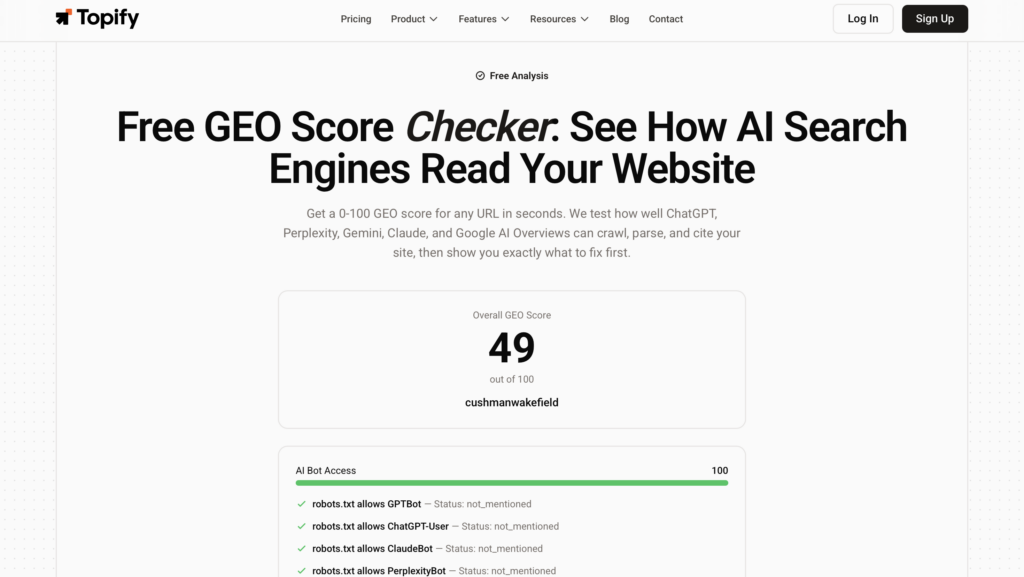
That’s a GEO problem, not a product problem. And you can measure it today with the GEO Score Checker, a free tool that returns a 0–100 AI visibility score in under 60 seconds.
✅ Free ⚡ Results in 60 seconds 🔒 No signup required
GEO Score Checker
The Deal You Didn’t Know You Lost
Commercial real estate decisions move slowly, but AI-assisted research happens fast. A capital markets advisor evaluating industrial acquisition targets. A corporate tenant scout comparing office leasing firms in three metros. A private equity LP screening CRE operators before a first call. All of them are now starting with an AI query, not a Google search.
According to research tracked across real estate properties, AI referral traffic grew over 500% year-over-year in 2025 and converts at 4–5x the rate of traditional organic search. That’s not a trend worth watching. That’s a shift worth responding to.
Most CRE firms haven’t responded yet. Their expertise sits in pitch decks, PDF market reports, and broker bios that AI crawlers either can’t access or can’t interpret. The result is a firm with deep institutional knowledge that registers as a blank to the AI platforms now shaping deal flow.
That gap is measurable.
The Four Numbers CRE Firms Keep Getting Wrong
The GEO Score Checker evaluates your firm’s AI visibility across four dimensions. Each one maps directly to a failure mode common in commercial real estate.
| Score Dimension | What It Measures | Commercial Real Estate Impact |
|---|---|---|
| Bot Access | Whether AI crawlers (GPTBot, ClaudeBot, PerplexityBot) can access your site | CRE sites with gated portals, PDF-heavy pages, or restrictive robots.txt block the crawlers that would otherwise index your expertise |
| Structured Data | Quality of schema markup and JSON-LD signals | Property listings, transaction data, and service area details need structured markup to be parsed correctly by AI |
| Content Signals | Depth, semantic richness, and E-E-A-T authority of your web content | Expertise locked in downloadable reports doesn’t count; AI reads what’s on the page, not what’s in the attachment |
| Visibility Score | How often your brand surfaces across ChatGPT, Perplexity, Gemini, and AI Overviews | A firm may dominate Google for “[city] commercial real estate” and register near-zero on AI platforms |
Scores below 40 signal near-complete AI invisibility. Scores between 41–60 mean you’re present but competitively disadvantaged. Most CRE firms running the check for the first time land in that 30–55 range.
Scenario 1: Market Reports Locked in PDFs, AI Gets Nothing
A mid-size industrial brokerage publishes quarterly submarket reports. These reports are thorough, data-rich, and downloaded hundreds of times per quarter. They’re also completely invisible to AI.
PDFs aren’t indexed the same way HTML pages are. GPTBot and PerplexityBot can’t reliably extract content from documents hosted behind a form or a download gate. The result: a Bot Access score in the 20–35 range, and a Visibility Score that doesn’t reflect the firm’s actual market knowledge.
The fix isn’t to stop publishing reports. It’s to mirror that content on crawlable web pages.
Scenario 2: Strong Rankings, Zero AI Citations
A multifamily development firm ranks on page one of Google for several high-intent keywords. Their SEO is solid. Their AI visibility score is 38.
The disconnect comes from Structured Data. Google crawls and indexes HTML content well without schema. AI platforms rely more heavily on structured signals to understand what a page is about, who the author is, what property types are referenced, and what geography is covered. Without that markup, the content exists but can’t be cited with confidence.
A Structured Data score below 40 typically explains this exact pattern.
Scenario 3: Expert Content Written for Humans, Not Machines
A CRE advisory firm has a blog with genuine insight: cap rate analysis, lease negotiation breakdowns, market cycle commentary. The writing is sharp. The Content Signals score is still 32.
Here’s the thing: authority in AI is built differently than authority in traditional SEO. Semantic depth matters. Entity associations matter. Whether the content explicitly connects the firm’s name to specific asset classes, transaction types, and geographies matters. Content written for a general business reader often lacks the specific, layered signals that AI uses to build entity associations.
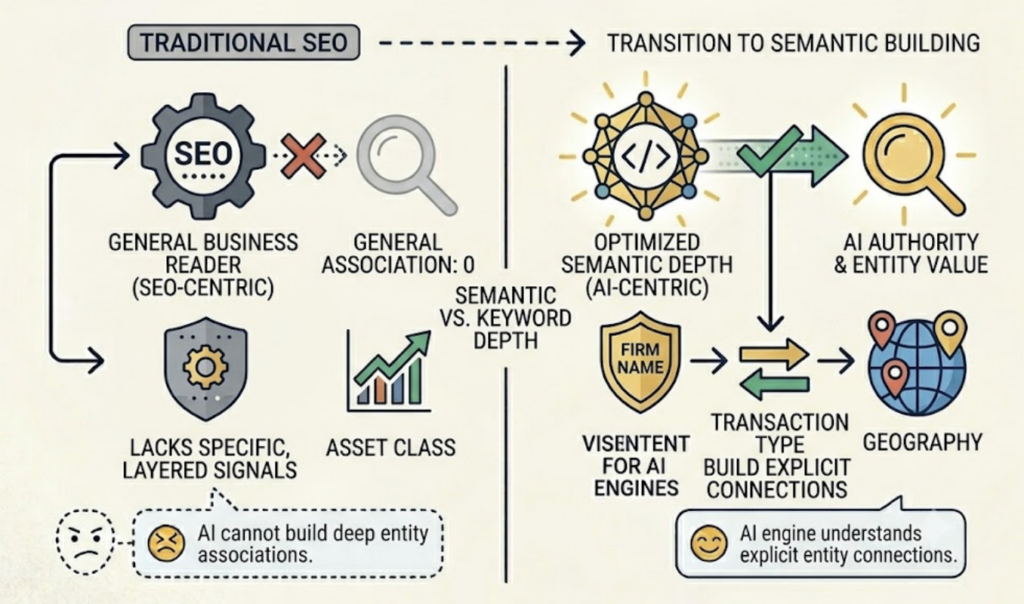
Good content and AI-optimized content aren’t the same thing.
How to Run the Check in Four Steps
- Go to GEO Score Checker
- Enter your firm’s domain or brand name
- Wait 60 seconds for your four-dimension score
- Identify the lowest-scoring dimension — that’s your highest-priority fix
What CRE Buyers Actually Ask AI Before They Call a Broker
The prompts that matter aren’t generic. CRE buyers ask AI with deal-stage specificity. Here’s what that looks like across platforms:
| AI Prompt Example | Platform | Search Intent | What It Reveals |
|---|---|---|---|
| “Best commercial real estate firms for industrial leasing in the Inland Empire” | ChatGPT | Broker shortlisting | Which firms have crawlable, authoritative content linked to this submarket and property type |
| “What cap rates are typical for Class B office in suburban Chicago right now?” | Perplexity | Market intelligence / vendor vetting | Whether your firm’s published research is structured for AI citation |
| “Which CRE advisory firms specialize in sale-leaseback transactions?” | Gemini | Service-specific qualification | Whether your structured data ties your firm’s name to this transaction type |
| “Top retail property management companies in the Southeast” | ChatGPT | Vendor evaluation | Whether your content has geographic + service-type entity associations |
| “Who are reliable commercial real estate developers for mixed-use projects?” | Perplexity | Developer sourcing | Whether your firm appears across multiple citation-worthy sources, not just your own site |
Five prompts, five different entry points into your deal pipeline. If your firm doesn’t appear in the answers, you’re not losing to a competitor with a better website. You’re losing to a competitor whose website is better structured for AI.
That’s a fixable problem.
Where CRE Brands Consistently Bleed GEO Points
Commercial real estate has structural characteristics that make AI visibility harder to build than in most other industries. Understanding the specific failure modes helps explain why a firm’s GEO Score Checker results often look worse than expected.
The PDF expertise problem. CRE firms produce high-quality research: market outlooks, vacancy trend analyses, investment memos. The industry norm is to package this as downloadable PDFs. That norm directly conflicts with how AI platforms consume content. GPTBot doesn’t download your Q1 market report. It indexes the page it lands on. If that page is a one-paragraph description with a download button, that’s all the AI sees.
Firms that migrate even a portion of their research content to crawlable HTML pages see measurable gains in Content Signals scores.
The structured data gap in property information. AI platforms use schema markup to understand the relationship between entities: firm name, property type, geography, transaction role. Most CRE websites are built for visual presentation, not semantic parsing. There’s no LocalBusiness schema, no ProfessionalService markup, no property-type entity associations. The AI has to guess what you do and where you do it. It often guesses wrong by defaulting to the most visible firm with the clearest markup.
The cross-platform consistency problem. A firm with decent Perplexity visibility may be nearly absent from ChatGPT. This isn’t random. Different AI platforms weight different signal types: Perplexity prioritizes recently crawled, cited sources; ChatGPT relies more on training data entity associations; Gemini draws heavily from Google’s knowledge graph. A firm that appears in Perplexity submarket queries may still be invisible in ChatGPT deal-sourcing conversations because its entity associations in the training corpus are weak.
| CRE Scenario | GEO Score Signal | Likely Cause | Action Direction |
|---|---|---|---|
| Firm doesn’t appear in broker recommendation queries | Visibility Score: below 30 | Low training corpus entity presence, no third-party citations | Build citeable web content; pursue industry publication mentions |
| Research content not cited by Perplexity | Bot Access: below 35 | PDFs gated or robots.txt blocking crawlers | Mirror key research content as crawlable HTML pages |
| AI can’t associate firm with specific asset class | Structured Data: below 40 | Missing schema markup for service type and geography | Add ProfessionalService + LocalBusiness schema with explicit property type associations |
| Content reads well but scores low on AI authority | Content Signals: below 45 | Expertise not structured for entity associations | Restructure content with explicit firm-asset class-geography-transaction type linkages |
From Snapshot to Signal: Tracking Your GEO Score Over Time
The GEO Score Checker gives you a precise starting point. You’ll know which dimension is weakest, whether that’s bot access, structured data, content authority, or platform visibility. That’s genuinely useful diagnostic information.
The checker gives you a snapshot. Topify‘s platform tracks the trajectory.
GEO signals shift continuously. A competitor adds structured data markup and moves up in AI recommendation sets. A Google AI Overview starts citing a new industry source that includes their name. Your submarket report gets referenced in an industry publication that Perplexity indexes. None of these changes are visible in a one-time score check.
| Capability | Free GEO Score Checker | Topify Platform |
|---|---|---|
| Check frequency | One-time snapshot | Continuous monitoring |
| Dimensions tracked | 4 GEO scores | Full GEO analytics + sentiment + citations |
| Historical trends | None | Full trend history with alerts |
| Competitor benchmarking | Not included | Real-time competitor tracking |
| Platform breakdown | Aggregated | Per-platform (ChatGPT, Perplexity, Gemini, AI Overviews) |
| Optimization actions | Directional guidance | Specific, prioritized execution steps |
Comprehensive GEO Analytics gives you the full picture: visibility trends across all AI platforms, citation tracking, sentiment analysis, and per-platform breakdowns. For a CRE firm managing multiple service lines or geographies, that level of detail matters.
Plans start at $99/month with a 7-day free trial, no credit card required. See full pricing options to find the right tier.
Conclusion
CRE firms with strong track records are losing AI-driven deal inquiries to competitors with better-structured digital signals. That’s the core problem the GEO Score Checker surfaces, and it’s more common than most firms expect.
Run your GEO Score Checker now to see exactly where your firm stands across all four dimensions. It takes 60 seconds and costs nothing.
If bot access or structured data comes back as your weakest dimension, the AI Robots Checker lets you audit your robots.txt in detail. The Brand Authority Checker helps you understand how AI platforms currently perceive your firm’s authority signals. And the Knowledge Freshness Checker shows how current AI models’ understanding of your brand actually is.
Frequently Asked Questions
What is a GEO Score for a commercial real estate firm?
A GEO Score is a 0–100 composite rating that measures how visible your CRE firm is to AI platforms like ChatGPT, Perplexity, and Gemini. It evaluates four dimensions: whether AI crawlers can access your site, whether your content is properly structured for machine parsing, whether your pages carry sufficient authority signals, and how often your brand actually surfaces in AI-generated responses. A score below 40 typically means AI platforms can’t reliably identify or recommend your firm, even for queries directly relevant to your services.
Why would a CRE firm with strong Google rankings score low on GEO?
Google and AI platforms use different signals. Google indexes HTML content effectively without requiring structured markup. AI platforms rely more heavily on schema data, entity associations, and semantic richness to understand what a firm does, where it operates, and what asset classes it handles. A firm can rank on page one for “Chicago industrial leasing” while registering near-zero on AI recommendation queries for the same topic, simply because the underlying page structure doesn’t communicate those associations to AI in a parseable way.
Does the GEO Score Checker work for regional or boutique CRE firms, not just global brokerages?
Yes, and in practice it’s often more useful for mid-size and regional firms. Large global brokerages tend to have some baseline AI visibility by default because of their training corpus presence. Boutique firms and regional specialists are more likely to have genuine GEO blind spots, particularly around Bot Access and Structured Data, because their sites are built for client presentation rather than AI indexing. The checker gives any firm a precise read on where those gaps actually are.
How often should a CRE firm check its GEO Score?
A one-time check is a useful starting point. But GEO signals shift as competitors update their content, as AI platforms retrain on new data, and as industry publications publish new citations. Checking once per quarter gives you a directional read. If you’re actively optimizing — adding schema markup, migrating PDF research to HTML, building third-party citation volume — you’ll want more frequent checks to track whether the changes are registering. That’s where continuous monitoring via Topify’s platform becomes relevant.
Which GEO dimension matters most for CRE firms?
It depends on the specific failure mode. Bot Access is the floor: if AI crawlers can’t reach your pages, the other dimensions don’t matter. Structured Data is the most common gap for CRE firms specifically, because the industry defaults to visual-first website design that lacks ProfessionalService and LocalBusiness schema. Content Signals tend to underperform when expertise lives in PDFs rather than crawlable pages. Visibility Score is the output of the other three: fix the upstream signals, and platform presence follows. Run the checker to see which dimension is lowest — that’s where to start.
Read More:

