

Your domain authority is solid. Your keyword rankings look clean. But when someone types a question into Google and AI Overviews fires, your brand either shows up in that synthesized answer or it doesn’t. And your existing rank tracker has no idea which one happened.
That’s the core gap an AI overview tracker is designed to close. But “tracking AI Overviews” is a lot more specific than it sounds. There are at least five distinct measurement layers involved, and most teams only understand one or two of them when they first start looking.
Here’s what a modern AI overview tracker is actually measuring — and why each layer matters.
It’s Not Rank Tracking. It’s Presence Detection.
Traditional SEO tools track position. Rank 1, rank 4, rank 11. AI Overviews don’t work that way.
When Google’s AI generates a response, there’s no rank 1. There’s only “included” or “not included.” So the first thing an AI overview tracker measures is brand presence: out of the set of prompts you’re monitoring, in how many did your brand actually appear in the generated response?
This metric is sometimes called Share of Voice in the AI context, expressed as the percentage of relevant AI answers that mention your brand compared to competitors. It’s the baseline number that tells you whether you even have a foothold.
Without presence detection, every other optimization effort is flying blind. You can’t improve what you can’t see.
The Sentiment Layer Most SEOs Skip
Getting mentioned is necessary. Getting mentioned well is the actual goal.
AI Overviews don’t just name brands — they describe them. And those descriptions carry weight. An AI might frame your brand as “the recommended choice,” or it might say “a lower-cost alternative with fewer enterprise features.” Both count as a mention. Only one is helping you.
Modern trackers use NLP to score each mention as positive, neutral, or negative — and beyond basic sentiment, they also track framing. Research from Ahrefs describes framing analysis as identifying whether AI positions a brand as a recommended solution, an alternative, or a budget option. These framings directly reflect how Google’s model has “mapped” your brand in its internal knowledge base.
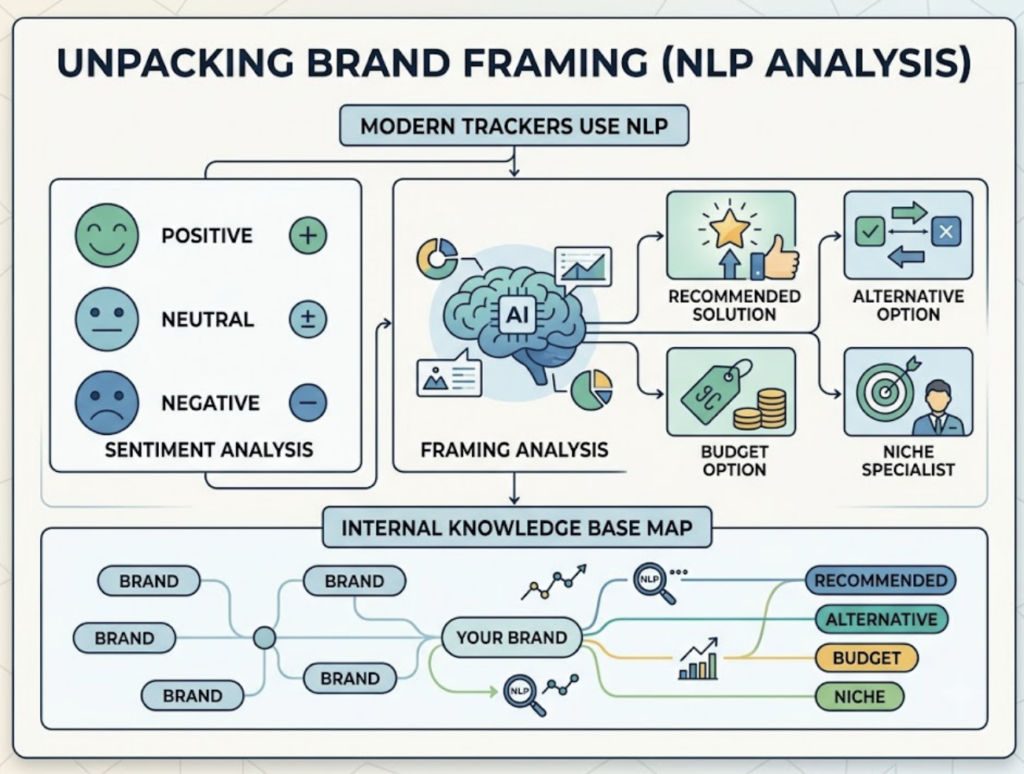
For brand managers and PR teams, sentiment and framing data is often the most actionable layer. A single piece of content can shift how AI describes your brand across thousands of queries.
Source Attribution: Which URLs Is AI Actually Pulling?
Presence and sentiment tell you what is happening. Source attribution tells you why.
Every AI Overview is built from somewhere. The tracker needs to identify the specific domains and URLs that Google’s model is pulling from when it references your brand. According to a 100-page study by CXL, roughly 55% of citations originate from the top 30% of page content — meaning well-structured, answer-first formatting gives content a meaningfully higher chance of being sourced.
That data point changes the content prioritization calculus entirely. If your tracker shows AI is citing a competitor’s blog post rather than your product page, you now know exactly where to focus.
Source analysis also reveals what content formats AI engines favor. Guides, comparison pages, and structured answer content tend to get cited more than generic service pages. Knowing which of your URLs are actually being referenced — and which aren’t — lets you close the gap systematically.
Position Within the Overview Still Matters
There’s no rank 1 in AI Overviews, but position within the response still affects outcomes.
When AI generates a multi-part answer, brands mentioned at the top of the response receive more user attention than those buried three paragraphs down. A tracker that only records presence/absence is missing this layer. Position tracking measures where within the AI-generated text your brand appears relative to competitors.
Think of it as the difference between being cited in the opening sentence versus being footnoted at the end. Both count. The business impact is not the same.
Competitor Co-occurrence: The Competitive Map AI Has Built
Here’s something most brands don’t think to check: which competitors consistently appear in the same AI answer as your brand?
AI models cluster related brands together based on how they’ve learned to categorize a market. Research on competitive clustering in AI responses shows that the set of brands appearing together in AI answers often reflects the AI’s current “market map” — which companies it considers close substitutes, and which it treats as distinct categories.
If your brand is consistently co-occurring with budget alternatives but never with premium competitors, that’s a signal your entity positioning needs work. A tracker surfaces this pattern automatically across a prompt set, saving hours of manual querying.
That’s the gap most brands still can’t see — until they start tracking co-occurrence.
Conversion Visibility Rate: Where Measurement Meets Business Outcomes
The metrics above cover how you appear in AI Overviews. CVR is about what happens next.
Conversion Visibility Rate measures the correlation between AI Overview presence and downstream business signals — branded search volume, direct traffic spikes, or user-initiated brand queries. McFadyen’s research on brand visibility in AIframes this as “entity correctness” feeding downstream discovery: the more accurately AI models represent your brand, the more reliably that representation converts to user intent.
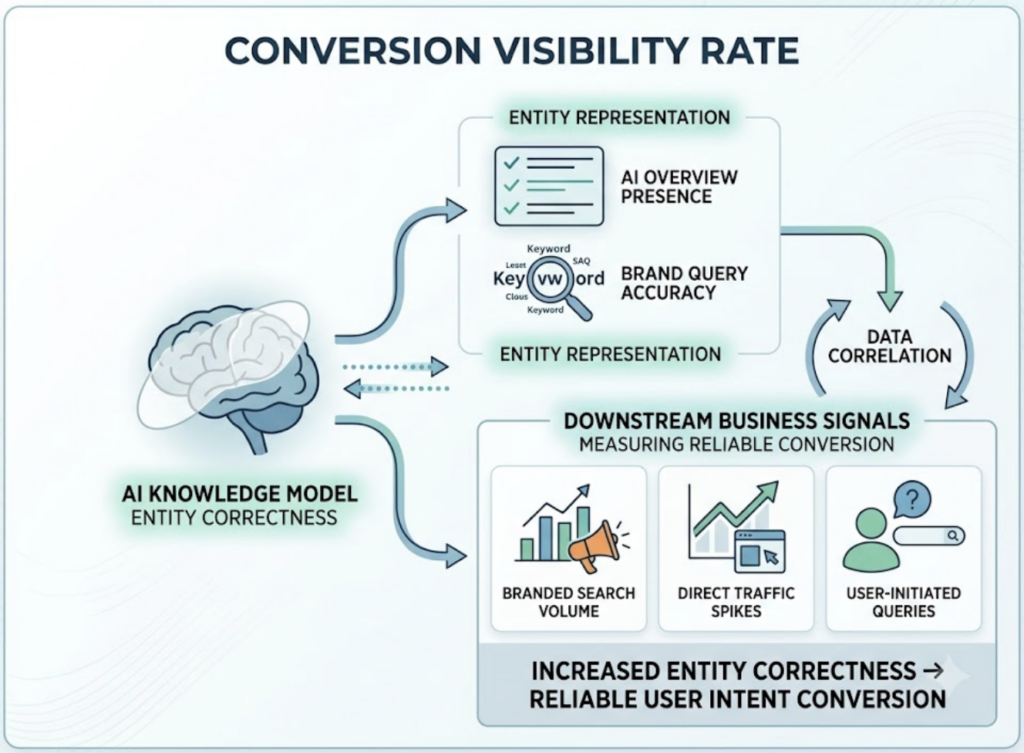
In practice, CVR lets marketing teams answer a question the C-suite actually cares about: what’s the ROI of appearing in AI Overviews? Without it, all you have is impression data. With it, you can tie AI visibility directly to revenue signals.
How Topify Tracks All Five Layers in One Place
The challenge with these five measurement layers is that tracking them separately — across different tools, prompt sets, and platforms — quickly becomes unmanageable.
Topify covers the full measurement stack through its Comprehensive GEO Analytics module, which monitors visibility, sentiment, position, source attribution, and CVR across ChatGPT, Perplexity, Google AI Overviews, DeepSeek, and other major AI platforms. Instead of running manual spot-checks or stitching together data from multiple tools, teams get a single dashboard showing how all five dimensions are performing for their brand and their competitors.
The platform also surfaces high-value prompt discovery continuously — as AI recommendations evolve, Topify identifies new query clusters where your brand should be present but isn’t. That’s a meaningful edge in a space where the AI’s “knowledge map” updates constantly.
For teams that have already outgrown “let me Google myself on ChatGPT,” Topify’s Basic plan starts at $99/month and covers 100 prompts with 9,000 AI answer analyses. Get started here.
Conclusion
An AI overview tracker isn’t a replacement for SEO analytics. It’s a separate measurement layer for a separate search channel. What it measures — presence, sentiment, source attribution, position, co-occurrence, and conversion visibility — can’t be inferred from keyword rankings or traffic data alone.
The brands building an early edge in AI search aren’t doing so by optimizing harder for traditional SERPs. They’re tracking the right signals in the right place. That starts with understanding what an AI overview tracker actually measures, and making sure yours covers all six layers.
FAQ
Q: What’s the difference between an AI overview tracker and a rank tracker?
A: A rank tracker monitors keyword positions on traditional SERPs. An AI overview tracker measures brand presence, sentiment, source attribution, and position within AI-generated responses — a fundamentally different data environment where traditional position metrics don’t apply.
Q: How often should you check your AI Overview data?
A: AI overview responses can shift within days as Google updates its models or as new content gets indexed. Most teams benefit from weekly monitoring at minimum, with daily tracking for high-priority prompt clusters during product launches or reputation events.
Q: Can an AI overview tracker tell me why my brand was excluded from a response?
A: Indirectly, yes. Source attribution data shows which domains and URLs AI is citing instead of your content. If competitors’ pages are consistently cited over yours, the tracker reveals which content formats and structural patterns are driving those citations — giving you a concrete starting point for content optimization.
Q: Does an AI overview tracker work across different AI platforms, or just Google?
A: That depends on the tool. Google AI Overviews is one channel, but the same brand visibility gaps often exist in ChatGPT, Perplexity, and other AI search platforms. The most useful trackers monitor all of them simultaneously so you’re not optimizing for one channel while losing ground on another.

