

A prospective franchise buyer sits down, opens ChatGPT, and types: “What’s the best home services franchise under $150K?” The answer comes back in seconds. Three brands get named, with investment ranges, support structures, and estimated ROI. Your franchise isn’t one of them.
This isn’t a branding problem. It’s a GEO problem. The technical signals that determine whether AI platforms recommend your franchise are measurable, and most franchise brands score poorly on all four of them.
Topify‘s GEO Score Checker runs a free diagnostic across the four dimensions that control whether AI names your brand or skips it entirely.
✅ Free ⚡ Results in 60 seconds 🔒 No signup required
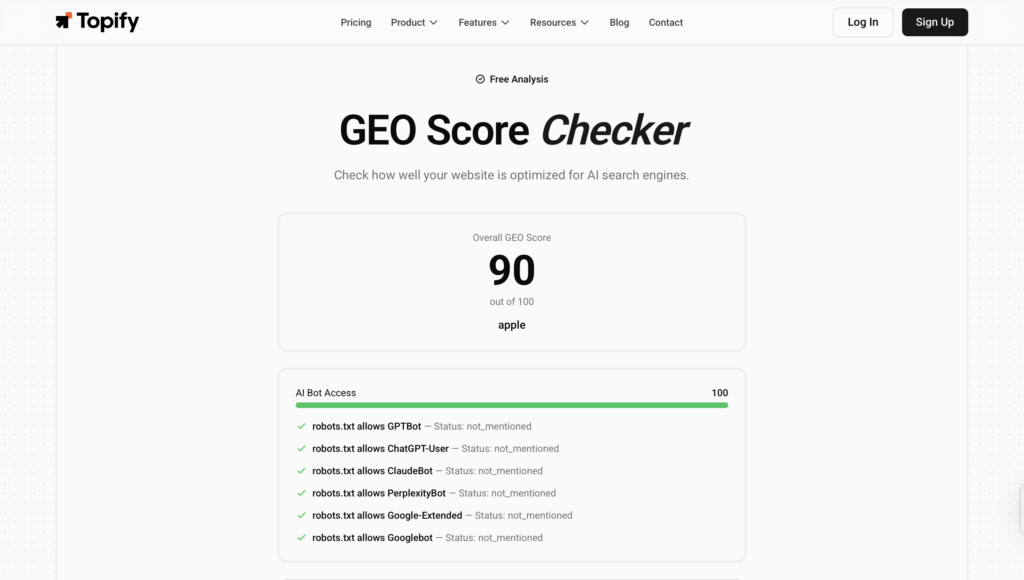
GEO Score Checker
The Four Numbers That Tell You Why AI Recommends Other Franchises Instead of Yours
Every franchise brand gets scored across four GEO dimensions. The difference between being named in an AI answer and being invisible often comes down to these numbers.
| Score Dimension | What It Measures | Franchise Impact |
|---|---|---|
| Bot Access | Whether AI crawlers (GPTBot, ClaudeBot, PerplexityBot) can reach your site | Many franchise sites use aggressive robots.txt rules that block AI bots while allowing Googlebot. The result: visible on Google, invisible to ChatGPT. |
| Structured Data | Quality and presence of schema markup (JSON-LD) | Franchise sites rarely deploy LocalBusiness schema per location. AI extracts structured facts with high confidence but struggles to parse investment details from unstructured prose. |
| Content Signals | Authority markers: E-E-A-T, content depth, semantic relevance | FDD summaries, franchisee testimonials, and unit economics data often live behind gated pages or in PDFs that AI can’t index. |
| Visibility Score | Actual brand presence across ChatGPT, Perplexity, Gemini, AI Overviews | A franchise can dominate Google’s local 3-pack in 200 markets and still appear in zero AI-generated “best franchise” recommendations. |
Your FDD Is Thorough, but GPTBot Can’t Read Your Site
A franchise brand with 15 years of operating history and a 300-page FDD should score well on authority signals. In practice, many don’t. The disclosure documents sit behind registration walls. The unit economics data lives in PDFs. The AI crawlers that would use this information to build a recommendation get a 403 error instead.
Bot Access scores below 30 typically mean AI platforms don’t even know your franchise exists as a recommendable option.
200 Locations, Zero Structured Data per Location
Research shows that 61% of pages cited by ChatGPT contain rich schema markup, compared to just 25% of traditional Google SERP pages. For franchise brands, the gap is worse. Corporate sites may carry Organization schema, but individual location pages almost never include LocalBusiness JSON-LD with service types, investment ranges, territory details, or franchisee contact information.
AI systems prefer structured facts they can extract with certainty. When your location pages offer nothing but a phone number in the footer, AI skips to a competitor whose page hands it clean, labeled data.
Strong Google Local Pack, Invisible on Perplexity
Here’s the thing. A franchise brand can hold the top local 3-pack position in 150 cities and still score below 20 on Visibility. Google local rankings rely on GBP optimization, review volume, and NAP consistency. AI platforms don’t use any of those signals. They synthesize answers from crawlable content, structured data, and third-party citations. Two completely different systems, two completely different scorecards.
How to check your franchise’s GEO score:
- Go to GEO Score Checker
- Enter your franchise brand name or corporate domain
- Get four-dimension scores in under 60 seconds
- Compare dimensions to identify your weakest signal
What Prospective Franchisees Ask AI Before They Ever Call a Broker
The franchise discovery process has shifted. Prospective buyers now arrive at discovery calls with AI-generated brand comparisons already in hand. Some upload FDD documents directly into ChatGPT for clause-by-clause analysis. The brands that appear in those early AI conversations shape the consideration set before a broker or franchise development rep ever gets a chance to pitch.
| AI Prompt Example | Platform | Search Intent | What It Reveals |
|---|---|---|---|
| “Best franchise to own under $100K with semi-absentee model” | ChatGPT | Investment screening | AI names 3-5 brands. If yours isn’t listed, you’ve lost the prospect at the research stage. |
| “Compare home services franchises: profit margins, training support, territory size” | Perplexity | Brand comparison | AI pulls structured data to build side-by-side tables. Brands without structured content get excluded. |
| “Is [franchise brand] a good investment in 2026?” | Gemini | Due diligence | AI evaluates brand reputation from reviews, news, and third-party citations. Thin online presence triggers a cautious or negative summary. |
| “Low-risk franchise opportunities for first-time business owners” | ChatGPT | Category discovery | AI recommends brands with clear authority signals: published franchisee success stories, transparent unit economics, third-party validation. |
| “What are the hidden costs of owning a [category] franchise?” | Perplexity | Risk assessment | AI cites sources that discuss fees, royalties, and real-world franchisee experiences. If your brand’s content doesn’t address these, competitors’ content fills the gap. |
According to McKinsey research, an estimated $750 billion in US revenue will flow through AI-powered search by 2028. For franchise brands, this means the “best franchise to buy” prompt is becoming the new top-of-funnel entry point, and the brands AI recommends at that stage capture disproportionate prospect attention.
That matters more than it sounds. A franchise prospect who asks AI for a recommendation and doesn’t see your brand won’t search for you next. They’ll contact the brands AI named.
The Local SEO Trap: Why a Decade of Google Optimization Doesn’t Help You in AI
Franchise brands have spent the last ten years perfecting local SEO. Google Business Profiles are claimed and optimized across every market. Directory listings are synchronized. NAP data is consistent. Review generation programs run at scale. And all of it worked, for Google.
The 2026 Local Visibility Index tells a different story for AI. Only 1.2% of franchise locations get recommended by ChatGPT when buyers ask “best [service] near me” or “[category] in [city].” The same locations appear in Google’s local 3-pack at a rate of 35.9%. That’s a 30x gap.
The gap exists because AI recommendation engines use fundamentally different inputs than Google local search. Google’s local algorithm weighs proximity, GBP completeness, review volume, and citation consistency. AI platforms weigh crawlable content depth, structured data quality, third-party mentions in authoritative sources, and cross-platform citation consistency. Almost none of the franchise industry’s local SEO investment transfers.
The Parent Brand vs. Location Entity Problem
AI treats entity resolution differently than Google. When someone asks Google for “best cleaning franchise near me,” Google has years of local index data connecting the parent brand to each location. AI platforms don’t. They encounter a corporate site talking about the brand and 200 location pages with thin content, and they can’t confidently connect the two into a single recommendable entity.
The result: the parent brand’s authority doesn’t flow down to individual locations, and the individual locations don’t have enough standalone authority to earn a recommendation. Both layers fail.
FDD Uploads vs. Brand Content Citability
Franchise attorneys have started warning buyers about relying too heavily on AI for due diligence, and for good reason. Prospects are uploading full FDD documents into ChatGPT and Claude, asking the model to flag risks, compare Item 19 financials, and generate questions for discovery calls. This practice is now common enough to have its own playbooks.
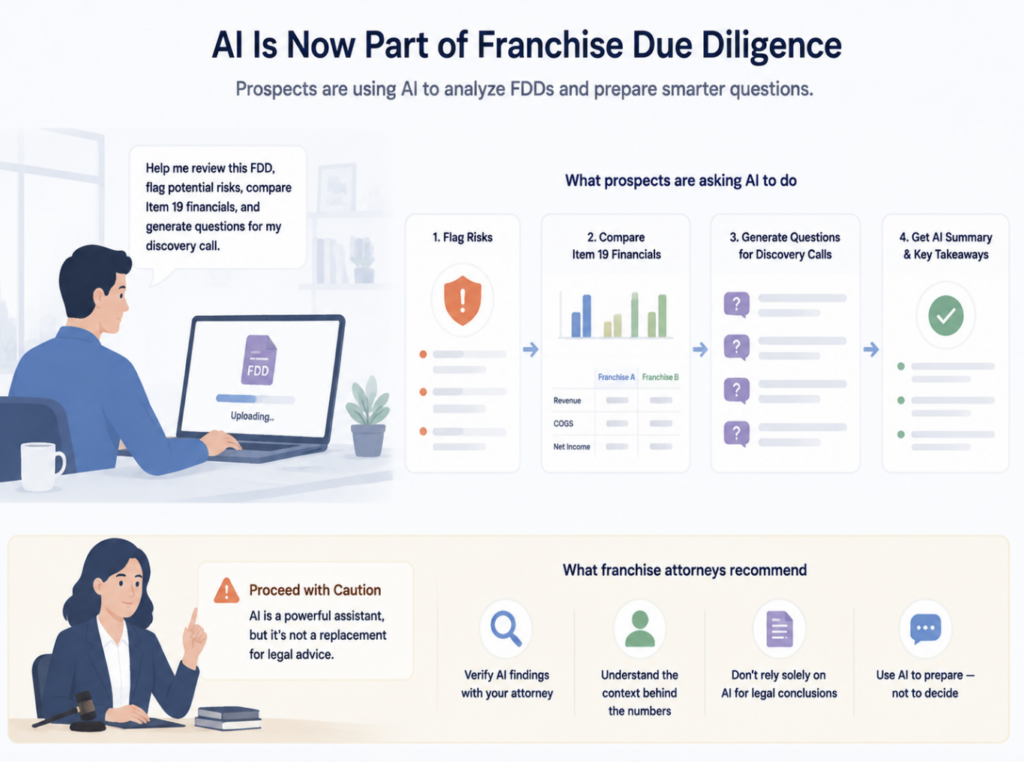
The irony is that franchise brands don’t structure their own web content to compete with those AI-analyzed FDD summaries. A prospect gets a detailed, AI-generated breakdown of a competitor’s unit economics from an uploaded FDD, then visits your website and finds a brochure-style page with no structured investment data, no schema markup, and no content that AI can cite as a credible source. Your own content loses to a competitor’s legally mandated disclosure document.
From a One-Time Score to Continuous Franchise GEO Monitoring
Running your franchise through the GEO Score Checker gives you a clear picture of where you stand right now. But GEO signals change. AI models update their training data. Competitors optimize. New franchise prospects ask new prompts. A single score tells you the starting point, not the direction.
Topify’s Comprehensive GEO Analytics picks up where the free checker leaves off, tracking all four GEO dimensions continuously across every major AI platform.
| Capability | Free GEO Score Checker | Topify Platform |
|---|---|---|
| Check frequency | One-time snapshot | Continuous monitoring |
| Dimensions tracked | 4 GEO scores | Full GEO analytics + sentiment + citations |
| Historical trends | None | Full trend history with alerts |
| Competitor benchmarking | Not included | Real-time competitor tracking |
| Platform breakdown | Aggregated | Per-platform (ChatGPT, Perplexity, Gemini, AI Overviews) |
| Optimization actions | Directional guidance | Specific, prioritized execution steps |
For franchise brands managing visibility across dozens or hundreds of locations, continuous tracking isn’t optional. It’s the difference between catching a Visibility Score drop in week one and discovering it three months later when prospect inquiries have already declined.
Every plan includes a 7-day free trial with no credit card required. See pricing for details, or start a free trial to connect your franchise brand today.
Conclusion
Franchise buyers are making decisions inside AI chat windows before they ever call a broker, attend a discovery day, or visit a franchise expo booth. The brands AI recommends at that moment capture the consideration set. The brands it doesn’t mention lose prospects they’ll never know existed.
That visibility gap is measurable. Check your franchise brand’s GEO score in 60 seconds, identify which of the four dimensions is holding you back, and start closing the gap between your Google presence and your AI presence.
If your Bot Access score reveals crawler blocks, the AI Robots Checker can pinpoint exactly which directives are keeping GPTBot and ClaudeBot out. For brands concerned about how current their AI representation is, the Knowledge Freshness Checker tests whether AI models are working with outdated brand information. And if you want a quick cross-platform snapshot before committing to continuous monitoring, the AI Visibility Report shows where your brand stands across ChatGPT, Perplexity, and Gemini in a single view.
Frequently Asked Questions
Why does my franchise rank well on Google but not appear in ChatGPT recommendations?
Google local rankings depend on GBP optimization, review volume, and NAP consistency. AI platforms use entirely different signals: crawlable content depth, structured data quality, and third-party citation authority. A brand can hold the local 3-pack in 150 cities and still score below 20 on AI Visibility because the inputs don’t overlap. The GEO Score Checker shows exactly which signals are missing.
Does the GEO Score Checker evaluate each franchise location separately or just the corporate site?
The checker evaluates whatever domain or brand name you enter. For franchise brands, running the check on both the corporate domain and a sample location page reveals how much brand authority actually transfers from parent to franchisee. In most cases, the gap between the two scores is where the real problem lives.
What’s the most common reason franchise brands score low on Structured Data?
Franchise corporate sites may carry basic Organization schema, but individual location pages almost never include LocalBusiness JSON-LD with territory details, service types, or investment information. Since AI systems extract structured facts with higher confidence than unstructured prose, missing schema at the location level is typically the single largest scoring drag for franchise brands.
Can improving my GEO score actually increase franchise lead volume?
Prospective franchisees increasingly start their research inside AI tools. When a buyer asks ChatGPT for “best fitness franchise under $200K” and your brand appears in the answer, that’s a qualified lead you didn’t pay for. Brands with Visibility Scores above 60 tend to appear in category-level AI recommendations consistently, which means their name enters the prospect’s consideration set before any broker or sales rep gets involved.
Read More:

