

Two GEO rank trackers, same brand, same week. One says you’re second in your category. The other says fourth. Neither number matches what happens when you open ChatGPT and ask the question yourself five times, where your brand shows up twice and gets skipped three times.
The dashboards aren’t broken. They’re reporting a metric borrowed from SERP tracking and applied to a system that doesn’t behave like a SERP. Before you argue about which tool is more accurate, it’s worth asking what “rank” is supposed to mean here in the first place.
What Your GEO Rank Tracker Means When It Says “Rank 3”
Open three GEO rank tracking products and you’ll find at least three definitions of the same word.
Some tools count the order your brand appears in the answer text. Others average your position across a prompt set and report a weighted score. A third group ranks the citation panel, meaning your “rank” is really the position of a URL in a source list that most readers never open.
These produce different numbers from the same underlying answer. That’s not a rounding problem. It’s a definitional one, and it means cross-tool comparison is meaningless until you know which layer each vendor is counting.
Here’s the thing: none of those three definitions tells you the number your CMO actually asked for, which is how often the brand appears at all.
The Ranking and Mention Gap Most GEO Rank Trackers Never Show
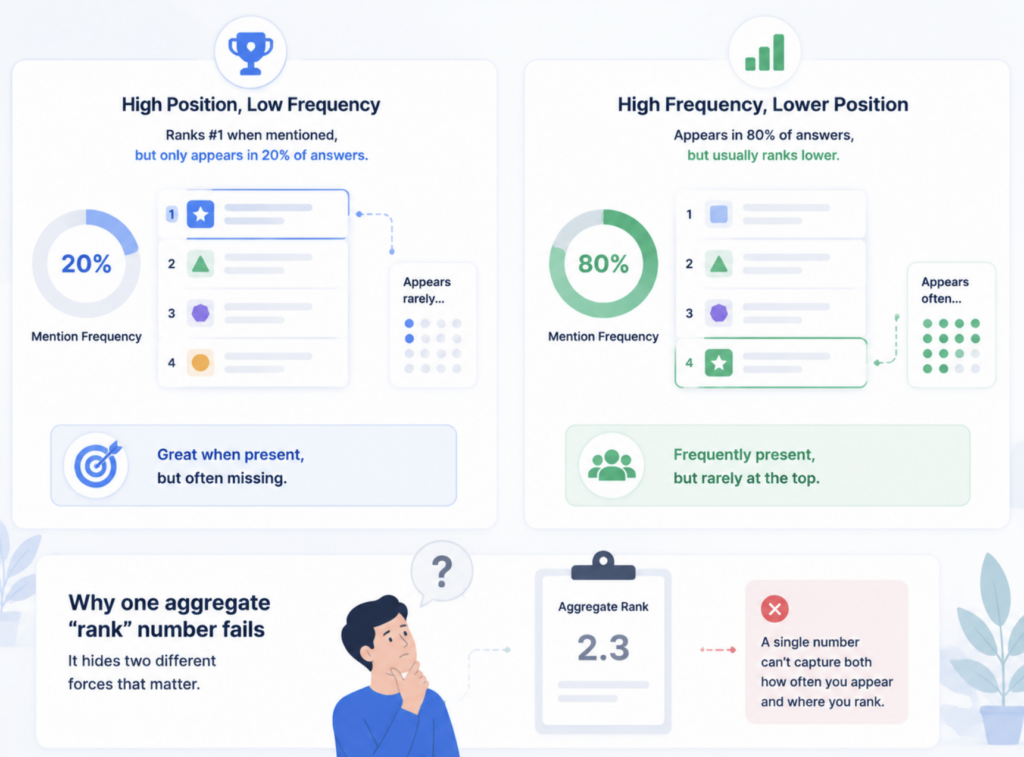
Position and mention frequency are separate phenomena. A brand can rank first every time it appears and still appear in only a fifth of relevant answers. Another can appear in most answers and land consistently in fourth place. One aggregate “rank” number flattens both into something that describes neither.
Onely documented a law firm holding the top Google position for a competitive local query while receiving zero ChatGPT mentions. Traditional ranking authority was intact. Presence in the answer was zero.
The retrieval data explains why. Ahrefs ran 15,000 long-tail queries through Google and Bing, then asked the same questions to four AI assistants, and found that on average only 12% of links cited by ChatGPT, Gemini, and Copilot appear in Google’s top 10 for the same prompt. Perplexity was the outlier at roughly one in three.
Short-tail queries don’t close the gap either. In a separate Ahrefs study of about 3,000 short-tail terms, ChatGPT’s URL overlap with Google’s top 10 sat at 10%, while Perplexity hit 65%.
Rank tells you how you’re described once you’re in the answer. Mention rate tells you whether you’re in the room.
Both matter, and they move independently. Conflating them is the single most common measurement error in AI search rank tracking today.
AI Answers Don’t Have a Position One. They Have a Sentence Order.
A SERP position is discrete, stable, and reproducible. Ask Google the same thing twice and you get the same ten results. Ask an AI assistant the same thing twice and the brand order can change without anything about your brand changing.
This isn’t a minor caveat. A 2026 variance-components study of non-determinism in LLM brand answers found that brand-ranking reliability sits near 0.01 for a single answer, rising to only about 0.36 across a fully crossed design spanning repeats, paraphrases, models, and languages.
Read that again. A single-sample rank number carries almost no signal.
The same paper found that pure within-prompt resampling accounts for 34.8% of total variance, and that adding a sixth repeat of the same prompt reduces relative-error variance by roughly 0.0003. Sampling more languages and more models buys reliability. Hammering the same prompt does not.
Most GEO rank trackers don’t disclose their sampling design at all. No repeat count, no paraphrase set, no model coverage. You’re handed a decimal point with no confidence interval attached, and then asked to make budget decisions with it.
There’s a related credibility problem worth naming. A practitioner discussion cited in Onely’s analysis argues that a large share of GEO trackers run on scraper plus API pipelines rather than the consumer product itself, producing results that diverge meaningfully from what real users see. Whether that estimate holds across every vendor, the underlying question stands: ask your provider what exactly they’re querying.
Four Blind Spots in Most GEO Rank Tracking Setups
Blind Spot 1: Single-Platform Coverage
Plenty of tools still report a rank that means “your position in ChatGPT.” As of May 2026, ChatGPT held 53.9% of worldwide AI assistant web visits, with Gemini at 27.9% and Claude at 9.2%. Roughly half your audience is being asked about by engines your tracker never touches.
Blind Spot 2: Keyword Input Instead of Prompt Input
A keyword is a lookup. A prompt is a request with intent, constraints, and phrasing baked in. Tools that convert keywords into synthetic prompts are measuring a query nobody typed.
Blind Spot 3: No Sentiment Layer on the Position
Appearing third with a strong recommendation beats appearing first as a hedged alternative. Gartner projects that 30% of brand perception will be shaped by generative AI, which makes the framing of a mention a reputation metric, not a nice-to-have.
Blind Spot 4: No Citation Attribution Behind the Rank
A rank change without a source explanation isn’t actionable. Citation concentration is severe: an analysis of 1,000 AI Overviews found the top 1% of cited domains capture 47% of all citations. When your position drops, the cause usually lives in that source layer.
| What the tracker shows | What’s actually happening | Decision risk |
|---|---|---|
| “Rank 2 in ChatGPT” | One engine, one sample, unknown repeat count | Optimizing for a number with near-zero reliability |
| “Visibility score 68” | Composite of mention rate and position, undisclosed weights | Can’t tell whether to fix presence or framing |
| “Rank improved 3 spots” | Sentence order shifted, mention rate flat | Reporting a win that didn’t change reach |
| “Cited in 12 answers” | No sentiment attached | Missing negative or hedged framing entirely |
What a GEO Rank Tracker Should Measure Instead
Five layers, aligned to the same prompt set, sampled on a disclosed schedule. Anything less and you’re guessing.
| Layer | The question it answers | What breaks without it |
|---|---|---|
| Mention rate | Do we appear at all, and in what share of runs? | Position looks fine while reach collapses |
| Position | When we appear, where in the answer? | Can’t tell a recommendation from a footnote |
| Sentiment | How are we framed relative to competitors? | High visibility, low persuasion, no explanation |
| Citation source | Which domains fed this answer? | Every change is unattributable |
| Prompt volume | How many people actually ask this? | Optimizing for prompts nobody uses |
The alignment matters as much as the metrics. Five numbers pulled from five different prompt sets can’t be cross-referenced, which is exactly why so many teams end up with a full dashboard and no diagnosis.
One more design point from the variance research: reliability comes from spreading samples across models and languages, not from repeating one prompt. Any GEO rank tracker that scales cost by repeat count instead of coverage has its incentives pointed the wrong way.
Reading a GEO Rank Tracker That Reports Both Layers
The practical requirement is simple to state and harder to buy. You need mention rate and position reported side by side, on the same prompts, across the engines your buyers actually use, with the citation trail attached.
Topify was built around that separation. Its analytics layer tracks seven metrics in parallel, including visibility, position, mentions, sentiment, volume, intent, and CVR, so a drop in one is legible against the others rather than averaged into a single score.
In practice that changes the workflow. You notice mention rate falling in Gemini while position holds steady in ChatGPT, open the citation view to see which domains stopped referencing your brand, and check whether a competitor picked up those same sources. Presence problem, framing problem, and source problem are three different fixes, and the platform is structured so you can tell which one you have. Coverage spans ChatGPT, Gemini, Perplexity, DeepSeek, Doubao, Qwen, and others, which matters for teams whose audience isn’t concentrated in a single English-language engine.
Sampling depth is a budget line, not a feature toggle. The entry plan runs $99 per month with 100 tracked prompts and 9,000 AI answer analyses, which is roughly what a statistically meaningful design costs once you stop taking single samples seriously.
Audit Your Current GEO Rank Tracker in One Afternoon
You don’t need a new vendor to find out whether your current numbers hold up.
Step one. Pick 10 prompts that reflect real buying questions in your category. Category prompts, comparison prompts, and alternative prompts, not keywords.
Step two. Run each one three times in the consumer app, not the API, across at least two engines. Log two things per run: did your brand appear, and in what order.
Step three. Calculate mention rate as appearances divided by total runs. Calculate mean position using appearances only. You now have the two numbers separated.
Step four. Compare against your tracker’s reported figure for the same week. A gap under 10 percentage points on mention rate is tolerable. Anything past 20 means the tool is modeling a version of the answer your customers don’t see.
Step five. Ask your vendor three questions: how many samples per prompt, which engines and interfaces, and whether the reported rank counts answer text or the citation panel. Vendors who can’t answer plainly are telling you something.
If you’d rather run the comparison against a platform that separates the layers by default, you can start a project in Topifyand point it at the same 10 prompts.
Conclusion
The disagreement between your two dashboards isn’t a data quality issue. It’s a category error. Rank was designed for a medium with fixed positions, and AI answers don’t have those. Until your GEO rank tracker reports mention rate and position as separate lines, on disclosed sampling, across the engines your buyers use, you’re optimizing against a number that can move for reasons that have nothing to do with your brand.
Start by splitting the two metrics in your own reporting this month. The diagnosis usually becomes obvious once they stop being averaged together.
FAQ
Q: What’s the difference between a GEO rank tracker and a traditional SEO rank tracker?
A: An SEO rank tracker reports a fixed, reproducible position in a result list. A GEO rank tracker samples probabilistic answers, so its output is a statistical estimate rather than a lookup. The methodological consequence is that sampling design determines accuracy, which is why disclosed repeat counts and engine coverage matter more than dashboard polish.
Q: How often do AI search rankings actually change?
A: Frequently enough that a single sample is unreliable. Variance research places brand-ranking reliability near 0.01 for one answer, meaning order can shift between two runs of the identical prompt with no change to your brand. Weekly sampling captures volatility; monthly aggregation gives a more stable directional read.
Q: How many prompts do I need before the numbers mean something?
A: Most practical setups start at 15 to 30 prompts covering category, comparison, alternative, and use-case intents, sampled multiple times across at least two engines. Coverage across engines and phrasings buys more reliability per dollar than repeating a single prompt.
Q: My brand ranks first but gets mentioned rarely. What should I fix?
A: That’s a presence problem, not a positioning one, and it usually traces to the source layer. Off-site coverage drives the majority of early-stage brand mentions, so the fix tends to be earning references in the listicles, comparison pages, and review roundups that AI engines retrieve from, rather than editing your own product pages.

