

Your GEO rank tracker says you moved from position 4 to position 2 in ChatGPT last week. Nobody on your team can explain why. Nobody can explain how to hold it, either.
Run the same prompt again tomorrow and the number may move again, with nothing on your site having changed. Most teams treat that number as a scoreboard. The research on how AI answers actually get assembled suggests it’s closer to a single frame pulled from a film that never plays the same way twice.
What a GEO Rank Tracker Actually Measures, and What It Leaves Out
A GEO rank tracker does one specific thing well. It sends a prompt to an AI engine, parses the brands in the response, and records where yours landed in the sequence.
That’s a snapshot of one generation, from one prompt, on one platform, at one moment.
The problem isn’t that the measurement is wrong. It’s that the underlying system isn’t stable enough for a single observation to mean much. AI answers are generated probabilistically, which means the same input can produce a different brand list on the next run without any change in your content, your backlinks, or your competitors’ behavior.
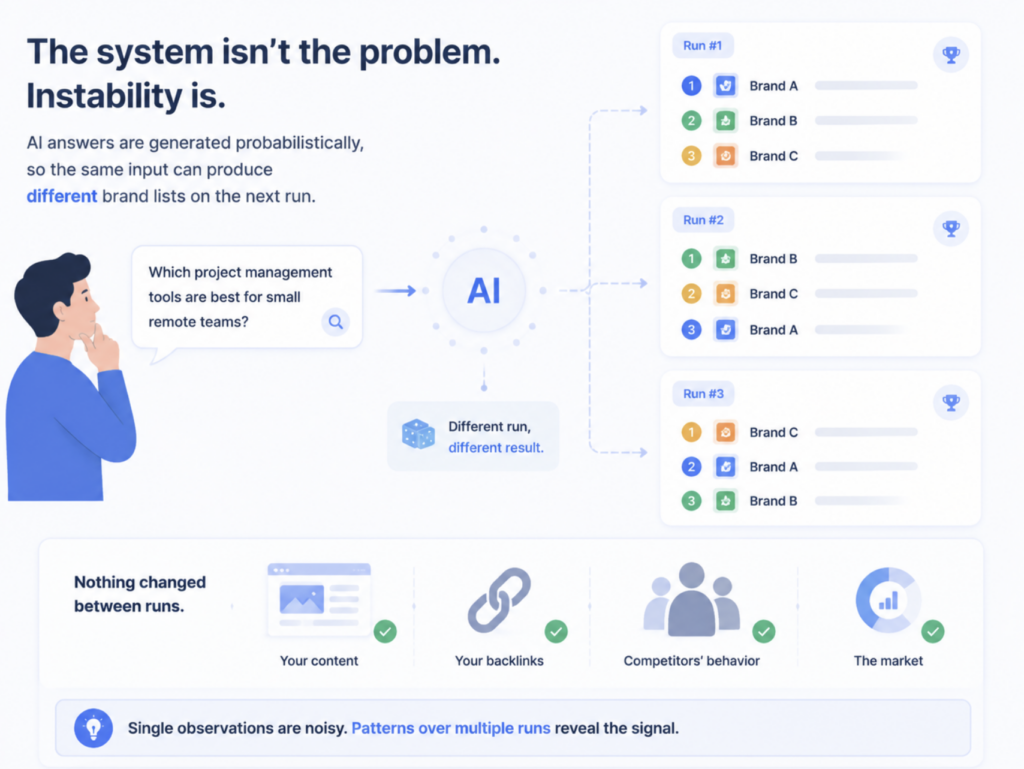
Traditional SEO trained everyone to read a position number as a state. In AI search, position is closer to a draw from a distribution. Rank tracking still has a job to do, but the job is narrower than most dashboards imply.
Ranking First in an AI Answer Isn’t the Same as Being Mentioned Often
This is the gap that costs teams the most, and it’s now well documented.
SparkToro ran what remains the largest public test of this question. Working with 600 volunteers, the team ran 12 prompts across ChatGPT, Claude, and Google AI a combined 2,961 times over two months. The result: fewer than 1 in 100 runsreturned the same list of brands for the same prompt, and roughly 1 in 1,000 returned that list in the same order.
Rand Fishkin’s conclusion was blunt: a tool that reports your “ranking position in AI” is reporting noise.
But the same dataset contains a second finding that gets quoted far less often. Aggregate appearance rates were considerably more stable. Across categories, the leading brands showed up in a consistent majority of runs even as their order shuffled every time.
Position and mention frequency are two different variables, and they don’t move together.
That separation has practical consequences. A brand can hold an average position of 2.1 while appearing in only a third of responses, and a competitor can average position 4 while appearing in 80% of them. The second brand wins almost every real buying conversation. A GEO rank tracker that averages positions across the runs where you appeared will never surface that, because it only measures the runs you were already in.
The metric that predicts commercial outcomes is how often you’re in the room, not where you sit once you’re there.
Your GEO Rank Tracker Can’t Tell You Which Sources Built the Answer
Position is an output. Citations are the input that produced it. Most AI search rank tracking stops at the output.
Ahrefs compared AI Mode and AI Overviews on the same queries and found they cited the same URLs only 13.7% of the time, while still reaching semantically similar conclusions 86% of the time. Two surfaces from the same company, agreeing on the answer and disagreeing almost completely on where they found it.
The connection between rankings and citations has also weakened fast. Only 38% of pages cited in AI Overviews still rank in Google’s top 10 for the same query, down from 76% eight months earlier.
Then there’s where the source material lives. Research from AirOps found that 85% of brand mentions in AI responses originate from third-party pages rather than owned domains, and that brands are roughly 6.5 times more likely to be cited through external sources than through their own site.
Read those three findings together and the implication is uncomfortable. Your position moved because a Reddit thread, a review roundup, or a comparison article entered or exited the citation pool. Your rank tracker recorded the effect. It has no visibility into the cause, which means it can’t tell you what to go fix.
A Position Number Says Nothing About How AI Describes You
Being cited first while being framed as the budget option is not a win. It’s a positioning failure that shows up as a green number on your dashboard.
Sentiment and position are structurally independent. An engine can lead its answer with your brand and then attach a qualifier that removes you from consideration for the exact buyer you’re targeting. Phrases like “popular but expensive” or “powerful but complex” do more damage than an absent mention, because the reader has already accepted the framing before they reach your site.
The durability is what makes this different from traditional reputation risk. A social post decays in days. A characterization baked into how a model describes your category can persist across millions of queries until the underlying sources change.
A GEO rank tracker has no field for any of this. It counts the mention and moves on.
One Prompt Isn’t a Market, and Sampled Rank Tracking Undercounts
Every tracking tool works from a prompt list. Real users don’t.
Semrush’s expanded 2026 AI Visibility Index analyzed 126 million U.S. AI search prompts, a jump from the 2,500 prompts in its original version. That scale gap is the whole issue in one number. A tracker sampling a few dozen prompts per day is estimating your presence across a query space several orders of magnitude larger.
The undercount runs in one direction. If your brand happens to be strong on a long tail of conversational queries nobody put on the tracked list, the dashboard reports weakness that doesn’t exist. If your tracked prompts happen to be the ones you win, it reports strength that doesn’t generalize.
Prompt coverage is a measurement decision that most teams make by accident, usually in the first week of setup, and then never revisit.
Volume context matters just as much. Ranking first on a prompt nobody sends is worth nothing, and the prompts that matter shift as AI-referred traffic grows. AI referral traffic converted 42% better than non-AI traffic in Adobe’s March 2026 analysis, a reversal from converting 38% worse a year earlier. The channel is small and getting more valuable per visit, which raises the cost of pointing your tracking at the wrong queries.
The Gap Between Knowing Your Rank and Knowing What to Change
Here’s the practical test for any GEO rank tracker. Your position drops three spots. What does the tool tell you to do?
For most, the honest answer is nothing. You get a number, a timestamp, and a line on a chart. The diagnosis, the source-level investigation, and the content decision all happen somewhere else, usually in a spreadsheet, usually a week later.
That gap explains why AI visibility programs stall after the first month. The data arrives, the meeting happens, and no one can point to a specific action with a defensible expected outcome. Only a small fraction of marketing teams currently track AI search performance at all, and among those that do, the bottleneck tends to be interpretation rather than collection.
Measurement without a causal chain isn’t analytics. It’s weather reporting.
What Belongs Around a GEO Rank Tracker in a Complete Setup
None of this means position should be discarded. It means position needs company.
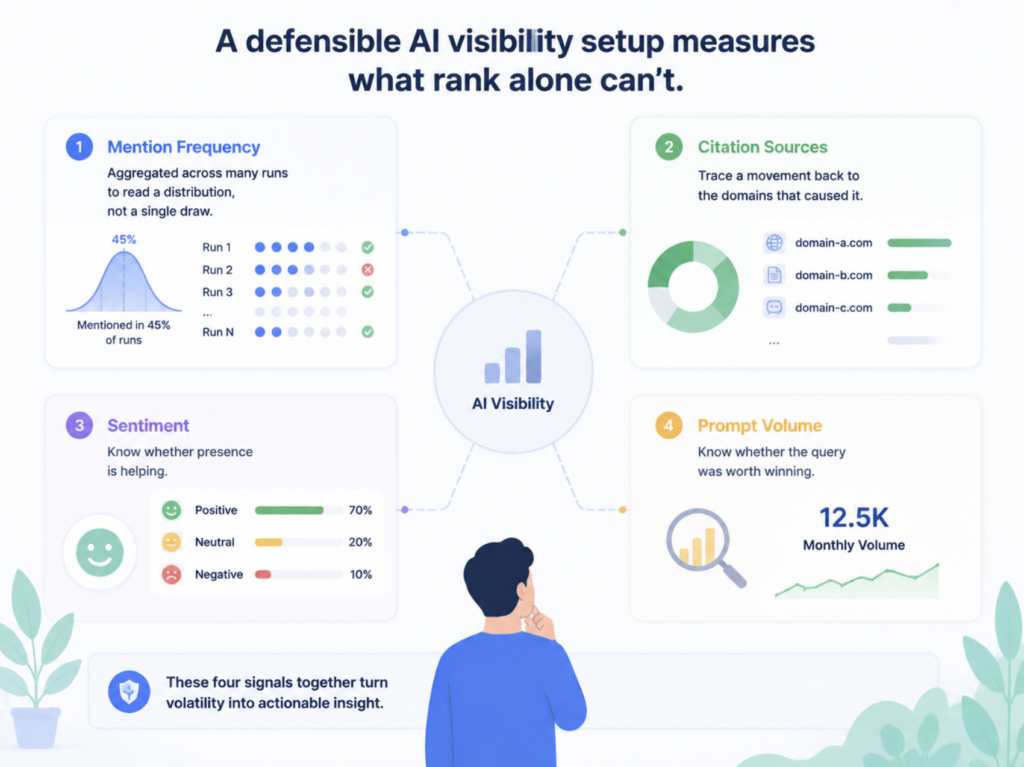
A defensible AI visibility setup measures four things a rank tracker alone can’t reach. Mention frequency aggregated across many runs, so you’re reading a distribution rather than a draw. Citation sources, so you can trace a movement back to the domains that caused it. Sentiment, so you know whether presence is helping. And prompt volume, so you know whether the query was worth winning.
Topify was built around that layering. Its GEO analytics run across seven metrics, visibility, sentiment, position, volume, mentions, intent, and CVR, tracked together across ChatGPT, Gemini, Perplexity, DeepSeek, and other engines rather than reported as isolated scores.
The part that matters operationally is the link between them. When visibility on a prompt cluster drops, the citation analysis shows which domains stopped feeding those answers and which competitor domains took the slot. Competitor benchmarking runs on the same data, so you can see whether a new entrant is pulling from sources you’ve never published on. Prompt discovery keeps the tracked list current as query patterns shift, which is where sampled rank tracking quietly goes stale.
The output is a diagnosis rather than a score. You can start with a free visibility check before committing to a tracked prompt set, which is usually the fastest way to find out how far your current numbers are from the aggregate picture.
Conclusion
A GEO rank tracker answers one question: where did my brand land in this response. That question mattered enormously in an ordered-list era. In generative search, where fewer than 1 in 100 identical prompts return an identical brand list, single-run position is the least stable thing you can measure.
The metrics that survive the noise are the aggregate ones. How often you appear across many runs. Which sources put you there. How you’re described when you arrive. Whether anyone is asking the question at all.
If your current reporting can’t answer those four, the position number isn’t telling you much, no matter which direction it’s moving. Start by auditing your prompt list against how your buyers actually phrase things, then add the citation layer underneath it.
FAQ
Q: What does a GEO rank tracker actually measure?
A: It sends a prompt to an AI engine, identifies the brands in the response, and records the order they appear in. That gives you a position for one generation of one prompt on one platform. It doesn’t measure how often you appear across repeated runs, which sources produced the answer, or how the engine characterized you.
Q: Is AI search rank tracking useless then?
A: Not useless, but narrower than it looks. Single-run position is noisy enough that it shouldn’t drive decisions on its own. Position tracked across many runs and read alongside mention frequency is still useful for spotting directional change. The failure mode is treating one snapshot as a trend line.
Q: How is a GEO rank tracker different from an SEO rank tracker?
A: An SEO rank tracker measures a deterministic system. Query the same keyword twice and you’ll get close to the same result. AI engines generate answers probabilistically, so identical prompts return different brand lists and different orderings. The measurement method carried over from SEO, but the underlying stability didn’t.
Q: How do I track brand mentions in ChatGPT answers reliably?
A: Run each tracked prompt many times rather than once, aggregate the appearance rate across those runs, and treat that percentage as your primary metric instead of average position. Then pair it with citation data so you can trace changes back to specific source domains. Platforms that handle repeated sampling and citation attribution together will get you there faster than manual spot checks.

