

Your brand held position two in ChatGPT’s answer for six weeks straight. Then on a Monday it showed up at position six. Nothing on your side had changed: no content edits, no lost backlinks, no competitor campaign. The obvious next move is to start fixing something.
That’s usually the wrong move. The thing that changed probably wasn’t your site. It was the model underneath the answer. And most GEO rank tracker setups can’t tell those two cases apart, because they report where you stand today instead of what happened across the last sixty days.
Your GEO Rank Didn’t Drop. The Model Changed Its Mind.
Three forces move a brand’s position inside an AI answer: your content, your competitors’ content, and the model’s own retrieval and ranking behavior. The first two move slowly. The third moves overnight.
And “overnight” is now the normal case. Major labs ship a flagship model every 6 to 12 months with point upgrades every few weeks in between, and public trackers log a notable release every few days once open-weight models are counted. OpenAI alone replaced GPT-5.2 with GPT-5.4 on March 5, 2026, then shipped GPT-5.5 seven weeks later.
Each swap can rewrite how the model retrieves.
When ChatGPT moved its default to GPT-5.3 Instant, the average number of domains cited per response fell from 19.1 to 15.2, roughly a 20% cut in citation slots. Nobody’s content got worse that week. The shelf just got shorter. A few months later, brand-website citation rates moved again, from about 57% on GPT-5.4 to about 47% on GPT-5.5, a ten-point swing between two versions launched roughly two months apart.
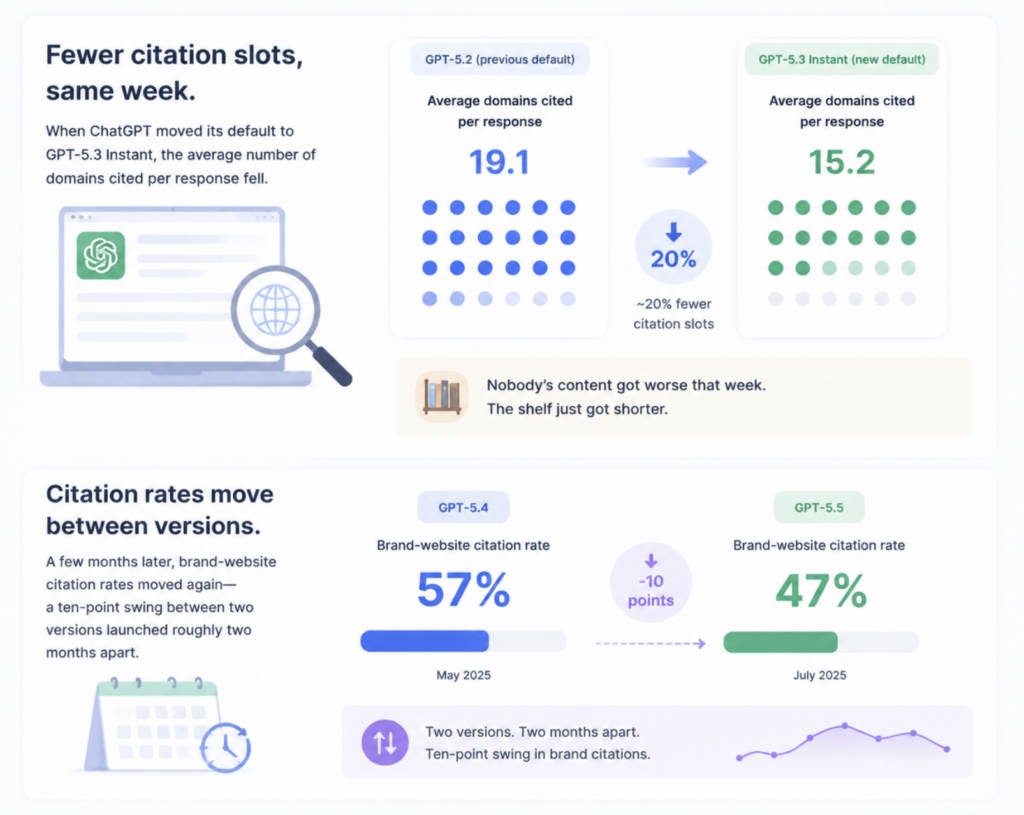
Here’s the part that costs teams money. If you reallocated budget toward brand-domain optimization after the first shift, the second shift partially walked it back. A model change is a measurement change before it’s a performance change, and teams that miss that distinction spend a quarter fixing a problem that never existed.
What a GEO Rank Tracker Measures That a Single Check Can’t
Most people treat “GEO rank” as one number. It’s at least three, and they don’t move together during a model transition.
| Layer | What it answers | Typical behavior during a model update |
|---|---|---|
| Position | Where does your brand sit in the recommendation order? | Moves first and moves loudest. Highest noise, lowest signal in isolation. |
| Mention rate | How often does your brand appear at all across a prompt set? | Moves slower. A real drop here is the one worth acting on. |
| Citation source | Which domains does the model pull from to justify the answer? | Often moves before the other two. The best early indicator. |
Position is the metric everyone screenshots and the one least worth reading alone. AI answers are non-deterministic by design: roughly 70% of content changes between repeated runs of the same query, and only about 30% of brands stay visible in back-to-back responses. Against that baseline, a two-place move on a single check tells you almost nothing.
The citation layer is where model updates show their hand earliest. If the mix of domains behind your category’s answers shifts from vendor sites toward community and editorial sources, the retrieval policy changed. Your rank is downstream of that, and no amount of on-page work will reverse it.
The 60-Day Curve: How Long Model Update Volatility Actually Lasts
A useful longitudinal window has three parts: 14 days of pre-update baseline, the transition itself, and 30 to 60 days of post-update observation.
The pre-update baseline is the part teams skip, and it’s the part that makes everything else interpretable. Without it you have no noise floor, which means you have no way to say whether a six-point move is a real event or a normal Tuesday.
After a transition, the pattern usually looks like a spike in variance followed by a new plateau. Where the plateau lands is the actual finding. Some brands return close to their old position within a few weeks, and practitioners tracking through transitions generally report partial recovery in the 4 to 8 week range when the cause is model behavior rather than competitive displacement.
Some brands don’t come back. That’s the case worth catching early, because it means the new retrieval policy structurally deprioritized the kind of source your visibility was built on. Waiting for it to “settle” wastes the window when a content correction still compounds.
The distinction between those two outcomes only exists in time-series data. A snapshot shows you the same number in both scenarios.
Rank Moves, Mentions Don’t. Most Dashboards Only Watch One.
This is the finding most GEO rank tracking misses, and it holds at scale.
Semrush’s 2026 AI Visibility Index analyzed 126 million U.S. AI search prompts from January through April 2026 and found that being mentioned and being cited are separate outcomes. On Gemini, the overlap between mentioned brands and cited domains can run as low as 30%. You can be the brand the model names and not the source it trusts, or the source it trusts and not the brand it names.
Recent academic work on the SEO-to-GEO transition points the same direction: traditional search metrics tend to predict where a brand lands within an AI answer, but they’re weak predictors of how often the brand gets mentioned at all. Ranking and mention frequency behave like two independent curves.
Which means a dashboard that only plots position can show a clean recovery while your mention rate keeps sliding.
It also explains why measurement gaps are so common. The same Semrush research found 45% of marketing leaders can’t accurately measure their brand’s presence in AI answers, and only 9% have tooling that covers the full metric set across platforms.
Three Signals That Tell You It’s the Model, Not Your Content
Before you change a single page, run these three checks. They take an afternoon and they’ll save you a quarter.
Signal 1: Your competitors moved too. Pull position data for the top five brands in your category over the same window. If four of five shifted in the same direction on the same date, you’re looking at a category-wide re-ranking, not a brand-specific problem. Nothing you publish will unwind it.
Signal 2: The source mix changed shape. Compare the domain types cited before and after. A swing from first-party vendor pages toward community platforms, review sites, or news is a retrieval policy change. Your fix is third-party presence, not more on-domain content.
Signal 3: Sentiment held while position fell. If the model still describes your brand in the same terms but ranks it lower, its evaluation of you didn’t change. Its ordering logic did. That’s a model event, and the response is patience plus source diversification, not a rewrite.
If all three point the same way, log the date as a model event and hold your content roadmap. If none of them do, the problem is yours and it’s fixable.
How to Run Your Own Longitudinal GEO Rank Study
Five steps. The discipline matters more than the tooling.
1. Lock a prompt set of 30 to 60 buyer-intent queries. Fewer than 25 and single-prompt noise dominates the trend. Cover definitions, comparisons, alternatives, and purchase-decision phrasings, not just your brand name.
2. Prioritize repeated runs over a bigger list. Because variance lives at the run level, a 50-prompt set run 10 times tells you more about stability than a 500-prompt set run once. Weekly cadence at minimum. Daily during a known transition.
3. Freeze the set for the full cycle. Adding or dropping prompts mid-comparison changes what you’re measuring and quietly invalidates the trend. Version the library and date every change.
4. Annotate model release dates on the timeline. This is the step that turns a chart into an explanation. Without event markers you have a squiggle. With them you have attribution.
5. Refuse to act on a delta that doesn’t clear the noise floor. Most week-over-week movement in AI visibility reporting is variance being narrated as strategy. Set a threshold before you look at the data, not after.
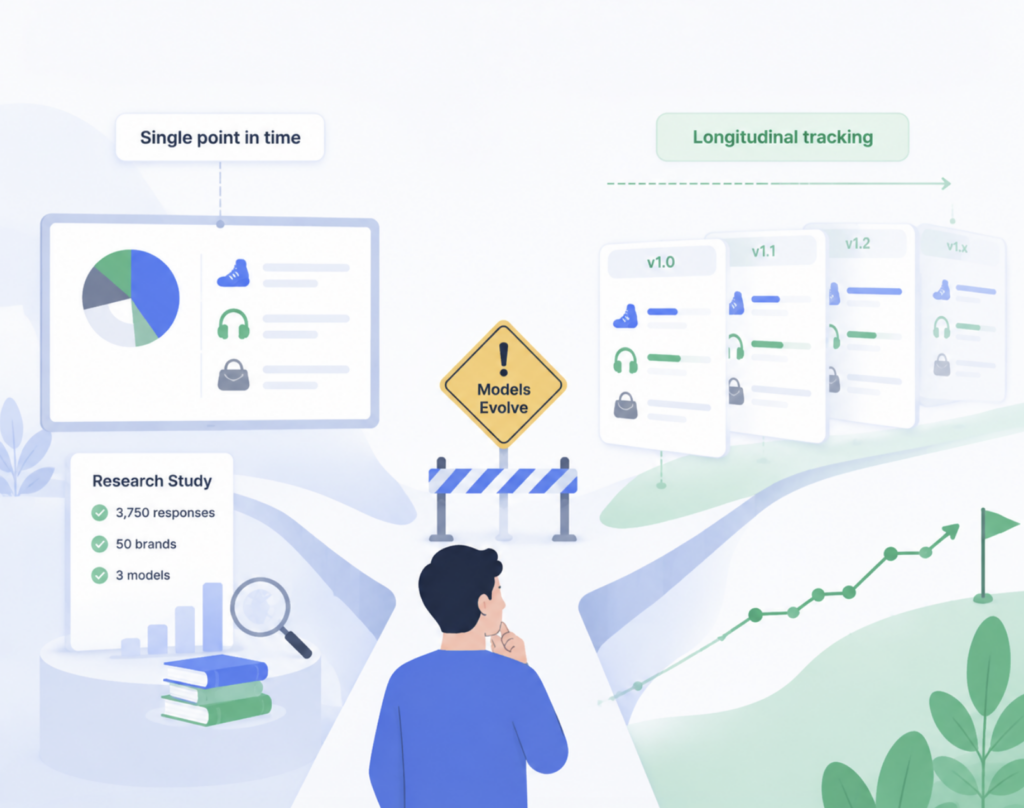
One caveat worth stating plainly. Even published research runs into this: a 2026 multi-industry study of brand ownership in AI recommendations covering 3,750 responses across 50 brands and 3 models flagged its own single-point-in-time design as the main limitation, noting that only longitudinal tracking would show how recommendation patterns evolve as models update. If a research team with 250 controlled queries hits that wall, a monthly dashboard check definitely does.
Where a GEO Rank Tracker Earns Its Keep
Everything above is doable by hand. It just doesn’t survive contact with a real workload, because the three things that make it work are continuous sampling, cross-platform synchronization, and event annotation. Miss any one and the attribution breaks.
That’s the gap Topify was built to close. Its GEO analytics layer tracks seven metrics on the same timeline, including visibility, position, mentions, sentiment, and CVR, so you can see whether a position drop came with a mention drop or without one. That single comparison resolves most model-update false alarms in about a minute.
Two other pieces matter during transitions. Competitor benchmarking runs against the same prompt set on the same schedule, which gives you Signal 1 without assembling it manually. And citation analysis reverse-engineers the exact domains and URLs the platforms are pulling from, which is where a retrieval policy change becomes visible before your rank reacts.
Coverage spans ChatGPT, Gemini, Perplexity, DeepSeek, Doubao, Qwen, and others. That breadth is what keeps a single platform’s release schedule from being mistaken for a global trend. Plans start at $99/mo, and you can set up a tracked prompt set and start building baseline data in an afternoon.
Build the baseline before the next release, not after it.
Conclusion
Model updates aren’t an edge case in GEO. They’re the background condition, arriving faster than most reporting cycles can absorb. A brand that reads every position change as a content problem will spend its budget chasing phantoms, and a brand that dismisses every change as noise will miss the one drop that was structural.
The difference between those two failures isn’t a better metric. It’s a longer window. Set a 14-day baseline, freeze your prompt set, mark the release dates, and separate mention rate from position before you touch anything. Do that once, and the next model swap becomes an event you can explain instead of a fire you have to fight.
FAQ
Q: Does a model update reset my GEO rank?
A: Not usually a full reset, but it can reorder recommendations within days. What actually changes is retrieval behavior: which sources the model trusts and how many it cites. Position follows from that, which is why the citation layer is the better early indicator.
Q: How often should a GEO rank tracker re-measure?
A: Weekly is the floor for stable trend data. Move to daily for the two weeks surrounding a known model release, since that’s when variance peaks and when the recovery curve is actually readable.
Q: My rank dropped after a model update. Should I change my content now?
A: Run the three signals first. If competitors moved with you and the source mix shifted, hold your roadmap and wait 4 to 8 weeks. If your mention rate dropped while competitors held steady, that’s a content and authority problem worth acting on immediately.
Q: Can free tools handle longitudinal GEO rank tracking?
A: Free checkers give you a useful snapshot of where you stand today. Longitudinal work needs a frozen prompt set, repeated runs, and stored history across platforms, which is where a dedicated tracker becomes the practical option.

