

Your GEO rank tracker showed your brand at an average position of 4.1 in March and 3.6 in May. Your VP asks what you did to earn that. You scroll back through the changelog: a pricing page rewrite, two comparison posts, a schema fix, one podcast appearance. Any of them could explain it. None of them explains it alone.
The uncomfortable part is that a chunk of that movement probably wasn’t yours. On the platforms most buyers use, recommendation lists reshuffle on their own every few days, which means a lot of what shows up in a rank chart is the platform breathing, not your work landing.
Rank Movement in a GEO Rank Tracker Is Mostly the Platform Breathing
The largest public 90-day panel on this question ran 1,247 buyer-intent prompts every single day across eight AI platforms, producing 897,840 answers between March and May 2026. Across that set, 17% of prompts returned a different set of recommended brands than they had the day before, and the median brand list survived unchanged for just five days.
Over the full 90 days, the top-recommended brand flipped at least once for 65% of prompts.
Stability varies by almost 3x depending on which platform your GEO rank tracker is pointed at.
| Platform | Daily brand-set churn | Median unchanged streak | #1 brand flipped in 90 days |
|---|---|---|---|
| Perplexity | 27% | 3 days | 84% |
| Google AI Mode | 23% | 4 days | 78% |
| ChatGPT | 18% | 5 days | 69% |
| Google AI Overviews | 13% | 7 days | 58% |
| Gemini | 11% | 9 days | 49% |
| Claude | 9% | 11 days | 41% |
Not all of that is real movement. When the same prompts were re-run ten times inside a single hour, ChatGPT came back with a different brand set in only 7% of pairs. Roughly a third of the day-over-day churn is sampling noise. The rest is the platform genuinely changing its mind.
Academic work points the same direction. A daily tracking study across four AI engines and four verticals found that visibility has to be treated as a probability across repeated runs rather than a fixed value, with brand sets overlapping only 45% to 59% between runs of an identical prompt.
Two caveats before you build a quarterly plan on these numbers. The panel skews US, English-language, and B2B software, and it runs clean sessions with no personalization or chat history. Your buyers carry both, which adds variance on top.
Three Signals That Moved GEO Rank, and Two That Didn’t
Once you strip out the noise, the levers that correlate with real position gains look nothing like a traditional SEO checklist.
Third-party review presence moved the most. A study of over 800,000 AI responses across ChatGPT, Gemini, Perplexity, and Google AI Mode sorted brands into four tiers by review profile depth. Brands with no profile had a median AI citation rate of 1%. Brands with even a minimal profile, as few as 1 to 13 reviews, jumped to 53.5%. That’s a 52-point swing from a setup task.
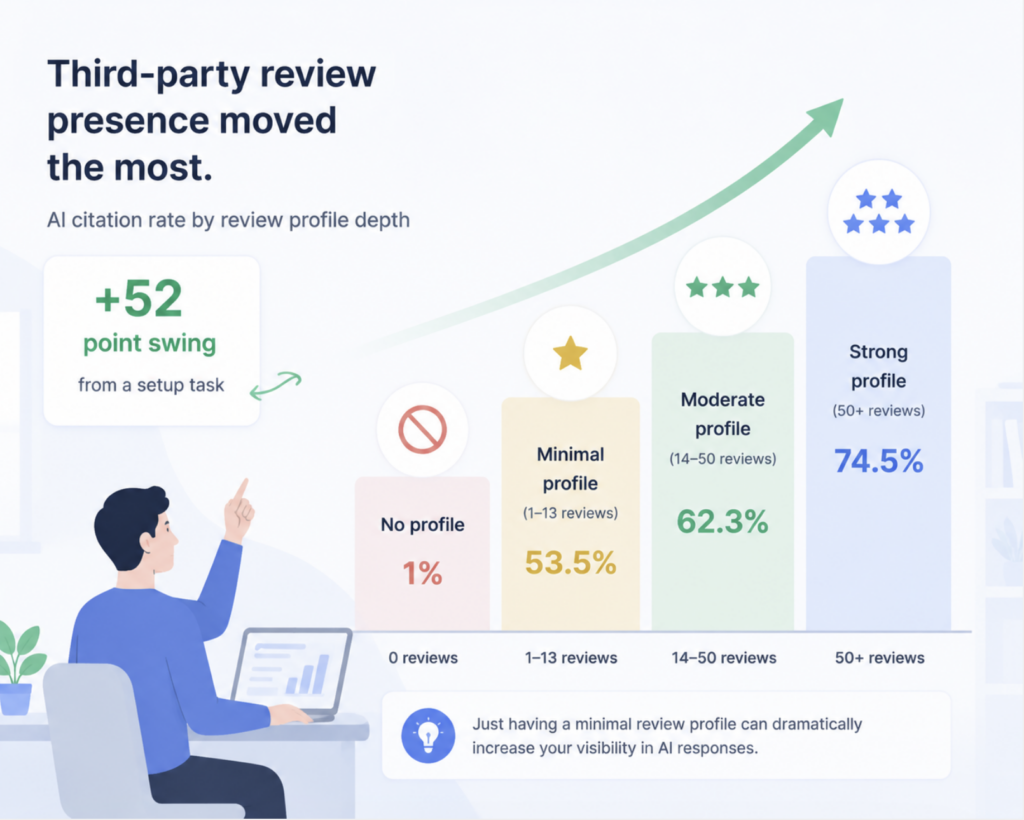
The effect concentrates where it matters commercially. Review and trust sites are a small slice of citations at the awareness stage and grow 10 to 20 times by the decision stage.
Earned brand mentions moved second. Analysis of 75,000 brands found that YouTube mentions correlate with AI visibility at 0.737 and branded web mentions at 0.664, both measured on the Spearman scale.
Source freshness moved third. Cited content runs meaningfully newer than organic top-10 results, and on retrieval-heavy platforms the pages behind your position rotate weekly. Keeping the sources that mention you current is closer to maintenance than to campaign work.
Now the two that didn’t.
Backlinks correlate at 0.218 in the same 75,000-brand dataset, and domain rating at roughly 0.18. Both are positive. Neither explains much. Publishing volume performs worse still, with content volume landing near 0.194, meaning the number of pages on your site has almost no bearing on whether AI systems name your brand.
One honest conflict is worth flagging. One analysis of AI Overview results reports that multi-modal content shows 156% higher selection rates than text-only pages, while a separate agency study found multi-modal content moved results far less than expected. The evidence here isn’t settled, so treat image and video additions as a hypothesis to test rather than a rule to adopt.
Why Your Citation Sources Move Rank Faster Than Your Page Edits
Here’s the thing most teams get backwards. You don’t optimize a page into an AI answer slot. You influence which sources get pulled when the answer is assembled.
The gap between those two ideas is now measurable. The overlap between Google’s top-10 rankings and the sources cited in AI answers collapsed from around 75% in mid-2025 to between 17% and 38% by early 2026. Winning the old surface stopped guaranteeing the new one.
Citation slots also rotate hard. In Google AI Overviews, the same URL holds its citation for an average of 3.87 consecutive days, and 91% of tracked URLs were dropped at some point during the study window.
That’s why a rewrite of your own page often produces nothing in the GEO ranking data while a single new third-party comparison article moves three prompts at once.
Prompt specificity matters here too. A test across 5,000 local queries found URL overlap between identical runs as low as 18% to 20% on vaguely phrased prompts, with specificity nearly doubling stability. If your tracked prompt set is full of “best CRM” rather than “HIPAA-compliant CRM for small clinics,” you’re measuring a noisier signal than you need to.
The Lag Between Doing the Work and Seeing It in GEO Ranking Data
Most GEO experiments get killed before they resolve.
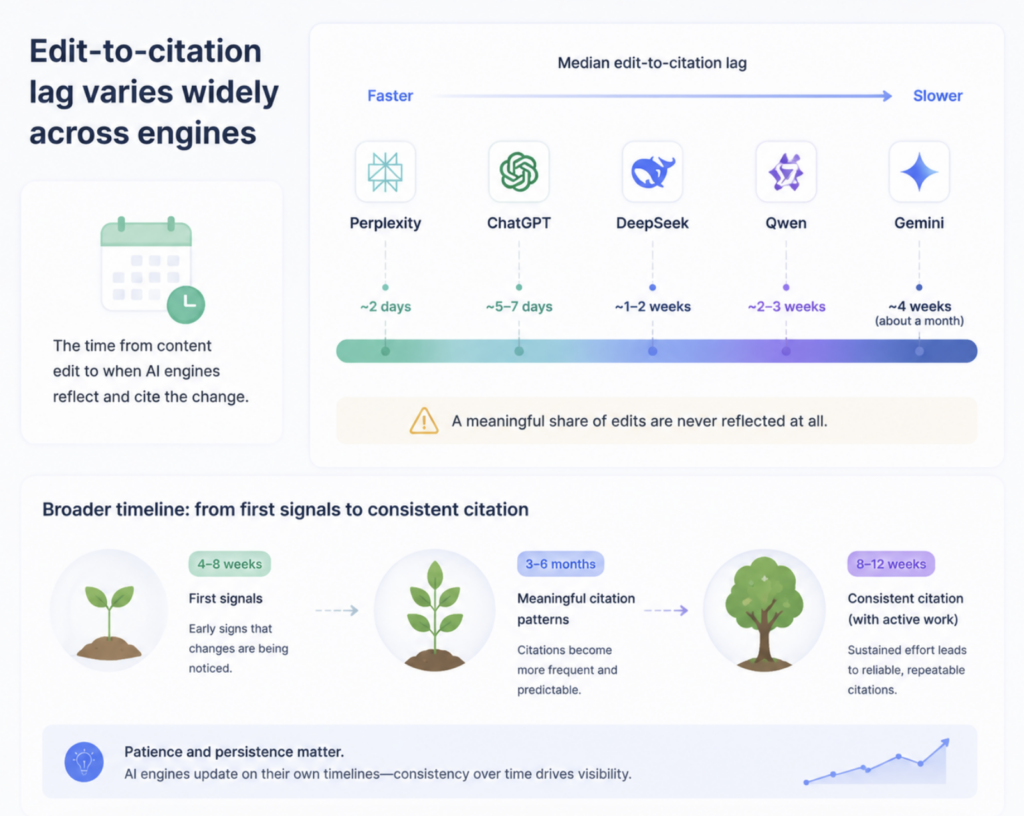
Edit-to-citation lag varies by an order of magnitude across engines, from a median of about two days on Perplexity to roughly a month on Gemini, with a meaningful share of edits never reflected at all. Broader timeline estimates converge on first signals at 4 to 8 weeks and meaningful citation patterns at 3 to 6 months, with one 2026 breakdown putting consistent citation at 8 to 12 weeks of active work.
Platform updates add a second trap. On days when a model refresh shipped, brand-set churn spiked to 2.7 times baseline and took four to six days to settle. A team that reads that spike as a strategy failure and rolls back its changes has just destroyed its own trend line.
Two operating rules follow. Don’t evaluate a GEO change on a window shorter than six weeks. And when churn spikes across every category at once rather than in the one you touched, wait a week before concluding anything.
Ranking Higher and Getting Mentioned More Are Not the Same Win
This is the part a position-only dashboard hides.
Analysis of 541,213 LLM responses across 20 brands and six platforms found a brand’s citation rate was 53.1% when the brand was named in the response and 10.6% when it wasn’t. The proposed mechanism is that the model chooses which brands to name from trained memory first, then retrieves sources to support those choices. Citations behave like a bibliography, not a brainstorm.
If that’s directionally right, then climbing from position 4 to position 2 inside answers you already appear in is a different achievement from getting named in answers where you’re currently absent. The first is an ordering problem. The second is a memory problem.
Research from Topify’s own team, currently under academic review, points the same way: traditional SEO metrics predict where a brand lands inside an AI answer but not how often the brand gets named at all. Ranking and mention frequency separate.
That’s the gap most rank trackers still can’t show you.
What a GEO Rank Tracker Has to Show You Besides Position
Everything above adds up to a fairly specific tool requirement. Position alone is a noisy, partial, single-platform metric. To act on GEO ranking data you need the mention layer, the citation layer, and the competitive axis in the same view, sampled often enough to see through the churn.
Topify is built around that combination. It tracks seven metrics in parallel, visibility, sentiment, position, volume, mentions, intent, and CVR, so a position drop can be checked against whether your mention rate fell with it or held steady. Those are two different problems with two different fixes, and a position-only chart can’t distinguish them.
The citation layer is where attribution usually gets settled. Topify’s citation analysis surfaces the exact domains and URLs the platforms pulled for a given prompt, which turns “our rank moved” into “a review aggregator that used to list us dropped us in week six.” Pair that with competitor benchmarking on the same prompt set and you can tell whether you slipped or a rival simply landed three new placements. Coverage spans ChatGPT, Gemini, Perplexity, DeepSeek, Doubao, and Qwen, which matters if any part of your audience searches outside the US.
Entry pricing starts at $99 per month for 100 tracked prompts and 9,000 AI answer analyses, which is roughly the sampling density the volatility data suggests you need.
How to Run a 90-Day GEO Rank Test That Survives Scrutiny
The method matters more than the tool. Five decisions do most of the work.
Freeze your prompt set. Pick 50 to 200 prompts that mirror real buyer questions and don’t change them mid-quarter. Swapping prompts destroys the trend line you’re trying to read.
Sample repeatedly, then report frequency. Run each prompt several times per platform per window and report the share of runs your brand appeared in, not a yes or no from a single check. Practitioners generally land on 5 to 10 runs per prompt per engine.
Hold conditions constant. Same time of day, clean sessions, fixed geography. Otherwise you’re measuring your own setup drift.
Change one variable at a time. The single most common reason teams can’t explain their own GEO ranking data is that they shipped four things in the same sprint.
Wait out the lag before you judge. Six weeks minimum, longer on model-led platforms.
Run that for a quarter and you’ll have something defensible: a baseline, a noise floor, and a short list of changes with dates attached. You can set up a tracked prompt set in Topify and let the first 30 days establish the baseline before you change anything.
Conclusion
Ninety days of data doesn’t make AI search predictable. It makes it legible. The honest read is that recommendation lists turn over every three to eleven days depending on platform, roughly a third of what a GEO rank tracker shows on a given day is sampling noise, and the changes that reliably move real position are off-site: review presence, earned mentions, and fresh third-party sources.
Start by measuring properly. Freeze a prompt set, sample it repeatedly for 30 days without touching anything, and find out what your brand’s natural variance actually looks like. Only then will a rank change mean something when you report it.
FAQ
Q: What’s the difference between a GEO rank tracker and a traditional SEO rank tracker?
A: An SEO rank tracker measures where a page appears in a results list. A GEO rank tracker measures whether a brand appears inside a generated answer, in what order relative to competitors, which sources the engine cited, and how the brand was described. The output is probabilistic, so it has to be sampled repeatedly rather than checked once.
Q: How often should I check my GEO rankings?
A: Daily or near-daily on the platforms your buyers use, with weekly review of the aggregate trend. Median brand-list persistence runs three to seven days on the most-used platforms, so weekly manual checks miss entire appearance windows.
Q: My position improved but my mention rate didn’t. What does that mean?
A: You got better ordering inside answers you were already appearing in, without expanding into new prompts. Position work responds to on-page and comparative content. Mention rate responds to off-site brand presence. They need different fixes.
Q: How many prompts do I need to track for the data to be meaningful?
A: Fifty is a workable floor for a single category, and 100 to 200 covers a mid-sized product line with room for competitor prompts. What matters more than raw count is repeated sampling per prompt and keeping the set frozen across the measurement window.

