

Monday morning. Your GEO rank tracker shows your brand sliding from position two to position seven in ChatGPT answers across your three highest-intent prompts. Nobody shipped anything last week. No pages were deprecated. No redirects broke.
The default reaction is to rewrite the pages that stopped getting cited. That reaction is wrong most of the time, because a position drop in AI answers has at least four separate causes and only one of them is fixed by touching your content. Picking the wrong branch costs you a sprint, and by the time you find out, the number has moved again.
A GEO Rank Drop Is Never Just One Problem
Traditional rank tracking trained a reflex: position falls, so audit the page. That reflex assumes a stable index behind the result. AI answers don’t have one.
The measurement layer itself keeps shifting. As Search Engine Journal pointed out in a breakdown of why prompt tracking needs a different approach, when OpenAI shipped a new default model, most AI citation trackers registered a collective drop. Optimization quality hadn’t changed. The number of citation links exposed in the response had.
So the first question after a drop isn’t “what did we do wrong.” It’s “which layer moved.”
Most teams can’t answer that, and they know it. Semrush’s 2026 AI Visibility Index, built on 126 million US AI search prompts from January through April 2026, found that 45% of marketing leaders can’t accurately measure brand visibility in AI-generated answers, and only 9% have tools covering every metric they need.
That gap is exactly where wasted sprints come from.
Step Zero: Prove the Drop Is Real Before You Diagnose It
Most reported GEO rank drops aren’t drops. They’re single samples pulled from a distribution that was always noisy.
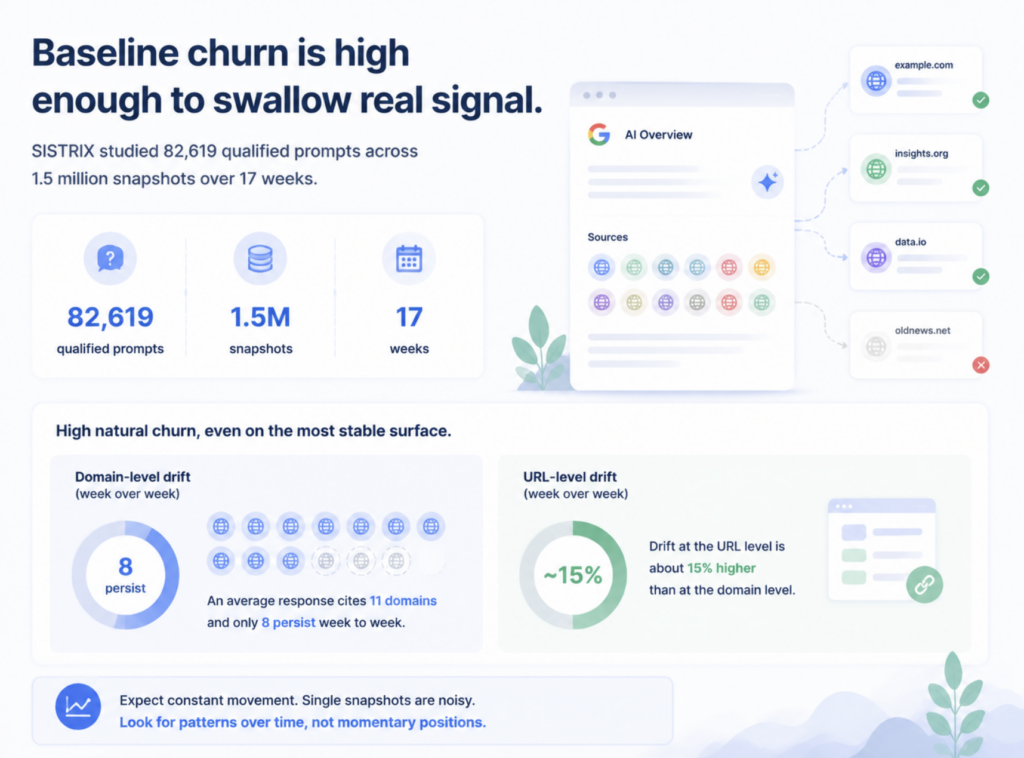
The baseline churn is high enough to swallow real signal. SISTRIX studied 82,619 qualified prompts across 1.5 million snapshots over 17 weeks and found that even on Google AI Overviews, the most stable surface tested, an average response cites 11 domains and only 8 of those persist week to week. At the URL level, drift runs about 15% higher than at the domain level.
Zoom out to a month and the picture gets rougher. Digital Authority Partners tracked citation persistence across five engines and measured an average 28-day citation retention rate of 33%, meaning roughly two-thirds of cited URLs get replaced inside four weeks without anyone doing anything.
Against that baseline, a single check proves nothing.
Three gates before you open an investigation:
- Sampling gate. The prompt has been run enough times in the window to separate rate from roll of the dice. One run is a screenshot, not a measurement.
- Persistence gate. The lower position holds across consecutive sampling windows, not just one refresh.
- Scope gate. You know whether the drop is confined to one prompt, one prompt cluster, or your whole tracked set. This single distinction eliminates two of the four branches below.
Run those gates first and a good share of your alerts close themselves.
The GEO Rank Tracker Decision Tree: Four Branches From One Drop
Once the drop clears the gates, it belongs to exactly one of four branches. They’re ordered by diagnostic cost, cheapest first.
| Branch | What the data looks like | Layer you need to check | First move |
|---|---|---|---|
| 1. Citation loss | Your position falls, the domains that used to cite you are gone from the answer | Cited source domains and URLs, before and after | Recover or replace the lost source |
| 2. Competitor gain | Your citations are intact, but a rival now sits above you | Competitor position history on the same prompts | Analyze what got them cited |
| 3. Platform change | Many unrelated prompts move on the same day, one engine only | Cross-engine comparison on the same date | Rebaseline, change nothing |
| 4. Framing drift | You’re still mentioned as often, but described differently and ranked lower | Sentiment and descriptor tracking over time | Fix the third-party narrative |
Branch 1: You Lost the Citation
Start here because it’s the only branch with a direct, controllable fix.
Compare the cited domain set from before and after the drop. If a review site, a forum thread, or a comparison page that used to appear in the answer is missing now, your position didn’t fall because your content weakened. Your evidence base did.
Common causes: a listicle got updated and dropped you, a directory listing expired, a media placement fell behind a paywall, or a page you own got restructured and lost the specific passage the engine was pulling.
The fix is source-level, not site-level. Restore that citation or earn a replacement of similar authority.
Branch 2: A Competitor Took the Slot
If your citations are unchanged and your position still fell, someone else moved up. AI answers rank on relative authority within a topic, so you can lose ground without losing anything.
This branch is more common in unsettled categories than most teams expect. Semrush and Kevin Indig’s study of 1,094 US categories and more than 50,000 brands found that clear category owners held first place in 90.4% of month-over-month comparisons, while in emerging and unsettled categories the top brand switched in 1,950 out of 5,470 comparisons.
Translation: if you own your category, a drop is probably noise. If you’re an emerging leader, a drop is probably a competitor.
The same research also found that real topic ownership means appearing in at least four of five related prompts with a five-point lead over the runner-up. Winning one prompt isn’t ownership, and losing one prompt isn’t a crisis.
Branch 3: The Model Changed, Not Your Content
This is the branch that burns the most budget, because the drop looks exactly like a content failure and responds to none of the usual fixes.
When ChatGPT switched its default model in early March 2026, Search Engine Land tracked 400 daily prompts over 14 weeks and found the average number of unique domains cited per response fell from 19 to 15, with unique URLs sliding from 24 to 19. Roughly a fifth of the citation surface vanished across the board, and it didn’t come back.
Every brand tracking that engine registered a decline that week. None of them had done anything.
The tell is scope plus timing: a large share of unrelated prompts move together, on one engine, on one date, while the same prompts on other engines hold steady. That pattern is only visible if you’re tracking more than one platform, which is why single-engine monitoring produces so many false diagnoses.
The correct response is to reset the baseline and hold the strategy. Chasing a platform-level change with a content sprint is how teams spend a quarter recovering ground that was never lost.
Branch 4: Your Framing Drifted
The subtlest branch. Mention frequency holds, but the answer now calls you the budget option, or the legacy option, or the tool for small teams, and the ordering shifts to match.
Position in an AI answer follows the descriptors the model has absorbed about you. When third-party coverage starts framing you differently, ranking moves before mentions do. This is a public relations problem wearing a GEO costume, and no amount of on-page work will fix it.
Mentions and Position Don’t Move Together
Here’s the structural point most dashboards miss: how often AI names your brand and where it places you are governed by different inputs. They can move in opposite directions in the same week.
Research on the shift from SEO to generative search keeps landing on the same separation. Conventional SEO strength tends to predict where a brand lands once it’s inside an answer, but it’s a weak predictor of whether the brand gets named at all. Off-site signals carry that part.
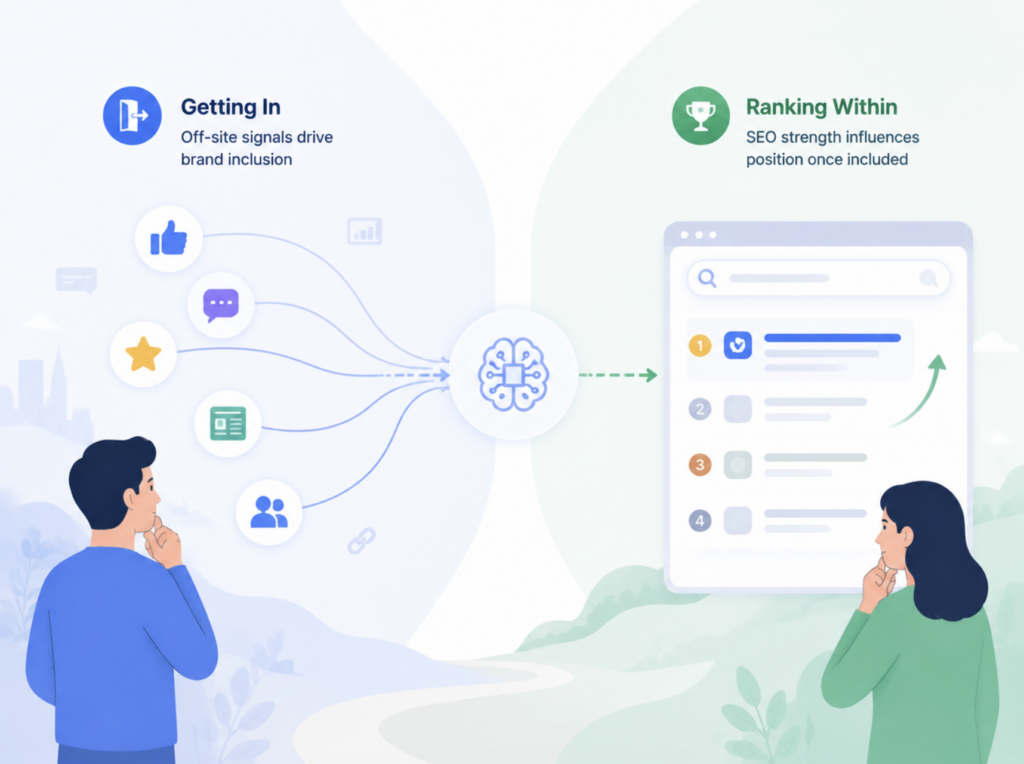
Ahrefs’ analysis of 75,000 brands put numbers on it. Branded web mentions correlated with AI Overview visibility at 0.664, branded anchors at 0.527, and brand search volume at 0.392, while referring domains, the classic backlink metric, came in at 0.218. Brands in the top quartile of web mentions earned up to 10 times more AI Overview mentions than the next quartile.
Which means a rank tracker that collapses everything into one visibility score is measuring two different systems and reporting one number.
That’s the number that tells you something dropped and nothing about what.
What Your GEO Rank Tracker Needs to Finish the Diagnosis
Walking this decision tree requires five data layers. Most tools ship two or three.
- Prompt-level position history, not just an aggregate score, so you can separate one bad prompt from a systemic slide.
- Cited source domains and URLs, tracked over time, so Branch 1 becomes a lookup instead of a guess.
- Competitor position on the same prompts, so Branch 2 is answerable without manual re-runs.
- Multi-engine coverage on a shared timeline, so Branch 3 is provable by cross-reference.
- Sentiment and descriptor tracking, so Branch 4 shows up before it becomes a positioning problem.
Topify was built around that structure rather than around a single score. It monitors brand performance across major AI platforms through seven metrics covering visibility, sentiment, position, volume, mentions, intent, and CVR, and its citation analysis reverse-engineers the exact domains and URLs each platform pulls from.
In practice, that turns a Monday morning alert into a ten-minute triage. You see the position drop, open the source view, and find that a comparison page which had been citing you for months now cites two competitors instead. That’s Branch 1 with a named target, not a hypothesis.
Engine coverage matters as much as depth, since Branch 3 can’t be ruled out from inside a single platform. Tracking spans ChatGPT, Gemini, Perplexity, DeepSeek, Doubao, Qwen, and others, so a platform-level shift is distinguishable from a brand-level one on the same chart.
The Repair Order After a GEO Rank Drop
Branch determines both the fix and the realistic timeline.
| Branch | What to do | What not to do |
|---|---|---|
| Citation loss | Rebuild the specific lost source, or earn an equivalent third-party placement | Rewrite unrelated pages |
| Competitor gain | Study what got the competitor cited, then contest that source set | Publish more of what already isn’t working |
| Platform change | Reset the baseline, document the date, keep executing | Launch an emergency content sprint |
| Framing drift | Correct the narrative at the source level through reviews, comparisons, and earned coverage | Add schema and hope |
Two rules worth holding across all four. Don’t optimize for one engine when your audience uses several, and don’t treat a week of data as a trend when the baseline churn is this high. If you want a working setup, start with a tracked prompt setof 30 to 50 real buyer questions, sample them on a fixed cadence, and let a full month accumulate before you call anything a drop.
Conclusion
A falling number in your GEO rank tracker isn’t a content problem. It’s an attribution problem, and it stays unsolvable as long as your tooling reports a single score instead of the layers underneath it.
Run the gates first. Confirm the drop survives sampling, persistence, and scope. Then walk the four branches in order, cheapest diagnosis first, and fix only what the data points at. Teams that do this spend their sprints on the one branch that’s actually broken. Teams that don’t spend them rewriting pages that were never the reason.
FAQ
Q: Why did my GEO rank drop overnight when nothing changed on my site?
A: Overnight movement across many unrelated prompts on a single engine usually points to a platform change rather than anything on your end. Default model swaps have measurably reduced how many sources get cited per response, which lowers everyone’s numbers at once. Check whether your other tracked engines held steady on the same date before you touch anything.
Q: How often should I check a GEO rank tracker?
A: Continuously for data collection, but weekly or biweekly for decisions. With roughly two-thirds of cited URLs rotating within a 28-day window, daily readings mostly capture noise. Set an alert threshold that requires the change to persist across consecutive sampling windows.
Q: Is a GEO rank tracker different from an SEO rank tracker?
A: The output looks similar and the mechanics aren’t. SEO rank tracking reads a stable index where the same URLs hold the same positions for weeks. GEO rank tracking samples a probabilistic system, so position has to be measured as a rate across repeated runs, and it has to be paired with citation-source data to be diagnosable.
Q: Can I recover a lost AI citation?
A: Sometimes directly, more often by substitution. If the source that cited you still exists and simply updated its content, an outreach or refresh path may work. If it’s gone, the practical route is earning a comparable third-party mention, since off-site brand mentions correlate far more strongly with AI visibility than backlinks do.

