

Your blog post ranks third on Google for a high-intent buyer keyword. Organic traffic is steady. Then a prospect types the same question into ChatGPT and gets a five-brand recommendation. Your brand isn’t on it.
That’s not a ranking failure. It’s a content format failure. In mid-2025, roughly 76% of URLs cited in AI Overviews also ranked in the organic top 10. By February 2026, that overlap collapsed to 38%. The signals that earn a Google ranking and the signals that earn an LLM citation are splitting apart, and most content teams are still writing for only one side.
The gap has a name: the Invisibility Gap. And closing it starts with how you structure your content.
Google Rewards Keywords. LLMs Reward Clarity.
Traditional SEO content follows a familiar formula: match the keyword, build backlinks, optimize meta tags, and climb the SERP. That formula still works for Google. It doesn’t work for the retrieval systems powering ChatGPT, Perplexity, and Gemini.
Here’s the difference. Google’s algorithm ranks pages. LLMs extract passages. When a generative engine receives a query, it doesn’t return a list of links. It runs a Retrieval-Augmented Generation (RAG) pipeline that converts the query into a vector, searches a live index, pulls 200 to 500 candidate URLs, scores individual passages for factual density and entity clarity, and then synthesizes a single answer from the top-scoring chunks.
Google’s AI Overviews, for example, narrow approximately 500 candidate pages down to 5 to 15 cited URLs. The selection criteria aren’t page-level authority metrics like Domain Rating. They’re passage-level qualities: semantic completeness, verifiable claims, and clear entity definitions.
That changes what “good content” looks like.
| Dimension | Traditional SEO Content | GEO-Optimized Content |
|---|---|---|
| Primary Goal | Rank in top 10 links | Earn inline citations |
| Core Logic | Keyword density + backlinks | Factual density + structure |
| User Behavior | Click-through to website | Synthesized answer in interface |
| Success Measure | CTR and organic traffic | Visibility Score and Sentiment |
The practical implication: a page ranking at position 50 can still get cited in an AI Overview if it contains a highly specific, factual answer that top-ranking pages lack. Position doesn’t guarantee citation. Content quality at the passage level does.
The Information Gain Problem: Why Most Content Gets Ignored
The single biggest factor separating cited content from ignored content in 2026 is Information Gain, the measure of genuinely new, unique, and verifiable insight that a piece of content adds to what already exists on the web.
LLMs are trained on (or retrieve from) massive text corpora. When your content says roughly the same thing as the other 30 articles on the topic, the model has no reason to cite yours specifically. It absorbs the information and attributes it to nobody.
Research from Princeton University, Georgia Tech, and the Allen Institute for AI, published at the 2024 ACM SIGKDD conference, quantified this effect. Their findings show that adding expert quotations to content increases AI visibility by 41%. Including original statistics provides a 32% boost. Citing authoritative third-party sources lifts visibility by 30%.
The “5-to-7 Rule” offers a practical benchmark: competitive content in 2026 needs five to seven distinct, original, attributable insights to have a realistic shot at citation. An “insight” means something specific enough to be quoted, like a proprietary data point, a coined framework, or an expert opinion that the LLM couldn’t have generated from its own training data.
Content that merely rephrases existing information scores low on Information Gain and gets absorbed. Content that introduces new data points becomes citable.
Four Pillars of Content That LLMs Actually Extract
LLMs don’t read content the way humans do. They parse it for machine-readable signals and extractable facts. Writing for both audiences requires a framework that bridges human readability with machine retrieval.
Pillar 1: Answer-First Architecture
Generative engines favor content that addresses the query directly in the opening section. The practical rule: lead every H2 with a 40 to 60 word “atomic” answer that directly responds to the question the heading implies.
This gives the RAG system a high-confidence snippet it can extract and serve as a direct response, with your URL as the cited source. Pages that bury the answer under three paragraphs of context lose to pages that lead with it.
Pillar 2: Entity Clarity Through Structure
Every section needs clear subject-verb-object (SVO) structures. LLMs use these to map “triples” into their knowledge graphs. Instead of writing “it provides better results,” write “[Product Name] increases [Metric] by [Percentage].”
Proper semantic HTML matters here too. Content with a clear H1-to-H4 hierarchy has a 40% higher parsing probability than flat, unstructured text. The model needs to understand what each section is about before it can decide whether to cite it.
Pillar 3: Third-Party Consensus
AI models trust external sources more than brand-owned content. The data is stark: earned media like Reddit threads, industry publications, and G2 reviews are cited at a rate of 72% to 92% in branded queries. Brand-owned blog content? Less than 27%.
That doesn’t mean your blog doesn’t matter. It means your blog alone isn’t enough.
The “Consensus Signal” triggers when an AI scans multiple independent sources and finds agreement. If your product is consistently described the same way across Reddit, YouTube, G2, and industry forums, the AI gains the confidence to recommend it. Your blog provides the canonical definition. External sources provide the validation.
Pillar 4: Freshness and Verifiability
Generative engines show a significant bias toward recent information. Content updated within the last 30 days is 3.2 times more likely to be cited than stale content. For Google AI Overviews, the highest citation rates appear for content between 30 and 89 days old.
This means core evergreen pages need to become “living documents,” refreshed every two to four weeks with new statistics, recent developments, and updated dateModified schema timestamps.
How to Rewrite Existing Content for AI Visibility
You don’t need to start from scratch. The highest-ROI move is auditing and restructuring content you already have. Here’s the process.
Step 1: Identify high-value pages. Start with pages that already rank on Google but aren’t being cited by AI. These have proven topical relevance. They just need structural upgrades to become citable.
Step 2: Add atomic answers. For each H2, write a 40 to 60 word direct answer to the question the heading implies. Place it immediately under the heading, before any context or background.
Step 3: Inject original data. Every section needs at least one verifiable, specific claim. Proprietary survey results, original benchmarks, or expert quotes all qualify. Generic statements like “many companies are adopting AI” don’t.
Step 4: Implement technical signals. Add FAQ, HowTo, or Product schema markup. Implementing these structured data types increases citation likelihood by 28% to 40%. Product schema alone drives a 73% higher selection rate in AI retrieval pipelines.
Step 5: Refresh consistently. Set a 14 to 30 day update cadence for your highest-priority pages. Even small additions, like a new statistic or an updated comparison, signal freshness to AI crawlers.
One pattern worth watching: YouTube’s share of social citations has doubled from 19% to 39% as models like Gemini prioritize multi-modal content. If you’re producing blog content on a topic, a companion video with an SEO-optimized transcript extends your citation surface into a channel most competitors are ignoring.
AI Visibility Tracking: Measuring Whether Your GEO Content Works
Traditional analytics can’t tell you whether AI is citing your content. Google Analytics tracks clicks. Search Console tracks rankings. Neither tracks whether ChatGPT mentioned your brand in a recommendation, or what Perplexity said about your pricing.
That’s the gap ai visibility tracking fills.
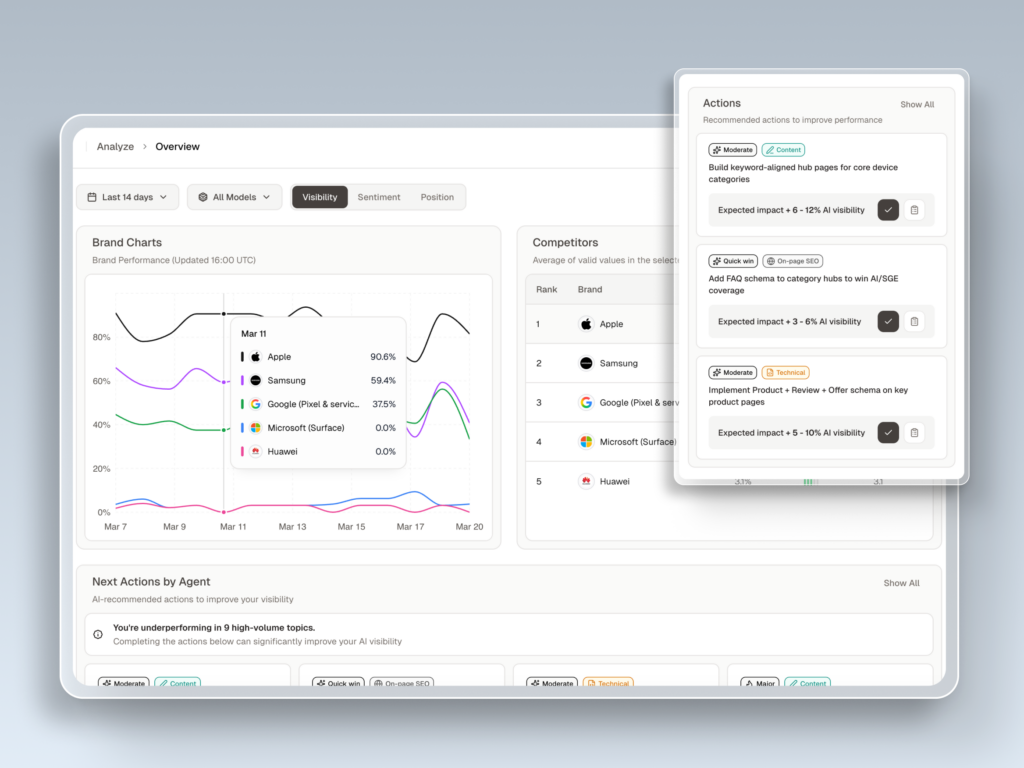
The core framework for measuring GEO content performance includes seven metrics. Visibility Score measures how often your brand appears across a universe of relevant prompts, with a 2026 benchmark of 60% or above for core categories. Recommendation Position tracks where you land in the AI’s response, since being first carries an implicit endorsement that third or fourth position lacks. Sentiment Velocity catches shifts in how the AI describes your brand before they compound into reputation problems. Source Citations reverse-engineer the specific URLs influencing the AI’s opinion. Conversion Visibility Rate estimates the economic value of each mention. Entity Confidence measures how accurately the AI distinguishes your brand from competitors. And Hallucination Monitoring alerts you when an LLM fabricates false claims.
For content teams running a GEO content strategy, the most actionable loop connects Source Citations back to content decisions. If you discover that Perplexity cites a competitor’s blog post in 40% of relevant answers, you know exactly what content gap to close. If your own article is being cited but with negative sentiment, you know which page to rewrite.
Topify runs this loop across ChatGPT, Gemini, Perplexity, DeepSeek, and other major platforms. It tracks all seven metrics in a unified dashboard, surfaces competitor positioning in real time, and continuously identifies new high-value prompts as AI recommendation patterns shift. For teams that need to connect GEO content output to measurable visibility changes, Topify’s Source Analysis traces which specific URLs the AI is citing, so you can validate whether a content rewrite actually moved the needle.
The economics reinforce the investment. AI search traffic converts at an average rate of 14.2%, compared to 2.8% for traditional organic search. That’s a 5x advantage, which means even modest improvements in ai visibility tracking metrics translate to outsized revenue impact.
Three Mistakes That Quietly Kill AI Visibility
Mistake 1: Treating Google Rankings as a Proxy for AI Citations
The overlap between organic rankings and AI citations dropped from 76% to 38% in less than a year. Teams that only monitor SERP positions are watching half the screen while the other half decides their market share. AI visibility requires its own measurement stack.
Mistake 2: Scaling Content with AI Without Adding Information Gain
Using LLMs to generate content at scale sounds efficient until every article reads like a reworded version of the same five sources. Models recognize content with low Information Gain and deprioritize it during retrieval. The fix isn’t to stop using AI for drafting. It’s to ensure every piece includes original data, expert perspectives, or proprietary frameworks that the model couldn’t have written on its own.
Mistake 3: Checking AI Visibility Once and Forgetting About It
AI responses are probabilistic. The same prompt can return different brands depending on model updates, data refreshes, and retrieval architecture changes. A single audit tells you where you stood on one day. Continuous ai visibility tracking tells you where you’re trending, and that trend line is what drives strategy.
Conclusion
The content that earns AI citations in 2026 isn’t fundamentally different from good content. It’s specific, structured, verifiable, and fresh. The difference is that traditional SEO let you get away with being vague. Generative engines don’t.
The framework comes down to three moves: write with answer-first architecture and original data so LLMs can extract and cite your content, build third-party consensus so the AI trusts what you’re saying, and track visibility across AI platforms so you know whether it’s working. The brands closing the Invisibility Gap aren’t doing anything mysterious. They’re just measuring what most teams still can’t see.
FAQ
Q: What’s the difference between SEO content and GEO content?
A: SEO content is optimized for page-level ranking signals like keywords and backlinks. GEO content is optimized for passage-level extraction by LLMs, focusing on factual density, clear entity definitions, and answer-first structure. The best content does both, but the optimization targets are different.
Q: How do I know if my content is being cited by AI?
A: You can’t tell from traditional analytics. You need a dedicated ai visibility tracking platform that monitors your brand’s appearance across AI search engines like ChatGPT, Perplexity, and Gemini. Topify tracks citation sources, visibility scores, and sentiment across multiple AI platforms in real time.
Q: Does optimizing for LLMs hurt my Google rankings?
A: No. The structural improvements that make content citable by LLMs, such as clear headings, direct answers, schema markup, and fresh data, also tend to improve traditional SEO performance. The two strategies are complementary, not competing.
Q: How often should I track AI visibility?
A: Weekly at minimum. AI responses are non-deterministic, meaning the same prompt can return different results across sessions. Continuous tracking establishes a statistical baseline and catches visibility drops before they compound.

