


Your domain authority is solid and your keyword rankings haven’t slipped. But when a prospect asks ChatGPT which vendor to pick in your category, you have no idea whether your name comes up. That blind spot has a name now: GEO score. It’s the number that tells you whether AI systems can even reach your site, let alone recommend it. Checking it takes about a minute, and it explains more about your AI visibility than any keyword report ever will.
What a GEO Score Actually Measures
A GEO score is a composite number, usually 0 to 100, that reflects whether generative AI platforms like ChatGPT, Perplexity, and Gemini can crawl, understand, trust, and ultimately recommend your website. It’s not a rebrand of your SEO ranking. SEO measures where you sit on a results page. A GEO score measures whether you show up inside an AI-generated answer at all, which is a different mechanism entirely.
That gap matters more than most teams realize. Only 22% of B2B marketers currently track AI visibility in any structured way. Everyone else is optimizing for a channel they can’t measure, which is exactly the position a GEO score is built to fix.
How to Check Your GEO Score for Free
Most people’s first move is Googling themselves, which tells you nothing about how AI systems see your site. The faster path is a purpose-built checker.
Here’s the actual process:
- Open Topify’s GEO Score Checker.
- Enter your domain or brand name. No account required.
- Wait about 60 seconds while it pulls your four dimension scores.
- Compare the four numbers to find your weakest one. That’s where you start fixing things, not with the overall score.
That last step matters. Two sites can land on the same overall score of 55 for completely different reasons, and the fix looks nothing alike in each case.
The Four Numbers Behind Your Score
| Score Dimension | What It Checks | Why It Matters |
|---|---|---|
| Bot Access | Whether AI crawlers like GPTBot, ClaudeBot, and PerplexityBot can actually reach your pages | If the bot can’t get in, nothing else on this list matters |
| Structured Data | Whether schema markup and JSON-LD make your content machine-readable | AI systems parse structure faster than they parse prose |
| Content Signals | Whether your content shows the depth and authority AI models weight when choosing a source | Signals like citations and statistics measurably change outcomes |
| Visibility Score | How often your brand actually appears across AI platforms today | This is the outcome the other three dimensions are trying to produce |
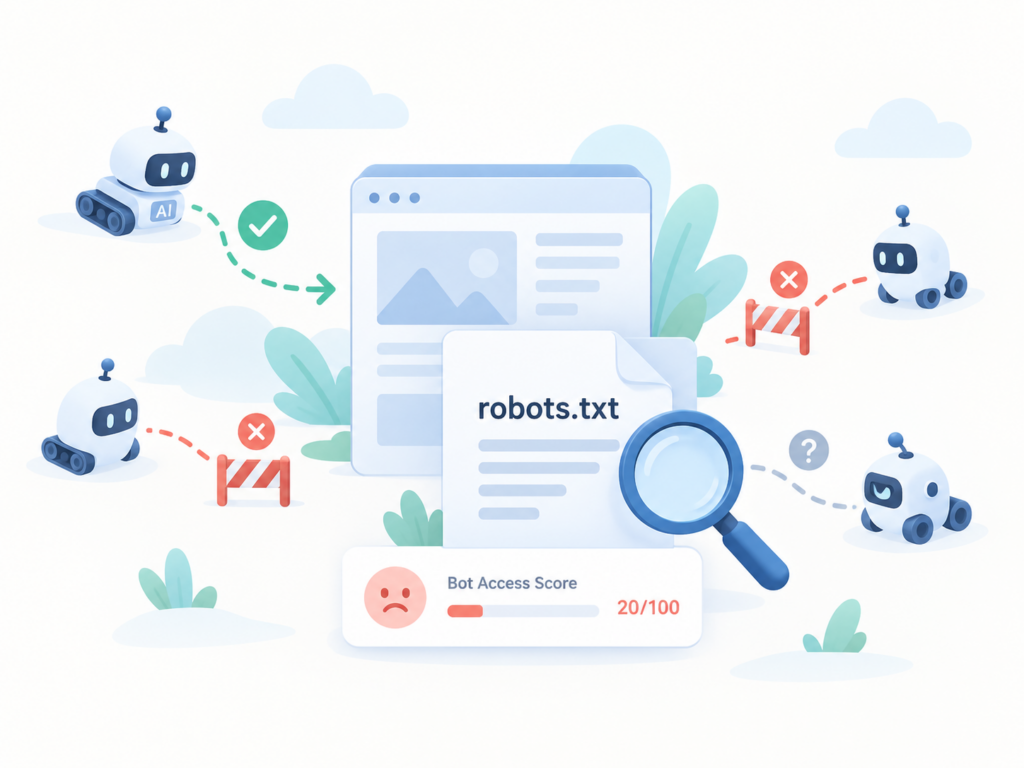
Bot Access turns out to be a more common failure point than teams expect. Roughly one in five top sites blocks at least one AI crawler in robots.txt, and a lot of that blocking is accidental collateral damage from a training opt-out rather than a deliberate decision. If your Bot Access score is low, check your robots.txt before you touch anything else.
Content Signals is where the research gets specific. A Princeton and Georgia Tech study found that adding statistics to a page improved AI visibility by 41%, and citing external sources lifted visibility by as much as 115% for lower-ranked content. That’s not a vague “write better content” recommendation. It’s a measurable lever tied directly to how the Content Signals dimension is scored.
Structured Data tends to get skipped because it’s invisible to a human reader. A page can read perfectly well and still score poorly here if there’s no schema markup telling an AI system what type of content it’s looking at, who wrote it, or when it was last updated. Visibility Score is the one metric that ties the other three together. It’s a direct read on how often your brand shows up when someone actually asks an AI platform a question in your category, which makes it the fastest way to tell whether fixes to the other three dimensions are working.
A Quick Scenario
Say your Bot Access score comes back at 35 while your Content Signals score sits at 78. That combination usually means the content itself is solid, well-structured, and citation-worthy, but a crawler is being turned away before it ever reads any of it. In that case, the fix isn’t a content rewrite. It’s a robots.txt audit. Running the same check for a site with the opposite pattern, high Bot Access and low Content Signals, points to a completely different fix: the crawler gets in fine, but the content it finds doesn’t give the AI system enough to work with. Same overall score, opposite root cause.
What Counts as a Good GEO Score
Score ranges give you a rough read on where you stand:
| Range | What It Means |
|---|---|
| 0 to 40 | Not visible. AI systems rarely surface or recommend you |
| 41 to 60 | Basic visibility, but competitors usually outrank you in AI answers |
| 61 to 80 | Solid visibility with room to close specific gaps |
| 81 to 100 | Strong visibility, AI systems recommend you with real consistency |
Here’s the caveat worth sitting with: there’s no single universal “good” score. What counts as strong depends on your prompt set, your market, and your competitor set, so the number is most useful as a baseline you track against itself over time, not a fixed target you chase in isolation.
A low score also isn’t proof your content is weak. It’s often a technical issue, a blocked crawler, missing schema, or thin structured data, sitting on top of content that’s actually fine.
That’s why the four-dimension breakdown matters more than the single overall number. Two brands can both land at 55, and one needs an engineering ticket while the other needs an editorial rewrite. Treating the overall score as the headline and the four dimensions as a footnote gets that priority backward.
Why a One-Time Score Isn’t the Full Picture
A GEO score is a snapshot, and the thing it’s measuring doesn’t hold still. Crawler access policies shift constantly. ClaudeBot, for example, has been the fastest-growing block target across sites in 2026, which means a site that scored well on Bot Access last quarter might not score the same way next quarter. Checking once tells you where you stood on the day you ran it. It doesn’t tell you which direction you’re moving.
That’s the gap Comprehensive GEO Analytics is built to close.
| Capability | Free GEO Score Checker | Topify Platform |
|---|---|---|
| Check frequency | One-time snapshot | Continuous monitoring |
| Dimensions tracked | 4 GEO scores | Full GEO analytics, plus sentiment and citation tracking |
| Historical trends | None | Full trend history with alerts |
| Competitor benchmarking | Not included | Real-time competitor tracking |
| Platform breakdown | Aggregated | Per-platform view across ChatGPT, Perplexity, Gemini, and AI Overviews |
The checker gives you a snapshot. The platform tracks the trajectory. If your team is past “are we visible at all” and into “are we gaining or losing ground against a specific competitor,” that’s the point where continuous tracking starts paying for itself. You can get started with Topify directly, and the pricing page lays out plans built around how much of that tracking your team actually needs.
Conclusion
A GEO score won’t tell you everything about your AI visibility, but it will tell you exactly where to look first. Run the free GEO Score Checker, find your weakest dimension, and fix that before you touch anything else. If the number keeps moving in the wrong direction between checks, that’s your signal to move from a one-time snapshot to ongoing tracking.
Frequently Asked Questions
What is a GEO score?
A GEO score is a 0 to 100 rating of how visible your brand is to generative AI platforms, based on four dimensions: bot access, structured data, content signals, and overall visibility. It’s produced by tools like the GEO Score Checker.
Is a GEO score the same as an SEO score?
No. SEO scores measure your position on a traditional search results page. A GEO score measures whether AI systems can crawl, understand, and cite your content inside a generated answer, which relies on a different set of technical and content signals.
How often should I check my GEO score?
Monthly is a reasonable starting cadence, since crawler access policies and AI citation patterns change often enough that a quarterly check can miss a real shift. Brands actively working on their GEO tend to check more frequently, which is usually when continuous monitoring makes more sense than repeated one-off checks.
What counts as a bad GEO score, and can it be fixed?
A score under 40 usually points to a fixable technical issue, most often a blocked AI crawler or missing structured data, rather than a content quality problem. Start by checking your robots.txt, since that single fix often moves the Bot Access dimension more than any content change would.

