

Your domain authority is 72. Your target keywords are ranking on page one. Traffic is up 18% quarter-over-quarter. Then a potential customer opens ChatGPT, types “best [your category] tool for mid-market companies,” and gets a confident list of five recommendations. Your brand isn’t on it.
That’s not an SEO failure. That’s a GEO visibility gap, and your current dashboards have no way to show it.
Your SEO Dashboard Is Green. ChatGPT Still Doesn’t Know You Exist.
Traditional SEO audits measure what Google’s algorithm values: backlinks, domain rating, page speed, and keyword density. Those signals still matter for Google. But generative engines like ChatGPT, Gemini, and Perplexity don’t use PageRank. They use Retrieval-Augmented Generation (RAG), pulling semantic chunks of content from the web, converting them into vector embeddings, and synthesizing a narrative response.
The selection logic is mathematical: when a user submits a prompt, the engine surfaces content that minimizes distance in a multi-dimensional semantic space. Visibility is a function of semantic relevance and factual density, not backlink volume.
This means a brand can rank first on Google and remain completely absent from AI-generated recommendations for the same category. Research suggests AI search now influences up to 73% of B2B buying journeys, yet most marketing teams are tracking zero metrics specific to it.
That’s the gap GEO analysis is built to close.
What GEO Analysis Actually Measures
GEO analysis is the systematic process of evaluating a brand’s presence, perception, and competitive standing inside generative AI responses. It’s not an extension of traditional SEO audit methodology. It’s a separate framework interrogating how AI models represent your brand.
A complete GEO analysis tracks seven dimensions:
Visibility (Share of Model): How often does your brand appear when users ask category-level questions? Share of Model (SoM) calculates this as a percentage of total possible recommendations across platforms. In the legal tech space, for example, one leading brand holds a 32.9% SoM on ChatGPT and 47.8% on Gemini, while competitors trail significantly.
Sentiment: A mention is only valuable if the framing is positive. AI responses that describe your brand as “expensive” or “suited for small teams” when you’re positioned as enterprise-grade are actively damaging. High-performing brands track a Net Sentiment Score (NSS) and target ratings above 80%.
Position: In AI answers, the first brand mentioned typically receives the most authoritative framing (“The industry leader is…”), while later mentions are framed as alternatives. GEO analysis tracks this ordinal ranking to understand perceived market hierarchy.
Citation Rate: When an AI cites a URL alongside a brand mention, it signals higher authority than an uncited mention. Optimized brands typically see citation rates between 20% and 50%. Unoptimized brands often sit below 10%.
Prompt Volume: Conversational AI search demand doesn’t map to traditional keyword volume. GEO analysis estimates how frequently users are actually asking specific prompts in tools like ChatGPT or Perplexity, separate from what Semrush or Ahrefs would show.
Source Domain Influence: AI doesn’t pull from the entire web equally. It relies on a retrieval set of trusted domains. Knowing which third-party sites shape the AI’s view of your brand tells you exactly where to invest your distribution and PR efforts.
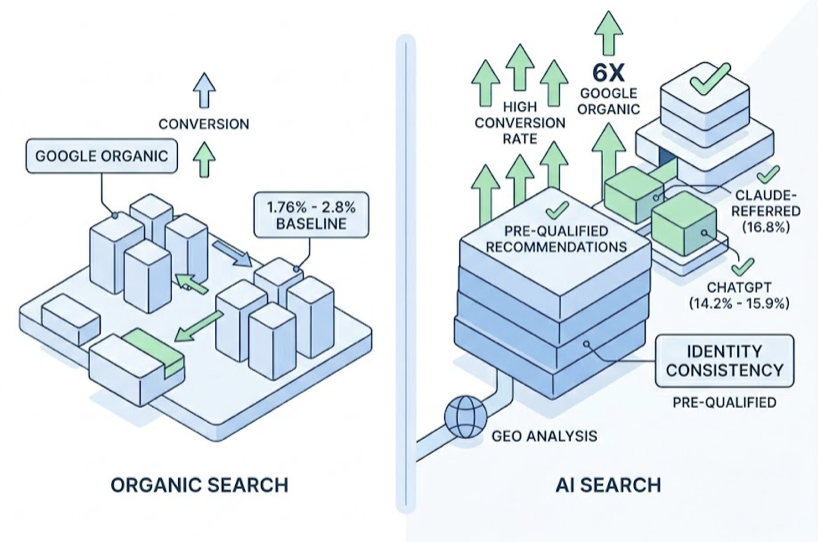
CVR (Conversion Visibility Rate): Traffic from AI search converts at dramatically higher rates than organic search, because the AI has already pre-qualified the recommendation. Claude-referred visitors convert at 16.8% (6x Google organic), ChatGPT at 14.2%-15.9%, and Perplexity at 10.5%-12.4%, compared to Google organic’s 1.76%-2.8% baseline. GEO analysis connects visibility to this conversion advantage.
How to Conduct a GEO Audit in 4 Steps
Step 1: Map Your Prompt Universe
A GEO audit starts with selecting 40-100 prompts that reflect how real buyers research your category. Cover three intent types: discovery (“What are the best [category] tools for mid-market?”), problem-solving (“How do I [specific workflow]?”), and comparison (“Brand A vs Brand B for [use case]”).
Without this mapping, you’re auditing a blank target. The prompt universe determines what the audit can actually tell you.
Step 2: Measure AI Search Visibility Across Platforms
Tracking one platform is a common audit failure. ChatGPT, Gemini, Perplexity, and Claude often return very different answers for the same prompt. Perplexity leans heavily on real-time news sources; Gemini integrates the Google Knowledge Graph. A meaningful AI search visibility analysis records mention rates, citation status, and position for every prompt on every platform.
This cross-platform view is where most single-dashboard solutions fall short.
Step 3: Run the Sentiment and Narrative Analysis
Does the AI accurately describe your value proposition? If your product is enterprise-grade but AI consistently describes it as “budget-friendly,” that’s a narrative misalignment that’s harder to fix than low visibility. This step also surfaces reputation risks: outdated pricing, discontinued features, or competitor comparisons that frame you unfavorably.
This is the difference between a GEO audit and a simple mention tracker.
Step 4: Source and Content Gap Audit
This is the most actionable part of any GEO audit. By analyzing the URLs an AI cites when discussing your category, you can identify exactly which third-party domains are shaping the model’s worldview. If competitors are being cited because of a specific industry report, a Reddit thread on a review platform, or a G2 category page you haven’t optimized, you now have a specific, executable content gap to close.
Brands that run this step systematically discover an average of 23 untapped prompt opportunities and 14 content gaps per audit cycle.
GEO Competitive Analysis: What AI Says About Your Competitors
GEO competitive analysis reveals a type of visibility gap traditional SEO can’t surface. If a competitor appears in 65% of relevant category queries while your brand appears in 8%, that deficit won’t show up anywhere in your existing analytics stack.
This happens because AI recommendation patterns are driven by “Entity Authority.” LLMs are trained to value consensus across multiple authoritative sources. If ten high-authority sites describe a competitor as the category leader, the model synthesizes that as a working truth. Reversing that requires either owning the same sources or introducing competing signals from equally authoritative domains.
The competitive intelligence from a GEO analysis is specific and actionable. You can see which sources your competitor dominates that you don’t. You can identify which prompt categories they’re winning that you’re not even present in. You can track whether their AI sentiment score is declining, which signals an opening.
That’s not a metric available in any traditional SEO tool.
How to Interpret Your GEO Visibility Scores
Raw GEO scores only matter in context. Here’s how to read the four key scenarios:
High visibility, low sentiment. The AI knows your brand but associates it with negatives. This is the “reputation risk” quadrant and it’s more dangerous than invisibility. The fix isn’t more content; it’s narrative correction through case studies, structured review content, and responses to specific misrepresentations in the sources the AI is pulling from.
High sentiment, low visibility. The AI has a favorable view but rarely surfaces you. You have a distribution problem, not a credibility problem. The fix is topical authority: creating content that answers the broad conversational questions in your category where you’re currently absent.
High citation frequency, low referral traffic. The AI is citing you, but users aren’t clicking. That’s often a zero-click pattern where the AI answer is comprehensive enough that users don’t need to visit your site. The fix is creating high-utility assets the AI can’t summarize: downloadable templates, calculators, or raw datasets.
Low across the board. This is the starting point for most brands running their first GEO audit. Prioritize prompt universe coverage first, then citation rate, then sentiment. Don’t try to fix everything simultaneously.
5 Content Tactics That Directly Improve GEO Performance Metrics
Research from Princeton and Georgia Tech identified specific tactics that measurably improve AI citation and mention rates. The lift is significant enough to treat these as strategic priorities, not stylistic preferences.
Adding statistics and original data increases AI visibility by 33.9% to 40%. AI models can’t generate original data; they synthesize it. Content with specific numbers, dates, and sourced claims is substantially more “citable” than content with qualitative descriptions.
Including quotes from recognized industry experts boosts visibility by 22.3% to 32%. These quotes give AI models synthesizable fragments they can use to add authority to generated summaries.
Citing authoritative external sources within your own content improves visibility by over 30%. It signals to the AI that your content is part of a verified information ecosystem, not an isolated claim.
Improving fluency (shorter sentences, active voice, cleaner structure) lifts visibility by approximately 30%. AI chunking algorithms favor passages they can extract cleanly.
Adding structured data (JSON-LD schema for Organization, Product, FAQ, and Person) can improve explicit brand mentions by up to 139%. Schema acts as a direct signal to AI knowledge graphs, providing context that reduces ambiguity about what your brand is and does.
One often-overlooked technical issue: many brands are inadvertently blocking AI crawlers through default firewall settings. One SaaS company saw a 217% increase in AI citations within 30 days simply by adjusting Cloudflare settings that were blocking GPTBot by default. A technical GEO audit should always verify bot accessibility via robots.txt before drawing conclusions about content performance.
From GEO Analysis to Action: Turning Data into a Content Strategy
The output of a GEO analysis is only useful if it connects to a content roadmap. Here’s how to translate each finding into a specific action:
Low visibility on discovery prompts means creating pillar content that directly answers category-level questions. Low citation rate means producing original research, statistics, or structured comparison tables that give AI models something specific to attribute. Sentiment misalignment means targeting the exact sources the AI is pulling from and seeding corrective content there. Source gaps mean getting your brand into the third-party domains that matter for your category, whether that’s industry roundups, review platforms, or vertical publications.
That’s how GEO analysis turns from a diagnostic into a content priority framework.
GEO Analysis Needs a Tool, Not a Spreadsheet
Between 40% and 60% of sources cited by AI change from month to month. That means a one-time GEO audit has a shelf life measured in weeks, not quarters.
Manually tracking 40-100 prompts across four AI platforms every month isn’t realistic for any marketing team. The personalization problem compounds this: AI responses vary based on user history, which means manual spot-checks introduce bias. Professional tools use incognito instances to ensure consistent, comparable data over time.
Topify is built specifically for this use case. It maps a complete GEO analytics stack across ChatGPT, Gemini, Perplexity, DeepSeek, and other major AI platforms, tracking Visibility, Sentiment, Position, Volume, CVR, and Source data in a single dashboard.
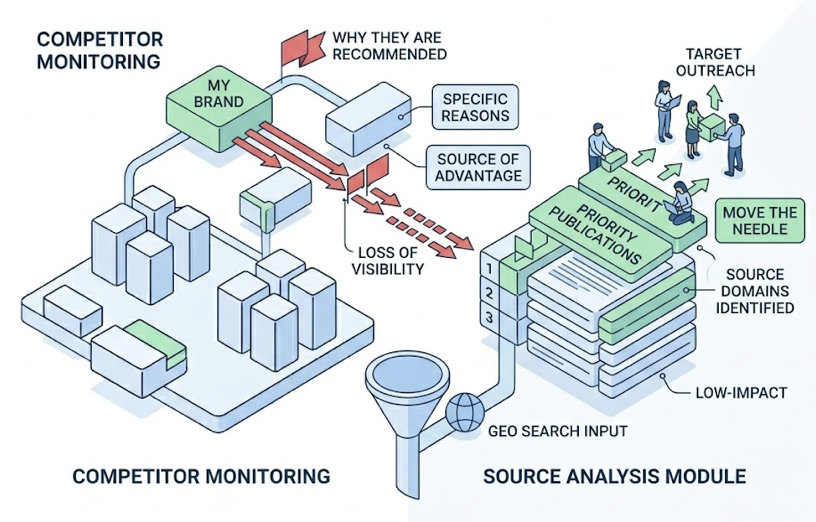
For teams running competitive GEO analysis, Topify’s Competitor Monitoring automatically detects when and why competitors are being recommended instead of your brand, and which specific sources are driving that advantage. The Source Analysis module identifies the domains the AI is pulling from in your category, so your PR and content teams can prioritize outreach to the publications that actually move the needle in AI search.
For agencies and brand managers who need to report GEO performance to stakeholders, Topify generates AI brand visibility reports that pull together cross-platform metrics into a shareable format, without manual data assembly.
The Basic plan starts at $99/mo and covers 100 prompts across 4 projects. For teams running multi-client or multi-brand audits, the Pro plan ($199/mo) supports 250 prompts and 8 projects. You can get started here.
Conclusion
The brands that will lead in AI search over the next three years aren’t waiting for a standardized GEO playbook. They’re building systematic analysis habits now, while most competitors are still measuring AI performance with tools designed for a different era.
GEO analysis gives you a clear map: where you’re visible, where you’re missing, what AI actually says about you, and which competitors are winning the recommendations you should own. That map exists whether you look at it or not. The question is whether you’re using it to make decisions.
FAQ
Q: How is GEO analysis different from a traditional SEO audit?
A: A traditional SEO audit evaluates technical performance, backlink profiles, and keyword rankings in Google’s index. GEO analysis evaluates how AI engines represent your brand in synthesized responses, measuring prompt-level visibility, citation rates, sentiment framing, and competitive position in AI-generated answers. The two frameworks measure fundamentally different systems and neither can substitute for the other.
Q: How often should you run a GEO analysis?
A: Monthly is the recommended baseline. Because AI citation patterns are probabilistic and between 40% and 60% of cited sources rotate from month to month, data older than 30 days can underrepresent current conditions. Brands in highly competitive categories may benefit from weekly tracking to catch significant shifts in Share of Model.
Q: What’s the minimum number of prompts needed for a meaningful GEO audit?
A: A representative audit typically requires 40-100 prompts covering discovery, problem-solving, and comparison intent types. Fewer than 40 prompts tends to produce uneven coverage, missing entire intent categories where the brand may be invisible or where competitors are consistently recommended.
Q: How do I measure sentiment in AI search results through GEO analysis?
A: Sentiment analysis in GEO evaluates the adjectives, framing, and context an AI uses when describing your brand. A structured approach tracks whether the language is endorsing, neutral, or framing your brand negatively relative to competitors. Platforms like Topify calculate a Net Sentiment Score (NSS) on a 0-100 scale, which lets you benchmark sentiment performance over time and against category competitors.

