

Open any list of GEO trackers and you’ll see the same promise a dozen times: track your brand’s visibility across AI search. The pitch sounds identical. What’s underneath isn’t. Some tools only watch ChatGPT. Others report whether you got mentioned but never explain which source taught the model to recommend a competitor instead. And AI engines keep shifting their citation patterns every few weeks, so last month’s snapshot is already stale.
The hard part isn’t finding a generative engine optimization tracker. It’s telling which one measures what actually moves your share of AI answers.
Most Generative Engine Optimization Trackers Watch One Engine. That’s the Trap.
The market has split into two camps. Legacy SEO suites bolt an “AI visibility” module onto an existing dashboard, and many of them still can’t reliably tell an LLM synthesis apart from an old featured snippet. Dedicated GEO platforms go the other way, specializing in citation analysis and sentiment across fragmented chat and search environments.
The problem with most single-engine trackers is that AI discovery doesn’t live in one place. A brand can dominate Perplexity and stay invisible in Gemini, because each model treats source attribution differently and pulls from a different information hierarchy.
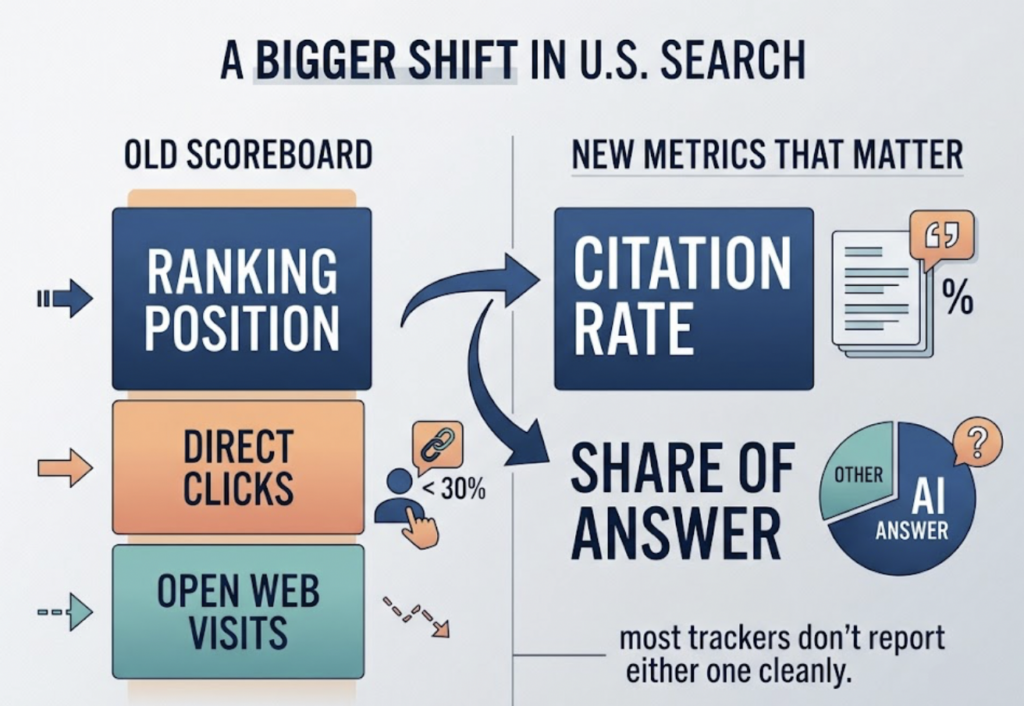
There’s a bigger shift underneath all of this. Fewer than 30% of U.S. searches now end in a direct click to the open web, which means an AI answer is often the only impression a buyer ever forms of your category. Ranking position stopped being the scoreboard. The metrics that matter now are citation rate and share of answer, and most trackers don’t report either one cleanly.
That’s the gap most brands still can’t see.
What a Real Generative Engine Optimization Tracker Has to Measure
Before ranking anything, it helps to agree on the scoring axis. A tracker worth paying for has to cover six things, not one.
Engine coverage breadth. Does it watch both browser-based AI search like Perplexity and Google AI Overviews, and chat-native interfaces like ChatGPT, Claude, and Gemini? Coverage gaps hide problems.
Citation velocity and quality. Not just whether you’re mentioned, but where in the response and why. The useful part is reverse-engineering the semantic patterns that led to the citation in the first place.
Competitor benchmarking. Your share of answer only means something next to rivals, measured topic cluster by topic cluster.
Sentiment and positioning. Tone matters. There’s a real difference between an AI calling you a category leader and calling you a budget alternative.
Actionable execution. Good generative engine optimization metrics tell you the score. A good tool also tells you how to rewrite a page so it’s more likely to get cited next time.
Direct attribution. Can it link AI-referred traffic to pipeline and revenue, not just session counts?
Here’s the thing. Most comparison lists rank tools on a single vanity number. The six pillars above are how you separate a real generative engine optimization tracker from a dashboard that just counts mentions.
The 7 Generative Engine Optimization GEO Trackers at a Glance
The 2026 market for GEO tools is crowded, so this list focuses on platforms with genuine feature depth across those six pillars. Here’s how the seven generative engine optimization GEO trackers compare at a glance.
| Tool | Engine coverage | Core strength | Competitor benchmarking | Citation analysis | Built for |
|---|---|---|---|---|---|
| Topify | ChatGPT, Gemini, Perplexity, DeepSeek, Doubao, Qwen | Full-funnel GEO analytics | Yes, real-time | Yes, source-level | Full-stack teams and enterprise |
| AthenaHQ | Multi-engine | Monitoring-to-execution workflow | Yes | Partial | Mid-to-large teams |
| Rankscale AI | Broad multi-engine | Cross-platform visibility | Yes | Limited | Agencies |
| Semrush AI Toolkit | Major engines | SEO suite integration | Yes | Partial | Existing SEO teams |
| Hall | LLM chat interfaces | Real-time mention alerts | Limited | No | Brand monitoring teams |
| Answer Socrates | Search-intent focused | Keyword and cluster discovery | No | No | Content marketers |
| Mangools AI Grader | Snapshot coverage | Entry-level visibility score | No | No | SMBs and solo founders |
The pattern is clear once you line them up. A few tools cover the full lifecycle, most cover one slice of it well, and entry-level options give you a baseline reading and little else.
Topify: Full-Funnel Generative Engine Optimization Tracking
Topify lands at the top here because it’s built around the whole GEO lifecycle, not a single metric. Where most trackers stop at “you were mentioned,” it reports across seven dimensions in one view: visibility, sentiment, position, volume, mentions, intent, and CVR.
That combination matters in practice. You can spot a drop in ChatGPT mentions, trace it to a specific source domain that stopped citing your brand, and check whether your position slipped in Perplexity at the same time, all without switching tabs.
Coverage is the second reason it ranks first. Topify tracks brand presence across ChatGPT, Gemini, Perplexity, DeepSeek, Doubao, and Qwen, which covers both the Western and Asian engines where most teams have blind spots. Single-engine tools simply can’t see a Gemini-versus-Perplexity gap, because they’re only looking at one side of it.
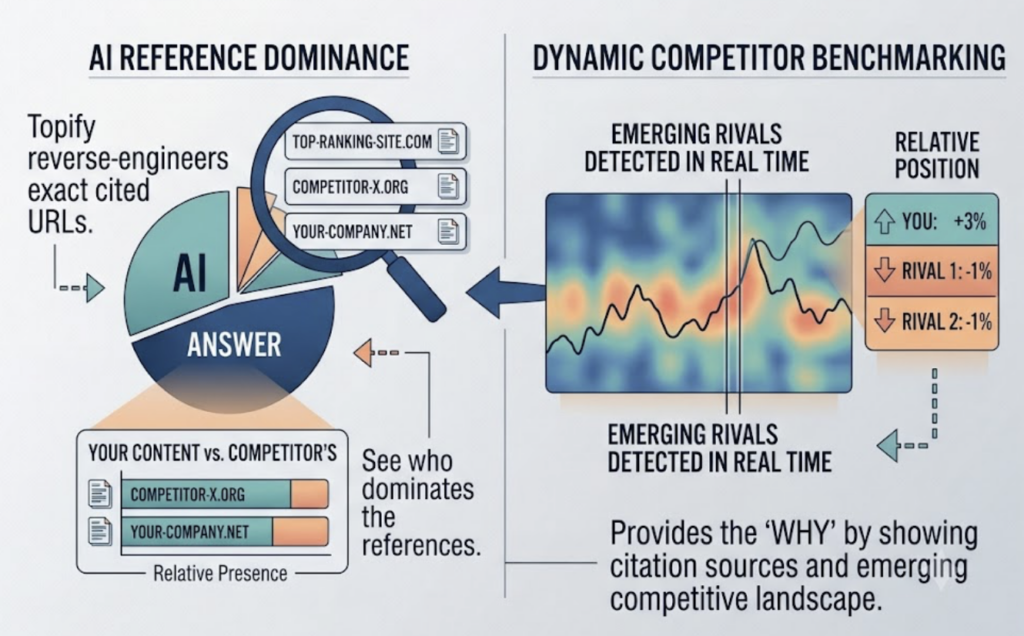
Then there’s the citation layer, which is where the depth shows. Topify reverse-engineers the exact domains and URLs that AI platforms cite, so you can see whether your content or a competitor’s dominates the references behind an answer. Pair that with dynamic competitor benchmarking, which detects emerging rivals in real time and shows your relative position, and you get the “why,” not just the “what.”
Most tools stop at data. Topify adds one-click execution on top of the analytics. You state a goal in plain English, review the proposed GEO strategy, and deploy it without building a manual workflow. For a marketing lead who’s tired of exporting numbers into a separate content brief, that closes the loop between insight and action.
On price, plans start at $99/mo for the Basic tier with a 30-day trial, $199/mo for Pro, and from $499/mo for Enterprise with a dedicated account manager. The usage-based structure is designed around how teams actually scale, so you can start small and expand as the value gets obvious. If you want to see your own numbers first, you can get started with Topify on the trial before committing.
Who it’s not for: a solo founder who only needs a quick monthly visibility reading will find the seven-metric depth more than they’ll use. That’s a fit problem, not a flaw.
How the Other GEO Trackers Stack Up
Each of the remaining tools earns its place for a specific use case.
AthenaHQ is the closest peer on lifecycle coverage. It’s built for the monitoring-to-execution path and works well for mid-to-large teams that want an end-to-end GEO workflow without assembling one from parts.
Rankscale AI leans into broad cross-platform visibility, which makes it a sensible pick for agencies juggling many client brands at once. Its strength is breadth of engine coverage more than citation depth.
Semrush AI Toolkit is the natural choice if your team already lives inside Semrush. It extends share-of-answer and sentiment reporting into AI models while keeping your existing SEO reporting in one place, so you avoid spinning up a separate data silo.
Hall focuses on real-time LLM mention monitoring. For a brand team that mainly wants fast alerts when AI tools start talking about them differently, it does that job cleanly, though it’s lighter on competitor and citation analysis.
Answer Socrates isn’t a full tracker so much as a discovery tool. It’s genuinely useful for content marketers mapping cluster-level intent and finding the prompts worth optimizing for before they invest in monitoring.
Mangools AI Grader is the entry point. It gives SMBs and founders a basic visibility score to establish a baseline, which is a reasonable first step before committing to enterprise-grade spend.
How to Pick a Generative Engine Optimization Tracker for Your Stack
The right tool depends less on the leaderboard and more on what your team already does.
If you’re an SEO-heavy team, staying inside the Semrush AI Toolkit usually beats adding a fragmented data source, since you keep your workflows intact. If you’re a first-mover brand that needs granular citation analysis and execution in one place, Topify or AthenaHQ are the platforms built for that non-linear search reality. And if you’re resource-constrained, start with Mangools AI Grader for a baseline, layer in Answer Socrates to understand your clusters, then graduate to a full tracker once the spend is justified.
The mistake to avoid is buying on engine count alone. A tracker that watches six engines but never tells you why you lost a citation leaves you exactly where you started, just with more charts.
Conclusion
GEO and SEO are now different disciplines, and the tool you choose should reflect that. The trackers that matter in 2026 don’t just confirm you exist in an AI answer. They tell you where you sit, why, against whom, and what to change next.
Map your needs to the six pillars first, then pick the platform that covers the ones you’re weakest on. If full-funnel coverage and source-level citation analysis are the gaps, that’s where a generative engine optimization tracker like Topify earns its slot. Run a real query on your own brand before you decide. The data usually settles the debate faster than another comparison table will.
FAQ
Q: What is a generative engine optimization tracker?
A: It’s a tool that monitors how AI engines like ChatGPT, Perplexity, and Gemini mention, cite, and position your brand in their answers. Unlike a traditional rank tracker, it measures share of answer and citation rate instead of blue-link position.
Q: What are the best generative engine optimization GEO trackers in 2026?
A: It depends on your stack. Full-funnel platforms like Topify and AthenaHQ suit teams that need citation analysis plus execution, Semrush AI Toolkit fits SEO-heavy teams, and Mangools AI Grader works as an entry-level baseline. Match the tool to the six pillars your team is weakest on.
Q: Why isn’t Google ranking enough to measure AI visibility?
A: Because fewer than 30% of U.S. searches now end in a click to the open web, and AI engines synthesize answers from sources differently than Google ranks pages. You can rank well on Google and still be absent from the AI answer a buyer actually reads.
Q: How often should I check my AI search visibility?
A: AI engines update citation patterns every few weeks, so monthly snapshots tend to lag reality. Real-time or weekly monitoring catches drops while you can still trace and fix the cause.

