

Your domain authority is strong. Your keyword rankings are solid. Your organic traffic has been climbing for three years. Then someone on your team types your core product category into ChatGPT and gets back a confident, detailed answer recommending four vendors. You’re not one of them.
That’s not a content quality problem. It’s a visibility layer problem that traditional SEO wasn’t built to solve.
What Generative Engine Optimization Actually Is (And Why It Doesn’t Work Like SEO)
Generative Engine Optimization (GEO) is the practice of structuring your content so that AI search platforms actively select, cite, and incorporate it into their generated responses. It was formally defined in a 2024 research paper from Princeton University, Georgia Tech, the Allen Institute for AI, and IIT Delhi — the first large-scale academic study measuring how specific content characteristics influence AI citation behavior.
The core distinction from SEO: traditional search engines act as directories. They rank links and let users choose. Generative engines synthesize information from multiple sources and deliver a single composed answer. Your content either shapes that answer or it doesn’t appear at all.
The underlying architecture is Retrieval-Augmented Generation (RAG). When a user submits a query, the AI decomposes it into sub-queries, retrieves relevant passages from indexed content, extracts 256–512 token blocks, and synthesizes a response. You can fail at any stage: retrieved but not extracted, extracted but not cited, cited but buried at the end where it carries minimal weight.
This is why brands with high domain authority can be invisible in AI answers. The retrieval mechanism is semantic, not link-based. The authority signals are different. The content format requirements are different.
GEO vs SEO: Same Goal, Completely Different Rules
Most GEO content describes this distinction at a surface level. Here’s the version that actually changes how you work:
| Dimension | SEO | GEO |
|---|---|---|
| What you’re optimizing | Page ranking in a list | Inclusion in a synthesized answer |
| Authority signals | Backlinks, domain authority | Factual density, expert citations, cross-platform consensus |
| Content format | Keyword-optimized copy | Structured, self-contained question-answer blocks |
| Measurement | Rankings, CTR, traffic | AI mention rate, sentiment polarity, citation position |
| Timeline | Weeks to months | 60–90 days for measurable citation shift |
| Zero-click impact | Moderate | Severe: 83% of searches end without a click when AI Overviews appear |
The Princeton-led research tested over 10,000 queries to measure what actually shifts citation rates. The finding that surprised most practitioners: keyword optimization has a slightly negative effect, reducing AI citation volume by around 8%. The signal AI engines prioritize is not keyword alignment. It’s information density.
That’s the gap most brands still can’t see.
The GEO Ranking Factors That Actually Influence AI Recommendations
The same research that benchmarked 10,000+ queries identified a clear, empirically tested hierarchy of what drives AI citations. These aren’t practitioner frameworks. They’re measured outcomes.
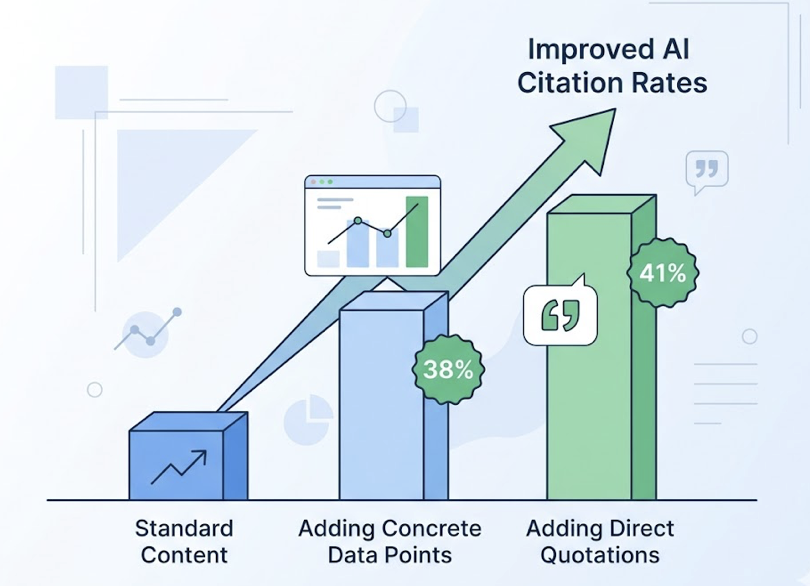
Statistics and quotations outperform everything else. Adding concrete data points to content improved AI citation rates by up to 38%. Adding direct quotations from recognized experts or primary sources pushed that number to 41%. LLMs assign higher attention weights to numerical tokens and cited authority during synthesis because they reduce the model’s internal uncertainty about factual accuracy.
Citing sources increases your own citation probability. When content includes outbound links to primary research, government data, or peer-reviewed studies, it signals to the AI that the document is a reliable conduit for information rather than an unsupported claim. This approach improved AI pickup rates by around 35% in controlled testing.
Topical authority beats breadth. AI engines don’t reward publishing volume. They reward publishing comprehensively on a narrow topic. A domain that covers 40 sub-questions around one concept consistently outperforms a domain that lightly covers 200 topics. The RAG pipeline’s vector matching rewards semantic depth.
Entity clarity matters. If an AI can’t cleanly identify what your brand is, what it does, and what category it belongs to, it won’t confidently include it in a recommendation. Structured schema markup — Organization, Product, FAQPage in JSON-LD — gives AI crawlers the explicit context they need to make that connection.
How to Build a GEO Strategy for Your Brand
Most teams start GEO by rewriting their homepage or publishing more blog content. That’s the wrong starting point. The correct sequence: measure first, identify gaps, then create.
Step 1: Audit your current AI visibility. Test 20–30 high-intent queries in your category across ChatGPT, Perplexity, and Gemini. Record which brands appear, how your brand is described, and what sources the AI cites. This gives you a baseline. Without it, you’re optimizing blind.
Topify automates this across platforms, tracking seven metrics per prompt: visibility, sentiment, position, volume, mentions, intent, and CVR. The alternative is running the audit manually, which works for a sample but doesn’t scale to the 50–100 prompts that actually matter for most categories.
Step 2: Find the prompts that matter. AI search users phrase queries differently from Google users. They ask full questions, use conversational language, and often include context that expands into multiple sub-queries behind the scenes. These “dark queries” carry zero Google search volume but are actively answered by AI platforms. Topify’s prompt discovery feature surfaces them continuously as AI recommendation patterns shift.
Step 3: Map what AI is already citing. For the prompts where your brand doesn’t appear, look at what sources do appear. What domains are being cited? What content format are they using? What depth of coverage? This is your content gap map, and it tells you exactly what to build.
Step 4: Build targeted topical coverage. For each gap, create content that addresses the full query with concrete data, clear structure, and verifiable sourcing. One well-structured piece that answers a question completely outperforms five pieces that each touch it partially.
GEO Content Optimization: What AI Platforms Actually Trust
GEO content optimization isn’t about writing differently. It’s about structuring information so AI can extract, trust, and synthesize it.
The format that consistently works: question as heading, direct answer in the first 40–60 words, followed by evidence. AI systems are trained to extract passage-level answers. If your answer is buried in the third paragraph of a discursive section, the extraction layer may skip it entirely.
Factual density is the clearest signal. “Our platform is used by leading companies” contributes nothing to AI retrieval. A statement like “brands that implement GEO best practices see citation rates shift from 8% to 24% within 90 days” is exactly what AI models are trained to surface. The specificity is the signal, not the claim.
Off-page consensus is where most teams underinvest. Research shows 89% of AI citations originate from earned media coverage, not owned content. AI models weight multi-source corroboration: a claim supported by your blog, a Reddit thread, a G2 review, and a trade publication mention carries higher confidence in the generation stage than the same claim on your blog alone. Your content strategy needs both layers.
On the topic of GEO best practices for content teams in 2025: refresh cadence matters. Recency bias is real in AI search. Platforms prefer sources with recent update timestamps for fast-moving topics. Scheduling quarterly refreshes on your highest-value content is a low-effort, high-return GEO tactic.
GEO Implementation Guide: How to Get Started From Scratch
A realistic timeline for teams starting from zero:
Weeks 1–2: Establish a baseline. Run an audit of your current AI visibility across the major platforms. Pick 30 prompts that represent your buyers’ actual research questions: category-level, comparison-level, and problem-specific. Record what you see.
Weeks 3–4: Prompt research and gap identification. Expand your prompt set. Identify which prompts have high AI search volume but no citation for your brand. Note what sources are being cited and what format they use.
Month 2: Content re-engineering. For B2B SaaS teams, start with your most competitive category-level queries. Restructure existing content into self-contained, question-answer blocks. Add statistics. Add expert quotations. Add outbound citations to primary research. You don’t need to publish more; you need to make existing content extractable and citable.
Month 3 onward: Off-page consensus building. Ensure your brand is being discussed in the places AI models pull from for corroboration: Reddit threads, G2 and Capterra reviews, trade publication coverage. This is the earned media layer that amplifies the credibility of owned content.
Topify’s managed service covers this full execution cycle — from prompt mapping to content production to distribution — starting at $3,999/month for teams that want GEO handled end-to-end.
One benchmark worth knowing: a $25M ARR project management SaaS platform moved from 8% to 24% AI citation rate in 90 days using structured GEO implementation, generating 47 qualified leads that converted at 2.8 times the rate of traditional organic traffic.
Your GEO Numbers Won’t Appear in Google Analytics
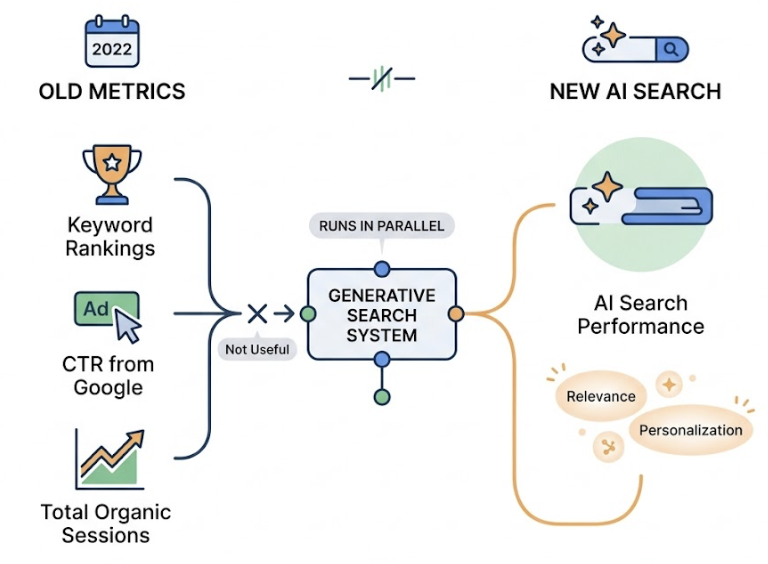
The metrics that mattered in 2022 don’t tell you anything useful about AI search performance today. Keyword rankings, CTR from Google, total organic sessions — these are outputs of a system that runs in parallel to generative search, not in place of it.
The GEO-specific metrics to track:
Share of Model (SoM): Your brand mentions divided by total category mentions across AI platforms. This is the GEO equivalent of share of voice.
Citation Position: Where in the AI response your brand appears. The top 50 brands by online authority receive 28.9% of all AI Overview mentions, and position within the response directly influences how users perceive the recommendation.
Sentiment Polarity: How the AI describes your brand — positive, neutral, or negative. A brand positioned as enterprise-grade but described by Perplexity as “a budget-friendly alternative” has a GEO problem that no SEO fix addresses.
AI Referral Traffic: Sessions arriving from chatgpt.com, perplexity.ai, and gemini.google.com. This is your direct revenue signal. B2B AI-referred visitors convert at up to 6 times the rate of traditional organic traffic, which is the ROI case for treating GEO as a primary channel.
Topify tracks all seven of these dimensions in a single dashboard across ChatGPT, Gemini, Perplexity, DeepSeek, and others. When your citation rate drops, you can trace it to a specific platform or prompt rather than guessing at causes.
GEO doesn’t replace SEO. 66% of B2B senior decision-makers already use AI tools to research vendors, which means the two channels are feeding the same buyer at different stages of their journey. Running both in parallel, with shared content infrastructure but distinct measurement systems, is where high-performing marketing teams are heading.
Conclusion
Generative search is already where your buyers do their research. 80% of users answer 40% of their queries without clicking a link when AI Overviews are present, and organic CTR for top-ranked results drops from 1.76% to 0.61% in those same sessions.
The brands showing up in AI answers are building a compounding asset: citation drives trust, trust drives branded search, branded search drives high-intent conversion. Starting with a visibility audit is the only way to know where you actually stand — not where you assume you are.
Get started with Topify to establish your AI visibility baseline and find the prompts where your brand should be appearing but isn’t.
FAQ
Q: What is generative engine optimization and how does it work?
A: Generative Engine Optimization (GEO) is the practice of structuring content so that AI search platforms like ChatGPT, Perplexity, and Gemini actively cite it in their generated responses. It works by optimizing for the Retrieval-Augmented Generation (RAG) pipeline: content needs to be retrieved via semantic matching, extracted as a coherent passage, and selected as an authoritative source during synthesis. The primary signals are factual density, clear structure, and corroboration across multiple platforms.
Q: How is GEO different from SEO?
A: SEO optimizes for ranking in a list of links. GEO optimizes for inclusion in a synthesized answer. Authority signals differ: SEO rewards backlinks and domain authority, while GEO rewards factual density, expert citations, and cross-platform brand mentions. Content format requirements also differ — SEO favors keyword coverage while GEO favors self-contained, question-answer blocks that AI models can extract and synthesize cleanly.
Q: How long does it take to see results from GEO optimization?
A: Most teams see measurable shifts in AI citation rates within 60–90 days of structured implementation. The content re-engineering phase tends to show results faster than the off-page consensus-building layer, which typically takes 3–6 months to build meaningful depth across earned media, review platforms, and community channels.
Q: How do I get my brand recommended by AI platforms like ChatGPT?
A: Start with a visibility audit to understand your current citation baseline. Identify the prompts where competitors appear but you don’t. Restructure or create content that’s factually dense, clearly organized, and backed by external citations. Then build earned media coverage across Reddit, G2, and trade publications to create multi-source corroboration. Track changes using a platform that monitors AI mentions across multiple engines simultaneously.

