

Your domain authority is solid. Your keyword rankings are holding. But when someone asks ChatGPT for a tool in your category, your brand isn’t in the answer. Not buried, not ranked third. Just absent.
That’s the core problem with applying traditional SEO instincts to AI search. The two systems run on different logic, and optimizing for one doesn’t move the needle on the other. Generative engine optimization is what bridges that gap.
What Is Generative Engine Optimization?
Generative engine optimization (GEO) is the practice of making your brand visible, citable, and recommendable within AI-generated answers across platforms like ChatGPT, Perplexity, Google AI Overviews, Gemini, and others.
The key word is “synthesis.” When a user types a question into an AI search engine, the model doesn’t return a ranked list of links. It pulls relevant information from its training data and real-time retrieval sources, then constructs a direct answer. GEO ensures your brand is part of what gets pulled.
That’s fundamentally different from traditional SEO, which optimizes for crawler indexing and link-based ranking signals. GEO optimizes for entity authority and content extraction within a Retrieval-Augmented Generation (RAG) framework.
Why Your SEO Rankings Don’t Protect You in AI Search
A brand can rank #1 on Google for a target keyword and still be completely invisible in AI search. This isn’t a bug. It’s a structural mismatch.
Traditional SEO prioritizes signals like backlink profiles, keyword density, and site authority to determine which pages rank highest in a list. AI search engines work differently. They use RAG to retrieve “chunks” of content that provide direct, extractable answers to a query, then synthesize those chunks into a coherent response.
The result: pages optimized purely for keyword ranking often get bypassed. LLMs prioritize information density, factual clarity, and E-E-A-T signals — not the same variables that determine position in a SERP. What ranks doesn’t always get cited.
This is what researchers call the “ranking-mention separation”: your position within an AI answer may follow some traditional SEO logic, but whether your brand gets mentioned at all depends on a different set of factors entirely.
How Generative Engine Optimization Actually Works
GEO operates on three core mechanisms that differ from standard AI SEO approaches.
Structured Clarity. AI engines extract content in chunks. Pages with clear headings, concise paragraphs, and machine-readable formatting (including JSON-LD structured data) are more likely to be accurately parsed and cited. Dense walls of text optimized for keyword frequency tend to perform poorly in this environment.
Authority Signals Across the Web. LLMs are trained to weight information from high-authority sources. Building what practitioners call “Entity Authority” — consistent, credible mentions across third-party publications, academic sources, industry directories, and review platforms — matters more than on-page optimization alone. Your brand needs to exist in the information ecosystem that AI systems draw from, not just on your own domain.
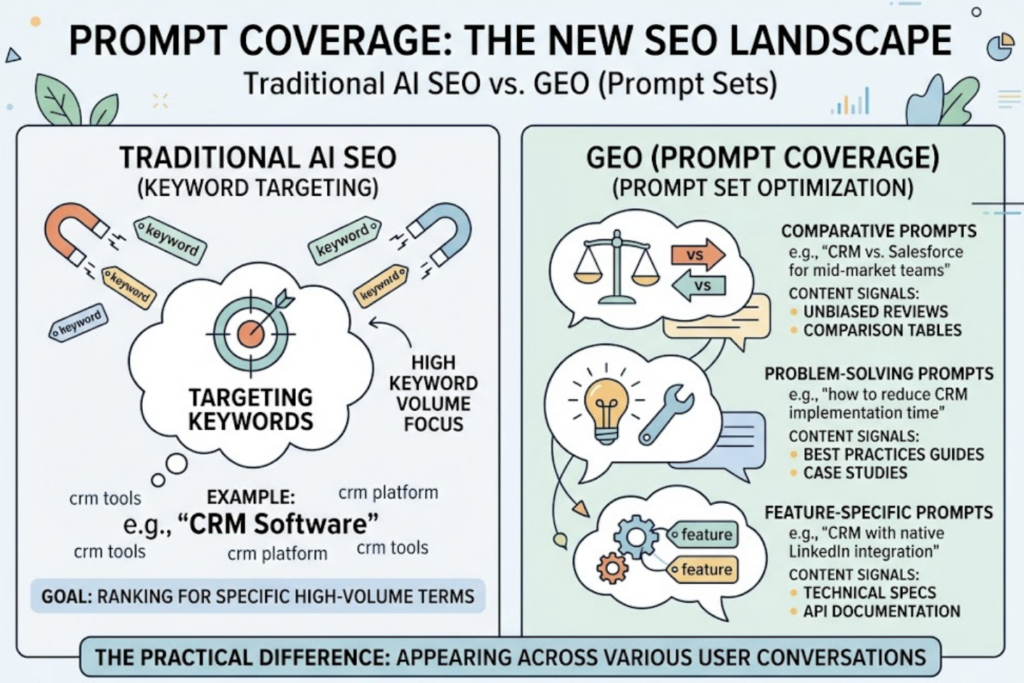
Prompt Coverage. Traditional AI SEO targets keywords. GEO optimizes for prompt sets. The practical difference is significant: instead of ranking for “CRM software,” you’re ensuring your brand appears across comparative prompts (“CRM vs. Salesforce for mid-market teams”), problem-solving prompts (“how to reduce CRM implementation time”), and feature-specific prompts (“CRM with native LinkedIn integration”). Each prompt type requires a different content and authority signal.
How to Measure Generative Engine Optimization
Standard metrics like organic sessions and SERP CTR don’t capture AI search performance. The industry has shifted toward a five-pillar measurement framework, as documented by Blue Compass:
| Metric | What It Measures | Why It Matters |
|---|---|---|
| Visibility Rate | % of target prompts where the brand is mentioned | Baseline awareness across AI channels |
| Citation Rate | How often the AI names or links the brand as a source | Trust and information authority |
| Sentiment Score | Tone of AI-generated brand descriptions | Brand reputation within AI “memory” |
| Position Rank | Where the brand appears in list-style answers | Competitive prominence |
| Source Attribution | Which URLs the AI cites when referencing the brand | Identifies citation clusters driving visibility |
Topify extends this framework with seven tracked metrics — adding AI Volume Analytics and CVR (Conversion Visibility Rate) to the standard five. The Volume metric quantifies actual AI search demand for prompts in your category, which is useful for prioritizing which prompt sets to optimize first. CVR estimates how likely an AI answer is to drive a user toward a brand interaction.
Tracking these metrics at the prompt level matters. Aggregate “AI visibility” scores obscure where you’re winning and where competitors are taking share. The actionable unit is the individual prompt, not the platform average.
A Practical GEO Strategy: From Audit to Execution
Search Engine Land and other AI search intelligence sources converge on a four-step operational cycle for teams building a GEO program.
Step 1: Audit your prompt universe. Map the full set of queries your target audience is using across AI platforms. This isn’t identical to your keyword list. It includes comparative prompts, problem-framing prompts, and category-exploration prompts that users would never type into a traditional search bar but ask AI assistants regularly.
Step 2: Identify competitive gaps. Find the prompts where competitors appear in AI answers but you don’t. This is where the visibility gap is costing you. Prompt-level competitor analysis is the starting point for prioritizing content and authority-building efforts.
Step 3: Optimize content for AI citation. Update existing content and create new assets with structured clarity in mind: clear factual statements, organized headings, authoritative citations, and schema markup. For authority building, focus on earning mentions in sources that AI platforms tend to cite in your category, typically industry publications, review platforms, and high-domain-authority third-party sites.
Step 4: Monitor and iterate. AI systems update their retrieval sources frequently. A prompt where your brand appeared last month may show different results today. Weekly tracking is the practical minimum for brands in competitive categories.
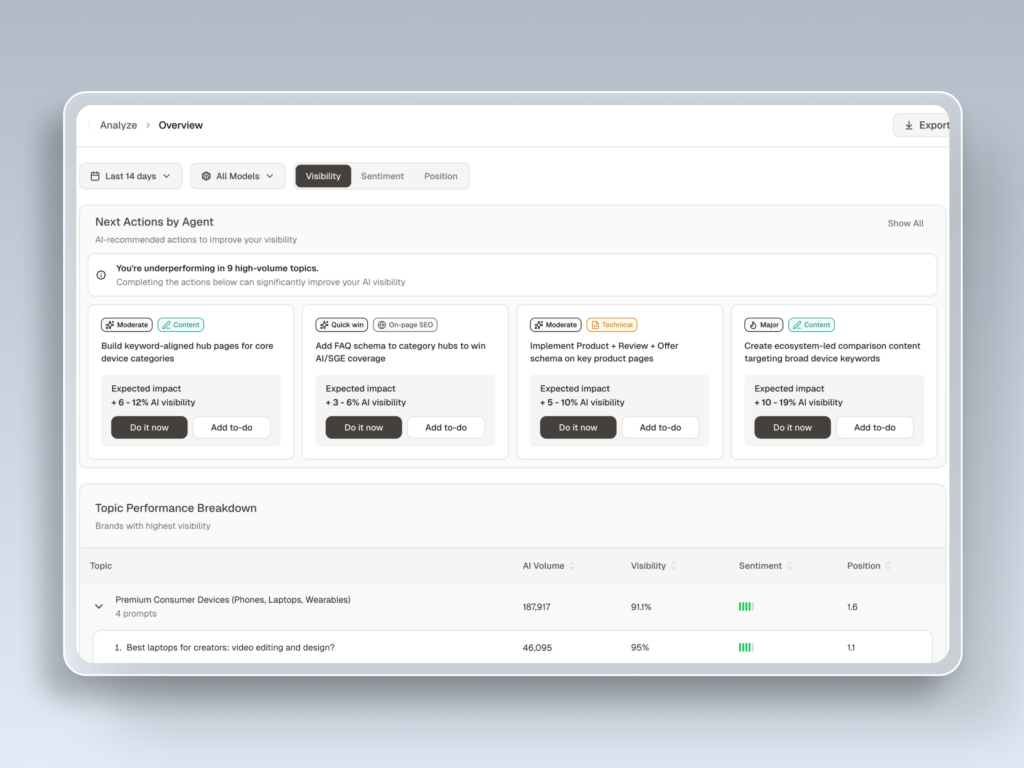
Topify’s One-Click Execution feature is designed to compress Steps 3 and 4. After identifying gaps through Source Analysis (which tracks the exact domains AI platforms cite in your category), the platform proposes a content and distribution strategy and deploys it without requiring manual coordination across tools. For teams managing GEO alongside traditional SEO workloads, that automation gap is where most programs stall.
5 Mistakes That Kill Your AI Search Visibility
Most GEO failures aren’t from bad strategy. They’re from applying the wrong assumptions, sourced from traditional SEO playbooks.
Treating GEO as a keyword exercise. Keyword density signals that work in SERP ranking often register as low-value noise to LLMs. AI search intelligence isn’t about stuffing; it’s about creating content that an AI would actually extract and cite as an authoritative source.
Tracking mentions without tracking sentiment. A brand mentioned in an AI answer as “a cheaper alternative” or “less suitable for enterprise use cases” is worse than not being mentioned at all. Sentiment monitoring is a non-negotiable part of any GEO program.
Ignoring multi-platform coverage. Different AI platforms cite different sources and weight authority signals differently. A GEO strategy that only tracks ChatGPT misses Perplexity, Gemini, Google AI Overviews, DeepSeek, and regional platforms where your audience may be just as active.
No competitive benchmarking at the prompt level. It’s not enough to know your overall AI visibility score. You need to know which specific prompts your competitors own that you don’t.
Static monitoring. AI retrieval sources shift constantly as models update. A “set it and forget it” approach gives you a snapshot, not a strategy. The brands building durable AI search visibility treat it as an ongoing operational discipline, not a one-time audit.
GEO Tools and Pricing: What to Expect
The GEO tooling market has bifurcated into three tiers based on capability and team size.
| Tier | Price Range | Best For |
|---|---|---|
| Entry-Level | $99–$250/mo | Small businesses establishing a baseline |
| Mid-Market Platforms | $200–$1,000/mo | Teams needing prompt-level tracking + multi-platform coverage |
| Enterprise / Managed | $2,000–$25,000+/mo | Full-service retainers with digital PR and ongoing content execution |
Topify sits at the mid-market tier with three platform plans: Basic at $99/mo (100 prompts, ChatGPT/Perplexity/AI Overviews tracking, 9,000 AI answer analyses), Pro at $199/mo (250 prompts, 22,500 analyses, 10 seats), and Enterprise from $499/mo with dedicated account management. For teams that need managed execution, Topify’s service plans start at $3,999/mo and include article production, Reddit visibility posts, and SEO keyword coverage alongside the platform data.
What to Look for in a GEO Platform
Four criteria separate effective AI visibility platforms from dashboards that look useful but don’t move anything.
Prompt-level tracking. Platform-level aggregates are decorative. You need to know which specific prompts your brand appears in, where it ranks within those answers, and how that changes week over week.
Multi-platform coverage. At minimum: ChatGPT, Perplexity, Google AI Overviews, and Gemini. Broader coverage matters if your audience includes international markets.
Competitor benchmarking. Visibility data without competitive context is hard to act on. The question isn’t just “are we visible?” It’s “are we more visible than the alternatives AI is recommending?”
Content and source recommendations. The best platforms close the loop between “what’s the gap” and “what do we do about it” without requiring you to manually interpret raw data into a content plan.
Conclusion
The transition from traditional SEO to generative engine optimization isn’t about abandoning what works. It’s about recognizing that AI search surfaces brands through a different mechanism — one that rewards entity authority, content clarity, and prompt coverage rather than link profiles and keyword density.
AI search intelligence is now a measurable channel. The brands building systematic visibility programs today will have a compounding advantage as AI search continues to displace traditional SERP traffic. The practical starting point is a prompt audit: map where you appear, where your competitors appear, and where the gaps are. From there, the optimization playbook follows the data.
Get started with Topify to run your first AI visibility audit across ChatGPT, Perplexity, and Google AI Overviews.
FAQ
Q: What are examples of generative engine optimization in practice?
A: A SaaS brand auditing which AI prompts its competitors appear in, then updating its comparison pages and earning coverage in industry publications to close the gap. A consumer brand discovering that AI platforms describe its product inaccurately and systematically updating third-party listings and structured data to correct the narrative. A marketing agency building monthly GEO reports for clients using prompt-level visibility data instead of generic traffic numbers.
Q: Is there a GEO checklist I can follow to get started?
A: A practical starting checklist: (1) Map your target prompt universe across comparative, problem-solving, and feature-specific query types. (2) Run a baseline visibility audit to see where your brand currently appears. (3) Audit competitor visibility in the same prompt set. (4) Review your top pages for structured clarity — clear headings, factual density, and schema markup. (5) Identify three to five high-authority external sources in your category that AI platforms cite regularly, and develop a plan to earn coverage there. (6) Set up weekly monitoring so you can track shifts as AI retrieval sources update.
Q: How is GEO different from AEO (Answer Engine Optimization)?
A: The terms are often used interchangeably, but there’s a useful distinction. AEO typically refers to optimizing for featured snippets and direct answers in traditional search results — it predates the LLM era. GEO is specifically oriented toward LLM-based answer engines (ChatGPT, Perplexity, Gemini) and the RAG retrieval mechanisms they use. GEO encompasses AEO’s goals and extends them to cover prompt coverage, entity authority building, and multi-platform AI search analytics that AEO frameworks weren’t designed for.
Q: How long does generative engine optimization take to show results?
A: Faster than traditional SEO in some dimensions, slower in others. Prompt-level visibility tracking can show meaningful data within days of setup. Content and authority-building changes typically take four to eight weeks to influence AI citation patterns, depending on how frequently the AI platforms update their retrieval sources and how competitive the prompt space is. Sentiment improvements, which require consistent off-site narrative management, often take three to six months to stabilize.

