

Perplexity now processes over 780 million queries every month. That’s not a rounding error; it’s a search surface you can’t afford to be invisible on.
But here’s the problem: most brands have no data on whether they’re showing up. They know Perplexity exists. They might even use it themselves. What they don’t have is a systematic way to track visibility, citations, or how AI answers position them against competitors.
That’s exactly what a Perplexity ranking tracker is built to solve.
Why Perplexity Ranking Is Nothing Like Google Ranking
In Google, ranking means position. You’re number one, number five, or off the first page.
In Perplexity, that framework breaks down entirely. Perplexity is a Retrieval-Augmented Generation (RAG) system: it crawls the web, synthesizes the most relevant information, and delivers a direct answer with citations. There’s no list of blue links. There’s an answer, and your brand is either in it or it isn’t.
The “zero-click” dynamic makes this even sharper. Users get what they need without visiting a website. Which means the only visibility that counts is visibility inside the answer, specifically as a cited source, a named recommendation, or a referenced comparison.
Traditional rank tracking tools can’t measure any of that.
What a Perplexity Ranking Tracker Actually Measures
A purpose-built AI ranking tracker monitors five core signals:
Mention Rate: The percentage of relevant prompts where your brand appears in Perplexity’s response. This is your baseline presence metric. If you’re running 100 category-specific prompts and you show up in 18, your mention rate is 18%.
Source Citations: Which specific domains (and URLs) Perplexity pulls when discussing your brand or category. Being mentioned in the text is one thing. Being cited as a source is a stronger signal of authority, and it’s what drives referral traffic.
Position in Answer: The order in which brands appear. First citation isn’t just a vanity metric; it carries disproportionate user attention and trust.
Sentiment Context: Not all mentions are equal. An AI ranking tracker analyzes whether Perplexity is recommending you, describing you neutrally, or surfacing criticism. The same mention rate with different sentiment profiles means entirely different things for your brand.
Share of Voice: How often your brand appears versus direct competitors across the same prompt set. This is your competitive baseline.
How a Perplexity Ranking Tracker Works
The core workflow has four stages.
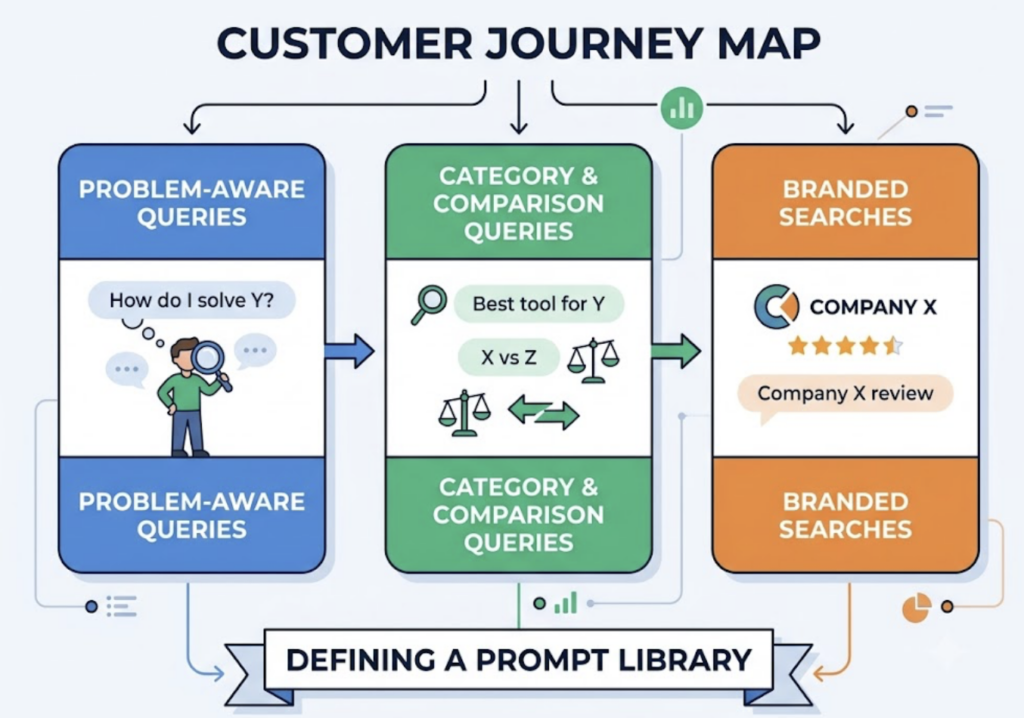
First, you define a prompt library: a curated set of queries that map your customer journey. These aren’t just branded searches like “Company X review.” They include category queries (“best tool for Y”), comparison queries (“X vs. Z”), and problem-aware queries (“how do I solve Y”). The prompts you choose determine what you see, which is why prompt engineering is half the job.
Second, the tracker runs those prompts automatically against Perplexity on a scheduled basis, daily, weekly, or in real time.
Third, it parses the outputs: identifying brand mentions, extracting citation URLs, noting position, and reading sentiment context.
Fourth, it aggregates that data over time into trend views, so you can see whether your visibility is improving, declining, or shifting in response to content changes.
That last part matters. Trend data is what separates a tracking tool from a one-time snapshot. Snapshots tell you where you are. Trends tell you whether what you’re doing is working.
5 Mistakes That Undermine Perplexity Tracking
Most brands that attempt Perplexity tracking make at least one of these errors.
Tracking brand keywords only. If every prompt you run contains your brand name, you’re not measuring discovery. You’re measuring confirmation. The more valuable data comes from category and comparison prompts, where buyers are still evaluating options and you either show up or you don’t.
Ignoring competitor tracking. Your mention rate means nothing in isolation. A 20% mention rate looks strong until you find out your main competitor is at 60%. Understanding why a competitor is cited, whether it’s a G2 review, an industry publication, or a Reddit thread, gives you a roadmap.
Manual logging. Screenshots and spreadsheets can capture a moment. They can’t surface a trend. If your mention rate dropped 12 points over three weeks after a competitor published a new comparison post, you’ll never know from a spreadsheet.
Treating mentions as endorsements. A brand mention in a Perplexity answer where the AI says “some users report limitations with X” is not a win. Sentiment context tells you the difference between being recommended and being cited as a cautionary example.
Not tracking source citations. This is the most underused signal. The domains Perplexity pulls from are the domains with authority in its training and retrieval patterns. If your competitors dominate those citation sources, you need to know which ones and pursue coverage there.
A Strategy That Actually Moves the Needle
Tracking without a feedback loop is just reporting. The goal is to turn data into action.
Start with prompt architecture. Organize your prompt library by customer journey stage: discovery prompts (“what is the best X for Y”), evaluation prompts (“X vs. Z comparison”), and decision prompts (“is X worth it”). Each stage tells you something different about where your brand falls out of the funnel.
Set a competitive baseline before you optimize anything. Run your full prompt set, measure your mention rate and Share of Voice against two or three direct competitors, and document it. This is your benchmark.
Then focus on source diversification. Use your tracker’s citation data to identify which domains Perplexity consistently pulls from in your category. Those are the platforms worth prioritizing for coverage: industry publications, review sites, subreddits, and forums that carry real authority with AI systems.
Implement structured data and direct answer architecture on your owned content: concise answers near the top of pages, schema markup that clarifies entity relationships, and content that’s updated regularly across related topics. AI systems reward topical consistency.
Then re-run your prompts in 30 days and compare. The loop closes when your content changes reflect in citation data.
Best AI Ranking Tracker for Perplexity in 2026
The tool that handles this end-to-end is Topify.
Topify is an AI search optimization platform that tracks brand visibility across ChatGPT, Perplexity, Gemini, and other major AI engines simultaneously. For Perplexity specifically, it covers all five tracking dimensions: Visibility Tracking (mention rate), Position Tracking (order of appearance), Source Analysis (which domains are being cited), Sentiment Analysis (tone of brand mentions), and Competitor Monitoring (Share of Voice against named competitors).
What sets it apart is the action layer. Most AI ranking trackers stop at the dashboard. Topify’s One-Click Execution lets you define optimization goals in plain language, review the proposed strategy, and deploy it without building a manual workflow. The platform also runs continuous prompt discovery, surfacing new high-intent queries you should be tracking as AI recommendation patterns shift.
Pricing starts at $99/month (Basic plan), which includes 100 prompts, 9,000 AI answer analyses, ChatGPT and Perplexity tracking, and 4 projects. The Pro plan at $199/month expands to 250 prompts and 22,500 analyses. Enterprise starts at $499/month with dedicated account management and custom configurations.
For teams that need managed execution alongside tracking, Topify’s service plans run from $3,999/month and include content production, Reddit visibility, and GEO prompt coverage.
Perplexity Ranking Tracker Checklist
Use this to evaluate whether your current setup is actually giving you complete data:
- Automated prompt execution: runs on a schedule, not manually triggered
- Prompt library by journey stage: includes discovery, evaluation, and decision queries (not just branded terms)
- Competitor benchmarking: tracks at least 2-3 direct competitors across the same prompt set
- Source citation tracking: identifies which domains are being cited, not just whether your name appears
- Sentiment analysis: distinguishes positive mentions from neutral descriptions and negative associations
- Historical trend data: at least 30 days of data to identify directional patterns
- Multi-platform coverage: tracks Perplexity alongside ChatGPT and Google AI Overviews for full AI search picture
If you’re missing more than two of these, you’re working with partial visibility data.
FAQ
What is a Perplexity ranking tracker?
A Perplexity ranking tracker is a tool that automates monitoring of how and whether a brand appears in Perplexity AI’s generated answers. It measures mention rate, source citations, position in answer, sentiment context, and Share of Voice against competitors across a defined set of prompts.
How do I improve my Perplexity ranking?
Focus on three things: publish content that directly answers high-intent category questions, build coverage on the domains Perplexity consistently cites in your space (use Source Analysis to find them), and maintain topical consistency across your owned content. Structured data and frequent content updates also help AI systems form a clearer picture of your brand entity.
How much does a Perplexity ranking tracker cost?
Entry-level AI ranking trackers like Topify start at $99/month. That tier covers 100 prompts and tracking across Perplexity, ChatGPT, and AI Overviews. More comprehensive plans with higher prompt volumes and multi-seat access range from $199 to $499+/month depending on team size and usage.
Can I track competitors on Perplexity?
Yes, and you should. Competitor Monitoring lets you run the same prompt set against multiple brands and compare mention rates, sentiment, and citation sources side by side. Your own data means little without knowing where you stand relative to the brands Perplexity is currently recommending instead of you.

