

You ran a free GEO audit last week. The report gave you a score, flagged a couple of missing schema fields, and told you your brand showed up in three of ten ChatGPT answers. Then you closed the tab, because a single number doesn’t tell you if that score is climbing or sliding, or what to do about it on Monday morning.
That gap between “here’s your score” and “here’s what changed and why” is exactly where most teams get stuck deciding if a one-time audit is enough, or if it’s time to pay for something that runs in the background.
What a Free GEO Audit Actually Checks
A free GEO audit is built to answer one question fast: how visible is your brand right now. Tools like Topify‘s GEO Score Checker run a single scan and return a score built from four signal groups: bot access, structured data, content signals, and current visibility. You get a number, a breakdown of what’s dragging it down, and a list of fixes, without creating an account.
That’s genuinely useful as a starting point. It tells you whether AI crawlers can reach your pages, whether your schema markup is doing its job, and roughly where you stand against a baseline most brands have never bothered to check. For a team that hasn’t looked at AI visibility at all, that first scan is usually the moment the problem stops being abstract.
Free doesn’t mean shallow, either. It just means the scan happens once, on demand, and stops there.
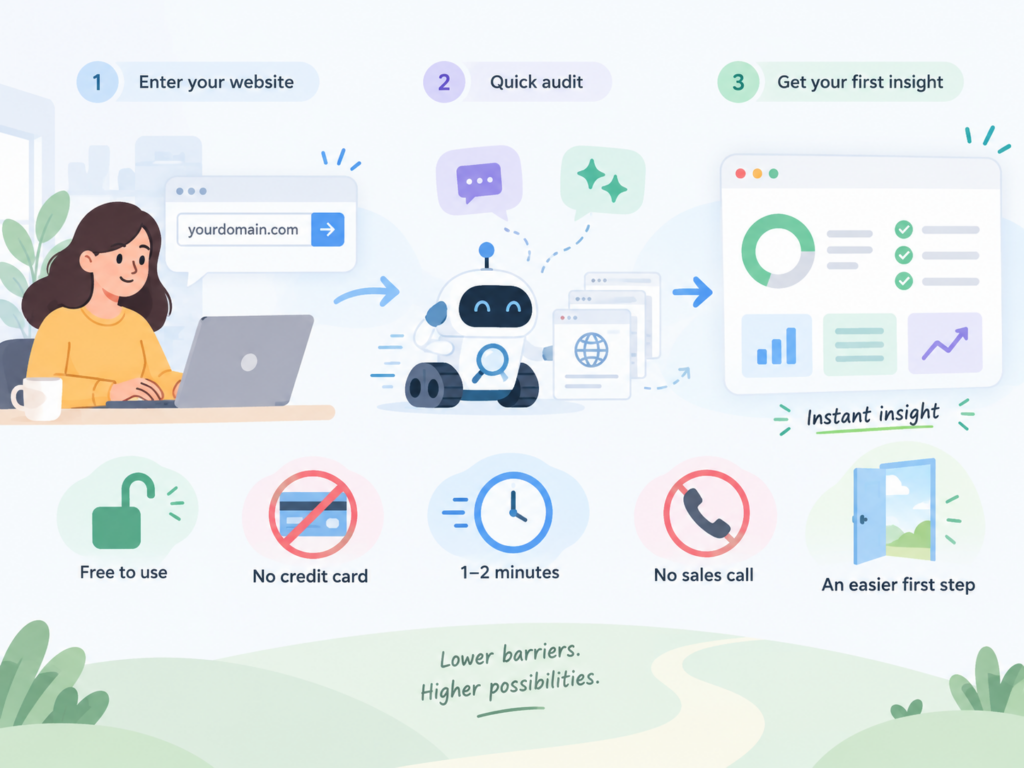
Most free checkers on the market work the same way, whether they’re general SEO tools adding an AI layer or dedicated GEO products. You plug in a domain, the tool crawls it and runs a handful of prompts against one or two AI platforms, and you get a report back within a minute or two. No credit card, no login wall, no waiting on a sales call. That accessibility is the entire point. It’s designed to lower the barrier to the first data point, not to replace a reporting system.
Where One-Time Audits Fall Short
The catch is timing. A free audit captures a single moment, and AI answers don’t hold still the way a Google ranking does. Only about 30% of brands stay visible in back-to-back responses to the same query, which means the citation your audit caught on Tuesday can be gone by Thursday, and the report in your inbox won’t say so.
A score tells you where you stood. It doesn’t tell you where you’re headed.
Response patterns can shift within days, especially on Perplexity and Gemini, and teams relying on a single scan tend to notice a drop only after the fact, often weeks after it actually happened. Free tools reinforce this by design: even the ones that offer an ongoing tier usually cap prompt volume, refresh frequency, or engine coverage well below what a paid plan runs. That’s not a flaw. It’s the trade-off that keeps a free tool free.
Engine coverage tends to be the second blind spot. A free scan usually checks one or two platforms, most often ChatGPT, and calls it done. But brand mentions on Perplexity, Gemini, and Google AI Overviews can move independently of each other, since each engine weighs citations and freshness differently. A brand that looks solid on a ChatGPT-only free scan can still be losing ground on Perplexity without anyone noticing, simply because nothing was watching that surface in the first place.
Free GEO Audit vs Paid Monitoring: A Side-by-Side Look
Laid out next to each other, the two approaches aren’t competing for the same job. One answers “where do I stand today,” the other answers “what’s changing and why.”
| Dimension | Free GEO Audit | Paid Monitoring |
|---|---|---|
| Data freshness | One-time snapshot | Refreshed on a set schedule |
| Platform coverage | Typically 1 to 2 platforms | ChatGPT, Gemini, Perplexity, and others tracked in parallel |
| Competitor tracking | Not included | Side-by-side benchmarking |
| Sentiment analysis | Not included | Tracked and trended over time |
| Citation source tracking | Basic overview | Domain-level source analysis |
| Trend detection | No history to compare | Week-over-week and month-over-month |
| Reporting | Single PDF or score page | Ongoing dashboard, exportable |
| Cost | Free | Paid plans, starting around $99/mo on Topify’s Basic tier |
The free column isn’t there to look weak. It’s there because most brands genuinely don’t need the paid column yet, and the table above is meant to help you tell which side of that line you’re on.
What Paid Monitoring Adds: Continuous Visibility, Not a Snapshot
Paid monitoring exists to answer the question a single audit can’t: what changed, and why. Comprehensive GEO Analyticstracks seven metrics side by side, visibility, sentiment, position, volume, mentions, intent, and CVR, so a drop in ChatGPT mentions can be traced back to the specific source that stopped citing your brand instead of staying a mystery.
In practice, this turns AI visibility into a channel you report on the same way you’d report organic traffic or paid conversions. A marketing manager can pull up a trend line instead of re-explaining a single audit score in a meeting three months later. If your team has reached the point of needing that kind of reporting, you can get started with Topify directly from a live dashboard rather than rerunning a manual scan every few weeks.
The seven-metric structure also matters for a reason that’s easy to miss. A visibility number on its own doesn’t tell you if AI is describing your brand accurately. Pairing it with sentiment and position data does, which is the layer a one-time audit was never built to capture.
Picture the difference in a real week. With a free audit, you’d notice your visibility score dropped the next time you happened to run the scan, maybe a month later, with no clue what caused it. With ongoing monitoring, the same drop shows up the day it happens, tied to a specific prompt, a specific competitor gaining ground, and a specific source AI started citing instead of yours. One approach leaves you guessing. The other gives you a starting point for a fix.
Signs You’ve Outgrown the Free Audit
A few patterns tend to show up right before a team decides a free scan isn’t cutting it anymore.
- More than one person on your team has asked “how are we doing in AI search,” and you keep rerunning the same free scan to answer them
- You’ve noticed a competitor gaining ground in AI answers but can’t explain when it started or why
- A client or exec wants a monthly AI visibility number, not a one-off report handed over once
- Your last audit score moved and you have no way to tell which fix, if any, caused it
A free audit can tell you what’s true today. It can’t tell you why it changed.
None of these signs mean the free tool failed you. They mean the question you’re being asked has changed from “are we visible” to “what’s driving the trend,” and that second question needs a different kind of tool to answer.
Conclusion
A free GEO audit is the right first move for almost every brand. It’s fast, it costs nothing, and it turns a vague worry into an actual number you can act on. The point where it stops being enough is the point where you need to explain a trend instead of a single score, whether that’s to your own team or a client asking for proof.
At that stage, moving from a one-time scan to ongoing monitoring isn’t about buying more features. It’s about matching the tool to the question you’re actually being asked.
FAQ
Q: How often should I run a free GEO audit?
A: Monthly at minimum. AI citation patterns can shift within days on platforms like Perplexity and Gemini, so a scan from three months ago tells you less than you’d think.
Q: Can a free GEO audit replace paid monitoring for a small team?
A: For a team just getting started, often yes. Once you’re tracking competitors or reporting trends to stakeholders on a recurring basis, a one-time scan usually falls short.
Q: Does the data from a free audit carry over when I move to paid monitoring?
A: In most cases, yes. Platforms that offer both, like Topify, use the same underlying signals for the free scan and the paid dashboard, so your first audit becomes a baseline rather than a throwaway report.
Q: Is a GEO audit the same thing as ongoing AI visibility monitoring?
A: No. An audit is a single measurement taken at one point in time. Monitoring tracks that same measurement continuously and flags changes as they happen.

